Create a Style Guide for Your Organization


Photo by imelda via Flickr

One way to ensure consistency in your communication materials is to create a style guide.  A style guide can cover both elements of your written material (editorial) and the look of your materials (design). Don’t be intimidated by putting one together. You can create one that’s just a few pages long.

 
Getting Started
You may want to use a published style guide such as the Associated Press (AP) Stylebook (probably best for nonprofit organizations) or the Chicago Manual of Style as your base, and then make additions or changes as needed.  These style guides cover items such as when to use commas (red, white, and blue as opposed to red, white and blue), and when to spell out numbers (one) as opposed to writing them as numerals (1).
 
Fonts
Choose a font that you will use in all of your materials. Serif fonts such as Garamond or Times Roman are best for print, and sans serif fonts such as Ariel or Verdana  work better for online materials. Whatever you decide, choose something that’s easy to read.  Here is some more detailed information on choosing fonts. The Best Fonts to Use in Print, Online, and Email
 
Your Organization
What is the official name of your organization, and what are the acceptable ways to abbreviate it? You could also include your mission statement and a brief history of your organization in your style guide.
 
Language
Figure out language that is specific to your organization. Are you a nonprofit, non profit, or non-profit organization?  Do you serve youth or children?  Are you active in the African-American or African American Community. Is there any language you should never use in your materials?
 
Tag Lines and Key Messages
Include your tag lines and key messages.  If you don’t have these, now is a good time to come up with some.  Be sure whatever you come up with is clear, concise, and conversational. Write in the active voice and don’t use jargon. Include these in all your materials and revisit them (maybe once or twice a year) to make sure they are still relevant.
 
Design
You can also use your style guide to indicate design preferences. Make sure you use the exact same colors in all your materials. Colors have PATONE numbers, which are used by designers and printers. Figure out which ones you will use – here is a guide to help you. Find a PANTONE color You’ll be amazed to see how many shades there are of one color. Having PANTONE numbers will be especially useful if you use more than one print company.
 
Logo
Decide how you want your logo to be sized and where it should be on the page. I recommend you keep your logo in the same place in all your materials to ensure a consistent, recognizable look. You may need to adjust sizing depending on the materials. 
 
Finishing Up
Once you have your style guide in place, go over it with staff, board members, volunteers, and consultants (anyone who might be communicating your message).  Make sure everyone has a copy or that it’s easily accessible on your shared server. When you hire new staff, go over the style guide with them at their orientation.  
 
Creating a style guide will take a little work up front, but it will be worthwhile in the end because your materials will have a consistent message and look. 
 
Here is an example of a style guide that uses AP as a base. VOICEOFSANDIEGO.ORG STYLE GUIDE
Take Time to Plan

Hopefully, your organization has its 2012 plans (operational, fundraising, marketing, program,etc.) in place.  If you don’t, it’s not too late to start.

You might have heard the expression, if you fail to plan, you plan to fail. Okay, maybe you won’t actually fail, but you will have a better chance at success if you put together a yearly plan, regularly monitor your progress (I recommend every quarter), evaluate what is working and what isn’t, and make any necessary changes.

Putting together a yearly plan with your goals and objectives doesn’t need to be a daunting process.  A planning tool you can use for your operational  plan is the organizational dashboard. Library of Sample Dashboard Indicators  Of course, you can modify this to meet your needs.

Here is some additional information about operational plans, and how they differ from strategic plans, as well as information about putting together fundraising and marketing plans.

Operational Plans

Fundraising plans

Marketing plans

Taking time to plan is time well spent. Good luck with your planning!

Does your Organization Need an Annual Report?

Photo by Eric (aka Herve) via Flickr

Nonprofit organizations are not required to produce an annual report, but I believe your organization will benefit by having one.

The main purpose of an annual report is to highlight your organization’s accomplishments. You don’t need a glossy 20 page document. In fact, if you are a small organization, that would not be a good use of your resources. Instead you can produce, a short (four to six pages), simple piece to send to your supporters. Here are a few things to include in your annual report.

  • Your accomplishments. Don’t overwhelm your readers with a lot of text and statistics. Use pictures, short stories, and quotes. If you run an afterschool program, a couple of pictures showing kids engaged in activities can emphasize the work you are doing. Be sure to show results, too.
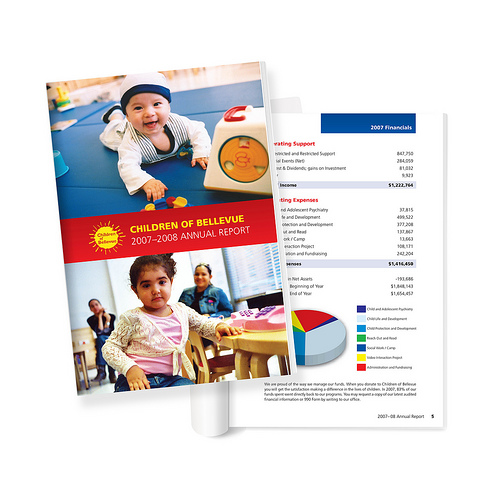
  •  Your financials. Include your revenue and expenses, and break them down by department (program, administration, etc.). Keep it simple and use a pie chart or bar graph. 
  •  A donor list. You may want to just list your major donors in the printed piece and include all donors on your website. Generally, organizations will group donors by giving level. 
  • Say thank you. In the brief introduction by the Executive Director and Board Chair and in the donor section, be sure to thank all your supporters. 

You don’t need to mail your annual report to all your supporters. You may want to mail it just to your major donors. Put your annual report on your website, and then let everyone know it’s available. You could send out a special e-mail announcement or include something about your annual report in your newsletter. Of course, you should make a hard copy available to anyone who wants one. You should also have hard copies available for potential funders and other supporters.

If you choose not to produce an annual report, you should still have a list of accomplishments readily available. You often need these for grant proposals, anyway. I recommend keeping a running list, so you are not scrambling to put something together when it’s time to do your annual report or a grant proposal. This can also help you get your annual report out earlier in the new year.

Show Gratitude

Saying the words thank you can be very powerful. We all know how important it is for nonprofit organizations to thank their donors. Each day that you get a donation, set aside time to send out great thank you letters. In addition, recognize your donors in your newsletters and annual report. But thank yous go beyond your donors. Who else should you thank?

Before we get to that, a few notes about showing gratitude.

  • Make sure it’s sincere. Don’t thank someone unless they deserve it. 
  • Make it specific. Thank someone for a particular task or something they did – Thank you for supporting our auction. Thank you for all your work on the grant proposal.
  • Beware of overkill. If you thank people too much, it won’t sound genuine. Remember to make it sincere and specific. 

Now, here are some people to thank.

Volunteers
After all, your volunteers are not being paid to help with office work, write newsletter articles, or work on events. They need a reason to keep coming in. Besides a verbal thank you, you could bring in treats for your volunteers or take them out to lunch.

Board Members
Board members are often busy professionals, as well as being volunteers. Board members are expected to make a commitment to serve your organization, and they deserve thanks for that. You can thank them individually for helping with a certain task and as a group in your newsletter or annual report.

Staff Members 
If you are a manager, don’t forget to thank your staff members for a job well done. People thrive on praise. Besides individual thank yous, find a way to thank the whole staff, such as having occasional group lunches.

Your Manager
Most managers want their staff members to succeed and would be thrilled if you thanked them for their support and guidance. Remember to be sincere and don’t suck up.

Your Colleagues 
Thank your colleagues if they provide you with information for a report or help you with something that just made your life a whole lot easier. It makes for a more congenial workplace.

Other Supporters
In your newsletter, you can thank other supporters for attending an event or calling their legislators about an issue. People always like to feel appreciated for what they have done.


It’s really quite simple to say thank you, yet at the same time it can be very powerful.

Image by woodleywonderworks via Flickr

Don’t Ask for Money in your Newsletter

Photo by elvinj via Flickr

Some organizations will put a fundraising appeal in their newsletter. I think that’s a bad idea. Your newsletter is one of the many ways to thank your donors. It should showcase your programs and clients – demonstrate to donors how their money is being spent (without actually saying that). Your newsletter is not an appropriate fundraising venue for a couple of reasons:

  • A good portion of your communications with donors and other supporters needs to be something other than a fundraising appeal. Many donors feel that the only time a nonprofit organization is in touch with them is when they are asking for money.
  • A fundraising appeal can get lost in a newsletter. To get the most out of your fundraising appeals, send separate, specific messages. Instead of including a reminder in your electronic newsletter for people to send in their annual appeal, send a separate e-mail message.


Even worse than including a fundraising appeal in your newsletter, is sticking a donation envelope inside your annual report. Your annual report is the ultimate thank you to your donors. It’s a place to list your accomplishments, tell stories about your clients and programs, show how your funds are being spent, and even include a list of donors. It’s not a place to ask for money.

I once received a donation envelope inside a holiday card that I received from a nonprofit organization. Not good. Holiday cards are great way to reach out to donors and other supporters, but leave the fundraising appeal out of it.

Of course, fundraising is very important, but don’t include donor appeals in your newsletter or annual report. Send out separate appeals. They will be more effective if you do.

Gotta Love Guidestar!

Are you familiar with Guidestar? Their mission is to “revolutionize philanthropy by providing information that advances transparency, enables users to make better decisions, and encourages charitable giving.” Guidestar’s website contains a wealth of valuable information. I should note that Guidestar is not paying me to say any of this. I just think it’s a great resource. Here’s why:

  • If you want to research a foundation, Guidestar’s free database will give you access to the foundation’s 990 form . The 990 is a form that tax exempt organizations file with the IRS. It will give you information on the foundation’s assets and grantees. This can help you to determine whether your organization is a good fit for a potential grant and how much money to request. 
  • The 990 form can also be useful when you are applying for a job and want to see the organization’s operating budget and other financial information. It also includes salaries of the highest paid individuals. This is helpful when determining whether the organization’s salary levels will meet your needs. 
  • Besides access to the organization’s 990 forms, Guidestar offers free webinars on a variety of topics. They also have a great bi-weekly newsletter to keep you up-to-date on different nonprofit trends. The website contains back issues of the newsletter, as well as blogs and other information. 

I hope you will take a look at Guidestar. Let me know about any other resources you like to use.

Make Your E-Newsletter Rock

Your organization has a lot of news to share, but how can you guarantee that people will read your newsletter. Marketing Consultant Kivi Leroux Miller offers some helpful tips on creating a great e-newsletter. Here are some of them:

  • Make sure your readers know who you are. It’s best to put your organization’s name in the subject line. You could also put a person’s name and the organization. That would make it a little more personal. Don’t just include a person’s name, unless that person is well known to your subscribers.
  • Include a subject line that captures someone’s attention. You could try something like Five Ways to Engage Your Board or Meet Our Youth Advisors. That would be a little more captivating than News from X Organization. 
  • Use a consistent template.  Have your logo in the same place and always use the same layout so your newsletter will be easily recognizable. Be consistent with colors, fonts, and columns. 
  • Make sure it’s easy to read. Actually, most people probably won’t be reading your e-newsletter; they will be skimming it (sad, but true). Be sure to include short paragraphs, bullets, and lots of white space. Use one or two columns with black text on a white background. Remember that some people read e-mail on their wireless devices and can only see limited text on the screen. 
  • Be personal and conversational.  Refer to your readers as you and your organization as we. Include stories and pictures and don’t bombard your readers with statistics and jargon. If multiple people are writing articles, you could include bylines. 
  • Know your audience. Figure out what your audience would be interested in reading. If your newsletter is going to donors, they will want to know how their money is being spent. Highlight one of your programs or a client. Be sure your story is personal and conversational. 
  • Make sure the content is good. This is kind of a no brainer, but make sure your articles are well written and free of grammatical errors and typos. Give your subscribers something they will want to read. 
  • Send the right amount of messages. This will vary depending on your organization. Sending a short e-newsletter (two or three articles) every two weeks might work. People are busy and aren’t going to want to deal with a lot of information at one time. Short and simple is best. 
  • Measure your results. Now that you have spent time trying to create a great newsletter, you want to make sure people are looking at it. You can use your e-mail service provider to measure open and click through rates. You could even segment your mailing list with different subject lists and stories, as well as sending out your newsletter on different days and times to see what is more successful. 

These are just few ways to make your e-newsletter rock. For more detailed information go Kivi’s website – Nonprofit Marketing Guide She also has an excellent blog.

Photo by  phaeldesign via Flickr 

Know Your Audience

When you are writing something, whether it be a fundraising letter or a newsletter article, think of your audience.

  • Who is reading this?
  • What are their interests?
  • What will capture their attention, make them read more, and even take action?                     

These days people are bombarded with email and text messages, as well as snail mail. They don’t have time to plough through a lot of information.

Make your message count – make it short and sweet. When crafting messages, think of both what your audience is interested in and how you can make your point clearly and concisely.

When you are writing a fundraising letter, do you think your donors are going to want to weed through a lot of text and statistics?

  • Find a way to engage them immediately, perhaps with a story. 
  • Show them how their donations have helped your clients. 
  • What do you think would inspire them donate to your organization?

If you are writing a newsletter article, especially if it’s an email article, is it short, to the point, and easy to read?

  • Think of what will be of interest to your audience. They will likely be more interested in success stories about your clients than news about staff members.
  • Here again, you can show your donors how their contributions have helped your clients. 
  • Use short paragraphs and bulleted lists to make your article easy to read. 

Remember that your audience is getting information from many different sources. Make whatever you send out something they will want to read.


Photo by batmoo via Flickr

Elevator Pitches and Consistency in Messaging

If you got your staff or board together and asked them to write a few sentences about what your organization does, it’s likely you might get a variety of different answers.

It’s very important that all your staff, board, and volunteers know what your organization does and that they are consistent with their messaging. 

This is something that should be covered in an orientation (you should have an orientation for your board members and volunteers, too) and revisited periodically.


A 30 second pitch about your organization is often know as an elevator pitch.

If your organization doesn’t have a written elevator pitch, you need to create one as soon as possible and make it available to all staff, board members, and volunteers.  Creating one as a group can be beneficial.

General Information About Elevator Pitches
  • Elevator pitches should be short and conversational.
  • Keep it simple.
  • Keep the following in mind – who are we, what do we do, how do we do it, and why is it important?
  • Don’t recite your mission statement when giving your elevator pitch.
  • Don’t use jargon.
  • Let your audience know the impact and importance of what you do.
Putting Together Your Elevator Pitch
  • What makes your organization unique? Come up with some key words and talking points.
  • Make sure everyone is consistent in their messaging.
  • Remember to revisit your pitch periodically (maybe once a year) to make sure it’s still relevant.
Using Your Elevator Pitch
  • Engage with the person/people you are talking to and tie what you do with their interests.
  • Find a way to tell a story.
  • If appropriate, initiate a call to action. Give the person your business card and ask them to call you for more information or let them know how they can donate or volunteer.
  • Remember that you are always an ambassador for your organization and how you represent yourself reflects upon the organization.
  • Keep practicing!
Photo by robinsonsmay 


    Five Things That May Not Be "Urgent", But Are Important

    You are a nonprofit professional – overworked  in an understaffed environment. You may feel like you are going crazy  trying to get everything done.  You are dealing with urgent, short-term items, but are you overlooking some important ones?   No matter how busy you are, here are five things you or your organization needs to do.

    You need to plan
    For all of your initiatives – program, marketing, fundraising, etc, you need a plan.  I’m not even talking about a strategic plan, which you should have as well.  Each year you need to make a plan with goals and objectives.  Every quarter you should be tracking your progress (see second item). You may find that you need to make changes to your plan, which is understandable.  Yes, this takes time, but it’s time well spent.

    You need to keep track of your progress
    On a regular basis, you should be keeping track of  your accomplishments. Don’t wait until a funder requests this.  You should also keep track of your progress in conjunction with your plans (see first item). Document everything and make sure it’s accessible in the future.

    You need to thank your donors
    You’ve worked hard on your annual appeal and now the money is coming in.  Don’t stop there – you need to thank your donors.  Set aside a time each day (or every other day) to write thank you notes to your donors.  If possible, add a personal note or have your board members call donors to thank them.

    You need to be consistent
    Consistency is key.  All of your messaging, marketing materials, etc. need to be consistent.  When your staff and board are talking about your organization, is everyone conveying the same message?  Take time at your next staff and board meetings to make sure everyone is on the same page.  Also, make sure that new staff, board members, and volunteers are well oriented to your organization and its mission.

    You need to take care of  yourself
    Finally, you are working really hard.  Don’t forget to take time to care of yourself.  Be sure to take a lunch break (and if possible, don’t eat at your desk).  Make sure you are well-hydrated and give yourself opportunities to walk or stretch.  If things get really crazy, go take a walk, or even give yourself a mental health day.

    I’ll be going into more detail about some of these in future posts.