The Many Benefits of Segmenting Your Donors

Segmenting your donors is important in many ways. If you’re running a campaign, you can send different letters to different types of donors or segment by gift amount and encourage them to upgrade. You can also create a new donor welcome series, a special thank you mailing for monthly donors, or reach out to lapsed donors.

Your donors are not the same. Some donors have given for at least five years (these donors should get a lot of attention). Some are monthly donors. Yet, many nonprofit organizations fail to recognize that and send everyone the same messages. 

I often receive generic, one-size-fits-all communication from organizations that don’t acknowledge I’m a longtime donor or recognize that I’m a monthly donor. How do you think that makes me feel?

Besides creating a personal connection, another benefit of segmenting your donors is it can help you raise more money and boost your retention rate. If you haven’t been segmenting your donors and have been struggling with meeting your revenue and retention goals, that may be why. During this time of economic uncertainty, for both your nonprofit and your donors, segmenting could make a difference.

Isn’t it time for you to start segmenting your donors? If you’re already segmenting your donors, kudos to you!

You may be worried about how much time this will take. Plus, you don’t think your current CRM/database can handle it and it will cost too much to get a better one. 

In reality, it may cost you more not to segment. A good CRM/database is worth the investment because segmenting your donors will help you with retention, which costs less than trying to find new donors. 

Your appeals and thank you letters will stand out if you can personalize them and not send everyone the same generic letter. You don’t need to create a 100 different types of letters, though. Four or five should be sufficient. 

Here are a few different types of donor groups to help get you started. Remember, investing in a good CRM/database will help you with this.

Current single gift donors

An appeal letter to current single gift donors (Monthly donors get their own appeal. More on that below.) must acknowledge their past support. You can segment donors by gift amount and use this opportunity to ask for an upgrade. Many organizations don’t do this, but it’s a good way to increase your revenue.

Your donors will be more receptive to upgrading their gifts if you’ve been doing a good job of thanking them and staying in touch throughout the year.

If these donors give again, they should get a handwritten note, phone call, or letter letting them know how much you appreciate their continued support. If they’ve upgraded their gift, be sure to acknowledge that, too. 

Potential/new single gift donors

If you’re sending an appeal to someone who’s never donated to your nonprofit before, what is your connection to them? Are they volunteers, event attendees, or people on a list you purchased?

The more you can establish a connection, the better chance you have of getting a donation.

The retention rate for first-time donors is horrible. One of the reasons is poor communication. You can help boost your retention rate by making your new donors feel special.

New donors should get a handwritten note, phone call, or letter welcoming them as donors. Invite them to connect with you in other ways, such as signing up for your newsletter, following you on social media, and volunteering.

Then a week or so later, send them a welcome package by mail or email. Personalization is crucial for new donors.

One of the biggest hurdles nonprofits face is ensuring first-time donors give a second time. If they keep giving after that, they’re showing their commitment to your organization. That’s why the second gift is called a golden donation. Don’t blow it by ignoring this.

New monthly donors

Brand new donors who opt for monthly or other recurring donations get the same special thank you treatment mentioned above. Welcome them to your family of monthly donors. 

Your current monthly donors must get their own appeal that recognizes them as monthly donors. In this appeal, you can either ask them to upgrade their gift or give an additional gift. 

When your donors give an additional gift or upgrade their monthly gift, they, of course, get an amazing thank you.

Current donors who become monthly donors

Your current donors who decide to become monthly donors are also showing their commitment to you. They get a handwritten note, phone call, or letter thanking them for their continued support and for joining your family of monthly donors. From now on, they should receive specialized appeals and other communication targeted to monthly donors. 

Segment as much as you can

While I’ve suggested a few ways you can segment, there are many more options. You can segment by gift amount and the number of years someone has been a donor. You can segment volunteers, event attendees, lapsed donors, and non-donors. If you have a variety of programs, you can segment by donors’ interests. If you want to go even further, you could segment by donor behavior, such as what motivated them to give. You can also use segmentation in other types of communication, such as creating a special newsletter for monthly donors (or at the very least including a cover letter for monthly donors with your newsletter) and sending handwritten notes to people on their donor anniversary.

Segmenting your donors makes a difference

Spend some extra time segmenting your donors into different groups. Unfortunately, if you don’t, you’re missing out on opportunities to connect with your donors, raise additional revenue, and boost your retention rate.


How to Write Donor Thank You Letters That Drive Results

Learn how to write donor thank you cards that make supporters feel truly seen and valued, boosting retention and long-term stewardship for your nonprofit.

Thanking your donors, and doing it well, is one of the most important parts of the fundraising equation. This post by Debbie Salat of ABC Fundraising is full of ways you can show appreciation to your donors. I also recommend creating a thank you plan to help you stay focused on gratitude all year round.

By Debbie Salat 

It’s a great feeling when your organization secures a gift from a new donor. However, a new donation also means the start of the stewardship journey. While some individuals only contribute to your organization once, your organization’s financial security depends on your team’s ability to keep donors coming back. The easiest way to build a strong relationship with your donors is simple: send a thank-you letter.

While it may seem obvious, showing genuine appreciation builds lasting connections with donors. Donor engagement tactics like these make contributors feel that your organization values their donations and helps them understand the impact their support makes. This article outlines a five-step process for creating meaningful donor appreciation routines to lead your fundraising efforts with gratitude.

1. Send an acknowledgment the moment you receive a gift.

Nobody wants to be left wondering if their gift was received. Reach out to supporters immediately upon receiving their donation to acknowledge their support and inform them how their funds will be used. A timely response to donations validates your supporter’s decision to give and establishes an air of professionalism. Organizations with a fast acknowledgment turnaround signal that they are organized, attentive, and genuinely grateful for their donors’ support.

Follow your initial response with a digital eCardWidget, letter, or postcard, sent within two business days, to reiterate your gratitude and provide additional context for how your organization will use their gift to make an impact.

Major gift donors and long-time contributors deserve special treatment. In addition to your immediate thank-you, flag specific gifts to receive a phone call from a development director. Personally acknowledging exceptional support shows that your team truly cares about your donors’ involvement and deepens their connection to your mission. 

2. Personalize the message for each supporter.

It’s easy to tell when you’ve received a form letter. When sending mass communications to supporters, make sure to include personalized elements that make recipients feel recognized, even in a standardized format.

These personal touches can show your supporters you care:

  • Include personal details. Address your donors by name and include relevant information about their giving level or specific contributions to give your communications a personal touch. 
  • Reference past involvement. Acknowledge previous gifts, volunteer hours, or recent event attendance to show your appreciation for their contribution.
  • Include a handwritten note. A brief, handwritten postscript adds warmth and proves that a real person sent their letter.

In addition to metrics, such as event attendance or gift amount, use your customer relationship management (CRM) software to track non-transactional details, such as a supporter’s preferred communication channel or their specific program interests. When you incorporate these preferences into your communications, it proves your team values your community members’ individual identity.

3. Explain the tangible impact of the contribution.

Financial transparency strengthens donor trust and long-term retention. As ABC Fundraising emphasizes, tracking your impact throughout the campaign boosts enthusiasm and engagement. When individuals understand how your organization uses their donations, they feel confident contributing and increase their stake in the resulting community improvements.

Use these strategies to give your donors updates on how their funds are helping your nonprofit’s mission:

  • Share specific success stories. Highlight a recent program milestone or a beneficiary narrative that clearly illustrates the tangible value of their support. Include images, video, or other media to help contributors visualize the scope of the program.  
  • Show the impact. Contributors want to know that they made a difference. In your donation follow-ups, share the specific impact their support had on your organization’s ability to support others. For example, you could share that a donor’s contributions to your school’s popcorn fundraiser will enable you to buy two new books for their child’s classroom.
  • Include visual elements. Visual data, such as an infographic or pie chart showing how you distribute funds, provides an easily digestible representation of where your funds go and the impact they have.

When designing funding allocation and impact statements for donors, clearly connect donated gifts to your operational plan and the expected real-world outcome. An annual impact report, included in a newsletter or sent to major donors, showing how your organization has contributed to your community using your donors’ contributions throughout the fiscal year, assures donors they’ve placed their funds in responsible hands. 

4. Incorporate strategies to write creative donor thank you cards.

Administrative fatigue can easily seep into donor communications if the process becomes purely transactional and repetitive. Inject creativity into your acknowledgment routine to revitalize the process for your staff and deliver a memorable experience to your audience.

These standard practices set a creative foundation for future outreach:

  • Use visually appealing designs. Select high-quality materials, cohesive typography, and attractive branding that distinctly reflect your organization’s identity. Branded outreach shows your organization’s professionalism.
  • Share the love. Assign certain donor thank you cards to team members who share a personal relationship with the contributor for an extra personal touch. 
  • Turn it into team building. Set aside dedicated time blocks to write donor thank you cards as a team-building exercise centered on gratitude.

When running a thank-you card writing session, give your volunteers a flexible script outline rather than a rigid template. While consistent messaging and topics are important, a customizable script lets each writer’s authentic, conversational voice shine through.

5. Transition into effective ongoing stewardship processes.

A thank-you card is just one part of an effective stewardship ecosystem. Create a long-term stewardship plan to encourage continuous engagement with your organization through programs, updates, and volunteer opportunities. Effective stewardship invites donors into the larger community nurtured by your organization, fostering deep commitments that last beyond the donation cycle.

Use these forward-looking tactics to sustain donor engagement after the initial thank you:

  • Create a communications calendar. A set approach to when and how your team should reach out to different donor segments throughout the year removes the guesswork from outreach. Include a variety of outreach types, including project updates, event volunteering invitations, and newsletters.
  • Invite deeper involvement. While some new donors may have experience with your organization, many are completely new to your mission. An excellent method to include new members in your broader community is to automatically send a welcome series to all new donors. This should include ways to get involved, such as volunteer opportunities, upcoming programming, and introductory materials featuring your primary mission outputs and broader ideology.
  • Avoid asking for another gift immediately. Allow time for the relationship to breathe, mature, and grow organically before initiating the next financial campaign. After thanking donors for their gift, your next outreach should feature digital newsletters, comprehensive impact reports, or exclusive event invitations to include new donors in your community without active solicitation. 

The stewardship journey invites donors into your larger community. Keep your donors up to date with your programming and new initiatives to build a strong, non-transactional relationship based on shared commitment to your cause. 

Conclusion: Thanking donors shows appreciation for their contributions

A sustainable funding pipeline depends on your team’s ability to build strong, non-transactional donor relationships. While it’s important to send donors a diverse array of communications to keep them up to date on your initiatives, prioritize grateful acknowledgment of their gifts. Appreciation goes a long way towards encouraging future support. As you refine your approach to stewardship, track your retention metrics to see which acknowledgment styles yield the highest return, helping your gratitude strategy evolve alongside your donors’ changing preferences.

​Debbie Salat is the director of fundraising activities and product development at ABC Fundraising®. Debbie joined ABC Fundraising® in 2010 and has helped launch over 6,500 fundraising campaigns for schools, churches, youth sports teams, and nonprofit organizations all across the USA. With over 20 years of fundraising experience, Debbie knows the path to success for fundraisers, which she shares with groups on a daily basis so they can achieve their fundraising goals.


Are You Sharing Stories With Your Donors?

Stories come in many forms. You can tell a story with words, pictures, and videos. I like written stories (preferably on paper), but others are drawn to videos. Some people might not have the time or energy to look at anything but a photo or infographic.

Your nonprofit organization needs to share stories using all these forms. Sharing stories will help you connect with your donors and improve your engagement.

Donors want to hear your stories

I imagine you’re not using stories as much as you should. That’s a mistake because people respond better to stories than a bunch of facts and statistics. Stories bring the work you do to life by using everyday language to create a scene.

You may be reluctant to use stories because it’s more work for your organization, but that shouldn’t stop you. Make time to come up with some engaging stories.

Your stories need to be relevant

Update your stories at least once a year. They need to take into account the ever-changing current situations. Unfortunately, there continues to be a lot going on. How is that impacting your clients/community? Many people are struggling right now.

Create a culture of storytelling

If you create a storytelling culture in your organization, you can make storytelling the norm instead of the exception.

Work with your program staff to create stories that will help you connect with your donors. Everyone needs to understand how important this is. Share stories at staff meetings and/or set up regular meetings with program staff to gather stories. 

When you put together a story, ask.

  • Why is this important?
  • Who is affected?
  • Why would your donors be interested in this story?
  • Are you using clear, everyday language (no jargon) to make sure your donors understand your story?
  • How are your donors helping you make a difference, or How can your donors help you make a difference?

Client or program recipient stories are best. Remember, donors want to hear how they’re helping you make a difference for your clients/community.

Another way to find stories is to put a Share Your Story form on your website. This could be a good way to get some current, relevant stories.

Your stories aren’t about your organization

Keep in mind that your stories aren’t about your organization. Your story is about a need or problem that affects the people/community you work with and how your donors can/did help with that.

Make your stories personal 

Tell a story of one (person or family). Use people’s names to make your stories more personal. I realize you might run into confidentiality issues, but you can change names to protect someone’s privacy. You could also do a composite story, but don’t make up anything.

Always be respectful to your subject(s). You may want to set up some ethical guidelines. 

Use different stories for different types of communication

Create a story bank to help you organize all your stories. Add to your story bank throughout the year, especially during times you aren’t as busy. 

You want to use stories as much as possible. Use them in your appeals, thank you letters, newsletters, updates, impact reports, website, blog, and other types of social media. You can also create a story calendar to help you consistently share stories throughout the year.

While you can come up with some core stories, they’ll be slightly different depending on the type of communication. 

In a fundraising appeal (all appeals should start with a story), you want to highlight a problem or need. Let’s say you run a food pantry. Here you can tell a story about Rhonda, a working single mother with three kids who is having trouble feeding her family because of rising food costs and cuts in benefits. Sometimes she has to choose between buying groceries and paying the heating bill. 

In your thank you letter, you can let your donor know that because of their generous gift, Rhonda can get healthy food for her family at the Riverside Community Food Pantry.

Then, in your newsletter, impact report, or update, you can tell a success story that because of your generous donors, Rhonda doesn’t have to worry so much about how she’ll be able to feed her family.

Tell a story in an instant with an engaging photo

You’ve probably heard the phrase a picture is worth a 1000 words. Cliche, yes, but it’s true.

You can capture your donors’ attention in an instant with an engaging photo. That doesn’t mean one of your executive director receiving an award. Use photos of your programs in action or something else that’s engaging.

Print newsletters and impact reports tend to be dominated by long-winded text. Most of your donors won’t want to read the whole thing. But if you share some engaging photos, they can get a quick glance at the impact of their gift without having to plow through a bunch of tedious text. You can share a little more information with a good photo caption.

Photos can enhance your print communication by breaking up the narrative. You can also complement your written stories with photos. If you’re worried about mailing costs, postcards and other short pieces with photos are the way to go. You could even do a Postcard Impact Report. 

If you use social media, you need to communicate several times a week. As your donors scroll through an endless number of posts, an engaging photo can stand out and get their attention.

Use photos everywhere – fundraising appeals, thank you letters/cards, newsletters, impact reports, updates, your website, and social media. Create a photo bank to help you with this.

It’s fine to use the same photos in different channels. It can help with your brand identity. Be sure to use high-quality pictures. Also, make sure your photos match your messages. If you’re writing a fundraising appeal about children who aren’t getting enough to eat every day, don’t use a picture of happy kids.

Work with your program staff to get photos and videos (more on videos below). Confidentiality issues may come up and you’ll need to get permission from your subjects or their guardians.

Showcase your work with a video

Videos are a popular way to connect. They can be used to show your programs in action, share an interview, give a behind-the-scenes look at your organization, or my favorite – thanking your donors. 

I would definitely recommend creating a personalized thank you video. If that’s not possible, you can make a general one.

Make your videos short and high quality. Short is key. If your video is more than a couple of minutes, your donors may not bother to watch it. 

You can use videos on your website, in an email message, on social media, and at an event.

Spruce up your statistics by using infographics

A typical impact report is loaded with statistics. You want to share these, along with your accomplishments, but you don’t want to overwhelm your donors with too much text.

Why not use an infographic in your impact report instead of including the usual laundry list of statistics and accomplishments? 

Infographics are also great in other types of communication, such as newsletters and updates. Good visuals will enhance both your print and electronic communication.

Connect with your donors and keep them engaged by sharing all types of stories.

Remember These 5 C’s of Good Nonprofit Communication

Are you behind in your revenue goals and struggling with your donor engagement? While you can’t control your donor’s financial situation, you can control the quality of your donor communication.

A lot of nonprofit communication is mediocre at best. Don’t settle for just okay. 

You should have more success if you practice these 5 C’s of good nonprofit communication. Keep them in mind when you’re writing a fundraising appeal, thank you letter, update, or any type of donor communication.  

Is it Clear?

What is your intention? What message are you sending to your donors? Are you asking for a donation, thanking them, or sharing an update? 

Whatever it is, make sure your message is clear. If you have a call to action, that needs to be clear, as well. You also want to stick to one call to action. Don’t distract your donors with too many choices. If you ask them to make a donation, volunteer, and contact their legislators in the same message, you run the risk of them not doing any of those.

You want your message to produce results. Plain and simple, your fundraising appeal should have a prominent ask and entice someone to donate. Your thank you letter should thank your donors (no bragging or explaining what your organization does) and make them feel good about donating.

Use language your donors will understand (no jargon). Avoid terms like food insecurity and underserved communities. Just because something is clear to you doesn’t mean it will be clear to others. 

Is it Concise?

Can you say more with less? Eliminate any unnecessary adverbs, adjectives, and filler. Make your point right away. Concise writing doesn’t mean you need to be terse or all your print communication has to be one page. Sometimes it will need to be longer, but the same rules apply. 

Nonprofit organizations like to pack a lot of information into their monthly/quarterly newsletters and impact reports, but many donors won’t read something if it looks like it will be too long. 

Shorter, more frequent communication is better. This applies to the example I gave above about not putting more than one call to action in a message. You’ll have better results if you send separate messages for each call to action.

Also, most people skim, so use short paragraphs and lots of white space, especially for electronic communication.

Make all your words count.

Is it Conversational?

Write as if you’re having a conversation with a friend and be personable. Use the second person – where you refer to your donors as you and your organization as we. Remember to use you much more than we. 

Avoid using jargon, clichés, multi-syllable words, and the passive voice. Is that the way you talk to your friends? I hope not.

You may think you’re impressing your donors by using jargon and big words, but most likely you’re confusing them or, even worse, alienating them. Connect with your donors by using language they’ll understand.

Is it Compelling?

Is whatever you’re writing going to capture someone’s attention right away and keep them interested? The average human attention span is eight seconds, so the odds are stacked against you. It’s an understatement that there’s a lot of stuff competing for our attention right now. If you can’t stand out, your donors are going to move on to something else.

Start with a good opening sentence. Leading with a question is often good. Stories are also great. 

Put a human face on your stories and keep statistics to a minimum. Start a fundraising appeal with an engaging story that leads to a call to action.

Are you establishing a connection?

Donors are drawn to your organization because they feel a connection to your cause. You also need to establish a connection with them. You can start by segmenting your donors by different types, such as new donors, current donors, and monthly donors. 

Get to know your donors better and give them content you know they’ll be interested in. Hint – it’s not bragging about your organization. They want to know how they’re helping you make a difference for your clients/community. They also want to feel appreciated. Focus on building and sustaining relationships.

Remember to keep those 5 C’s in mind to help you raise more money and engage with your donors.

Why It’s Important Not to Take a Vacation From Your Donor Communication

It’s summer! I hope you get/had a chance to take a vacation or just some time off. It may be quieter at your nonprofit, or maybe it isn’t, considering everything that’s going on, especially in the U.S. Either way, you don’t want to be too quiet and ignore your donors. Summer is a great time to do some relationship building. 

You should communicate with your donors at least once a month and that includes the summer months. Don’t make the mistake of taking a vacation from your donor communication. Continuing to stay in touch with your donors will help you when you launch your fall fundraising campaign. Better relationships can help you raise more money.

Maybe this sounds impossible, especially if you’re a small organization and worried about your finances, but you can do this!

Here are a few ways you can connect with your donors this summer, as well as throughout the year, and build those important relationships. 

Brighten your donor’s day with a handwritten thank you card

Nonprofit organizations don’t thank their donors enough and that’s a problem. You don’t need a reason to thank your donors. Just do it and do it often. You’ll stand out if you do.

This is a good time to do something personal, such as sending a handwritten thank you card. Pour on the gratitude and let your donors know how much you appreciate them.

You only need to write a few sentences, but make it warm and friendly. Think of it as having a conversation with a friend. Get board members and other volunteers to pitch in and help. You could also have a client/beneficiary write thank you notes.

Send a postcard

It used to be fairly common for people to send postcards when they went on vacation. I don’t know how many people still do that, although I always enjoy receiving them.

Postcards are a great way to connect with your donors. Communicating by mail is more effective than electronic communication. I know mail is expensive, but a postcard shouldn’t cost too much. Your donors are also more likely to see your messages if you send them by mail. 

You can say thank you, share an update, or a combination of both. Besides feeling appreciated, donors also like to hear how their gift is making a difference. You could consider creating an infographic postcard.

Sending something by mail is an investment that can pay off if your postcard (or handwritten card) entices a donor to give again and possibly upgrade.

Email and social media are okay, too.

While it’s important to stay in touch once a month, it may not be possible to use direct mail that much. You can also use email and social media. Email has an advantage here because you can personalize your messages and the engagement levels are better, although not as good as direct mail. The downside is that people get a ton of email and social media messages, so make yours stand out.

You could send your donors a thank you photo or video. Maybe you already do a monthly e-newsletter. Spruce it up a little. You could even make it shorter. Share a story that lets your donors know how they’re helping you make a difference for your clients/community.

You don’t need anything fancy and make it easy for yourself by keeping it simple. There are so many ways to thank your donors and share an update. It’s okay to have a little fun and get creative. It’s summer, after all. It could also be a nice distraction from everything that’s going on in the world right now.

Get donors involved

I know we’re facing a lot of economic uncertainty, but donors want to help if they can. 

Will certain policies or funding cuts affect your organization? Most likely, the answer is yes.

Share ways your donors can help – perhaps by contacting their legislators, volunteering, or making a donation.

I’m a big fan of advocacy alerts. They can be a great way for people to engage with your organization. Be sure to thank participants and keep them updated on any outcomes.

When all levels of government make funding cuts or policy changes, the need in the community grows, which puts more of a burden on nonprofit organizations. Remember, some donors will step up and help, if they can. 

Make room for improvement and plan ahead

Summer can be a good time to make improvements in your existing communication. Spend time finding some engaging stories and photos for your newsletters and other updates. This is also a good time to warm up your donors for your fall campaign.

Start working on your appeal and thank you letters for your next campaign. Make sure they focus on building relationships and are donor-centered. Segment your donors by different types – new, renewing, monthly, etc.  Also, make sure your CRM/database is up to date.

If you’re feeling pinched financially, I recommend starting your fall campaign earlier, maybe in September or October. Many nonprofits run year-end campaigns. The earlier you start, the less likely you’ll compete with an onslaught of appeals. I realize the midterm elections in the U.S. are coming up in November, but that doesn’t always affect nonprofit fundraising.

You could try a summer campaign if you’ve experienced a big cut in funding, although summer generally isn’t the best time for a fundraising campaign. You could, however, try to raise some additional revenue by inviting current donors to join your family of monthly donors and reaching out to your lapsed donors.

For now, keep relationship building front and center. Keep communicating with your donors. They want to hear from you. Just don’t take a vacation from your donor communication.

Is Your Nonprofit Meeting Its Fundraising and Communications Goals?

Can you believe we’re already halfway through 2026? It’s been another tumultuous year so far, especially in the U.S, although the World Cup is bringing us some much-needed joy. 

The midpoint of the year is a good time to see if you’re meeting your fundraising and communications goals. For this post, I’m assuming your fiscal year is the same as the calendar year. If you’re on a different fiscal cycle, you can make the appropriate time adjustments.

Your fundraising revenue may be down. You might have lost some federal funding, and cuts in federal funding can trickle down to the state and local levels.

Even though we’re in an uncertain economy, that doesn’t mean you should stop fundraising. Never stop fundraising! Donors will give if they can.

You may need to make some changes to your fundraising plan and other goals. And, if you never made a fundraising plan for this year, stop right there and put one together now and use it for the remainder of the year. Always have a plan.

Take a look at what’s working and what’s not. It will be different for every organization. If you’re doing okay, keep it up, although your circumstances could change. If you’re falling short, figure out where you need to make changes.

If you’re relying too much on grants and events and those aren’t bringing in the revenue you need, focus more on individual giving. Many nonprofits raise the most money from individual giving. 

Summer is usually a less busy time for nonprofits. Take advantage of that with these suggestions to help you stay on track this year.

Start or enhance your monthly giving program

Monthly giving is doable for all sizes of nonprofit organizations, even small ones. It’s a great way to raise more money, as well as your donor retention rate. Retention rates for monthly donors are considerably better than other retention rates. You’ll have a steady stream of income and it may be more feasible for your donors, especially if they’re feeling pinched financially. It’s also one of the few types of fundraising that’s growing right now.

If you don’t have a monthly giving program, start one now. To get more monthly donors, send a special targeted letter to current donors inviting them to become monthly donors. This is a good opportunity to upgrade smaller dollar donors, or any donors for that matter.

Small gifts of $5 or $10 a month can make a difference. You could also get larger gifts of $10 or $20 a month. Again, this can be more appealing than giving a bigger sum all at once.

Also, this is a good time to do something special for your current monthly donors. Send them a thank you postcard or email. They’ve made a commitment to you – now make a commitment to them.

I’ve always been a big fan of monthly giving, even more so over the last several years. They’re one of your most committed donor groups. 

Having a strong monthly giving program is going to be a big help if you’re worried about meeting your fundraising goals.

Look into higher levels of giving

Another advantage of monthly giving is that these donors are more likely to become mid-level, major, and legacy donors. Starting a major gift program will take time, but it’s doable even for small organizations. Look into starting one soon. Organizations with strong major gift programs tend to do better financially. Look into starting a legacy program, too. Bequest giving is also on the rise.

Get in touch with your lapsed donors

This could also be a good time to reach out to donors who haven’t given for a year or two. There are many reasons for that. Maybe they can’t afford to give right now. Maybe you’re doing a poor job with your donor communication. Maybe they were busy and forgot. Send them an engaging, personal appeal saying how much you’ve appreciated their support, state your need, and ask them to give a gift.

Don’t assume donors aren’t going to give right now.  Although if you hear from a donor who says they can’t give at this time, respect that. Most likely, your need is growing, and remember, many donors will help if they can. 

Ramp up your donor engagement

Since summer is usually a slower time for fundraising, it’s a good time to show some donor appreciation and plan for fall. Don’t disappear over the summer.

Some donors will pull back on their giving, but that doesn’t mean ignoring them. Keep engaging with them to help ensure they’ll give again, if they can. Remember the ask, thank, report, repeat formula, with a focus on thanking and reporting. 

Make improvements to your donor communication

Many nonprofits can do a better job of communicating with their donors. Are you one of them?  Look at metrics such as website visits and email open rates. I know these don’t always tell the whole story, but if you’re not seeing a lot of engagement, figure out why.

Often, it’s because your content is boring or it’s too long. Maybe it’s hard to read because of poor layout and design. You could also be targeting the wrong audience. Summer is a good time to make some changes. Do a marketing audit to see where you’re falling short.

It’s not too late, yet

If you’re falling behind in your goals, you still have time to do better, but you need to make an effort.

Be sure to keep evaluating your progress for the rest of the year. Remember, even if you’re doing okay now, circumstances can change. I would recommend monitoring your progress more frequently (once a month instead of once a quarter) so you can try to stay on track. You don’t want to get caught off guard. 

Keep monitoring your progress to help ensure a successful year.

How To Encourage Donors To Make Bequests to Your Nonprofit

Looking to inspire legacy gifts at your organization? Explore these planned giving marketing ideas to connect with supporters and grow long-term funding.

By Patrick Schmitt 

Building a reliable pipeline of legacy gifts is essential for securing your organization’s long-term financial health and sustaining your programs well into the future. However, initiating conversations about bequests (gifts made through wills or trusts) can feel intimidating for development teams.

Ultimately, success comes down to clear, educational communication with donors rather than aggressive solicitation. By focusing on stewardship, you can naturally introduce the concept of legacy giving while strengthening your current relationships. To guide your approach, we’ll explore several donor-centric strategies to communicate the value of bequests to your community.

Design comprehensive planned giving brochures

Providing your supporters with accessible, easy-to-understand educational materials is a foundational step in any legacy giving strategy. Creating a dedicated brochure, whether distributed physically at events or digitally via email, gives donors the space to learn about their options on their own timeline without feeling pressured.

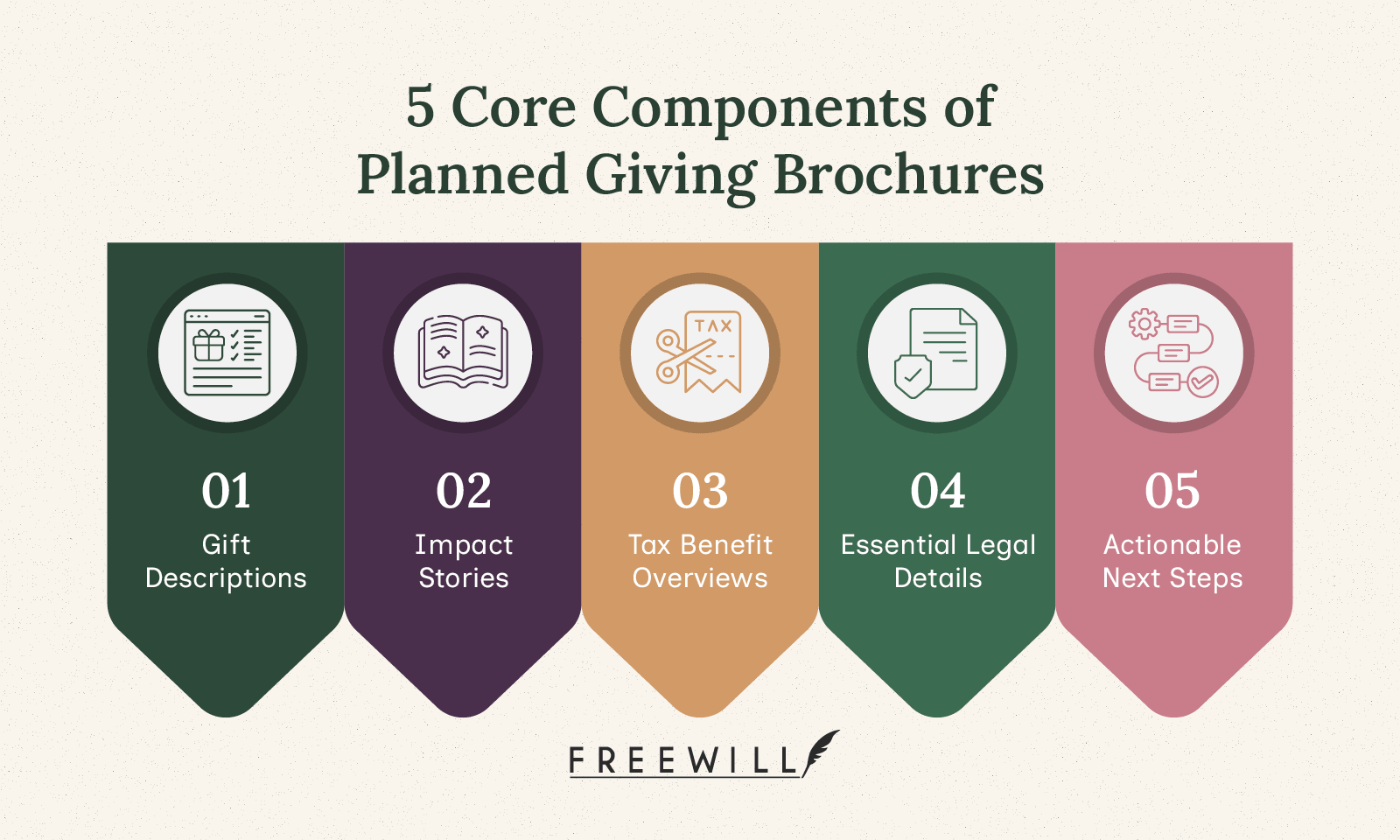
FreeWill’s guide to planned giving brochures lays out five essential elements to include:

Alt text: A summary of the components to include in your planned giving brochures

  1. Gift descriptions: Explain the different types of legacy gifts, such as bequests or beneficiary designations, using simple language so donors fully grasp their options.
  2. Impact stories: Share examples of how previous legacy gifts have advanced your nonprofit’s mission.
  3. Tax benefit overviews: Briefly highlight the potential financial advantages for the donor and their heirs, while advising them to consult their own financial planner.
  4. Essential legal details: Provide the information donors need to complete their forms, such as your organization’s full legal name and tax ID (EIN).
  5. Actionable next steps: Outline what the supporter should do if they are ready to document their gift or if they want to speak with a staff member for more information.

To maximize the effectiveness of these brochures, consider partnering with local estate planning attorneys who can display your materials in their waiting rooms. This places your organization’s bequest options directly in front of community members when they are making important financial decisions.

Feature planned giving options on your main website

A well-optimized digital presence acts as a silent fundraiser, working around the clock to inform your community about how they can support your work. Your nonprofit’s website is a natural spot to promote estate planning. It starts the conversation and ensures high-capacity prospects can independently discover how to leave a lasting mark.

Maximize your website’s potential by implementing these key strategies:

  • Create a dedicated legacy giving page or microsite that outlines your organization’s long-term vision and provides easy access to the information from your brochure (e.g., gift descriptions, impact stories, and tax benefits).
  • Link to this page in your main navigation, making it a natural part of the browsing experience rather than a hidden resource.
  • On your Ways to Give page, feature bequests and other legacy options alongside standard credit card donations and check mailing instructions, normalizing these gifts as a standard method of support.
  • Publish spotlight features on your blog that explain why a specific supporter chose to leave a legacy gift and their impact, providing powerful social proof that inspires others.

To maximize the visibility of your website’s planned giving resources, actively drive traffic to these pages using external marketing channels. Promoting your legacy giving microsite or Ways to Give page using paid search ads covered through the Google Ad Grant, targeted social media campaigns, and email outreach ensures you capture high-intent prospects when they are most receptive to estate planning information, which brings us to our next point.

Add planned giving to your email marketing strategy

Strategic digital communications can gently introduce the concept of bequests without overwhelming your audience. Email provides a direct channel to your donors, and by integrating legacy giving topics like bequests into your outreach, you can grow awareness in a low-pressure way.

Normalize the conversation

The goal is to make legacy giving feel like a natural part of supporting your mission. Instead of a once-a-year ask, incorporate short, educational mentions into your regular emails. This might look like:

  • Donor spotlights in your newsletters about a legacy society member that links to their full story on your blog.
  • Postscript (PS) mentions of planned giving at the bottom of general fundraising appeal emails.
  • Standalone emails that highlight a single, simple concept—such as the ease of naming your nonprofit as a beneficiary in a will.
  • A full email campaign for National Make-A-Will Month in August.

Let data drive your efforts

Pay close attention to engagement metrics, such as click-through rates on legacy-related links, to identify which messaging angles resonate best. A click often signals interest, and a targeted follow-up to subscribers who engaged with planned giving outreach can open the door to more personalized, one-on-one stewardship conversations.

Test planned giving marketing messaging in targeted segments

Not every donor is at the same stage in their legacy journey. Leverage your email segmentation tools to ensure your messaging reaches the supporters most likely to be receptive to planned giving outreach.

EverTrue’s donor segmentation guide highlights that you can group your supporters using five core categories: demographics, affinity for your cause, engagement with your nonprofit, preferences, and giving capacity.

With this context in mind, here are some segmentation strategies to try:

  • Focus on loyalty over wealth. High-net-worth individuals aren’t the only legacy prospects. Your most loyal donors—those who have given consistently for years, regardless of the amount—are often your best candidates for planned giving.
  • Leverage behavioral triggers. Identify likely prospects by tracking who has already interacted with legacy-related content. You might create a segment for anyone who clicked a link in your newsletter about naming a nonprofit in their will or visited your legacy giving landing page. These donors have signaled intent and are prime candidates for a more direct follow-up.
  • Tailor the “why.” Use segmentation to match the legacy opportunity to the donor’s specific interests. For instance, you might send a targeted note to donors over age 70 about the tax-wise benefits of naming your nonprofit as a beneficiary of their IRA, or share how a simple bequest in a will can provide a “forever gift” to a specific program they have supported for years.

By narrowing your focus and making outreach personal, you ensure each message feels like a relevant invitation rather than a generic mass appeal.

Weave impact reporting into your donor communications

Donors treat bequests as the ultimate investment in an organization’s future, meaning they need to be absolutely certain that their legacy will be handled responsibly. Transparent reporting proves your operational competence and highlights the enduring value of your work.

As part of your planned giving marketing strategy, outline how you’ll demonstrate long-term value through reporting. Aim to:

  • Showcase organizational longevity. Highlight your history and major milestones to prove you are a permanent fixture capable of honoring a donor’s intent decades from now.
  • Connect past gifts to present success. Share “Legacy at Work” stories that illustrate how previous bequests fund current programs, helping donors visualize the scale of their potential impact.
  • Prioritize financial transparency. Regularly share “under the hood” details—like annual audits or board oversight—to build the institutional trust necessary for a donor to include you in their estate plans.

Beyond standard annual reports, consider creating a dedicated Legacy Impact Update Report. This report should highlight the programmatic expansions made possible by realized bequests, showing prospective donors exactly how their future gift will create a lasting footprint.

Wrapping up

Securing legacy gifts is an ongoing endeavor that relies on cultivating authentic, communicative relationships with donors. By taking a pressure-free educational approach across the channels you have available, you’ll empower your supporters to leave a lasting mark on a cause they care about.

Ensure your development team regularly reviews your planned giving analytics to see which outreach channels and messages drive the most inquiries. Adjusting your strategy based on these insights will ultimately help you build a sustainable legacy pipeline.

Patrick Schmitt and co-CEO Jenny Xia founded FreeWill at Stanford University’s Graduate School of Business in 2016. FreeWill’s charitable giving platform makes it easier for nonprofit fundraising teams to unlock transformational gifts, and to date has generated over $6.6 billion in new gift commitments for thousands of nonprofit organizations. Patrick hosts FreeWill’s popular webinar series, educating thousands of nonprofit fundraising professionals each month about planned and non-cash giving strategies.

Before FreeWill, Patrick was the Head of Innovation at Change.org, where he helped grow the organization to 100 million users in four years. Prior to that, he ran email marketing for President Obama and served as Campaign Director for MoveOn.org.

Are You Making Sure Your Audience Understands You?

One of the most important aspects of communication (written and verbal) is to make sure your audience understands you. There are many reasons this doesn’t happen. In nonprofit communication, organizations will overcomplicate things or use jargon and other language donors don’t understand. Some people like to show off their large vocabulary or only think about things from their perspective.

The problem is that if your audience doesn’t understand you, you can’t connect with them. You may have trouble convincing them to take action, such as making a donation.

Remember, you are not your audience and you need to keep them in mind when you communicate with them. Here’s what you need to do to make sure your audience understands you.

Write at a sixth to eighth-grade level

This is not dumbing down. You’re smartening up so you can ensure your donors will understand you.

I find it annoying if I come across a word I don’t understand and have to look it up (thank goodness for dictionary apps). I have a pretty good vocabulary but wonder why the writer didn’t use a more understandable word. Some people might not bother to look something up and then won’t know what you’re trying to convey.

Maybe we’re going back to our school days when we were encouraged to use all those big vocabulary words we studied or write lengthy, complex essays.

A readability tool, such as Flesch Kincaid, can help you with this.

Keep jargon to a minimum

One of the biggest culprits here is that dreaded jargon. Some nonprofits may be using the same boring, jargon-laced templates they’ve used for years or they’re so used to some of these terms that they don’t realize these words fall flat with their donors. I think people use jargon because it’s insider language that makes them feel like they’re “in the know” in their professional community. It’s easy to slip into jargon mode in your work environment. But the danger comes when jargon creeps outside of your insular world and into your donor communication.

Sometimes we get lazy and use jargon when we can’t think of anything fresh and original. Instead, you see appeal letters, thank you letters, newsletter articles, and impact reports laced with cringeworthy terms such as food insecurity, at-risk youth, and underserved communities. While your donors may know what some of these terms mean, they’re vague, impersonal, and can come across as demeaning.

Keep in mind that we’re seeing many examples of real problems affecting real people right now. Donors are expecting more authenticity, too. 

How to break free from your jargon

You may know you need to freshen up some of your messages but aren’t sure how to start. 

Sometimes you need to give a little more information. Let’s look at these problem terms and what you can say instead. You may use some of these terms internally and they might be in your mission statement, but please try to limit them when you communicate with your donors.

  • Food insecurity The USDA defines it as “the limited or uncertain availability of nutritionally adequate and safe foods, or limited or uncertain ability to acquire acceptable foods in socially acceptable ways.“ Yikes, that’s a mouthful! I’ve never liked the term food insecurity because it’s so impersonal. We hear this term often because it’s a huge problem and is likely to get worse. Let’s go a step further and put it in human terms by describing a situation where a single mother has to choose between buying groceries and paying the heating bill.
  • At-risk means there’s a possibility something bad will happen. Instead of just saying at-risk students or youth, tell a story or give specific examples of something bad that could happen or has happened. Our tutoring program works with high school students who are more likely to fail their classes, be held back, and drop out of school. Remote learning didn’t work for many of the students in our community and they’re still struggling to catch up. 
  • Underserved means not receiving adequate help or services. Instead of saying we work with underserved communities, explain what types of services these residents don’t receive. Maybe it’s healthcare, affordable housing, decent preschool education, or all of the above. Tell a story or give a specific example. Mary has to take two buses to see a doctor for her diabetes because there isn’t a good healthcare facility in her community. She often feels depleted after these trips, so sometimes she skips her appointments.

Another way to help you transition from jargon to understandable language is to stop using it in your work environment. That means at staff meetings and in interoffice written communication. Maybe you go so far as to rewrite your mission statement to make it more conversational. And telling staff and board members to recite your mission statement as an elevator pitch is a bad idea unless you can make it conversational.

It’s important for you to take time to break free from your jargon to ensure your donors will understand you. Write as if you’re having a conversation with a friend.

Tell a story

This is why stories are so important. You can get beyond that vague, impersonal language and jargon to let your donors see firsthand how they’re helping you make a difference for your clients/community.

Visualize your reader 

Donor or audience personas can be useful on many levels. How much do you know about your donors? The average age of a donor is 64. That’s something to take into account. So is what drew them to your organization.

I always like to use this analogy. Imagine you’re at a family gathering and you’re explaining what your organization does to your 75-year-old Aunt Shirley, or maybe it’s Uncle Ted. Does she look confused and uninterested when you use terms like underserved and at-risk, or does he perk up and want you to tell him more when you mention you’ve been able to help homeless families move out of shelters and into their own homes?

You can go one step further and ask a friend or family member (maybe Aunt Shirley) to look at some of your messages. Remember, what’s clear to you may not be clear to others.

Always take into account who’s reading your fundraising letter or other type of communication. Most likely, your donors don’t have a medical or social services background. They also don’t have a lot of time to look up something they don’t understand. 

What they do want is a personal connection and to be able to understand you.

A Postcard Is a Great Way to Engage With Your Donors

Some of you may remember when people sent postcards when they went on vacation, especially back in the days before email and social media. Now people are more likely to post photos on social media, whether you want to see all their pictures or not. 

We don’t use postal mail as much anymore and many nonprofits are a part of that group. This is a mistake. Direct mail is more personal and your donors are more likely to see something they receive in the mail, as opposed to any type of electronic message you send. Plus, people never get nearly as much mail as they do email and social media messages. Think about how many pieces of mail you get each day. It’s probably fewer than 10. Electronic communication is good, but communicating by mail is better.

I’m a big fan of communicating by mail and believe nonprofits should communicate by mail more often than they do. Now you might say – “But mail is too expensive. So is printing something. We have a small staff and barely have time to get anything done.” I understand all that. I know direct mail can be expensive and putting together a mailing takes more time, but it’s an investment that can help you raise more money.

One way to mail that shouldn’t cost too much is to use postcards. First, you can probably do them in house. Also, if you do it well, it’s a quick, easy way to capture your donor’s attention right away. Creating a postcard will be less expensive than something like a four-page newsletter or impact report. Donors have a lot going on and don’t want to be bombarded with too much information. 

Direct mail is a proven way to communicate and engage. I encourage you to give postcards a try. Landscaping companies, realtors, and political candidates all use postcards, and so should you. With summer coming up (yea!), it’s a great way to stay in touch, and maybe even brighten your donor’s day. Here are a few ways you can engage with your donors by using postcards.

Say thank you

Never miss an opportunity to thank your donors and a quick, easy way to show gratitude is with a postcard.

Create a postcard with a thank you photo, image, or word cloud. The best option is to create a card with enough space so you can include a handwritten note. If that’s not possible, then create one with a pre-printed message.

Let your donors know how their gifts are helping you make a difference for your clients/community and that you can’t do your work without them. 

Send a thank you postcard between one of your fundraising campaigns, so your donors know you’re thinking about them. Another idea is to send one as a warm-up before a campaign.

Ideally, you should be thanking your donors at least once a month. Many organizations don’t mail any type of thank you card, so you’ll stand out if you do.

Share an update

A postcard can be a good way to share an update with your donors. You could make an infographic to give them a quick look at your progress. Some organizations use oversized postcards for their impact/annual report. 

Some infographics just show a bunch of numbers, and numbers don’t mean that much without knowing why something is important. For example, instead of just listing the number of people visiting your food pantry, let your donors know you’re seeing higher numbers because families are having trouble making ends meet since groceries are so expensive.

Other ways to use postcards

You could send a postcard wishing your donors a Happy Thanksgiving or Happy Holidays. Another option is a donor’s anniversary or their birthday, if you keep track of that.

You can also use a postcard for fundraising. While not as effective as a direct mail package (letter, reply envelope, etc.), it can be used as a heads-up for a campaign or a reminder. You could include a QR code and a website link so your donors can easily make a gift or get more information.

Postcards are good for a Save the Date for an event. You could also use one for an informal event.

What to keep in mind

Your postcard needs to capture your donor’s attention right away. It needs to be visual and not include a lot of text (but not just numbers). The text you do include needs to be engaging, conversational, and donor-centered. Examples could include Thank You, Because of you, or Look what you helped us do. Don’t be afraid to get a little creative by using shaped printing. 

Yes, communicating by mail costs more, but it can pay off if you create something more personal that your donors will see. Whether you’re saying thank you, sharing an update, or a combination of both, engage with your donors by sending them a postcard.

Making The Right Investments Can Help Your Nonprofit Raise More Money

With all the economic uncertainty right now, you may be worried about your nonprofit’s finances.

Maybe your giving has gone down and you’ve cut back on some expenses. While that’s understandable on one level, you need to be careful before you nix something you think you can’t afford. It may be something you should be investing in.

Instead of going on autopilot and saying “We can’t afford this,” think about how you can make the right investments. Stay away from the scarcity mindset. It’s often not helpful.

You may also assume donors won’t want to give right now. That’s not necessarily true. Some donors may pull back on their giving, but many step up during tough economic times. You won’t know if you don’t ask.

Here are a few areas you should invest more money (and time) in, even in a down economy. The good news is that if you do it well, these investments can help you raise more money.

Invest in a good CRM/database

Plain and simple, a good CRM (customer relationship management)/database can help you raise more money. You can segment your donors by giving amount and politely ask them to give a little more in your next appeal – $35 or $50 instead of $25. Many organizations don’t ask their donors to upgrade their gifts and you’re leaving money on the table when you don’t do this.

A good database can help you with retention, which will save you money since it costs less to keep donors than to acquire new ones. Donor retention continues to be a big problem. Having a good database also helps with donor engagement.

Many CRMs have built-in payment processors. If not, invest in a good one. 

Your CRM will let you personalize your letters and email messages. Make sure to invest in a good email service provider, too. Personalized letters and messages mean you can address your donors by name and not Dear Friend. You can welcome new donors and thank current donors for their previous support. You can send targeted mailings to lapsed donors to try to woo them back. You can send special mailings to your monthly donors. You can record any personal information, such as conversations you had with a donor and their areas of interest.

In short, you can do a lot with a good CRM/database. Invest in the best one you can afford, and Excel is not a database.

If you’re worried about spending $50 to $100 a month on a CRM/database, you may be able to recoup that expense if you can ask for an upgrade and personalize your communication.

Invest in direct mail

You may not use direct mail that much. If that’s the case for you, you’re missing out on an effective and more personal way to communicate with your donors. Think of the enormous amount of email and social media posts you receive as opposed to postal mail. Your donors will be more likely to see your messages if you send them by mail.

Yes, direct mail is more expensive, but you don’t have to mail that often. Quality is more important than quantity, but aim for at least three or four times a year, and don’t just send fundraising appeals.

Give some thought to what you send. Some ideas, besides appeal letters, include thank you letters/cards; Thanksgiving, holiday, and/or Valentine’s Day cards; infographic postcards; two-to-four-page newsletters; and impact reports. You could put a donation envelope in your newsletter to raise some additional revenue, but do not put one in a thank you or holiday card. I wouldn’t recommend putting one in an impact report either, especially if you only do one a year.

Shorter is usually better. Lengthy communication will cost more and your donors are less likely to read it. 

A few ways you can use direct mail without breaking your budget are to clean up your mailing lists to avoid costly duplicate mailings, spread thank you mailings throughout the year – perhaps sending something to a small number of donors each month, and look into special nonprofit mailing rates. You may also be able to get print materials done pro bono or do them in-house, as long as they look professional.

Of course, you can use email, but your primary reason for communicating that way shouldn’t be because it’s cheaper. Both direct mail and email have their place, but in many cases, direct mail is more effective. They also work well when you use them together.

Invest in monthly giving

If you don’t have a robust monthly giving program, you’re missing out on a great way to raise more money. Monthly giving is one of the few types of fundraising that has increased over the last few years. It’s good for all nonprofit organizations, but it’s especially beneficial for small nonprofits.

Monthly giving will provide you with a steady stream of revenue throughout the year. That’s important during this time of economic uncertainty and funding cuts. It can also be a more feasible option for donors if they can spread out their gifts over the year.

All it takes is for someone to start giving $5.00 or $10.00 a month (hopefully more). These small gifts add up. Also, the retention rate for monthly donors is around 90%. Plus, they’re more likely to become mid-level, major, and legacy donors.

This is why having a good CRM is so important. It will help you find potential monthly donors and segment your current monthly donors so you can send them specialized donor communications. Spend a little time searching your database for people who have donated at least twice and invite them to become monthly donors.

Don’t wait any longer to invest in this proven way to raise more money. If you already have a strong monthly giving program (kudos to you), take the next step and invest in mid-level donors and so on.

Invest in donor communications

By donor communications I mean thank you letters/notes, newsletters, and other updates. Some organizations don’t prioritize these and want to spend their time “raising money.” They don’t seem to realize they can raise more money with better donor communications. Remember this formula – ask, thank, report, repeat.

Don’t skimp on your communications budget. Creating thank you cards and infographic postcards is a good investment and a necessity, not a luxury. Thank you cards are a much better investment than mailing labels and other useless swag.

Maybe you need to reallocate your budget to cover some of these expenses. You could also look into additional sources of unrestricted funding (more on that below). 

Of course, you can also use email and social media to communicate with donors. This reiterates the need for a good email service provider with professional looking templates for your email newsletter and other updates.

Invest in unrestricted funding options

Many nonprofits rely on grant funding. Grants, especially federal ones, have become precarious and, in some cases, not an option. A lot of grants are considered restricted funding and may not cover things like staff salaries and infrastructure. Some funders only want to cover “program expenses.” This is a problem because how can we successfully run our programs if we don’t have enough staff and can barely afford to pay the people we do have? A rotating door of development staff makes it hard to maintain those important relationships. We also have to pay rent and other expenses (including a CRM, direct mail communication, etc.).

Spend some time investing in finding unrestricted funding sources, which could include grants. More often, it’s those important individual gifts, such as monthly donations and mid-level/major gifts. Ramping up your major giving will require more investment from your board (time/connections, not just money), but it should pay off. 

Don’t limit yourself by saying you can’t afford certain expenses. If you make the right investments, you should be able to raise more money.