Looking to inspire legacy gifts at your organization? Explore these planned giving marketing ideas to connect with supporters and grow long-term funding.
By Patrick Schmitt

Building a reliable pipeline of legacy gifts is essential for securing your organization’s long-term financial health and sustaining your programs well into the future. However, initiating conversations about bequests (gifts made through wills or trusts) can feel intimidating for development teams.
Ultimately, success comes down to clear, educational communication with donors rather than aggressive solicitation. By focusing on stewardship, you can naturally introduce the concept of legacy giving while strengthening your current relationships. To guide your approach, we’ll explore several donor-centric strategies to communicate the value of bequests to your community.
Design comprehensive planned giving brochures
Providing your supporters with accessible, easy-to-understand educational materials is a foundational step in any legacy giving strategy. Creating a dedicated brochure, whether distributed physically at events or digitally via email, gives donors the space to learn about their options on their own timeline without feeling pressured.
FreeWill’s guide to planned giving brochures lays out five essential elements to include:
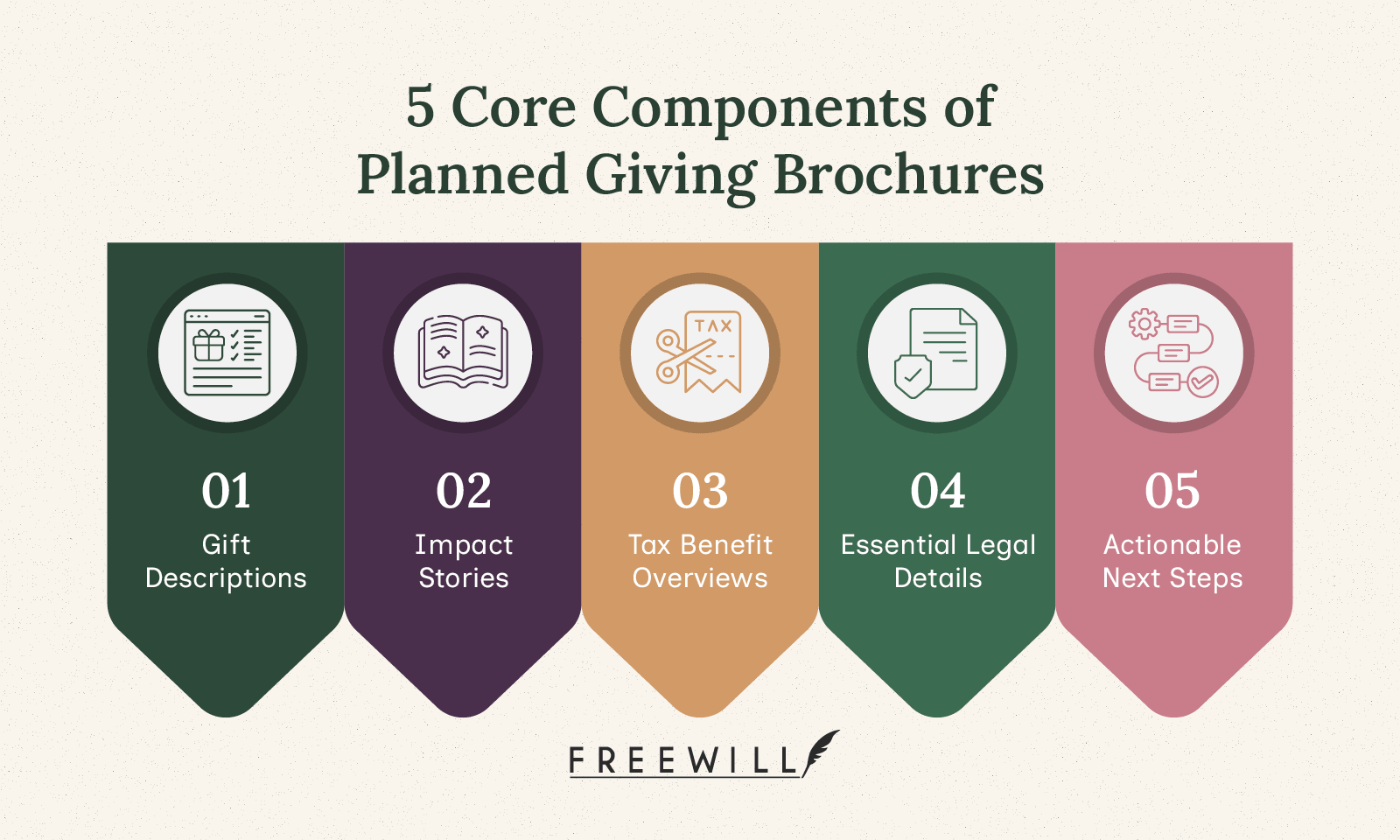
Alt text: A summary of the components to include in your planned giving brochures
- Gift descriptions: Explain the different types of legacy gifts, such as bequests or beneficiary designations, using simple language so donors fully grasp their options.
- Impact stories: Share examples of how previous legacy gifts have advanced your nonprofit’s mission.
- Tax benefit overviews: Briefly highlight the potential financial advantages for the donor and their heirs, while advising them to consult their own financial planner.
- Essential legal details: Provide the information donors need to complete their forms, such as your organization’s full legal name and tax ID (EIN).
- Actionable next steps: Outline what the supporter should do if they are ready to document their gift or if they want to speak with a staff member for more information.
To maximize the effectiveness of these brochures, consider partnering with local estate planning attorneys who can display your materials in their waiting rooms. This places your organization’s bequest options directly in front of community members when they are making important financial decisions.
Feature planned giving options on your main website
A well-optimized digital presence acts as a silent fundraiser, working around the clock to inform your community about how they can support your work. Your nonprofit’s website is a natural spot to promote estate planning. It starts the conversation and ensures high-capacity prospects can independently discover how to leave a lasting mark.
Maximize your website’s potential by implementing these key strategies:
- Create a dedicated legacy giving page or microsite that outlines your organization’s long-term vision and provides easy access to the information from your brochure (e.g., gift descriptions, impact stories, and tax benefits).
- Link to this page in your main navigation, making it a natural part of the browsing experience rather than a hidden resource.
- On your Ways to Give page, feature bequests and other legacy options alongside standard credit card donations and check mailing instructions, normalizing these gifts as a standard method of support.
- Publish spotlight features on your blog that explain why a specific supporter chose to leave a legacy gift and their impact, providing powerful social proof that inspires others.
To maximize the visibility of your website’s planned giving resources, actively drive traffic to these pages using external marketing channels. Promoting your legacy giving microsite or Ways to Give page using paid search ads covered through the Google Ad Grant, targeted social media campaigns, and email outreach ensures you capture high-intent prospects when they are most receptive to estate planning information, which brings us to our next point.
Add planned giving to your email marketing strategy
Strategic digital communications can gently introduce the concept of bequests without overwhelming your audience. Email provides a direct channel to your donors, and by integrating legacy giving topics like bequests into your outreach, you can grow awareness in a low-pressure way.
Normalize the conversation
The goal is to make legacy giving feel like a natural part of supporting your mission. Instead of a once-a-year ask, incorporate short, educational mentions into your regular emails. This might look like:
- Donor spotlights in your newsletters about a legacy society member that links to their full story on your blog.
- Postscript (PS) mentions of planned giving at the bottom of general fundraising appeal emails.
- Standalone emails that highlight a single, simple concept—such as the ease of naming your nonprofit as a beneficiary in a will.
- A full email campaign for National Make-A-Will Month in August.
Let data drive your efforts
Pay close attention to engagement metrics, such as click-through rates on legacy-related links, to identify which messaging angles resonate best. A click often signals interest, and a targeted follow-up to subscribers who engaged with planned giving outreach can open the door to more personalized, one-on-one stewardship conversations.
Test planned giving marketing messaging in targeted segments
Not every donor is at the same stage in their legacy journey. Leverage your email segmentation tools to ensure your messaging reaches the supporters most likely to be receptive to planned giving outreach.
EverTrue’s donor segmentation guide highlights that you can group your supporters using five core categories: demographics, affinity for your cause, engagement with your nonprofit, preferences, and giving capacity.
With this context in mind, here are some segmentation strategies to try:
- Focus on loyalty over wealth. High-net-worth individuals aren’t the only legacy prospects. Your most loyal donors—those who have given consistently for years, regardless of the amount—are often your best candidates for planned giving.
- Leverage behavioral triggers. Identify likely prospects by tracking who has already interacted with legacy-related content. You might create a segment for anyone who clicked a link in your newsletter about naming a nonprofit in their will or visited your legacy giving landing page. These donors have signaled intent and are prime candidates for a more direct follow-up.
- Tailor the “why.” Use segmentation to match the legacy opportunity to the donor’s specific interests. For instance, you might send a targeted note to donors over age 70 about the tax-wise benefits of naming your nonprofit as a beneficiary of their IRA, or share how a simple bequest in a will can provide a “forever gift” to a specific program they have supported for years.
By narrowing your focus and making outreach personal, you ensure each message feels like a relevant invitation rather than a generic mass appeal.
Weave impact reporting into your donor communications
Donors treat bequests as the ultimate investment in an organization’s future, meaning they need to be absolutely certain that their legacy will be handled responsibly. Transparent reporting proves your operational competence and highlights the enduring value of your work.
As part of your planned giving marketing strategy, outline how you’ll demonstrate long-term value through reporting. Aim to:
- Showcase organizational longevity. Highlight your history and major milestones to prove you are a permanent fixture capable of honoring a donor’s intent decades from now.
- Connect past gifts to present success. Share “Legacy at Work” stories that illustrate how previous bequests fund current programs, helping donors visualize the scale of their potential impact.
- Prioritize financial transparency. Regularly share “under the hood” details—like annual audits or board oversight—to build the institutional trust necessary for a donor to include you in their estate plans.
Beyond standard annual reports, consider creating a dedicated Legacy Impact Update Report. This report should highlight the programmatic expansions made possible by realized bequests, showing prospective donors exactly how their future gift will create a lasting footprint.
Wrapping up
Securing legacy gifts is an ongoing endeavor that relies on cultivating authentic, communicative relationships with donors. By taking a pressure-free educational approach across the channels you have available, you’ll empower your supporters to leave a lasting mark on a cause they care about.
Ensure your development team regularly reviews your planned giving analytics to see which outreach channels and messages drive the most inquiries. Adjusting your strategy based on these insights will ultimately help you build a sustainable legacy pipeline.
Patrick Schmitt and co-CEO Jenny Xia founded FreeWill at Stanford University’s Graduate School of Business in 2016. FreeWill’s charitable giving platform makes it easier for nonprofit fundraising teams to unlock transformational gifts, and to date has generated over $6.6 billion in new gift commitments for thousands of nonprofit organizations. Patrick hosts FreeWill’s popular webinar series, educating thousands of nonprofit fundraising professionals each month about planned and non-cash giving strategies.
Before FreeWill, Patrick was the Head of Innovation at Change.org, where he helped grow the organization to 100 million users in four years. Prior to that, he ran email marketing for President Obama and served as Campaign Director for MoveOn.org.