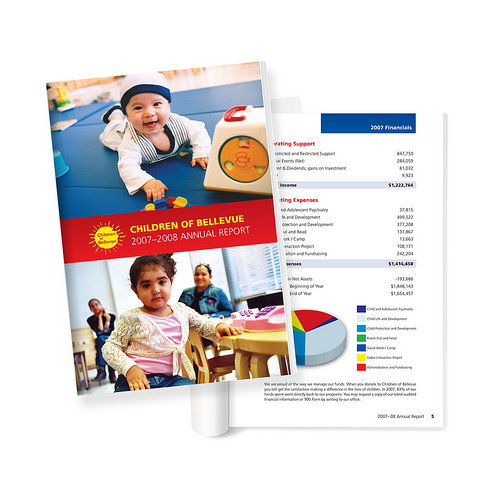
Do Annual Reports Still Make Sense?

The answer is, it depends.  They are often not done very well, but they can be useful.  An annual report is a good way to show accomplishments to funders and potential funders.
Here are a few things to consider when deciding whether it makes sense for your organization to produce an annual report.
What do your donors want?
Your annual report is for your donors and it should reflect what they want –  not what your board wants.  Just because you have always done an annual report, doesn’t mean you should.
Send a short survey to your individual donors and get their opinion.  Do they even read your annual report?  Grant and corporate funders will probably be more interested in the nitty gritty, while individual donors will want something short and visual.
It gets old quickly
An annual report can end up being a static document.  One huge problem is that for some organizations,it’s the only time they share accomplishments with their donors. Dear Fundraisers: The Annual Report Is Yesterday’s News 
Ideally, you should be sharing accomplishments regularly – at least once a month.
If you wait until the beginning of the next calendar year to start on your annual report, and then spend a lot of time gathering all the materials, writing, and editing it, your 2013 annual report ends up going out sometime in the middle of 2014. 
It’s putting me to sleep
The traditional annual report was often a 10-20 page document filled with long-winded text. It listed activities rather than accomplishments and focused on the organization and not how the organization was making a difference for the people they served. Fortunately, this seems to be changing,
In short, annual reports tend to be boring.  It’s not just length.  I’ve seen four-page reports that weren’t very engaging either.
It takes a lot of resources
Annual reports can take a lot of time to put together and then you have to factor in printing and mailing, if you choose to go that route.  It may not make sense for a small organization.
We want to produce an annual report.

Okay, you’ve thought it over and decided that an annual report does make sense for your organization.  Here are a few suggestions to help you create a good one.
Who are your donors?
Remember that annual reports are for your donors and different donors have different needs.  You may want to produce different types of annual reports for your grant funders and individual donors, or only produce one for your grant funders.  One size doesn’t fit all.
Start working on it this summer
You want your 2013 annual report done by the beginning of next year.  A lot of it can be done ahead of time. 
Take time this summer to collect stories, testimonials, quotes, accomplishments, and photos.  You could even do a video.  RETHINKING THE ANNUAL REPORT FOR VIDEO 
Everything you include should emphasize how your donors are helping you make a difference for the people you serve. 
Create a plan
Think carefully about what you want to produce for different donor groups.  I’m not trying to create extra work for you by suggesting you make more than one type of annual report.  Once you have the stories, accomplishments, photos, etc, it should be pretty straightforward.   
Do what’s best for your donors.
This link gives you more suggestions about creating annual reports.
I’ll write another post in the fall exploring this a little more and help you make your annual report engaging.
  

Time To Thank Your Donors

Do you remember the commercial from years back where the Dunkin Donuts baker would rise each morning and declare?  “Time to make the donuts.”  Time to make the Donuts  Well, it’s time for you to thank your donors.
Of course, it’s always time to thank your donors, and you should be showing gratitude on a regular basis, not just after you have received a gift.  But take it up a notch and do something really special this month.
You may be thinking, why now?  It’s not Thanksgiving, the holidays, or Valentine’s Day.  Precisely.  Your donors probably won’t be expecting anything and should be pleasantly surprised. Send something early in the summer before your donors start to go on vacation.
Keep in mind that if your donors don’t feel appreciated, they may not donate again.
Here are a few things to help get you started and some different ways to thank your donors.
Create a good photo
The first thing you should do is find or take some great photos.  Maybe one where you get people together to hold a thank you sign.  Here are a few examples.  The first one is actually a video, but you can do the same thing with a photo.

You could also show your work in action.  Whatever you decide, be sure it’s engaging.  
Make a list of accomplishments
Choose a few accomplishments you have achieved so far this year and share those with your donors.  Remember to focus on how your donor is helping you make a difference for the people you serve.
Send a thank you card
Take that great photo and use it to create a note card or postcard.  It’s a good idea to invest in one of these, so you can have them on hand to send to volunteers and board members, as well as donors.  If cost is an issue, you could get a print shop to do it pro bono or find a corporate sponsor.  You could also just buy some thank you cards, but something that references your organization would be better.
Thank you cards are small, so you only need a few sentences.  Get a group together to write them – staff, board members, volunteers, even clients (if feasible).  Here’s a great suggestion of throwing a card shower. MANY, MANY, MANY THANKS 
Think about investing in note cards or a postcard.  Handwritten notes make a difference.
Email works, too
In addition to thank you notes, you can send out an email thank you.  You may also choose email if mailing cards is too hard to pull off.
Just because you are sending email,doesn’t mean you should skimp on quality.  Use an engaging photo and share some of those accomplishments.  Write a really heartfelt message and make it look nice.
Create a video
It’s so much easier to make videos now.  Think about creating a special thank you video.  The example I included above features different people connected with the organization saying thank you. This link includes a few more examples.  Our Favorite Nonprofit Thank You Videos 

Your video doesn’t need to be long, either.  A minute or less is perfect. 
You can use this video in an email message, in social media, and on your website.
These are just a few suggestions of ways to thank your donors right now.  Keep thanking them all year round, too.  Thank Your Donors All Year Round 

How are you thanking your donors?

Conquering Your Communication Challenges – Getting People To Respond To Your Messages

Over the last few weeks, I’ve been writing about different ways to conquer some of your communication challenges.  Another challenge that nonprofit organizations face is that people aren’t responding to their messages.
 
There can be a number of reasons for this.  Perhaps it is one of the following.
 
Your content isn’t strong enough
In my last post I wrote about creating engaging content, which is most often success stories where you show your donor how they are helping you make a difference.
 
Let’s use a fundraising letter as an example.  Some of the key components should include a story, an ask, thanking donors for their past gift, how their money will be spent, what you have accomplished, and what you plan to do in the future.
 
When creating content, remember the four C’s – clear, concise, conversational, and compelling. The 4 Cs of Writing Good Content
 
Besides being well written, your messages need to be easy to read and navigate.  Use short paragraphs with lots of white space and at least a 12-point font.  If your email message or web page is a cluttered mess with tiny type, your supporters are less likely to read it.
 
Here is more on creating good content.
 
You are reaching out to the wrong audience
Maybe not the “wrong” audience, but a weaker one.  Your current donors are more likely to give to your annual appeal than other supporters, such as email list subscribers.  You also probably won’t have as much success with event attendees or mailing to a cold list.
 
If you are holding an event, you should get a better response if you post an announcement on your Facebook page as opposed to the events calendar in your local paper.  Get social on social media and take it a step further.  Ask your followers to spread the word about your event, as well as help you recruit volunteers and even raise money.
 
You may also be using the wrong channels.  Perhaps your donors don’t use Twitter very often.
 
This is why you need to know your audience.  If you have limited resources, which is the case for many nonprofits, don’t spend a lot of time and energy reaching out to a weak audience.
 
Once is not enough
Maybe you do have strong messages and you are reaching out to a good audience, but your supporters still aren’t responding.  Well, these folks are busy and are barraged with messages from a variety of sources.  That’s why you need to send your message again (and again).
 
You should never send out one fundraising letter and sit around and wait for the money to flow in, because it will come in as a trickle.  Remind your donors via email, social media, your website, phone, and maybe even another letter.  The same goes for promoting events.
 
Keep track of your response rate, because if it’s not as strong as you would like it to be, you can often fix it.
 
Here are some other reasons why your messages may not be getting a response.  You should be able to avoid the first one if you reach out to the right audience.


How do you get people to respond to your messages?

Conquering Your Communication Challenges – Creating Engaging Content

Over the last couple of weeks, I’ve been writing about how to conquer some of your communication challenges.  Another challenge many nonprofit organizations face is coming up with engaging content on a regular basis.

Do you find yourself saying any of the following?

We’re having trouble getting organized
Your biggest ally here is an editorial calendar.  How to Create an Editorial Calendar You can do one for the year, but also break it down into smaller components. This doesn’t need to take a lot of time, and it’s a huge time-saver overall. Each month figure out what you will include in your newsletter. Every week decide how you are going to connect with your supporters. Spend 15-20 minutes a day looking for content you can share on social media

Your editorial calendar will include time-sensitive content, such as events or that April is national volunteer month, as well as evergreen content – stories you can use at any time.  

We don’t know what to write about
Your content should focus on how you are making a difference for the people/community you serve.  You have good stories to tell.  Work with your program staff to create a story bank to use for your annual appeal, website, newsletter, etc.  You can also include profiles of clients, donors, board members, volunteers, and staff.   

Don’t forget to thank your donors in your newsletter and other updates.  Avoid stories that are more focused on your organization, such as obtaining new computers for your staff, unless you can tie that back to your mission.

Here is more information on creating stories.

Use measurement and analytics to see what types of content hit home with your supporters.  Most likely it will be success stories that emphasize how they are helping you make a difference.

We don’t a lot of time to do this
I covered time constraints in my last post, and this is a challenge for many organizations. 

Nonprofits do need to communicate often with their supporters.  Try to reach out once a week.  If that’s impossible, aim for every other week.  It’s not as daunting as you may think. Planning and strategy always helps.

Some consistency is good for your newsletter.  Use a template that you can fill in each month. Maybe you will always include a success story or a profile. Also, keep in mind that your newsletter only needs a few articles.

Your supporters are busy and will appreciate short messages. In addition to your monthly newsletter, you can reach out with a brief update, advocacy alert, or one-question survey.  Another way to connect is to share the outcome of your advocacy alert or the results from your survey.

Use the same content in different channels.  For example include links to your newsletter, as well as updates, advocacy alerts, and surveys on Facebook and Twitter.

Another good way to engage is to post a photo of your program in action on social media.  A great photo can tell a story in an instant. 
I hope this helps you conquer the some of the challenges of creating engaging content.  How do you handle this challenge?

Conquering Your Communication Challenges – Dealing with Limited Resources

This is the second post in my series about how to conquer some of your communication challenges.  Many nonprofit organizations have limited resources, and one thing to remember is that planning and prioritizing can help.

Have you ever found yourself saying the following?

We feel like we have no time to get anything done
If you have plans and strategies in place, you probably won’t feel as strapped for time.  I covered that in my last post.  Conquering Your Communication Challenges – Planning, Strategy, and Measurement

Find ways to help you get organized. For example, use an editorial calendar to plan your content  How to Create an Editorial Calendar and a style guide to help keep your messages and look consistent. Create a Style Guide for Your Organization
Figure out what is most important and do the best you can with the resources you have.  Fundraisng is always a priority.  So is making your supporters happy.  That includes current donors and potential donors (email subscribers, website visitors, etc.). Thank your donors, keep your supporters engaged with newsletters and other updates, and be sure your website is up-to-date.

Look at how you are spending your time.  Are you doing work that may not be that important?  Meetings can be a huge time sink.  Evaluate whether you need to have so many meetings, and make the ones you have efficient.  Use measurement to make sure you are taking on initiatives that are beneficial to your organization.  

You may feel so overwhelmed that you think you need to chain yourself to your desk in order to get your work done.  Not true.  In fact getting away from your desk and out of the office can make you more productive.

Our budget is tiny
If you have a small budget, again figure out what’s most important. Printing and mailing are two of the biggest expenses.  Perhaps you will forgo a printed newsletter and send out a high-quality electronic one instead.

You don’t need fancy materials, but you do need to look professional.  You can often get printed materials such as an event invitation or annual report donated.  Ask a print shop to do it pro bono or find a foundation to sponsor it. 

Speaking of funding, reach out to granting agencies that will cover general operating support.

Spend wisely.  You should mail out an annual appeal letter, but you don’t need to mail out an annual report to ALL your donors.  

We have don’t have enough staff
Many nonprofits are understaffed, and some organizations turn to interns and volunteers to fill in the gaps.  This can be a mixed bag.  Interns and volunteers may not be that experienced and often don’t stay around very long.   If you do take them on, make sure they are well-trained and supported. If you can find good people, it might work in your favor.  How To Ensure Effective and Engaged Volunteers 

It’s not uncommon for board members to be more involved at a small nonprofit.  This doesn’t mean they should be running the day-to-day operations, but they can share their expertise in an advisory role. Your board should have a fundraising committee, and preferably a marketing committee.  Find board members who are willing and able to give you a little boost as you try to grow.

Having limited resources, whether it’s time, budget, staff, or a combination of the three, is a challenge.  Planning and prioritizing can help you conquer these challenges. 

How do you deal with limited resources? 

Conquering Your Communication Challenges – Planning, Strategy, and Measurement

Over the next few weeks, I’m going to write about how to conquer some of your communication challenges.  Do these sound familiar to you?

We don’t have a plan or strategy
This is where you need to begin.  You need to have fundraising and marketing plans.  Not having a plan is like starting a journey without a map (or these days programming your GPS).  You need to know where you are headed and how you will get there.

Not only do you need to have overall plans, but each campaign or communication tool (website, newsletter, etc.) needs a strategy. Make it as detailed as possible.  Figure out each step of your annual appeal or event.  Create a timeline.

Set goals. These include the obvious such as how much money you need to raise and how many volunteers you want to recruit, as well as what you want your newsletter to achieve.  In this case it could be to engage, educate, entertain, or a combination of the three.

Here is some more detailed information about putting together a campaign. Campaign, champagne – what’s that thing called again?

Creating plans and strategies will take some time upfront, but it will save you time in the end. And it is time well spent.

We know we should be measuring our progress, but it’s so overwhelming
It’s not as overwhelming as you might think.  Now that you have plans and strategies, use those as your basis to figure out what you need to measure.   I wrote an entire post about measuring your progress a few weeks ago, so I won’t go into a huge amount of detail.

For your annual plans, measure your progress at least once a quarter.  For engagement (newsletter, social media, website), try to look at analytics once a month.  In addition, use a more personal approach and ask questions through social media and conduct short surveys in your newsletter and website.  You can also do a longer, but not too long, survey once or twice a year.

Once you have completed a campaign or event, figure out what worked and what didn’t.  Then make changes for the future. 

If you don’t measure your progress, how will you know if you are successful?   Perhaps you’ve had an annual event for years that’s really more trouble than it’s worth.  Or, you are trying to engage with your donors on Twitter, and not many of them use it. 

Don’t get too discouraged if you encounter a setback. Think of it as a learning experience.


You don’t need to be a data geek to do measurement. You can do a lot of it on a spreadsheet.  Here are a few examples you might find helpful.

Creating plans and strategies and coming up with a system for measurement is your first step towards conquering your communication challenges.  In my next post, I’ll write about dealing with limited resources – time, budget, and staff.

What are some of your communication challenges?

Make Your Newsletter Shine

In our social media world, is a newsletter still a relevant form of communication?  It can be, if it’s done well, which it often isn’t. 

Marketing consultant Kivi Leroux Miller recently surveyed a number of nonprofit organizations and found a majority of the respondents were either somewhat satisfied or not satisfied with their newsletter.  Some of the responses she received included organizations weren’t getting the response rates they wanted and they were unclear on their goals.
Leroux Miller also asked a more specific question about newsletter goals and found over half of the respondents had rather vague goals  like “Keep people informed about the work of our organization.” and “Remind people we are here and doing good work,” as opposed to 10% who replied “share results and gratitude with current donors.”
How does your newsletter fare?  Do you have strong goals?

As I mentioned above, newsletters still have a role in nonprofit communications.  Here are a few ways to make your newsletter shine.

Make it visual
Your donors are busy and don’t have a lot of time to read your newsletter, and likely won’t read all of it (sad, but true).  That’s why it needs to be visual.

Whether you have a print or electronic newsletter, use pictures.  With an electronic newsletter, you could include a link to a video.  Showcase engaging photos and video of your work in action. Tell a visual story.

Be reader-friendly
Continuing with the visual theme, make your newsletter is easy to read and scan. Use bold headings, short paragraphs, and at least a 12-point font.  Make sure your headings convey enough information to give your readers the gist of your stories.

Consider including just the opening paragraph in your electronic newsletter with a link to your website, so you are not cluttering up the screen with lots of text.

Short and sweet
The problem with many newsletters is they are too long. A monthly newsletter only needs three or four stories. Think quality over quantity.

Engage your readers
Another problem with newsletters is they are boring.  Your donor wants to be thanked and hear how you making a difference for the people you serve.  They are not as interested in hearing that your CEO received 
an award from the Chamber of Commerce.

Lead with a story that shows how you are helping people.  Use the inverted pyramid and put your most important story first. 

You can include profiles of board members and volunteers, but tie it back to how you are making difference.

Write in the second person and draw in your readers by being personal and conversational.

Be professional
No matter the size of your organization, make sure your newsletter looks professionalGive it a consistent look, such as always having your logo in the same place.  Using an email service provider can help with that. 

Use other channels to promote your newsletter
Include links to your newsletter on social media.  This can be useful in case your donor misses your original email.  Also, include links to your newsletter on your website.

Make it mobile friendly
Many of your donors will read your newsletter on a mobile device, so make sure it fits nicely on the screen.  Here’s some information to help you with that. 
Measure your success
One way to monitor your success is to measure click through rates.  That may not give you all the information you need.  You can also survey your readers at least once a year to get their feedback.

Take into account what you have learned.  If you are struggling with your newsletter, figure out why. 

You will have more success with your newsletter if you produce one that’s easy to read and filled stories about how you are making a difference.  Make it shine!

The Communication Journey

Marketing expert Seth Godin recently blogged Communication is a path, not an event 

In short, it’s not a one-time thing.  While he focuses more on sales, this also applies to all your nonprofit fundraising and marketing.  You don’t just send a fundraising letter or even a thank you letter and not communicate again for awhile.  It’s an ongoing process. 

Here are few ways to ensure a successful communication journey.

Lots of drops will help your garden grow
Godin ends his post by saying “Drip, drip, drip.”  Drip marketing is a strategy where you send a series of messages to prospects.  An example would be sending welcoming messages to prospective donors before making an ask.  The term’s origin is thought to have come from a gardening technique in which small amounts of water are fed to plants over a long period of time. 

This is a helpful analogy to consider when you communicate with your donors and other supporters.  Read on for more information about drip campaigns. How to Create an Email Drip Campaign for Your Nonprofit 

Consistency is key
Be consistent in your fundraising and marketing.  This means your messages and look must be consistent, as well as how often you send out your messages.  If you send out a monthly newsletter, make sure it goes out around the same time each month.  Don’t skip a month. 

Don’t start your journey without a map
Creating a strategy and putting together an editorial calendar can serve as a road map for your communication journey.  Here’s more information, as well as an editorial calendar link. 
The LightBox Collaborative 2013 Editorial Calendar
Communication is a two way street
Listen to your audience.  Ask questions on social media, respond to comments, and send out surveys or polls.

Take your supporters’ feedback into account and give them information they want.

Communication takes different paths
Most of us communicate through more than one channel – email, social media, direct mail, phone. Different modes work for different audiences, but often you use a combination of channels.

This is very helpful during fundraising campaigns. A multi-channel approach gives you more than one opportunity to reach your audience, in case they miss your first message.

Be known but don’t be annoying
Communicate often enough so your supporters will remember you, but not too much so that you are bothering them.  Most organizations don’t communicate enough.  Remember to be consistent.  Don’t send three email messages in one day and not communicate again for three weeks.

As a general rule, send email once a week and post on social media once a day.

In your quest not to annoy your supporters, share content where you show gratitude and demonstrate how you are making a difference for the people you serve.  Keep your supporters engaged.

One of the benefits of communicating weekly is that your messages can be short.  Shorter more frequent communication usually works better for getting your message across.

Don’t get derailed
It may seem daunting to keep up this ongoing communication journey, but good relationships, like gardens, need lots of attention.  It’s not as difficult as you might think.  Having an editorial calendar and strategy will help.  And your messages don’t need to be long.  Also, it can be fun to thank donors and share success.   

Make it a worthwhile journey for your supporters.

How Are You Making a Difference?

When nonprofit organizations reach out to donors and other supporters to share accomplishments, I often see something like the examples below.  (All names are fictitious).

We started a community garden in the Westside neighborhood.

Youth First just opened a new activity center for our afterschool program.

We received a $50,000 grant from the Jones Foundation.

A Place to Call Home found affordable housing for over 100 families last year.

These are okay on one level, but they are more focused on activities than accomplishments.  They don’t answer the question – How are you making a difference for the people you serve?

Focus on why rather than what
When you are communicating with donors, think about why your accomplishments are important.

Instead of just reporting that you have started a community garden, emphasize how that will make a difference.  Now neighborhood residents have access to fresh fruit and vegetables, which are often not available at nearby stores or are too expensive.

Instead of just noting that your afterschool program has a brand new activity center, demonstrate that you are providing a safe place for young people to interact and learn new skills.

Of course, publically acknowledging your major funders is important, but what will that $50,000 grant be used for?  How will it help people?

What does it mean for the families who you helped find affordable housing?  Show how a family that was living in a shelter or with relatives now has a place they can call home.

Be conversational and personal
Draw in your reader with something personal.  Use stories, quotes, and testimonials, as well as photos and videos.  Go easy on the statistics and avoid using jargon.  

When you tell a story, choose a protagonist – an individual or family- and give them a name. You can change their names to protect their privacy.

This post by Katya Andreson is about mission statements, but can apply to all your communications. How do I make my mission sound more exciting?  She recommends giving your messages a heartbeat, which I think is great advice.  She also says, Always answer the question, at the end of the day, whose life is better for what we do?” 

Many people donate because they have a personal connection to your cause.  Don’t bore them with a lot of long-winded facts.

They want to see how you are making a difference. 

Work with program staff to find stories
Often development and marketing staff don’t have firsthand knowledge of how your organization is making a difference.  This is why you need to work with program staff to create compelling stories and testimonials.  

Come up with a system that won’t make anyone feel overburdened.  Let’s Work Together – The Importance of a Good Relationship with the Program Department 

Show your donors how they are helping you make a difference
Finally, don’t forget to thank your donors and let them know that they are a key to your success.  After all, you wouldn’t be able to make a difference for the people you serve without their support.

How is your organization making a difference?

Time to Measure Your Progress

We are already three months into 2013.  This is a good time to measure your progress so far.  Take out your fundraising and marketing plans (You do have written plans, don’t you?), and let’s see how you are doing. Here are a few things you should measure.

Fundraising
Are you on target with your fundraising goals?  If not, how far off are you?  You may need to give it a little more time or do something differently. Perhaps the foundations you are approaching aren’t a good match for your organization.

If you have had any events or campaigns recently, assess what worked and what didn’t.  Hopefully, you have already measured results from your year-end appeal, so you can apply what worked to this year’s campaign.

Donor relations
Besides raising revenue, your fundraising plan should include a donor relations component.  Are you thanking your donors and keeping them engaged on a regular basis?  One way to track engagement is to measure the response rates of your email messages.  Another way is to get feedback by sending out a short survey or asking questions on social media.

Volunteer recruitment
If your organization relies on volunteers, are you meeting your recruitment goals?   Keep track of which groups are more likely to volunteer.  Do you tend to get more seniors or students?  Are corporations or faith-based communities a better place to find volunteers?

Marketing/communications
This is closely related to your donor relations.  Are you sending out a newsletter and other updates?  Measure the response rates of your messages and website.

If your messages don’t seem to resonate with your supporters, figure out why.  Maybe you need better email subject lines or more compelling content.  Are your messages filled with gratitude and success stories about how you are making a difference thanks to your donors, or are you sending out something long, boring, and focused on the organization?

Looking at your number of email subscribers and social media followers is just one part of the equation.  Make sure you are keeping them engaged with good content.

Another reason your response rate might be low is that you are sending messages to people who aren’t strong supporters.
You may also want to measure media coverage.  It’s not easy to get media coverage.  You are competing with many other organizations, as well as current news stories.  Make sure you are targeting the right publications (smaller and local is often better) with the right stories.

What else does your organization need to measure?
This post by the Veritus Group offers some more suggestions. 1st Quarter Check Up!  One point they make is that it’s still early in the year.  If something’s not working, you have plenty of time to fix it and still meet your year-end goals.

Here is a great tool to help you with your measurement. Library of Sample Dashboard Indicators
Look it over. You may find some other things you need to measure.

Take some time to measure your progress. Then make a point to do it again at least once between now and the beginning of July.