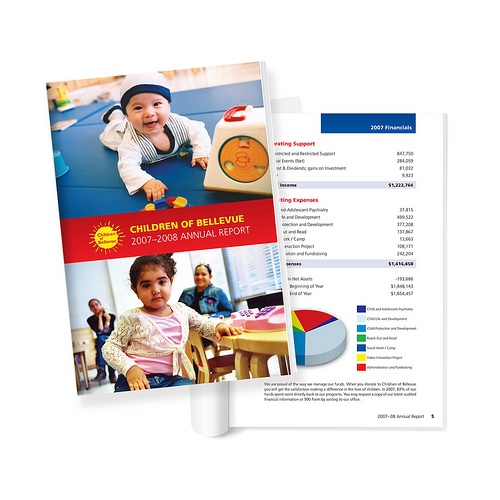
Get Organized This Summer – Prepare for your Annual Report

Photo by Eric (aka Herve) via Flickr

Over the last couple of weeks, I have been offering tips to help you get organized during your summer “downtime” and prepare for a busy fall. 

You may not be thinking about your annual report during these lazy, hazy days of summer, but you should be. Putting together an annual report can take awhile.  However, if you start preparing ahead of time, you should be able to get it done by the beginning of next year.

While you won’t be able to do everything, such as financials, there is a lot you can do now.  Some of the components listed below are not exclusive to your annual report.

Your annual report doesn’t need to be a glossy 20 page document.  If you are a small organization, that would not be a good use of your resources. The trend now is about four to six pages.  All annual reports – short or long – should be visual and not filled with long-winded text and statistics.

Remember that the focus of your annual report is showing gratitude to your donors and demonstrating how their support has made a difference.

What can you work on ahead of time?

Stories
Gather stories about the people you serve.  It’s a good idea to have a set of stories available to use in a variety of materials besides your annual report.  These include your annual appeal, website, and newsletter.  Stories are much more captivating than explanatory text.

Quotes
Work with your program staff to interview clients and find interesting quotes.  You can also use quotes in your other materials.  Put together a quote bank for future use.

Pictures
Invest time in creating some great photographs. Your supporters are not going to spend much time reading your annual report, but if you can engage them with photos, you should be able to tell a story instantly.  

Choose photos of people participating in an activity, such as kids in an afterschool program.  You’ll save time in the future if you have a collection of photos to use in all your fundraising and marketing materials.

This link will give you more information about creating stories and photographs.

Accomplishments
Last year I wrote a post about annual reports and suggested keeping a running list of accomplishments.  Does your Organization Need an Annual Report?  

If you have been doing that, great. If not, start thinking about what you want to include.  Have you met or exceeded certain goals?  Be sure to list accomplishments and not activities.  Show results and how you have made a difference.

Donor list
Depending on what type of donor database you have, it may or may not be easy for you to quickly compile a list of donors by giving level.  If it isn’t, why not start on this now and save time later.

These are a just few areas where you can get a head start.  I’ll revisit this subject again in the fall with more information on creating a great annual report.

Finding Quality Donors and Keeping Them

Photo by roboppy via Flickr

Some nonprofit organizations are very focused on raising lots of money and having as many donors as they can get. Of course, this is important.  Nonprofits generally rely on fundraising for a bulk of their revenue.  But what’s also important is the quality of your donors. You could have one donor who gives you $100 and never gives again. Likewise, you could have another donor who has given you $25 each year over the last couple of years and also gets their friends to donate. 

Many donors give once and never give again. There are several reasons for this. One might be that some donors care more about your organization than others do.  Another is that you are not building relationships with your donors.

Why do people donate to YOUR organization?
Some may be very invested in your organization’s cause. Others may donate because they are a friend or family member of a board or staff member. These donors are fine until the board or staff member leaves, and then they often stop donating.

Others may donate for reasons unrelated to your cause. Let’s say you hold an event where a well-known person speaks. You charge $50 a ticket and raise lots of money, which is great, but some of these donors never give again because they were more interested in seeing the celebrity than in your cause.

Keep that in mind when you decide how you are going to raise money. Ideally, you want to find donors who will donate more than once.

Build relationships
Just reaching out to potential donors who you know will be interested in your cause is not enough. You need to build good relationships with your donors so they will donate year after year.   

This starts with showing appreciation and communicating with your donors on a regular basis in ways in which you are not asking for money.  Send a thank you letter and welcome packet for new donors within 24-48 hours.  In the thank you letter, invite donors to subscribe to your email list and join you on social media.  

Do not add your donors to your email list without their permission.  If you do, you are spamming them. Your newsletter articles and social media posts should emphasize how your donors’ support is having a positive impact on the people you serve and in the community. 

Be known, but don’t be annoying
Send out your donor-centered newsletters once or twice a month. You can also connect by sending out advocacy alerts and brief updates. As a general rule, try not to send out email messages more than once a week. You can post to social media more often, but remember everything needs to be of interest to your donors. And as much as it may pain you to do this, let your donors unsubscribe from your list if they choose to. 
It’s easier to focus on building relationships with your current donors than trying to find new ones.  This is especially true in an uncertain economy.

Easy cultivation tools
Not everyone who is getting your newsletter or following you on social media is a donor, but if you keep sending out material focusing on how you are making a difference, you might be able to convert them into donors.

Again, you want donors who will stick with you for a while. That means not only finding people who are committed to your cause, but also building relationships that show how much you appreciate their support.

Here are some ways to keep your donors engaged all year round. 

More on donor relations


It’s All About Your Donors


Image by worldlywonderworks via Flickr 


Most nonprofit organizations rely on fundraising for a good portion of their revenue. They spend a lot of time strategizing and working on sending out appeals,and then it kind of stops. 


Of course,these aspects of fundraising are important, but you need to spend just as much time on donor relations, because it’s all about your donors

Thank your donors right away
Every single donor, no matter how much they have given or whether they donated online, gets a thank you letter mailed to them. Thank you letters should be sent out no later than 48 hours after you have received a donation. This shouldn’t be hard to do. Carve out some time each day you get a donation and send out your thank you letters.

Send out a great thank you letter
Spend as much time creating your thank you letters as you do your annual appeal. Make sure your thank you letters are addressed to a person and not Dear Friend. Instead of the usual,Thank you for your donation of $50….., get creative.  Try something like –
                
—You are amazing. Your generous donation of $50 will provide Sarah and her brother Michael with brand new coats this winter. Thank you so much.—

This lets your donors know how much you appreciate them and highlights what your organization is doing with their donation. 

You can also invite donors to sign up for your newsletter, visit your website, or call if they have any questions. Whatever you do, don’t ask for another donation in your thank you letter.

Add a personal handwritten note to the letter, preferably something that pertains to that particular donor. For example, if the donor has given before or attended one of your recent events, you could mention that. 

In addition, make sure all the letters are hand signed. Again, this shouldn’t take your Executive Director too long if you are generating thank you letters on a regular basis, as opposed to letting a huge pile of them accumulate.

If possible, consider sending out handwritten notes, but if you can’t do that, send a great printed letter. Here are some examples.


Take an extra step and make thank you calls
Making thank you calls to your donors is a great extra step. This is something your board can do.  Here is more information on getting your board to make thank you calls.
Donors really appreciate thank you calls and it’s a good way to engage your board.

Show appreciation all year round
You don’t want your communication with your donors to end after you send out the thank you letter. Communicate often, between once a week and once a month, sending out messages in which you are not asking for money. A newsletter is a great way to do this. Make sure your newsletter is donor-centered and focus on success stories that demonstrate how you are making a difference with your donors’ contributions. For example, I used to work for a mentoring organization and we would feature a different mentor/mentee match each month in our newsletter. 

Another good way to show appreciation to your donors is to hold an open house at your organization. Offer tours so your donors can see the inner workings of your organization. Make your open house informal and fun,and provide food. Have a brief program that might include a video/power point presentation or a few words from a client. If cost is an issue, you could have food donated.

If you can’t have a gathering at your organization, consider asking a restaurant donate space and some food. Either way, highlight your accomplishments and be sure to thank your donors for have all they have done. Even if your donors don’t come to your open house, they will appreciate the invitation.

Remember, it’s all about your donors. If you treat them well, they’ll treat you well the next time you send out your annual appeal.