How to Turn Grant Funders into Long-Term Supporters

Securing grant funding is difficult and requires significant nonprofit resources. Fortify grant funder connections to minimize effort while attracting funding.

By Erin Murphy

Winning a grant is no small feat—it takes time, effort, and a compelling proposal to secure funding. But the real payoff lies in turning that one-time grant into a long-term partnership. Building strong, lasting relationships with grant funders not only saves your nonprofit valuable staff time but also stabilizes revenue and creates opportunities for greater mission impact.

With the right approach—one rooted in care, transparency, and a thoughtful communication strategy—you can transform grant funders into loyal supporters who champion your cause for years to come.

1. Align Proposals with Funder Priorities

The foundation of any strong funder relationship is alignment. Grant funders want to see that your nonprofit understands their mission and values, and that your programs directly support their priorities. This requires more than just a well-written proposal; it demands thorough research and a tailored approach.

Start by diving into each funder’s stated goals and past grantmaking. What types of projects have they supported in the past? What outcomes do they prioritize? By identifying the overlap between their mission and your nonprofit’s impact, you can frame your programs as mutually beneficial.

Then, you’ll have enough information to start creating your proposals. When crafting them, avoid the temptation to rely on generic templates. Instead, customize each proposal to reflect the funder’s unique priorities and demonstrate shared values. This not only builds trust but also sets the stage for a partnership that feels collaborative from the outset.

2. Demonstrate Impact Through Consistent Reporting

Winning a grant is just the beginning. Funders need to see that their investment is making a difference. According to Thompson Grants, transparent, timely reporting is essential for complying with funder requirements while also strengthening their confidence and trust in your organization. 

When reporting to funders, go beyond the basics. Provide both qualitative stories and quantitative data to paint a full picture of your impact. For example, an educational nonprofit could share a compelling story about a student who gained access to college through their scholarship program, alongside metrics showing increased graduation rates.

Also, don’t be afraid to highlight unexpected results or lessons learned. For example, if a housing initiative aimed to renovate 50 units but only completed 40 due to supply chain delays, explain how you adapted and built stronger vendor partnerships. Or if a workforce program discovered higher demand for digital skills training than anticipated, show how you pivoted resources to meet community needs. Funders appreciate this kind of honesty and value learning alongside you. 

3. Cultivate Relationships Beyond the Grant Cycle

A common mistake nonprofits make is only engaging with funders during the grant cycle. To turn funders into long-term supporters, you need to build relationships that extend beyond the check. Get started by:

  • Scheduling regular updates to keep funders informed about your work—not just when reports are due. These updates can take the form of emails, phone calls, or informal check-ins to share progress, challenges, and upcoming plans. Transparency in these communications builds trust and keeps your nonprofit top of mind.
  • Inviting funders to experience your work firsthand through site visits, events, or behind-the-scenes tours. Seeing your programs in action deepens their emotional connection and reinforces the value of their contributions.
  • Ensuring personalized communication. A thank-you call, handwritten note, or spotlight on their contribution in your newsletter can make funders feel appreciated and recognized. Tailoring your outreach to their preferences shows you value them as individuals, not just financial backers.

By treating funders as true collaborators in your mission, you can build trust, show gratitude, and turn first-time funders into long-term allies.

4. Involve Funders in Strategy and Storytelling

When funders feel like active partners in shaping your nonprofit’s future, they’re more likely to stay invested. Involving them in your strategy and storytelling deepens their connection to your mission and fosters a sense of shared purpose. You can do so by:

  1. Telling your story. Share compelling stories that highlight the human side of your impact—stories that make the outcomes of their funding tangible and relatable. These stories can be shared in newsletters, impact reports, or even during one-on-one conversations. Just ensure you use real human testimonials to strengthen your story’s emotional appeal.
  2. Soliciting their feedback on new initiatives or strategic plans. Asking for their input not only shows that you value their expertise but also helps them feel like collaborators in your work. This can be as simple as inviting them to brainstorming sessions or sharing drafts of upcoming projects for their review.
  3. Spotlight funders in your communications (with their permission) to publicly acknowledge their contributions. You can also invite them to share their expertise by serving as advisors or guest speakers at events. This not only gets existing funders more involved with your story but can also serve as social proof for potential funders.

By involving funders in both your strategy and storytelling, you create a deeper sense of partnership and ensure they feel personally connected to your nonprofit’s success. 

5. Strengthen Stewardship with Systems and Teamwork

Sustainable stewardship requires strong systems, clear processes, and a team-wide commitment to maintaining funder relationships. By building the right infrastructure, you can ensure no funder falls through the cracks.

Start by creating internal workflows for tracking funder interactions. A centralized system, such as a CRM or grants management platform, can help you keep records consistent and accessible. Use these tools to log communications, track deadlines, and monitor progress on grant deliverables.

Next, assign stewardship responsibilities to specific team members so funders have a clear point of contact. Whether it’s sending updates, scheduling check-ins, or preparing reports, having dedicated roles ensures funders feel prioritized.

Regardless of their exact role on your team, training your staff on stewardship best practices is also essential. Equip your team with the skills to communicate effectively, personalize outreach, and demonstrate gratitude via workshops and training resources. Additionally, educate your team on how to use your CRM data to strengthen stewardship with regular upskilling sessions.


Turning grant funders into long-term supporters is one of the most impactful steps your nonprofit can take to ensure reliable funding and lasting partnerships. With the right approach, you can transform one-time grants into enduring partnerships that drive your mission forward. 

Erin Murphy, MBA, is the Vice President of Marketing at Thompson Grants, where she leads strategic initiatives to expand the organization’s reach and impact. She leads initiatives that connect grant professionals with expert guidance, training, and tools designed to simplify compliance and strengthen funding strategies. Erin combines her background in marketing with a passion for supporting nonprofits, governments, and institutions as they navigate the complex world of grants management.

Why You Need to Share Stories With Your Donors

Stories come in many forms. You can tell a story with words, pictures, and videos. I like written stories (preferably on paper), but others are drawn to videos. Some people might not have the time or energy to look at anything but a photo or infographic.

Your nonprofit organization needs to share stories using all these forms. Sharing stories will help you connect with your donors and improve your engagement.

Donors want to hear your stories

I bet you’re not using stories as much as you should. That’s a mistake because people respond better to stories than a bunch of facts and statistics. Stories bring the work you do to life by using everyday language to create a scene.

You may be reluctant to use stories because it’s more work for your organization, but that shouldn’t stop you. Make time to come up with some engaging stories.

Your stories need to be relevant

Update your stories at least once a year. They need to take into account the everchanging current situations. There’s a lot going on. How is that impacting your clients/community? Many people are struggling right now.

Create a culture of storytelling

If you create a storytelling culture in your organization, you can make storytelling the norm instead of the exception.

Work with your program staff to create stories that will help you connect with your donors. Everyone needs to understand how important this is. Share stories at staff meetings and/or set up regular meetings with program staff to gather stories. 

When you put together a story, ask.

  • Why is this important?
  • Who is affected?
  • Why would your donors be interested in this story?
  • Are you using clear, everyday language (no jargon) to make sure your donors understand your story?
  • How are your donors helping you make a difference or How can your donors help you make a difference?
  • Client or program recipient stories are best. Remember, donors want to hear how they’re helping you make a difference for your clients/community.

Another way to find stories is to put a Share Your Story form on your website. This could be a good way to get some current, relevant stories.

Your stories aren’t about your organization

Keep in mind that your stories aren’t about your organization. Your story is about a need or problem that affects the people/community you work with, and how your donors can/did help with that.

Make your stories personal 

Tell a story of one (person or family). Use people’s names to make your stories more personal. I realize you might run into confidentiality issues, but you can change names to protect someone’s privacy. You could also do a composite story, but don’t make up anything.

Always be respectful to your subject(s). You may want to set up some ethical guidelines. 

Use different stories for different types of communication

Create a story bank to help you organize all your stories. You want to use stories as much as possible. Use them in your appeals, thank you letters, newsletters, updates, impact reports, website, blog, and other types of social media. You can also create a story calendar to help you consistently share stories throughout the year.

While you can come up with some core stories, they’ll be slightly different depending on the type of communication. 

In a fundraising appeal (all appeals should start with a story), you want to highlight a problem or need. Let’s say you run a food pantry. Here you can tell a story about Melanie, a working single mother with three kids who’s having trouble feeding her family because of rising food costs and cuts in benefits. Sometimes she has to choose between buying groceries and paying the heating bill. 

In your thank you letter, you can let your donor know that because of their generous gift, Melanie can get healthy food for her family at the Eastside Community Food Pantry.

Then, in your newsletter, impact report, or update, you can tell a success story that because of your generous donors, Melanie doesn’t have to worry so much about how she’ll be able to feed her family.

Tell a story in an instant with an engaging photo

You’ve probably heard the phrase a picture is worth a 1000 words. Cliche, yes, but it’s true.

You can capture your donors’ attention in an instant with an engaging photo. That doesn’t mean one of your executive director receiving an award. Use photos of your programs in action or something else that’s engaging.

Print newsletters and impact reports tend to be dominated by long-winded text. Most of your donors won’t want to read the whole thing. But if you share some engaging photos, they can get a quick glance at the impact of their gift without having to plow through a bunch of tedious text. You can share a little more information with a good photo caption.

Photos can enhance your print communication by breaking up the narrative. You can also complement your written stories with photos. If you’re worried about mailing costs, postcards and other short pieces with photos are the way to go. You could even do a Postcard Impact Report

If you use social media, you need to communicate several times a week. As your donors scroll through an endless number of posts, an engaging photo can stand out and get their attention.

Use photos everywhere – fundraising appeals, thank you letters/cards, newsletters, impact reports, updates, your website, and social media. Create a photo bank to help you with this.

It’s fine to use the same photos in different channels. It can help with your brand identity. Be sure to use high-quality pictures. Also, make sure your photos match your messages. If you’re writing a fundraising appeal about children who aren’t getting enough to eat every day, don’t use a picture of happy kids.

Work with your program staff to get photos and videos (more on videos below). Confidentiality issues may come up and you’ll need to get permission from your subjects or their guardians.

Highlight your work with a video

Videos are a popular way to connect. They can be used to show your programs in action, share an interview, give a behind-the-scenes look at your organization, or my favorite – thanking your donors. 

I would definitely recommend creating a personalized thank you video. If that’s not possible, you can make a general one.

Make your videos short and high quality. Short is key. If your video is more than a couple of minutes, your donors may not bother to watch it. 

You can use videos on your website, in an email message, on social media, and at an event.

Spiff up your statistics by using infographics

A typical impact report is loaded with statistics. You want to share these, along with your accomplishments, but you don’t want to overwhelm your donors with a lot of text.

Why not use an infographic in your impact report instead of including the usual laundry list of statistics and accomplishments? 

Infographics are also great in other types of communication, such as newsletters and updates. Good visuals will enhance both your print and electronic communication.

Connect with your donors and keep them engaged by using all types of stories.

How to Create an Engaging Nonprofit Impact Report

Is your nonprofit still producing one of those multi-page “annual reports”?  If so, why? Anything that’s more than four pages is too long. Besides that, they’re often boring, they focus too much on the organization and not on the donors, they require a lot of time and effort from staff, and there’s no guarantee donors will even look at them.

Now you have a dilemma. Organizations need to share accomplishments and show gratitude to their donors, but is the “annual report” the best way to do that? 

First, let’s stop calling it an annual report and call it an impact or gratitude report instead. Plus, sharing accomplishments and showing gratitude is something you can do more than once a year (more on that below). In this post, I’ll use the term impact report (but don’t forget about gratitude). I’ve also seen organizations use the term Donor Impact Report, which I like.

However, renaming it is just the first step. If you’re still creating one of those long, boring booklets, you’re not making much of an improvement.

It’s possible to make this a better experience for both donors and nonprofit organizations. Here’s how.

You don’t have to do an “annual report”

Nonprofit organizations aren’t required to do an annual report. This doesn’t let you off the hook for sharing accomplishments with your donors. You could send short impact reports a couple of times a year. This makes a lot of sense if taking on a big report sounds too overwhelming. Shorter, more frequent updates are better for your donors, too.

If you decide to do a report once a year, I encourage you to move away from the traditional multi-page one. Aim for something no longer than four pages. Bigger isn’t always better.

Your impact report is for your donors

Keep your donors in mind when you create your impact report and include information you know will interest them. Also, donors have a lot going on, so that’s another reason not to create a huge report they may or may not read. 

You might want to consider different types of impact reports for different donor groups. You could send an oversized postcard with photos and infographics or a one-to-two-page report to most of your donors. Your grant and corporate funders might want more detail, but not 20 pages. See if you can impress them with no more than four pages.

Keep in mind that the human attention span is about eight seconds. Granted, most of us can stay focused longer than that, but your impact report is competing with other pieces of mail and whatever else is going on in your donors’ lives, and right now there’s a lot. 

Imagine your donor receiving a traditional long report and thinking it might be interesting but she doesn’t have time to read it right now, so it sits in a pile for two months and then gets recycled, unread. But if you send a postcard or a short report, your donors can get a quick glimpse of how they’re helping you make a difference.

Pour on the gratitude

Donors want to feel good about giving to your nonprofit. Make sure your impact report is focused on thanking donors. You could go one step further and call it a gratitude report. If you decide to do three or four short reports a year (highly recommended), make at least one of them an all-out gratitude report.

Use phrases like Thanks to you or Because of you to show appreciation to your donors for their role in helping you make a difference. 

Tell a story

Donors want to hear about the people they’re helping. You can tell a story with words, a photo, or a video. 

For example – Mara, a single mother with three kids, has been struggling to make ends meet over the last few years. It’s been hard to find steady work and she’s having trouble affording groceries. She also wonders if she’ll have enough money to pay rent and utilities each month. 

Mara had never gone to a food pantry before and felt ashamed to have to do that. But when she reached out to the Westside Community Food Pantry, she was treated with respect and dignity. Now, thanks to donors like you, she’s able to bring home healthy food for her family.

An engaging story is one of the most important elements of your impact report.

How are you making a difference?

The theme of many reports is look how great we are. They’re organization-centered instead of being donor-centered and community-centered.

They also include a bunch of statistics, such as the number of clients served. You need to share specific accomplishments that show how you’re making a difference.

Focus on the why and not the what. Numbers don’t mean a lot without a story or example. For instance, Thanks to donors like you, we were able to serve more students in our tutoring program. X number of students are now getting better grades and can graduate from high school on time.

Make it visual

Remember, your donors have a lot going on and won’t have much time to read your report. Engage them with some great photos, which can tell a story in an instant. Choose photos of people participating in an activity, such as volunteers working at a food pantry or a one-to-one tutoring session. Be sure to get permission if you want to use pictures of clients.

Use colorful charts or infographics to highlight your financials. This is a great way to keep it simple and easy to understand. Include some quotes and short testimonials to help break up the text.

Be sure your report is easy to read (and scan). Use at least a 12-point font and black type on a white background. A colored background may be pretty, but it makes it hard to read. You can, however, add some color with photos, headings, charts, and infographics.

Write as if you’re having a conversation with a friend

Be careful about using jargon. Most of your donors don’t use words like underserved or at-risk, and neither should you. Use everyday language such as – Because of you, we found affordable housing for over 100 homeless families. Housing prices continue to skyrocket and a shelter or motel is no place to raise a family. Now, these families have a place to call home.

Write in the second person and use a warm, friendly tone. Use you much more than we.

Skip the donor list (and the letter from your executive director)

Think twice about including a donor list in your impact report. It takes up a lot of space and there are better ways to show appreciation. If you feel you must have a donor list, you could put one on your website or just include major funders. Including a QR code or link directing people to your website for more detailed information is a good way to ensure a shorter report.

Also, do you need a letter from the executive director as part of your report? These tend to be very organization-centered. If you must have one, make sure it focuses on thanking your donors. You could also include it as a cover letter if you’re mailing your report in an envelope.

Send it by mail

Be sure to send your impact report by mail. It’s more personal and donors are more likely to see it. Don’t let costs deter you from sending something by mail. Remember, you have the option of sending short impact reports.

You could also send an electronic version a few weeks later as a follow-up.

Planning is crucial

I know putting together a yearly impact report can be time-consuming. One way to make it easier is to set aside a time each month to make a list of accomplishments. This way you’re not going crazy at the end of the year trying to come up with a list. You can just turn to the list you’ve been working on throughout the year.

You also want to create a story and photo bank and you can draw from those when you put together your impact report.

Creating a shorter report or an infographic postcard will also help make this easier for you. Once again, you have the option of not doing a yearly impact report and sending periodic short updates instead.

Whatever you decide, put together an impact report that’s a better experience for everyone. 

Improve Your Donor Engagement by Creating Some Great Stories

Stories come in many forms. You can tell a story with words, pictures, and videos. I prefer written stories, but others are drawn to videos. Some people might not have the time or energy to look at anything but a photo or infographic.

Your nonprofit organization needs to share stories using all these forms. Sharing stories will help you connect with your donors and improve your engagement.

Donors want to hear your stories

I imagine you’re not using stories as much as you should. That’s a mistake because people respond better to stories than a bunch of facts and statistics. Stories bring the work you do to life by using everyday language to create a scene.

You may be reluctant to use stories because it’s more work for your organization, but that shouldn’t stop you. Make time to come up with some engaging stories.

Your stories need to be relevant

Update your stories at least once a year. They need to take the everchanging current situations into account. How are the economy, the influx of migrants, discrimination, climate change, etc. impacting your clients/community right now?

Create a culture of storytelling

If you create a storytelling culture in your organization, you can make storytelling the norm instead of the exception.

Work with your program staff to create stories that will help you connect with your donors. Everyone needs to understand how important this is. Share stories at staff meetings and/or set up regular meetings with program staff to gather stories. 

When you put together a story, ask.

  • Why is this important?
  • Who is affected?
  • Why would your donors be interested in this story?
  • Are you using clear, everyday language (no jargon) to make sure your donors understand your story?
  • How are your donors helping you make a difference or How can your donors help you make a difference?

Client or program recipient stories are best. Remember, donors want to hear how they’re helping you make a difference for your clients/community.

Another way to find stories is to put a Share Your Story form on your website. This could be a good way to get some current, relevant stories.

Your stories aren’t about your organization

Keep in mind that your stories aren’t about your organization. Your organization may have had to make a lot of changes over the last few years to do some of the work you do, but that’s not your story. Your story is why this is important for the people/community you work with. 

Maybe you had to change the way you run your food pantry, but what’s most important is that people in your community continue to have access to healthy food. 

Make your stories personal 

Tell a story of one (person or family). Use people’s names to make your stories more personal. I realize you might run into confidentiality issues, but you can change names to protect someone’s privacy. You could also do a composite story, but don’t make up anything.

Always be respectful to your subject(s). You may want to set up some ethical guidelines

Use different stories for different types of communication

Create a story bank to help you organize all your stories. You want to use stories as much as possible. Use them in your appeals, thank you letters, newsletters, updates, impact reports, website, blog, and other types of social media. You can also create a story calendar to help you consistently share stories throughout the year.

While you can come up with some core stories, they’ll be slightly different depending on the type of communication. 

In a fundraising appeal (all appeals should start with a story), you want to highlight a problem or need. Let’s return to the food pantry example. Here you can tell a story about Cara, a working single mother with three kids who’s having trouble feeding her family because of rising food costs. Sometimes she has to choose between buying groceries and paying the heating bill. 

In your thank you letter, you can let your donor know that because of their generous gift, Cara can get healthy food for her family at the Westside Community Food Pantry.

Then in your newsletter, impact report, or update, you can tell a success story that because of your generous donors, Cara doesn’t have to worry so much about how she’ll be able to feed her family.

Tell a story in an instant with an engaging photo

You’ve probably heard the phrase a picture is worth a 1000 words. Cliche, yes, but it’s true.

You can capture your donors’ attention in an instant with an engaging photo. That doesn’t mean one of your executive director receiving an award. Use photos of your programs in action or something else that’s engaging.

Print newsletters and impact reports tend to be dominated by long-winded text. Most of your donors won’t want to read the whole thing. But if you share some engaging photos, they can get a quick glance at the impact of their gift without having to plow through a bunch of tedious text. You can share a little more information with a good photo caption.

Photos can enhance your print communication by breaking up the narrative. You can also complement your written stories with photos. If you’re worried about mailing costs, postcards and other short pieces with photos are the way to go. You could even do a Postcard Impact (Annual) Report

If you use social media, you need to communicate several times a week. As your donors scroll through an endless number of posts, an engaging photo can stand out and get their attention.

Use photos everywhere – fundraising appeals, thank you letters/cards, newsletters, impact reports, updates, your website, and social media. Create a photo bank to help you with this.

It’s fine to use the same photos in different channels. It can help with your brand identity. Be sure to use high-quality pictures. Also, make sure your photos match your messages. If you’re writing a fundraising appeal about children who aren’t getting enough to eat every day, don’t use a picture of happy kids.

Work with your program staff to get photos and videos (more on videos below). Confidentiality issues may come up and you’ll need to get permission from your subjects or their guardians.

Highlight your work with a video

Videos are a popular way to connect. They can be used to show your programs in action, share an interview, give a behind-the-scenes look at your organization, or my favorite – thanking your donors. 

I would definitely recommend creating a personalized thank you video. If that’s not possible, you can make a general one.

Make your videos short and high quality. Short is key. If your video is more than a couple of minutes, your donors may not bother to watch it. 

You can use videos on your website, in an email message, on social media, and at an event.

Spruce up your statistics by using infographics

A typical impact report is loaded with statistics. You want to share these, along with your accomplishments, but you don’t want to overwhelm your donors with a lot of text.

Why not use an infographic in your impact report instead of including the usual laundry list of statistics and accomplishments? 

Infographics are also great in other types of communication such as newsletters and updates. Good visuals will enhance both your print and electronic communication.

Connect with your donors and keep them engaged by using all types of stories.

How to Improve Your Communication for Better Donor Engagement

In my last post, I wrote about potential missed opportunities for donor engagement. You may think you’re practicing donor engagement by sending thank you letters and an e-newsletter, but is the content actually engaging? It’s often formulaic and just downright dull.

Many nonprofits send all their donors the same appeal and thank you letters. In these letters, they never thank a donor for their past support or acknowledge they’re a monthly donor.

If that’s not bad enough, many of these letters use vague and impersonal language and even worse, jargon.

It sounds obvious, but your donor engagement should be engaging. If it’s not, it’s time to move away from generic and impersonal communication. Your donors deserve better. Here are a few suggestions to help you improve your donor communication.

Segment your donors

Your donors aren’t the same, so they shouldn’t all get the same letter or other types of communication. Segment your donors into different groups as much as you can. At the very least, create different letters for new donors, repeat donors, and monthly donors. You can also personalize letters to lapsed donors, event attendees, volunteers, etc.

I emphasize segmenting your donors a lot in my posts because it’s so important. Both because it allows you to send your messages to the right audience and you can personalize those messages. Donors like it if you recognize their past giving or anything that shows them this is more than a generic, one-size-fits-all message. 

Also, please stop sending Dear Friend letters. You’re not being a good friend if you don’t even use your donors’ names.

I know this will take more time, but it’s worth the investment. So is a good CRM/database to help you with this. Your donors will feel appreciated and are more likely to give again, possibly at a higher level.

Use language your donors will understand

If you use vague, generic language and jargon, you’re going to instantly bore and/or confuse your donors. Most of your donors don’t have a medical or social services background. They don’t use terms like food insecurity, at-risk populations, and underserved communities – and neither should you. Stay away from insider language

Connect with your donors by using language they’ll understand. Instead of writing about food insecurity, give an example of a single mother choosing between buying groceries and paying the heating bill.

What do you mean by at-risk or underserved? Are high school students less likely to graduate on time? Do residents of a certain community not have good health care nearby? Is housing too expensive? Get specific, but at the same time, keep it simple. Also, terms like at-risk and underserved undermine your clients/community. Remember, these are human beings you’re writing about.

A great way to break free from generic language and jargon is to tell stories. Most people respond better to a human-interest story than a bunch of boring statistics.

Make time for improvement

You may be between fundraising campaigns right now and have a little more time (or maybe not). If so, work on segmenting the donors in your database, if you haven’t already done that. Segment your donors on an ongoing basis. For example, some of your single-gift donors may have upgraded to monthly. If you can do this after every campaign, you should have fairly up-to-date information on your donors.

In addition, dust off those templates and freshen up your appeal letters and thank you letters. Situations throughout the world keep changing and your communication needs to be relevant. Create letter templates for different donor groups and replace your vague, generic language with something clear, conversational, and specific.

You can also use this time to add new stories to your story bank or start putting one together, if you don’t already have one.

Have someone outside of your organization, a friend or family member, look at your messages. Something that’s clear to you may confuse others.

Create communication that shows your donors how much you appreciate them by recognizing who they are and giving them engaging content they can relate to.

The Many Forms of Nonprofit Stories

Stories come in many forms. You can tell a story with words, pictures, and videos. I prefer written stories, but others are drawn to videos. Some people might not have the time or energy to look at anything but a photo or infographic.

Your nonprofit organization needs to share stories using all these forms. Sharing stories will help you connect with your donors.

Donors want to hear your stories

I imagine you’re not using stories as much as you should. That’s a mistake because people respond better to stories than a bunch of facts and statistics. Stories bring the work you do to life by using everyday language to create a scene.

You may be reluctant to use stories because it’s more work for your organization, but that shouldn’t stop you. Make time to come up with some engaging stories.

Your stories need to be relevant

Update your stories at least once a year. They need to take the everchanging current situations into account. How are the economy, the aftereffects of the pandemic, discrimination, climate change, etc impacting your clients/community right now?

Create a culture of storytelling

If you create a storytelling culture in your organization, you can make storytelling the norm instead of the exception.

Work with your program staff to create stories that will help you connect with your donors. Everyone needs to understand how important this is. Share stories at staff meetings and/or set up regular meetings with program staff to gather stories. 

When you put together a story, ask.

  • Why is this important?
  • Who is affected?
  • Why would your donors be interested in this story?
  • Are you using clear, everyday language (no jargon) to make sure your donors understand your story?
  • How are your donors helping you make a difference or How can your donors help you make a difference?

Client or program recipient stories are best. Remember, donors want to hear how they’re helping you make a difference for your clients/community.

Another way to find stories is to put a Share Your Story page on your website. This could be a good way to get some current, relevant stories.

Your stories aren’t about your organization

Keep in mind that your stories aren’t about your organization. Your organization may have had to make a lot of changes over the last few years to do some of the work you do, but that’s not your story. Your story is why this is important for the people/community you work with. 

Maybe you had to change the way you run your food pantry, but what’s most important is that people in your community continue to have access to healthy food. 

Make your stories personal 

Tell a story of one (person or family). Use people’s names to make your stories more personal. I realize you might run into confidentiality issues, but you can change names to protect someone’s privacy. You could also do a composite story, but don’t make up anything.

Use different stories for different types of communication

Create a story bank to help you organize all your stories. You want to use stories as much as possible. Use them in your appeals, thank you letters, newsletters, updates, impact (annual) reports, website, blog, and other types of social media. 

While you can come up with some core stories, they’ll be slightly different depending on the type of communication. 

In a fundraising appeal (all appeals should start with a story), you want to highlight a problem or need. Let’s return to the food pantry example. Here you can tell a story about Melanie, a working single mother with three kids who’s having trouble feeding her family because of rising food costs and cuts in benefits. 

In your thank you letter, you can let your donor know that because of their generous gift, Melanie can get healthy food for her family at the Eastside Community Food Pantry.

Then in your newsletter, impact report, or update, you can tell a success story that because of your generous donors, Melanie doesn’t have to worry so much about how she’ll be able to feed her family.

Tell a story in an instant with an engaging photo

You’ve probably heard the phrase a picture is worth a 1000 words. Cliche, yes, but it’s true.

You can capture your donors’ attention in an instant with an engaging photo. That doesn’t mean one of your executive director receiving an award. Use photos of your programs in action or something else that’s engaging.

Print newsletters and impact reports tend to be dominated by long-winded text. Most of your donors won’t want to read the whole thing. But if you share some engaging photos, they can get a quick glance at the impact of their gift without having to plow through a bunch of tedious text.

Photos can enhance your print communication by breaking up the narrative. You can also complement your written stories with photos. If you’re worried about mailing costs, postcards and other short pieces with photos are the way to go. You could even do a Postcard Impact/Annual Report.

If you use social media, you need to communicate several times a week. As your donors scroll through an endless number of posts, an engaging photo can stand out and get their attention.

Use photos everywhere – fundraising appeals, thank you letters/cards, newsletters, impact reports, updates, your website, and social media. Create a photo bank to help you with this.

It’s fine to use the same photos in different channels. It can help with your brand identity. Be sure to use high-quality pictures. Also, make sure your photos match your messages. If you’re writing a fundraising appeal about children who aren’t getting enough to eat every day, don’t use a picture of happy kids.

Work with your program staff to get photos and videos (more on videos below). Confidentiality issues may come up and you’ll need to get permission to use pictures of kids.

Showcase your work with a video

Videos are becoming a more popular way to connect. They can be used to show your programs in action, share an interview, give a behind-the-scenes look at your organization, or my favorite – thanking your donors. 

I would definitely recommend creating a personalized thank you video. If that’s not possible, you can make a general one.

Make your videos short and high quality. Short is key. If your video is more than a couple of minutes, your donors may not bother to watch it. 

You can use videos on your website, in an email message, on social media, and at an event.

Spiff up your statistics by using infographics

A typical impact report is loaded with statistics. You want to share these, along with your accomplishments, but you don’t want to overwhelm your donors with a lot of text.

Why not use an infographic in your impact report instead of including the usual laundry list of statistics and accomplishments? 

Infographics are also great in other types of communication such as newsletters and updates. Good visuals will enhance both your print and electronic communication.

Connect with your donors and keep them engaged by using all types of stories.

Don’t Wait Too Long to Start Planning Your Year-End Fundraising Campaign

It’s hard to think about fall when it’s been so hot in many parts of the United States and Europe, but September will be here before you know it.

Even though it might be sweltering outside, now is a good time to start planning your year-end fundraising campaign, hopefully in an air-conditioned space. If you’re behind in your revenue goals, you may want to launch it earlier than you have in the past. 

I’ve put together a checklist to help you get started. You can also use this for fundraising campaigns at other times of the year.

How much money do you need to raise?

You may have already set a goal for your year-end campaign in your 2023 fundraising plan (at least I hope you did) and maybe that has changed. 

You must determine how much money you need to raise before you start your campaign and raising as much as we can is not a goal.

Do you have a campaign plan?

Put together a plan for your campaign that includes a timeline, task list, and the different channels you’ll use. Make it as detailed as possible.

When do you want to launch your appeal? Plan on everything taking longer than you think it will, so earlier is better. Keep in mind you’ll be competing with many other organizations who are doing appeals. 

I strongly encourage you to mail an appeal letter. Direct mail appeals are more successful. You can also send an email appeal and follow up with email, as well. 

Maybe you want to send your appeal letters the first week in November. Maybe it’s better to send them in October. Whenever it is, make your goal to have the letters done at least a week before that. Work backwards to figure out how you can get to your proposed send date.

Also, how are you mailing your appeal? Do you use a mail house or get staff and volunteers together to stuff envelopes? Either way, plan ahead, so you’re not scrambling at the last minute.

Do you have a good story and photo to share?

If you’ve been using the same boring, generic appeal letter template for the last few years, it’s time for a refresh. It’s a good idea to revise your templates at least once a year. Our world has changed a lot in the last three years and you need to take that into account.

A good way to start is to create an engaging story for your appeal. Even though the public health emergency is over, COVID is still a part of our lives. Are your clients/community feeling the aftereffects of the pandemic? Are they facing economic challenges? Focus on them, not your organization. Each year is different and this is why you need new stories.  

You’ll want some good photos for your letter and donation page, too. Quotes from clients will also enhance your appeal.

How can your donors help you make a difference?

Your appeal letter should focus on a need and let your donors know how they can help you make a difference. You might want to start by creating a brief and an outline.

You may be seeing more people at your food pantry because of rising food costs and cuts in benefits. Maybe your clients are struggling to find affordable housing.

You can also highlight some of the accomplishments you’ve made recently and state what you would like to do in the coming year, although these are usually more appropriate for a newsletter or impact report. 

One way to frame this is to describe a situation such as this. You run a tutoring program in your community and work with students who are falling behind in school. You can describe how thanks to your generous donors, your one-to-one tutoring program has helped students get better grades and are now less likely to be held back a year. You want to keep that going and serve more students.

Remember to focus on your clients/community and don’t brag about your organization.

Are your mailing lists in good shape?

Make sure your mailing lists are up-to-date. Check for duplicate addresses and typos. Your donors don’t want to receive three letters at the same time or have their names misspelled. Take a little time to do some data hygiene. Give your email list some attention, too.

Also, now is a good time to segment your mailing lists – current donors, monthly donors, lapsed donors, event attendees, etc. This is so important. Your current donors are your best source of donations. You should have more success if you can personalize your appeal letters. Acknowledge if someone has donated in the past or is a monthly donor. Donors like it when you recognize them for who they are.

Do you have enough letterhead, envelopes, and stamps?

Don’t wait until September or October to check your supply of letterhead and envelopes. Make sure you have enough. 

Speaking of envelopes, something besides the standard white business envelope can improve your response rate. Think about using an oversized, colored, or embellished envelope. If that’s not possible, don’t use a window envelope because it resembles a bill. A general rule is you don’t want any of your direct mail pieces to look like a bill or junk mail.

Even though many people donate online, you want to make it easy for donors who prefer to mail a check. Include a pledge envelope or a return envelope and a preprinted form with the donor’s contact information and the amount of their last gift.

Stamps are more personal, so you might want to find some nice ones to use. 

Is it easy to donate online?

Be sure your donation page is user-friendly and consistent with your other fundraising materials. Using a branded donation page and not a third-party site is best. Highlight your year-end appeal on your homepage and include a prominent Donate Now button.

One way to ensure a good experience is to have someone on your staff or, even better, someone outside of your organization make a donation on your website. If they want to tear their hair out, you have some work to do.

Do you offer a monthly or recurring giving option?

I’m a huge fan of monthly giving. It’s a win-win for your organization. You can raise more money, boost your retention rate, receive a steady stream of revenue, and allow your donors to spread out their gifts.

If you don’t have a monthly giving program or have a small one, don’t wait any longer to start one or grow the one you have. Be sure to highlight it as a giving option.

Do you want to find a major funder who will give a matching gift?

One way to raise additional revenue is to find a major funder to match a portion or all of what you raise in your year-end appeal. If you want to go down this route, now would be a good time to reach out to these potential funders.

How will you thank your donors?

Spend as much time on your thank you letter/note as you do on your appeal letter and write them at the same time. And if it’s been a while since you’ve freshened up your thank you templates, you know what you need to do. It’s so important to thank your donors, and thank them well, as soon as you receive their gifts, so have a thank you letter/note ready to go.

Handwritten notes and phone calls are much better than a preprinted letter. Create or buy some thank you cards and start recruiting board members and volunteers to make thank you calls or write notes. 

You’ll want to put together a welcome plan for your new donors and that also needs to be ready to roll after the donations come in.

How will you keep up with your donor communication?

Even though you’ll be busy with your appeal, you want to ramp up your donor communication this fall. Keep engaging your donors and other supporters (who may become donors) by sharing updates and gratitude. Pour on the appreciation! 

Send at least one warm-up letter or email. You could create a thank you video or a video that gives a behind-the-scenes look at your organization. Maybe you could hold an open house or offer tours. Just don’t disappear until appeal time.

Yes, we’re still in a period of economic uncertainty. Some donors may not give as much or at all, but others will give more. They won’t give anything if you don’t ask.

There’s still plenty of time to go to the beach and get ice cream, but right now find that air-conditioned space and start planning your year-end campaign.

Best of luck!

Photo by CreditDebitPro

Get Noticed in an Instant by Sharing Visual Stories

In my last post, I wrote about the importance of sharing stories with your donors. Written stories are great, but donors may not have the time or energy to read a story.

This is why you also need to use visual stories. Some people respond better to visual stimuli, anyway. Here are a few ways to tell visual stories.

Tell a story in an instant with an engaging photo

You’ve probably heard the phrase a picture is worth a 1000 words. Cliche, yes, but it’s true.

You can capture your donors’ attention in an instant with an engaging photo. That doesn’t mean one of your executive director receiving an award. Use photos of your programs in action or something else that’s engaging.

Print newsletters and annual reports tend to be dominated by long-winded text. Most of your donors won’t want to read the whole thing. But if you share some engaging photos, they can get a quick glance at the impact of their gift without having to plow through a bunch of tedious text.

Photos can enhance your print communication by breaking up the narrative. You can also complement your written stories with photos. If you’re worried about mailing costs, postcards and other short pieces with photos are the way to go. You could even do a Postcard Annual Report.

If you use social media, you need to communicate several times a week. As your donors scroll through an endless number of posts, an engaging photo can stand out and get their attention.

Use photos everywhere – fundraising appeals, thank you letters/cards, newsletters, annual reports, updates, your website, and social media. Create a photo bank to help you with this.

It’s fine to use the same photos in different channels. It can help with your brand identity. Be sure to use high-quality pictures. Also, make sure your photos match your messages. If you’re writing a fundraising appeal about children who aren’t getting enough to eat each day, don’t use a picture of happy kids.

If you use a caption with a photo, make sure it emphasizes the donor’s role in what’s happening in the picture.

Work with your program staff to get photos and videos (more on videos below). Confidentiality issues may come up and you’ll need to get permission to use pictures of kids.

Highlight your work with a video

Videos are becoming a more popular way to connect. They can be used to show your programs in action, share an interview, give a behind-the-scenes look at your organization, or my favorite – thanking your donors. 

You can share videos that are relevant to our current situations. You could talk about how the pandemic, inflation, or systemic racism is impacting the people/community you work with. 

I would definitely recommend creating a personalized thank you video. If that’s not possible, you can make a general one.

Make your videos short and high quality. Short is key. If your video is more than a couple of minutes, your donors may not bother to watch it. 

You can use videos on your website, in an email message, on social media, and at an event (virtual or in person, if it’s safe).

Spruce up your statistics by using infographics

A typical annual report is loaded with statistics. You want to share these, along with your accomplishments, but you don’t want to overwhelm your donors with a lot of text.

Why not use an infographic in your annual report instead of including the usual laundry list of statistics and accomplishments? 

Infographics are also great in other types of communication such as newsletters and updates.

Good visuals will enhance both your print and electronic communication. Keep your donors engaged with all types of stories.

Keep Connecting With Your Donors by Using Visual Stories

In my last post, I wrote about the importance of connecting with your donors by sharing stories. Written stories are great, but donors may not have the time or energy to read a story.

This is why you also need to use visual stories. Some people respond better to visual stimuli, anyway. Here are a few ways to tell visual stories.

Tell a story in an instant with a great photo

You’ve probably heard the phrase a picture is worth a 1000 words. Cliche, yes, but it’s true.

You can capture your donors’attention in an instant with a great photo. That doesn’t mean one of your executive director receiving an award. Use photos of your programs in action or something else that’s engaging.

Print newsletters and annual reports tend to be dominated by long-winded text. Most of your donors won’t want to read the whole thing. But if you share some engaging photos, your donors can get a quick glance at the impact of their gift without having to slog through a bunch of tedious text.

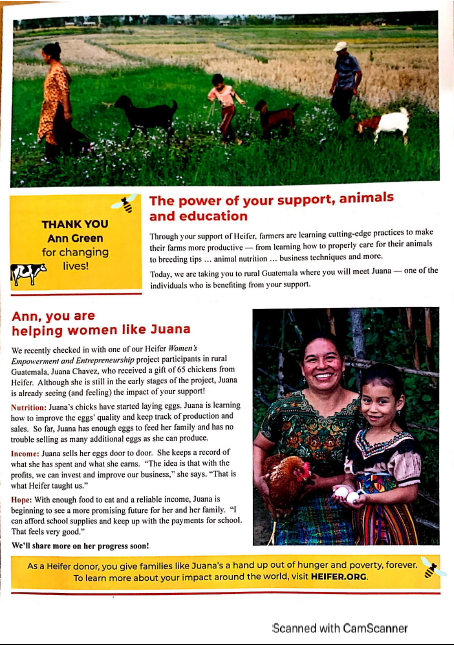
Photos can enhance your print communication by breaking up the narrative. You can also complement your written stories with photos. Here’s a great example from an update I recently received.

You’ll notice that it’s a short, but engaging update. There’s no need for long print pieces. If you’re worried about mailing costs, postcards and other short pieces with photos are the way to go. You could even do a Postcard Annual Report 

If you use social media, you need to communicate several times a week. As your donors scroll through an endless number of Facebook and Twitter posts, an engaging photo can stand out and get their attention.

Use photos everywhere – fundraising appeals, thank you letters/cards, newsletters, annual reports, updates, your website, and social media. Create a photo bank to help you with this.

It’s fine to use the same photos in different channels. It can help with your brand identity. Be sure to use high-quality pictures. Also, make sure your photos match your messages. If you’re writing a fundraising appeal about children who aren’t getting enough to eat each day, don’t use a picture of happy kids.

Work with your program staff to get photos and videos (more on videos below). Confidentiality issues may come up and you’ll need to get permission to use pictures of kids.

10 Ways Nonprofits Can Leverage Visual Storytelling

6 Ways to Tell Your Nonprofit Story With Images

6 Steps to Establishing a Photo Policy that Boosts Giving & Shows Respect

Highlight your work with a video

Videos are becoming a more popular way to connect. They can be used to show your programs in action, share an interview, give a behind-the-scenes look at your organization, or my favorite – thanking your donors. 

You can share videos that are relevant to our current situations. If you’re a museum that’s re-opened, you can show people how they can visit it safely. You could give a virtual tour of some of your collections for people who aren’t comfortable visiting. You could also talk about how the pandemic or systemic racism has impacted the people/community you work with. 

I would definitely recommend creating a personalized thank you video. If that’s not possible, you can make a general one.

How to (Easily) Thank Donors with Video

Make your videos short and high quality. Short is key. People are still spending a lot more time online. If your video is more than a couple of minutes, they may not bother to watch it.

You can use videos on your website, in an email message, on social media, and at an event (virtual or in person, when it’s safe).

6 Ways to Fundraise With Video

5 Examples of Nonprofit Storytelling that Compel People to Give

5 Inspirational Nonprofit Impact Story Videos

Spruce up your statistics by using infographics

A typical annual report is loaded with statistics. You want to share these, along with your accomplishments, but you don’t want to overwhelm your donors with a lot of text.

Why not use an infographic instead of the usual laundry list of statistics and accomplishments? Here are some examples. 

A Great Nonprofit Annual Report in a Fabulous Infographic

Infographics are also great in other types of communication such as newsletters and updates.

6 Types of Nonprofit Infographics to Boost Your Campaigns

3 Infographic Tips for Nonprofits

10 Tools for Creating Nonprofit Infographics

Good visuals will enhance both your print and electronic communication. Keep your donors engaged with all types of stories.

A Beginner’s Guide to Visual Storytelling in Your Nonprofit Communications

Let’s Try to Stop Using Jargon So Much

Over the last year, we’ve seen many examples of real problems affecting real people. We’ve also seen more authenticity. So why are some nonprofit organizations still using jargon in their donor communication?

They may be using the same, boring templates they’ve used for years or they’re so used to some of these terms that they don’t realize they fall flat with their donors. I think people use jargon because it’s insider language that makes them feel like they’re “in the know” in their professional community. It’s easy to slip into jargon mode in your work environment (whether that’s in person, virtual, or a combination of both). But the danger comes when jargon creeps outside of your insular world and into your donor communication.

People need to understand you to connect with you

We can get lazy and use jargon when we can’t think of anything fresh and original. Instead, you see appeal letters, thank you letters, newsletter articles, and annual reports laced with cringe-worthy terms such as food insecurity, at-risk youth, underserved communities, and impactful. While donors may know what some of these terms mean, they’re vague, impersonal, and can come across as demeaning.

Are You Speaking The Same Language As Your Donors?

How to do better

Sometimes you need to give a little more information. Let’s look at these problem terms and what you can say instead. You may use some of these terms internally and they might be in your mission statement, but try to limit them when you communicate with your donors.

  • Food insecurity The USDA defines it as “a household-level economic and social condition of limited or uncertain access to adequate food.” Well, that’s a mouthful. I’ve never liked the term food insecurity because it’s so impersonal. We’re hearing this term a lot right now because it’s a huge problem. Let’s go a step further and put it in human terms by describing a situation where a single mother has to choose between buying groceries and paying the heating bill.
  • At-risk means there’s a possibility something bad will happen. Instead of just saying at-risk students or youth, tell a story or give specific examples of something bad that could happen. Our tutoring program works with high school students who are more likely to fail their classes, be held back, and drop out of school. Last year it was crucial that we were able to provide students with Chromebooks, so they could continue their weekly tutoring sessions virtually. 
  • Underserved means not receiving adequate help or services. Instead of saying we work with underserved communities, explain what types of services these residents don’t receive. Maybe it’s healthcare, affordable housing, decent preschool education, or all of the above. Tell a story or give a specific example. Tina has to take two buses to see a doctor for her diabetes because there isn’t a good healthcare facility in her community. This made her anxious during the height of the pandemic and sometimes she skipped her regular appointments.
  • Impact means having an effect on someone or something. How are you doing that, and why is it important? Again, give a specific example. Thanks to donors like you, we’ve helped families find affordable housing so they don’t have to live in a shelter or with other family members, which isn’t always safe during the pandemic. Now they have a place to call home. And, let’s please all agree to stop using the word impactful.

Tell a story

This is why stories are so important. You can get beyond that vague, impersonal jargon and let your donors see firsthand how they’re helping you make a difference for your clients/community.

Telling Your Stories in the Current Climate

What would Aunt Shirley think?

I always like to use this analogy. Imagine you’re at a family gathering (provided everyone is either vaccinated or taking other measures to stay safe) and you’re explaining what your organization does to your 75-year old Aunt Shirley. Does she look confused and uninterested when you use words like underserved and at-risk, or does she want you to tell her more when you mention you’ve been able to help homeless families move into their own homes?

Stop using jargon in your work environment

Another way to help you transition from jargon to understandable language is to stop using it in your work environment. That means at staff meetings and in interoffice written communication. Maybe you go so far as to re-write your mission statement to make it more conversational. And telling staff and board members to recite your mission statement as an elevator pitch is a bad idea unless you can make it conversational.

Let’s stop using jargon when we can use clear, conversational language instead. Read on for more examples of why you should stop using jargon.

The Curse of Knowledge: You’re Using Jargon and You Don’t Even Know It

4 Reasons to Stop Using Nonprofit Jargon

Nonprofit Jargon: Do Your Supporters Understand Your Fundraising?

I Have No Idea What You’re Talking About [Nonprofit Jargon]