The Problem with “Annual Reports”

Time for a quick quiz (don’t worry it should be easy). 

What’s the problem with “annual reports”?

A. They’re too long.

B. They’re boring.

C. They focus too much on the organization and not on the donors.

D. They require a lot of time and effort from staff and there’s no guarantee donors will even look at them.

E. All of the above

If you answered E, you would be right! This poses a dilemma. Organizations need to share accomplishments and show gratitude to their donors, but is the “annual report” the way to do that? 

First, let’s stop calling it an annual report and call it an impact or gratitude report instead. Plus, sharing accomplishments and showing gratitude is something you can do more than once a year (more on that below). In this post, I’ll use the term impact report (but don’t forget about gratitude). One organization recently sent me something called 2023 Donor Impact Report (yes!).

However, renaming it is just the first step. If you’re still creating one of those long, boring booklets, you’re not making much of an improvement.

It’s possible to make this a better experience for both donors and nonprofit organizations. Here’s how.

You don’t have to do an “annual report”

Nonprofit organizations aren’t required to do an annual report. This doesn’t let you off the hook for sharing accomplishments with your donors. You could send short impact reports a couple of times a year. This makes a lot of sense if taking on a big report sounds too overwhelming. Shorter, more frequent updates are better for your donors, too.

If you decide to do a report once a year, I encourage you to move away from the traditional multi-page one. Aim for something no longer than four pages. Bigger isn’t always better.

Your impact report is for your donors

Keep your donors in mind when you create your impact report and include information you know will interest them. Also, donors have a lot going on, so that’s another reason not to create a huge report that they may or may not read. 

You might want to consider different types of impact reports for different donor groups. You could send an oversized postcard with photos and infographics or a one-to-two-page report to most of your donors. Your grant and corporate funders might want more detail, but not 20 pages. See if you can impress them with no more than four pages.

Keep in mind that the human attention span is about eight seconds. Granted, most of us can stay focused longer than that, but your impact report is competing with other pieces of mail and whatever else is going on in your donors’ lives. 

Imagine your donor receiving a traditional long report and thinking it might be interesting but she doesn’t have time to read it right now, so it sits in a pile for two months and then gets recycled, unread. But if you send a postcard or a short report, your donors can get a quick glimpse of how they’re helping you make a difference.

Pour on the gratitude

Donors want to feel good about giving to your nonprofit. Make sure your impact report is focused on thanking donors. You could go one step further and call it a gratitude report. If you decide to do three or four short reports a year (highly recommended), make at least one of them an all-out gratitude report.

Use phrases like Thanks to you or Because of you to show appreciation to your donors for their role in helping you make a difference. 

Tell a story

Donors want to hear about the people they’re helping. You can tell a story with words, a photo, or a video. 

For example – Leah, a single mother with three kids, has been struggling to make ends meet over the last few years. It’s been hard to find steady work and rising food costs make it difficult to afford groceries. She also wonders if she’ll have enough money to pay rent and utilities each month. 

Leah had never gone to a food pantry before and felt ashamed to have to do that. But when she reached out to the Eastside Community Food Pantry, she was treated with respect and dignity. Now, thanks to donors like you, she’s able to bring home healthy food for her family.

An engaging story is one of the most important elements of your impact report.

How are you making a difference?

The theme of many reports is look how great we are. They’re organization-centered instead of being donor-centered and community-centered.

They also include a bunch of statistics, such as the number of clients served. You need to share specific accomplishments that show how you’re making a difference.

Focus on the why and not the what. Numbers don’t mean a lot without a story or example. For instance, Thanks to donors like you, we were able to serve more students in our tutoring program. X number of students are now getting better grades and are able to graduate from high school on time.

Make it visual

Remember, your donors have a lot going on and won’t have much time to read your report. Engage them with some great photos, which can tell a story in an instant. Choose photos of people participating in an activity, such as volunteers working at a food pantry or a one-to-one tutoring session. Be sure to get permission if you want to use pictures of clients.

Use colorful charts or infographics to highlight your financials. This is a great way to keep it simple and easy to understand. Include some quotes and short testimonials to help break up the text.

Be sure your report is easy to read (and scan). Use at least a 12-point font and black type on a white background. A colored background may be pretty, but it makes it hard to read. You can, however, add some color with photos, headings, charts, and infographics.

Write as if you’re having a conversation with a friend

Be careful about using jargon. Most of your donors don’t use words like underserved or at-risk, and neither should you. Use everyday language such as – Because of you, we found affordable housing for over 100 homeless families. Housing prices continue to skyrocket and a shelter is no place to raise a family. We’re also seeing an influx of migrants who need housing. Now, these families have a place to call home.

Write in the second person and use a warm, friendly tone. Use you much more than we.

Skip the donor list (and the letter from your executive director)

Think twice about including a donor list in your impact report. It takes up a lot of space and there are better ways to show appreciation. If you feel you must have a donor list, you could put one on your website or just include major funders. Including a QR code directing people to your website for more detailed information is a good way to ensure a shorter report.

Also, do you need a letter from the executive director? These tend to be very organization-centered. If you must have one, make sure it focuses on thanking your donors.

Send it by mail

Be sure to send your impact report by mail. It’s more personal and donors are more likely to see it. Don’t let costs deter you from sending something by mail. Remember, you have the option of sending short impact reports.

You could also send an electronic version a few weeks later as a follow up.

Planning is crucial

I know putting together a yearly impact report can be time-consuming. One way to make it easier is to set aside a time each month to make a list of accomplishments. This way you’re not going crazy at the end of the year trying to come up with a list. You can just turn to the list you’ve been working on throughout the year.

You also want to create a story and photo bank and you can draw from those when you put together your impact report.

Creating a shorter report or an infographic postcard will also help make this easier for you. Once again, you have the option of not doing a yearly impact report and sending periodic short updates instead.

Whatever you decide, put together an impact report that’s a better experience for everyone. 

Don’t Your Donors Deserve to Feel Appreciated?

We all like to feel appreciated and that includes your donors. Thanking your donors should be a priority for your nonprofit organization. Is that the case? Unfortunately, the answer is usually no.

Thanking your donors is not just something you do after you receive a donation and then do nothing for a while. You need to show gratitude all year round and with Valentine’s Day coming up, that’s a great opportunity to thank your donors and show them how much you appreciate their support.

Maybe you would rather not go the Valentine’s Day route, which is understandable, although Valentine’s Day doesn’t have to be just for couples and the world could use a little kindness right now. 

That said, you should still do something to show appreciation this month (and every month). The holidays are over and February can be a dreary month if you live in the Northern Hemisphere. Sunshine is in short supply where I live right now. Your donors could use a little pick-me-up.

This is also a good opportunity to keep in touch with the people who gave to your year-end appeal, especially first-time donors. If you haven’t shown any appreciation since your year-end appeal, you don’t want to wait much longer.

Your donors have the option to give to countless nonprofit organizations, but they chose yours. Keep this quote from Mark Phillips in mind – “They are not your donors; you are one of their charities.” Don’t they deserve to feel appreciated?

Here are a few ways you thank your donors throughout the year.

Create a thank you photo

Make your donor’s day with a great photo like this one.

You can send thank you photos via email and social media, use one to create a card, and include one on your thank you landing page.

Make a video

Videos are a great way to connect with your donors. They’re simple, yet effective, so don’t worry if you weren’t a film major. It’s not hard to create a video.

One idea for your video is to show a bunch of people saying thank you. You’ll want your video to be short, donor-centered, and show your organization’s work up close and personal. You can also create personalized videos, which are always a nice gesture.

Your thank you landing page is the perfect place to put a video. This is your first opportunity to say thank you and most landing pages are just boring receipts (and receipts fall short when it comes to showing gratitude). You can also put your thank you video on your website and share it by email and social media.

Send a card

A handwritten thank you card will also brighten your donor’s day. If you don’t have the budget to send cards to everyone, send them to your most valuable donors. These may not be the ones who give you the most money. Do you have donors who have supported your organization for more than three years? How about more than five years? These are your valuable donors. Don’t take these donors for granted.

That said, I do think you should make every effort to send a card to ALL your donors at least once a year. You can spread it out so you mail a certain number of cards each month, ensuring all your donors get one sometime during the year. You could also opt for a thank you postcard.

Many organizations don’t send thank you cards, so you’ll stand out if you do.

Share an update 

In addition to saying thank you, share a brief update on your success and challenges. Emphasize how you couldn’t have helped someone without your donor’s support. For example – Thanks to you, Jeffrey won’t go to bed hungry tonight. His family has been struggling to make ends meet right now.

Phrases like Thanks to you or Because of you should dominate your newsletters and updates.

How you can do better

Make this the year you do a better job of thanking your donors. Remember, it should be a priority.

Thank your donors right away and send a thank you note/letter or make a phone call. Electronic thank yous aren’t good enough.

Be personal and conversational when you thank your donors. Don’t use jargon or other language they won’t understand. Write from the heart, but be sincere. Give specific examples of how your donors are helping you make a difference.

Also, make sure your thank you note/letter puts gratitude front and center. You don’t need to explain what your organization does, brag, or ask for another donation. You have plenty of opportunities to ask for donations, and if you do a good job of thanking your donors you can raise more money. Plain and simple, the purpose of a thank you letter is to thank your donors.

I’m a big fan of communicating by mail, even if it’s only a few times a year. It’s much more personal. Yet, many nonprofits are skittish about spending too much on mailing costs.

If your budget doesn’t allow you to mail handwritten cards, is there a way you can change that? You may be able to get a print shop to donate cards. You could also look for additional sources of unrestricted funding to cover cards and postage. Think of these as essential expenses for your essential donors.

Maybe you need a change of culture – a culture of gratitude. This comes from the top, but you also need to get your board, all staff, and volunteers invested and involved in thanking your donors. 

You can’t say thank you enough. Make a commitment to thank your donors at least once a month. Create a thank you plan to help you with this. Planning ahead and creating systems makes a difference.

Keep thinking of ways to let your donors know how much you appreciate them. You don’t even need to wait for a holiday or special occasion. Just thank your donors because they’re amazing and you wouldn’t be able to make a difference without them. Don’t they deserve that?

Read on for more information about how you can make your donors feel appreciated.

Donor Recognition: When & How to Acknowledge Supporters

26 Techniques to Thank and Inspire Your Donors

11 Creative Ways to Thank a Donor

Why It’s Important to Build Relationships With Your Donors

Why does making a donation often feel like a transaction? Organizations get so caught up in the raising money part that they forget about building relationships with their donors.

Giving Tuesday is the worst example of this, with Year End close behind. Generally, it happens way too often.

Remember this – Building relationships is just as important as raising money. 

The concept of relationship fundraising has been around for a while, even though it’s not always put into practice. Many nonprofits seem focused too much on meeting their revenue goals, which don’t get me wrong, is important.

That said, it’s hard to keep raising money if you don’t build a good relationship with your donors. The two go together. Every single interaction with your donors needs to focus on building relationships. That includes fundraising appeals. It’s possible to raise money and build relationships at the same time.

Follow this formula – ask, thank, update, repeat. Thanking and updating should naturally evolve into building relationships, although that doesn’t always happen.

Nonprofit giving continues to decline. If that’s the case for your organization, you’ll have more success if you can move away from transactional fundraising and focus on building relationships. Here are some ways to do that.

Stop using transactional language

First, the word transaction should not appear anywhere in your fundraising. Sometimes I see the words “Transaction complete” after I make an online donation. That’s not giving me a nice, warm, fuzzy feeling at all. I made a gift, not a transaction.

Even more prevalent is the word receipt, which is often used in lieu of thank you. After a donor makes a gift, they should feel appreciated. 

An email subject line is one of your first chances to connect with your donor. How would you feel if this is what you saw? 

“Your recurring donation has been processed”

“Donation tax receipt”

This again emphasizes the transaction. Payment information should not be the lead of any type of thank you. Where are the words thank you?

It’s not easy to find good thank you email subject lines. Here are some that are better.

“Thank you for your generous monthly gift”

“Thank you for investing in Peace!”

“Thank you for supporting Malala Fund, Ann”

“Your monthly gift in action” 

That last subject line leads into an email message that emphasizes how the donor is helping that organization make a difference, which is a good example of building relationships.

Make a point to change your thank you email subject lines so they include these very important words – Thank You.

When organizations lead their fundraising appeals by saying “It’s our year-end appeal” or “It’s GivingTuesday,” they’re not connecting with their donors by concentrating on why donors give. 

Many donors don’t care that it’s your year-end appeal. They care about your work and want to help. Instead, say something like – How you can help families in the community put food on the table

Make relationship building part of your fundraising campaigns

You need to build relationships before, during, and after each of your fundraising campaigns. Keep this in mind – Your Fundraising IS Your Relationship.

Before your next appeal, send your donors an update to let them know how they’re helping you make a difference. This is especially important if you do more than one fundraising campaign a year. You don’t want your donors to think the only time they hear from you is when you’re asking for money.

Segment your donors

One way to help ensure you’re focusing on relationships is to segment your donors and personalize your appeal letters and other types of donor communication. 

Don’t send the same appeal to everyone on your mailing list. What is your relationship with these individuals? Maybe they’ve given once or many times. Perhaps they’re event attendees, volunteers, e-newsletter subscribers, or friends of board members. Mention your relationship in your appeal letter. For example, thank a long-time donor for supporting you these past five years.

Monthly donors get their own appeal letter. This doesn’t happen enough and it’s one of my biggest pet peeves. Build relationships with these committed donors. Recognize they’re monthly donors and either invite them to upgrade their gift or give an additional donation.

Let your donors know how much you appreciate them

Your focus on building relationships continues when you thank your donors. Many organizations do a poor job of this. Send a handwritten note or make a phone call, if you can.

Welcome your new donors. Let them know how much you appreciate this new relationship. If you don’t, it’s likely to be a short relationship.

Be sure to also shower your current donors with appreciation so you can keep your relationship going. Recoginize the value of your long-time donors and do something special for people who have supported you for several years. 

Make sure your donors get a heartfelt thank you, not something that resembles a receipt.

Thanking donors is something you can do at any time of the year. I think one of the best ways to connect is by sending a handwritten card. These cards can be generated electronically, if it’s not feasible to actually write them. This will make more sense for large organizations. I just received a nice card thanking me for giving a year-end gift in addition to my monthly donations. It makes a difference if you can connect in a more personal way.

Holiday cards are also a good way to reach out, but don’t put a donation envelope in one. You have other opportunities to make appeals. Make it 100% about showing appreciation.

You can send thank you cards at other times of the year, too. If money is tight, spread out your mailings over the year so each donor gets at least one card.

Don’t miss out on opportunities to build relationships

There are many ways you can build relationships with your donors throughout the year. 

You can give donors other opportunities to connect, such as volunteering, participating in advocacy alerts, signing up for your email mailing list, and following you on social media. You could also offer tours of your organization (either in person or create a video tour).

Newsletters and impact reports that focus too much on the organization are the equivalent of being at a party where someone just talks about himself and you may as well not even be there. If you do it well, a newsletter, impact report, or another form of an update can be a good relationship-building tool.

I’m amazed that after I attend an event, support someone in a walkathon, or give a memorial gift, most organizations don’t do a good job of building a relationship. I could be a potential long-time donor. Personally, I would never give a memorial gift or support someone in a charity walk if I didn’t believe in that organization’s cause. Don’t miss out on a potential opportunity to build longer-term relationships.

It takes time to build relationships, which is why you need to include donor engagement and stewardship as part of your fundraising strategy. Organizations with strong major giving and legacy programs see more success, but these initiatives don’t happen without good donor relationships

Hold a relationship-building day

My main objection to giving days, such as GivingTuesday, is they focus so much on asking. What if we put all the time and energy we focus on giving days into a relationship-building day?

I’m not saying you can’t participate in giving days, but instead of the relentless begging, follow the formula above and build relationships before, during, and after your campaign.

Of course, you could choose not to participate in a giving day and have an all-out relationship-building day instead.

Build relationships all year round

It’s easier to stay focused on donors when you’re sending an appeal or thank you, but this is just the beginning. Many organizations go on communication hiatus at certain times of the year and that’s a huge mistake. Ideally, you should keep in touch with your donors every one to two weeks, once a month at the most.

Always stay focused on relationships. Good relationships with your donors will help you raise more money and keep your donors for a long time. 

Sharing Donor Stories on Your Nonprofit Website: 4 Tips

Donor stories and testimonials help show appreciation for supporters and encourage others to get involved. Use these tips to write better donor stories. 

By Anne Stefanyk 

Donors want to know that their contributions matter to your nonprofit. According to Double the Donation’s donor retention guide, not receiving a proper thank-you is one of the top reasons donors stop giving. One way to effectively thank supporters while encouraging others to get involved is to incorporate donor stories and testimonials into your website. 

Often, nonprofits share donor stories to promote participation in planned and legacy giving programs. However, you can incorporate donor stories on other fundraising pages too, like peer-to-peer fundraising information pages or your ways to support page. You can even create a dedicated donor stories page to highlight a variety of supporters.

With that being said, here are a few tips to create better online donor stories: 

  1. Include rich details
  2. Show impact
  3. Ensure stories are engaging
  4. Include a call to action

Throughout this post, we’ll highlight examples of effective donor stories from the best nonprofit websites, including some best practices used and ways to emulate each example in your content strategy.  

1. Include rich details

Your donor stories should paint a detailed picture of who donors are, how they became involved with your cause, and what motivates them to continue participating. Use the following strategies to infuse your donor stories with informative detail: 

  • Incorporate facts about your donors’ lives. Help website visitors understand your donors on a personal level by including information about their interests and backgrounds in addition to their giving motivations. For instance, you could mention their hobbies, job histories, or family information. This helps potential donors find more in common with your current supporters, generating a stronger sense of community. 
  • Make the stories relatable. Choose a wide array of diverse stories that resonate with different audience segments. For example, The Michael J. Fox Foundation website includes donor stories that cover all types of giving, including supporters who participated in peer-to-peer fundraising, donated through their estates, gave in tribute to their loved ones, and more. 
  • Use donor-focused language. Make sure the text on your donor stories page uses supporter-focused language. For example, the CARE donor stories page includes a “Supporters Like You” title to inspire a sense of belonging to a community. 

When you provide plenty of details and relatable information about your current donors, you’ll make it easier for prospects to envision themselves becoming part of your donor community. For example, if a wealthy prospect feels connected to a donor testimonial because of a shared interest in your volunteer program, they might feel inspired to leave your organization a bequest in their will. 

2. Show impact

Another common reason donors stop supporting nonprofits is because they didn’t receive any information about how their gift was used. Ensure your donor stories include information about the impact of your donors’ gifts to show supporters that your nonprofit uses donations effectively. 

The Santa Clara University “Why We Give”page offers a few helpful examples of ways to show impact. For example, a story about a recent grad details the positive impact of receiving an endowed scholarship. The story includes direct quotes from the grad about how the support allowed her to become the first member of her family to graduate from college. 

Showcase your donors’ impact on your website by including:

  • Direct quotes or audio clips from beneficiaries
  • Statistics, charts, graphs, or maps that demonstrate the extent of your donors’ impact
  • Before and after comparisons via images or videos that visually demonstrate the power of donations

Impact updates give current donors a greater sense of fulfillment from their involvement. Meanwhile, prospective supporters will be able to see how your organization has put past donations to good use, reassuring them that you’ll also make the most of their gift. 

3. Ensure stories are engaging

By making your donor stories interesting and fun to read, you’ll encourage more website visitors to engage with them. This can increase the chances that they’ll connect with your mission and be inspired to give. 

Write interactive and intriguing stories by taking these steps: 

  • Include multimedia elements. Photos, videos, audio clips, infographics, and other multimedia content help break up text blocks and add more visual intrigue to your donor stories. Check out the University of Georgia’s donor recognition stories for some examples. These gratitude stories feature photos, videos of donor interviews, information about donors’ impact, and more. 
  • Naturally incorporate stories throughout your web design. Your donor stories don’t have to be limited to a page of links to testimonials. You can incorporate shorter snippets or features on pages like your online donation page or ways to give page. For example, look at how the Girls Who Code Ways to Support page features a short donor story and image seamlessly incorporated into the page’s layout. 

An example of a donor story on the Girls Who Code website, with a short text description and image

  • Keep your stories fresh and up to date with a regular posting schedule. Maintaining content freshness shows potential supporters that your organization is successful at continually bringing new donors on board. Freshness is also one of many factors that can help your content rank higher on search engines. Create a schedule for your content team to follow that provides deadlines for writing new donor stories, gathering images and other visuals, publishing the stories, and promoting them on social media and other marketing channels. Assign clear task owners to each step of the process to promote accountability. 

Kanopi’s WordPress for Nonprofits guide recommends writing for the web as you develop your content to make your testimonials more readable and accessible to all. Avoid jargon, use simple language, and incorporate more “you” pronouns rather than “I or “our.” Keeping the focus on the reader helps promote donor-centricity, making supporters and constituents the heroes of your stories.  

4. Include a call to action

Your donor stories should end on an inspiring, uplifting note that encourages readers to take action immediately. 

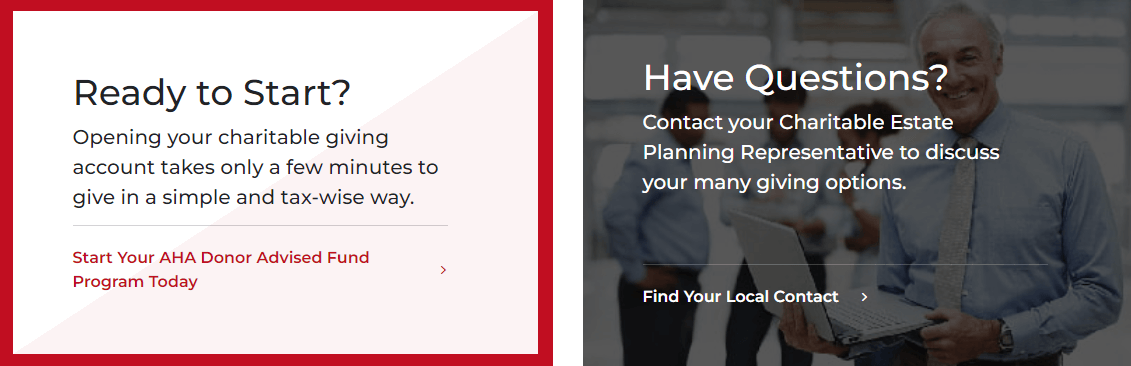
For example, the American Heart Association offers an effective example of useful calls to action (CTAs) for healthcare websites. Their donor stories end with CTAs that help visitors open a charitable giving account or reach out to a local representative with any questions. 

American Heart Association CTAs for opening a charitable giving account or contacting a representative

Welcome new donors with clear CTAs that allow website visitors to take the next step that aligns with their interests and needs. For example, your CTAs could say:

  • Support our scholarship fund today to help other students in need.
  • Leave a positive legacy with a planned gift.
  • Contact a local representative for more information about the impact of your gift.
  • Find the giving opportunity that works for you.

Your CTAs should be specific and welcoming, and they should lead to a user-friendly form or information page where supporters can take the next steps toward becoming donors or getting more involved in your cause. 


After optimizing your donor stories, promote them across multiple channels, including social media, email, and your printed newsletter. This will help reach a wider potential donor audience and ensure as many current donors as possible see your gratitude efforts. 

As Founder and CEO of Kanopi Studios, Anne Stefanyk helps create clarity around project needs, and turns client conversations into actionable outcomes. She enjoys helping clients identify their problems, and then empowering the Kanopi team to execute great solutions.

Anne is an advocate for open source and co-organizes the Bay Area Drupal Camp. When she’s not contributing to the community or running her thoughtful web agency, she enjoys yoga, meditation, treehouses, dharma, cycling, paddle boarding, kayaking, and hanging with her nephew.

How Your Nonprofit Can Ensure Success in 2024

Happy New Year! I hope you had a nice holiday. My vacation went by way too quickly.

I also hope 2023 was a successful year for your nonprofit organization. If it wasn’t, you can work to make 2024 a better year. As with personal New Year’s resolutions, you want your goals to be realistic and attainable. If you’re a small organization, you may not have much luck pulling off a huge gala.

Here are a few ways to help you ensure a more successful year.

Have a plan in place

You must have fundraising and communications/marketing plans. If you haven’t put together these plans yet, do that now! 

You know from past experience that you may need to make changes to your plans. In 2020, organizations that were able to make changes to a plan already in place were most successful.

Take a look back at 2023 to see what worked and what didn’t in your fundraising and communications/marketing. Incorporate what you’ve learned into your 2024 plans. 

Be sure your fundraising plan includes a diverse stream of revenue. Individual giving has proven to be successful. A lot of small donations can add up! Start or grow your monthly giving program (more on that below). Also, look into major and legacy giving. 

You can apply for grants and hold events, but those sometimes require more effort than it’s worth. Invest in strategies that make sense for your organization.

Revisit your fundraising and communications/marketing plans regularly and make changes as needed. Do this at least every two to three months.

Make sure that donor relations and donor retention are part of your fundraising plan. Those are key to your success.

Pay attention to your donor retention

Many donors have stepped up over the past few years to support nonprofit organizations. You don’t want to lose these valuable donors.

Donor retention should be a priority. You’ll have more success if you work to keep the donors you already have instead of focusing on getting new ones.

First, if you don’t already know it, figure out your retention rate. Do this after every fundraising campaign.

If it’s low, it’s something you can fix, usually with better communication. Donor retention is a huge problem for nonprofits. Your goal should be to have donors who support you for a long time.

It’s easier and less expensive to keep your current donors than to find new ones so once again, make donor retention a priority.

That said, you may have some new donors who saw a need and felt a connection to your cause. Don’t let these donors slip away either.

Go all in on monthly giving 

Speaking of retention, the retention rate for monthly donors is 90%. These donors are dedicated to your nonprofit. 

I’m a huge fan of monthly giving. It’s always made sense, but it’s been especially crucial over the last few years. Organizations that have monthly giving programs receive a steady stream of revenue throughout the year. Donors who opt for monthly giving find it’s easier on their finances. Even gifts of $5.00 or $10.00 a month can make a difference for your organization. Dedicated monthly donors have also stepped up and have given additional donations.

Work on starting or growing your monthly giving program so you can have a bunch of highly committed donors. A good way to start is to invite your current donors to become monthly donors.

Monthly donors are also potential major and legacy donors. Remember the importance of individual giving.

Do a better job of communicating with your donors 

There are many ways to do a better job of communicating with your donors. First, make this the year you say goodbye to boring, generic communication. Stop using jargon, such as at-risk and underserved. Tell more stories and go easy on the statistics. It makes a difference if you can put things in human terms, so you can do a better job of connecting with your donors.

Better communication also means more frequent communication. Donors want to  feel appreciated and know how they are helping you make a difference. Be sure to implement the ask, thank, report, repeat formula

You want to segment and personalize your communication, too. Address your donors by name (not Dear Friend) and recognize their past giving or if they’re a monthly donor.

Better, more frequent communication will help you raise more money. Having a communications calendar will help you with this. 

Work on building relationships

You may think the most important component of fundraising is raising money. While that’s important, so is building relationships with your donors. 

It’s hard to raise money year after year if you don’t build a good relationship with your donors. Every single interaction with your donors needs to focus on building relationships. That includes fundraising appeals. It’s possible to raise money and build relationships at the same time. 

Stop thinking of the donations you receive as a transaction and instead think of them as the start or continuation of a relationship. 

Good relationships with your donors will help you with retention.

Create an attitude of gratitude

A big part of building relationships is showing gratitude to your donors. Many nonprofits do a poor job of this. 

You need to start by sending a heartfelt thank you immediately after you receive a donation and then find ways to thank your donors throughout the year. Put together a thank you plan to help you with this.

Start the New Year off by making fundraising and communications/marketing plans, if you haven’t already done so. Prioritize donor retention, monthly giving, showing gratitude, and building relationships with your donors. This will help bring you more success in 2024.

Photo by Marco Verch

Welcome Your New Donors With Open Arms

Year-end fundraising is underway. I hope your campaign is going well so far. Perhaps you also participated in Giving Tuesday. The latter often brings in new donors and that’s never something you want to take for granted. 

These donors saw a need and found a connection to your cause. Or maybe they were drawn into whatever Giving Tuesday promotion you initiated, but I like to think they wanted to help you make a difference. 

Unfortunately, it’s unlikely these donors will stick with you. The retention rate for first-time donors is around 20%. We can and have to do better.

This is why it’s so important to get a second donation, also known as a golden donation. Once you get that golden donation, you’re more likely to have long-time donors who will stick with you. One way to ensure this is to make your new donors feel welcome.

Start with a special thank you

According to fundraising expert, Dr. Adrian Sargeant, “The thank you is the single most important piece of communication that your donors get. They have a higher recall of it than the appeal that generated the gift.”

Keep that in mind, especially for your new donors.

If someone donates online, it’s hard to tailor the thank you email specifically to new donors. But you can do that with a phone call, handwritten note, or thank you letter.

Try to call your new donors or send a handwritten note. This will make a great impression on them. Get together a group of board members, other volunteers, and staff to help you. If that’s not possible, create a thank you letter specifically for your new donors.

*Make sure these are actually new donors. A good CRM/database will help you avoid any missteps.*

Create a welcome plan

A week or two after the initial thank you, send a welcome package. You can do this by mail, email, or a combination of both. Try to send at least one welcome message by mail. Mail is always more personal and your donors will be more likely to see it.

Welcome your new donors. Thank them again and show them other ways they can connect with you. Invite them to subscribe to your newsletter, join you on social media, and volunteer.

Your welcome package should include a warm introductory message and a few facts about your organization, but don’t brag too much. Keep it donor-centered and be personable. You could also direct people to your website for more information about your organization.

Be careful about how much information you send. Donors want to feel welcome, not overwhelmed.

I don’t recommend sending unsolicited swag. Personally, I don’t like it, but some donors might. You could offer your new donors a gift and they can let you know if they want to receive it, but it’s not necessary. What donors really want from you is to know how they’re helping you make a difference.

Create a series of messages, also known as a drip campaign. Set a timeline. The first sequence of messages can be sent about once a week. After that, you should continue to communicate regularly (at least once a month) and follow the ask, thank, update formula. In a few months, you could invite your new donors to give monthly. Monthly donors are committed donors.

Welcome emails have high open rates. Impress your new donors right away, so they’ll be more likely to donate again.

Who are your new donors?

They could be event attendees, volunteers, or newsletter subscribers. If you know, refer to that in your thank you note, letter, or phone call. If not, send a short survey with your welcome package and ask, “How did you hear about us?” or “What drew you to our organization?” 

Another question to ask is whether your donors prefer print or electronic communication. Short surveys are also a good way to connect throughout the year. The more you know about your donors the easier it will be to communicate with them.

Make your current donors feel special, too

While I’ve been focusing on new donors in this post, retention rates for current donors aren’t anything to celebrate. The overall donor retention rate is around 45%, so we have some work to do.

Remember the golden donation, but don’t stop there. You want a third (would that be platinum?) and a fourth, etc. donation.  

If you’re not acknowledging a donor’s past support, you’re making a huge mistake. Imagine how you would feel if you gave to an organization for over five years and they never thank you for your long-time support.  

These valuable, long-time donors could leave at any time, so ignore them at your own peril. Make sure they also get a special thank you from you.

Keep it up throughout the year

It’s so important to communicate with your donors regularly. Plan on special mailings or emails specifically targeted to new donors. Remember to try to send something by mail if you can. 

Think of other ways to do something special for your new donors too, such as an open house or a tour of your facility, either in person or virtual.

Of course, don’t ignore your other donors. You could do something special when you get that all-important second gift. Keep reaching out – at least once or twice a month. 

Show appreciation and share updates. A huge factor in donor retention is a good donor relations plan that you’ll carry out regularly as long as your donors support you, which hopefully will be for many years.

Do a Stellar Job of Thanking Your Donors

Year-end fundraising season is underway. You may have started working on your appeal, which is great. But don’t stop there. It’s just as important, if not more important, to plan how you’ll thank your donors. 

I highly recommend creating a thank you plan, which will help you show gratitude before, during, and after a campaign. 

Your donors deserve a stellar thank you. The problem is most thank yous don’t come anywhere close to being stellar. Many organizations treat thanking their donors as an afterthought and it shows. You can’t do that. It will hurt your chances of getting future donations.

There are many ways to thank your donors after an appeal – by mail, phone, email, on your website, or a combination of those. The more you can do, the better.

Thanking your donors is something you need to do well. Don’t shortchange your donors with a half-hearted, generic thank you.

Do a stellar job of thanking your donors. Make it a priority. Here are a few ways to do this. 

Start planning now

Don’t wait until the day after your appeal goes out. Give yourself plenty of time to plan. Write your thank you letter at the same time you write your appeal. 

Figure out what you’ll be able to do. I highly recommend a handwritten note or phone call. Can you do that for all your donors? If not, maybe you’ll break it down by new donors, long-time donors, or donors who have given a certain amount.

It’s important to thank your donors as soon as possible. I understand that handwritten notes and phone calls take more time, especially during the busy year-end season. If that’s the case, you can and should do those at other times of the year instead.  At the very least, your donors should get a letter, even if they’ve donated online. Thank you emails tend to resemble receipts, but we can change that. Whatever you decide, remember to get started on the content now. 

In the past, the standard was to send thank you letters within 48 hours. If that’s too hard, don’t wait much longer than a week. Make sure you’re ready to go when the donations come in. 

Make your donor’s day with a handwritten thank you note

I love it when a nonprofit sends a handwritten thank you note. This is a rare occurrence, so if you do it, your thank you note will stand out in your donor’s mailbox.

Handwritten notes are great in many ways, but one advantage is you don’t have to write that much. In fact, you can do one in just a few minutes.

You could make thank you cards with an engaging photo or buy some nice thank you cards. Get together a team of board members, staff, and volunteers right after your appeal goes out to help you with this.

Think about how much your donors will appreciate this nice gesture. Here’s a sample note.

Dear Cara,

Thank you so much for upgrading your gift to $75. We’re still seeing more people coming into the Eastside Community Food Pantry. It’s difficult for many families in the community to afford groceries. Your generous gift will help a lot. We’re so happy you’ve been a donor these past five years.

Phone calls are another personal way to show appreciation

Calling first-time donors is known to improve retention rates. But you could also call long-time donors to make them feel special.

Again, you want to get a team together to help. This is a great thing for your board to do. Here’s a sample phone script.

Hi David, this is Tracy Clark and I’m a board member at the Eastside Community Food Pantry. Thank you so much for your generous donation of $50 and welcome to our donor family. Your gift will help feed more local families right now. Many of them are struggling since grocery prices are so expensive.

Write that stellar thank you letter

If it’s impossible to send handwritten notes or make phone calls, you can still impress your donors with a stellar thank you letter. As I mentioned before, many thank you letters aren’t stellar at all and are mediocre at best. You’ll have an advantage if you take some time to create a great, donor-centered letter.

The purpose of a thank you letter is to thank your donors. Keep that in mind at all times.  

Don’t start your letter with On behalf of X organization…. If you’re sending it on your letterhead, it should be obvious it’s coming from your organization. Instead, start your letter with – Thank you, You’re amazing, or You did something great today!

You also don’t need to explain what your organization does. This often comes across as bragging by saying something like – As you know, X organization has been doing great work in the community for 20 years…. Someone who’s donated to your organization should already be familiar with what you do. 

And, don’t ask for another gift in your thank you letter. You did that in your appeal letter. You can ask again another time. Always keep gratitude front and center.

Write separate thank you letters for different types of donors. Welcome new donors and welcome back your current donors. Monthly donors should also get special recognition.

Your thank you letter needs to make your donors feel good about giving to your organization. Let them know how their gift is helping you make a difference. Include a brief story or example, such as the sample handwritten note or phone script I included above.

As with all writing, make your letter personal and conversational. Write to the donor using you much more than we and leave out jargon and any other language your donors won’t understand. Also, you must address your donors by name – not Dear Friend. Personalization is crucial when thanking your donors.

I’ve been emphasizing the importance of envelopes lately. Don’t use a boring, white #10 envelope. Make your letter stand out by using a colored or textured envelope. You could include a teaser that says Thank You and use a nice stamp (You can buy thank you stamps). Hand address the envelopes if you can and include a handwritten note inside that will help make it more personal. You could also include an engaging photo in the letter.

Yes, you do need to include the tax-deductible information, but do that at the end, after you impress your donors with your letter, or include it on a separate page. It’s easiest to include this with your thank you letter or email. Then you don’t have to send it again unless your donor requests it.

Create a more personal online thank you

The thank you plan I reference above gives you advice on how to create better thank you landing pages and email acknowledgments. These often come across as transactional. You need to think of the donations you receive as the start or continuation of a relationship, not a transaction.

Remember, even though your online donors will get an electronic acknowledgment, they should still get thanked by mail or phone. I like to think of the landing page, email, and what comes in the mail or by phone as the thank you journey. Don’t forget this is an ongoing journey.

We may be looking at another tough fundraising season. One thing that can help is to do a stellar job of thanking your donors, both now and throughout the year.

Image by Graham Irwin

How You Can Create a Better, More Personal Fundraising Appeal

Can you believe September is already here? Depending on where you live, you may or may not be getting that nice refreshing air September often brings. 

It also brings us to the start of the busiest time of the year for nonprofit organizations, especially if you’re doing a year-end appeal. 

If you’re falling short of your revenue goals, you may want to start your campaign earlier this year. Even if you’re not planning on launching your campaign until later in the fall, you should get started on your appeal now. Everything always takes longer than you think.

You need to create an appeal that will stand out and resonate with your donors. If you’ve been using the same boring, generic template for years, it’s time for something new. 

You need a letter that takes into account what’s going on in 2023. How are the everchanging current situations affecting your clients/community?

Your appeal also needs to be personal – both for your donors and when you write about your clients/community. 

Here are some ways you can create a better, more personal appeal. 

Your envelope matters

You may not think your envelope makes much of a difference, but it does. You need to get your donors to open your letter. If you can’t get them to do that, then all your hard work has gone to waste.

Make it look as personal as possible. Use something other than the standard #10 white business envelope and steer clear of a window envelope because that makes it look like a bill. Think about using an oversized or colored envelope. 

Perhaps you’d like to include a teaser on the outer envelope. Fundraising experts are mixed on whether this is a good idea. It makes it look less personal, but a good teaser can capture your donor’s attention. This doesn’t mean one that says 2023 Annual Appeal. That’s not inspiring. Instead, say something like – Find out how you can help kids learn to read.

A hand-addressed envelope will look more personal. If that isn’t feasible, print directly on the envelope. You could also use mailing labels. Use some nice stamps if you can.

Create an inviting piece of mail.

Share a compelling story

A good appeal letter should open with a compelling story. Focus on a person or family and not your organization. Your donors want to hear about the people they’ll be helping and it needs to be relevant to the current climate. 

Here’s an example – Melanie, a single mother with three kids, has gone through a lot over the past few years. It’s been hard to find work that pays enough and groceries are so expensive. 

But thanks to generous donors like you (or because of our generous donors if you’re writing to people who haven’t given before), she’s been able to get boxes of healthy food at the Eastside Community Food Pantry. At first, Melanie was embarrassed that she had to rely on a food pantry to feed her family, but she’s always treated with respect and dignity when she visits. 

We want to continue providing Melanie and other members of our community with healthy food when they need it.

You could also share a first-person story from a client/program recipient.

Include a photo

Include an engaging color photo in your letter or on your pledge form. Photos can tell a story in an instant.

Next comes the ask

Ask for a donation at the beginning of the next paragraph (after the story). Make sure it’s prominent and clear. Also, ask your current donors if they can give a little more right now. Don’t be afraid to ask your donors to upgrade their gifts. People want to help if they can.

Phrase your ask like this – We’re so grateful for your previous gift of $50. We’re continuing to see more people coming into the food pantry right now. Would you be able to help us out a little more this time with a gift of $75?

Asking for an upgrade can help you raise more money. Also, if you’ve been doing a good job of engaging your donors throughout the year (and I hope that’s the case), they shouldn’t mind if you ask for a larger gift. Including the amount of your donor’s previous gift is helpful since people don’t often remember what they gave before.

Be sure the ask is the only call to action in your appeal. Don’t distract people with information about an upcoming event or volunteering. Save that for a different message.

Be donor-centered, as well as community-centered

There’s been some dichotomy over the past few years between being donor-centered and being community-centered, but I think you can be both. What you don’t want is to be organization-centered.

Show your donors how they can help you make a difference for your clients/community and how much you appreciate their role in that. Make your donors feel good about supporting your nonprofit.

At the same time, respect your clients/community by not undermining them when you use terms like at-risk youth or underserved communities. They are people, after all.

Share your success and challenges

Highlight some of your accomplishments, but you can share challenges, too. 

Show how you plan to continue your work with your donor’s help. Remember to stay donor-centered and community-centered! 

Personalization is crucial

Don’t send everyone the same appeal. Try to send different letters to current donors, monthly donors, lapsed donors, people on your mailing list who haven’t donated yet, event attendees, volunteers, and friends of board members. 

The more you can segment, the better, but at the very least, you must do these two things.

Send a personalized appeal to current donors. They’re your best bet for getting donations. Let them know how much you appreciate their support. 

Also, send a specific appeal tailored to monthly donors, giving them the recognition they deserve. For your year-end appeal, I would thank them for all their generous support and ask them to give an additional gift. You can ask them to upgrade at a different time.

Don’t send a generic, one-size-fits-all appeal letter. Go the extra mile for your donors, so they’ll continue to support you.

Your appeal letter should also have a personal salutation (first names are best) and not be addressed to Dear Friend or Dear Valued Donor. How much do you value this relationship if you can’t even use a person’s name?

If this sounds like a lot of work, give yourself enough time to do it. This is important. Personalizing your letters can also help you raise more money.

Make it easy for your donors to give

Include a reply envelope with amounts to check off (this is also known as a bangtail envelope) or a reply envelope and a pledge form. Create donation tiers that show what each amount will fund. Do this on your donation page, too.

Some donors prefer to donate online. Direct them to a user-friendly donation page on your website. You could create a QR code for your letter and reply device. Make sure your donation page is mobile-friendly, too.

Offer a monthly or recurring giving option

Monthly gifts can generate more revenue, give you a steady source of income throughout the year, and improve donor retention. Encourage your donors to give $5, $10, or even $20 a month. This may be a more viable option for some of them. 

Be careful and don’t send an appeal to your current monthly donors that invites them to become monthly donors. That’s one reason why they need their own appeal.

Your letter must be easy to read (and scan)

Use short paragraphs and bulleted lists, along with bold or color for keywords, but keep it tasteful. Make it easy to read and scan. Most people won’t read your letter word for word. Use a simple font and at least a 12-point type.

Human attention spans are less than 10 seconds. But go figure, longer fundraising letters (four pages as opposed to two) have been shown to perform better, especially for prospective donors.

Resist the temptation to create a one-page letter. This often means cramming a bunch of tiny text on the page. With a longer letter, you’ll have more space to tell a story and repeat messages. You can also break up the text with a photo, testimonials, and short paragraphs. Printing on both sides of the page is fine, too.

Quality and readability are essential here. Make every word count. 

Think of your letter as a conversation with a friend

You can create a better, more personal appeal if you think of your letter as a conversation with a friend. That means not using jargon like at-risk youth and underserved communities. Be specific and use everyday language. Your goal should be for your reader to understand you.

Refer to your reader as you and use you a lot more than we.

Too many editors spoil the appeal

Your entire staff doesn’t need to be involved in writing your appeal. Generally, the more people you involve in writing your letter, the worse it becomes. Fundraising Consultant Tom Ahern refers to this as letter writing by committee.

Your best writer should craft it and then turn it over to your best editor. Whoever signs the letter (your Executive Director?) can take a quick look at it, but don’t send it to a committee.

If you don’t have someone on your staff who can write a good fundraising appeal, then hire a freelancer or consultant to do it.

Besides weakening the content, involving more people takes extra time.

Make a good lasting impression

Repeat your ask at the end of your appeal. Don’t forget to say please and thank you.

Be sure to add a PS. People often gravitate to the PS as they scan the letter, so include something that will capture their attention. It may be the only thing they look at. This is a good opportunity to summarize your appeal – Please make a donation today to help us feed more families in the community.

Get your pens out

Include a short handwritten note, if you can. Make it relevant to each donor, such as thanking someone for a previous donation or hoping a potential donor will support you. You could also stick on a handwritten Post-it note. Hand sign the letters in blue ink.

Nonprofit giving has declined recently and that may continue. This is why you need to spend some time writing a better, more personal appeal letter that will stand out and help bring you the donations you need. Good luck!

Image by Howard Lake

Don’t Wait Too Long to Start Planning Your Year-End Fundraising Campaign

It’s hard to think about fall when it’s been so hot in many parts of the United States and Europe, but September will be here before you know it.

Even though it might be sweltering outside, now is a good time to start planning your year-end fundraising campaign, hopefully in an air-conditioned space. If you’re behind in your revenue goals, you may want to launch it earlier than you have in the past. 

I’ve put together a checklist to help you get started. You can also use this for fundraising campaigns at other times of the year.

How much money do you need to raise?

You may have already set a goal for your year-end campaign in your 2023 fundraising plan (at least I hope you did) and maybe that has changed. 

You must determine how much money you need to raise before you start your campaign and raising as much as we can is not a goal.

Do you have a campaign plan?

Put together a plan for your campaign that includes a timeline, task list, and the different channels you’ll use. Make it as detailed as possible.

When do you want to launch your appeal? Plan on everything taking longer than you think it will, so earlier is better. Keep in mind you’ll be competing with many other organizations who are doing appeals. 

I strongly encourage you to mail an appeal letter. Direct mail appeals are more successful. You can also send an email appeal and follow up with email, as well. 

Maybe you want to send your appeal letters the first week in November. Maybe it’s better to send them in October. Whenever it is, make your goal to have the letters done at least a week before that. Work backwards to figure out how you can get to your proposed send date.

Also, how are you mailing your appeal? Do you use a mail house or get staff and volunteers together to stuff envelopes? Either way, plan ahead, so you’re not scrambling at the last minute.

Do you have a good story and photo to share?

If you’ve been using the same boring, generic appeal letter template for the last few years, it’s time for a refresh. It’s a good idea to revise your templates at least once a year. Our world has changed a lot in the last three years and you need to take that into account.

A good way to start is to create an engaging story for your appeal. Even though the public health emergency is over, COVID is still a part of our lives. Are your clients/community feeling the aftereffects of the pandemic? Are they facing economic challenges? Focus on them, not your organization. Each year is different and this is why you need new stories.  

You’ll want some good photos for your letter and donation page, too. Quotes from clients will also enhance your appeal.

How can your donors help you make a difference?

Your appeal letter should focus on a need and let your donors know how they can help you make a difference. You might want to start by creating a brief and an outline.

You may be seeing more people at your food pantry because of rising food costs and cuts in benefits. Maybe your clients are struggling to find affordable housing.

You can also highlight some of the accomplishments you’ve made recently and state what you would like to do in the coming year, although these are usually more appropriate for a newsletter or impact report. 

One way to frame this is to describe a situation such as this. You run a tutoring program in your community and work with students who are falling behind in school. You can describe how thanks to your generous donors, your one-to-one tutoring program has helped students get better grades and are now less likely to be held back a year. You want to keep that going and serve more students.

Remember to focus on your clients/community and don’t brag about your organization.

Are your mailing lists in good shape?

Make sure your mailing lists are up-to-date. Check for duplicate addresses and typos. Your donors don’t want to receive three letters at the same time or have their names misspelled. Take a little time to do some data hygiene. Give your email list some attention, too.

Also, now is a good time to segment your mailing lists – current donors, monthly donors, lapsed donors, event attendees, etc. This is so important. Your current donors are your best source of donations. You should have more success if you can personalize your appeal letters. Acknowledge if someone has donated in the past or is a monthly donor. Donors like it when you recognize them for who they are.

Do you have enough letterhead, envelopes, and stamps?

Don’t wait until September or October to check your supply of letterhead and envelopes. Make sure you have enough. 

Speaking of envelopes, something besides the standard white business envelope can improve your response rate. Think about using an oversized, colored, or embellished envelope. If that’s not possible, don’t use a window envelope because it resembles a bill. A general rule is you don’t want any of your direct mail pieces to look like a bill or junk mail.

Even though many people donate online, you want to make it easy for donors who prefer to mail a check. Include a pledge envelope or a return envelope and a preprinted form with the donor’s contact information and the amount of their last gift.

Stamps are more personal, so you might want to find some nice ones to use. 

Is it easy to donate online?

Be sure your donation page is user-friendly and consistent with your other fundraising materials. Using a branded donation page and not a third-party site is best. Highlight your year-end appeal on your homepage and include a prominent Donate Now button.

One way to ensure a good experience is to have someone on your staff or, even better, someone outside of your organization make a donation on your website. If they want to tear their hair out, you have some work to do.

Do you offer a monthly or recurring giving option?

I’m a huge fan of monthly giving. It’s a win-win for your organization. You can raise more money, boost your retention rate, receive a steady stream of revenue, and allow your donors to spread out their gifts.

If you don’t have a monthly giving program or have a small one, don’t wait any longer to start one or grow the one you have. Be sure to highlight it as a giving option.

Do you want to find a major funder who will give a matching gift?

One way to raise additional revenue is to find a major funder to match a portion or all of what you raise in your year-end appeal. If you want to go down this route, now would be a good time to reach out to these potential funders.

How will you thank your donors?

Spend as much time on your thank you letter/note as you do on your appeal letter and write them at the same time. And if it’s been a while since you’ve freshened up your thank you templates, you know what you need to do. It’s so important to thank your donors, and thank them well, as soon as you receive their gifts, so have a thank you letter/note ready to go.

Handwritten notes and phone calls are much better than a preprinted letter. Create or buy some thank you cards and start recruiting board members and volunteers to make thank you calls or write notes. 

You’ll want to put together a welcome plan for your new donors and that also needs to be ready to roll after the donations come in.

How will you keep up with your donor communication?

Even though you’ll be busy with your appeal, you want to ramp up your donor communication this fall. Keep engaging your donors and other supporters (who may become donors) by sharing updates and gratitude. Pour on the appreciation! 

Send at least one warm-up letter or email. You could create a thank you video or a video that gives a behind-the-scenes look at your organization. Maybe you could hold an open house or offer tours. Just don’t disappear until appeal time.

Yes, we’re still in a period of economic uncertainty. Some donors may not give as much or at all, but others will give more. They won’t give anything if you don’t ask.

There’s still plenty of time to go to the beach and get ice cream, but right now find that air-conditioned space and start planning your year-end campaign.

Best of luck!

Photo by CreditDebitPro

Don’t Take a Vacation from Your Donor Communication

It’s summer! More people may be traveling this summer and I hope you’ll also get a chance to take a vacation (or a staycation). I can’t say we’re living in normal times. There’s a lot going on, including an uncertain economy. Fundraising numbers are down and who knows how year-end will go, but it’s important to stay strong and not pull back.

This may be a quieter time for your nonprofit, but you don’t want to be too quiet and ignore your donors. Something the pandemic taught us is we should communicate more during tough times. This would be a great time to do some relationship building

You should be communicating with your donors at least once a month and that includes the summer months. Don’t make the mistake of taking a vacation from your donor communication. Continuing to stay in touch with your donors will help you when you launch your fall fundraising campaign. 

Maybe this sounds impossible, especially if you’re a small organization, but you can do this!

Here are a few ways you can connect with your donors this summer, as well as throughout the year, and build those important relationships. 

Make your donor’s day with a handwritten thank you card

Nonprofit organizations don’t thank their donors enough. You don’t need a reason to thank your donors. Just do it and do it often. You’ll stand out if you do.

This is a good time to do something personal, such as sending a handwritten thank you card. Pour on the gratitude and let your donors know how much you appreciate them.

You only need to write a few sentences, but make it warm and friendly. You can even think of it as having a conversation with a friend. Get board members and other volunteers to pitch in and help.

Send a postcard

It used to be fairly common for people to send postcards when they went on vacation. I don’t know how many people still do that, although I always enjoy receiving them.

Postcards are a great way to connect with your donors. Communicating by mail is more effective than electronic communication. I know mail is expensive, but a postcard shouldn’t cost too much. Your donors are also more likely to see your messages if you send them by mail. 

You can say thank you, share an update, or a combination of both. Besides feeling appreciated, donors also like to hear how their gift is making a difference. You could consider an infographic postcard.

Sending something by mail is an investment that could pay off if your postcard (or handwritten card) entices a donor to give again and possibly upgrade.

Email and social media are okay, too.

While it’s important to stay in touch once a month, it may not be possible to use direct mail that much. You can also use email and social media. Email has an advantage here because you can personalize your messages and the engagement levels are better, although not as good as direct mail.

You could send your donors a thank you photo or video. Maybe you already do a monthly e-newsletter. Jazz it up a little. You could even make it shorter. Share a story that lets your donors know how they’re making a difference for your clients/community.

You don’t need anything fancy and make it easy for yourself by keeping it simple. There are so many ways to thank your donors and share an update. It’s okay to have a little fun and get creative.

Tie in current situations

We’re facing a lot of economic uncertainty, but donors want to help if they can. 

Will certain policies or budget cuts affect your organization? Many states have issued their budgets for the next fiscal year.

Share ways your donors can help – perhaps by contacting their legislators, volunteering, or making a donation.

Advocacy alerts can be a great way for people to engage with your organization. Be sure to thank participants and keep them updated on any outcomes.

When all levels of government make funding cuts or policy changes, the need in the community grows, which puts more burden on nonprofit organizations. Remember, some donors will step up and help, if they can. 

Make room for improvement and plan ahead

The summer can be a good time to make improvements in your existing communication. Spend time finding some engaging stories and photos for your newsletters and other updates. This is also a good time to warm up your donors for your fall campaign.

Start working on your appeal and thank you letters for your next campaign. Make sure they focus on building relationships and are donor-centered. Segment your donors by different types – new, renewing, monthly, etc.  Also, make sure your CRM/database is up to date.

If you’re feeling pinched financially, you may want to start your fall campaign earlier – September/October instead of November/December. A few ways to raise additional revenue are to invite current donors to join your family of monthly donors and reach out to your lapsed donors.

For now, keep relationship building front and center. Keep communicating with your donors. They want to hear from you. Don’t take a vacation from your donor communication.