How You Can Make Your Messages Stand Out

Do you feel as if information overload is getting worse every year? There’s so much going on right now. Getting your messages out is never easy, but like everything else, it’s gotten a whole lot harder over the past two years.

Your nonprofit organization needs to continue communicating regularly with your donors and you need to do it well. With everything that’s going on, it’s possible they’ll miss your messages. 

Here are a few ways you can make your messages stand out. 

What’s your intention?

What’s the purpose of your message? What do you want your reader to do? Are you asking for a donation? Maybe you’re thanking your donor or sharing an update.

Think from your reader’s perspective. What would she be interested in or what would make him take action?

Don’t muddle your messages with too much information. Keep it simple and stick to one call to action or type of message. 

Choose the right channels

Most likely you’ll use more than one channel to communicate. Pay attention to the channels your donors are using and focus your efforts there.

Email may be the primary way you’re communicating right now and there’s a reason for that. It’s fast, easy, relatively inexpensive, and almost everyone has an email address. You can quickly get a message out to a lot of people. Also, unlike social media, it’s something you can control. You don’t have to rely on a social media algorithm to hope your message ends up in your donor’s feed.

The downside is people get a huge amount of email from a variety of different sources. Plus, the average open rate is around 20%. I don’t know what’s going on in the conservative world, but some liberal political groups send way too much email, which I pretty much ignore. And, social media is often just a lot of of a lot.  

It’s easy for your electronic messages to get lost in the shuffle. Your donors may just tune things out, even if you have something engaging to share. 

While you’ll likely use electronic communication pretty regularly, don’t discount direct mail. Your donors are more likely to see these messages. We get far less postal mail than electronic communication. Also, someone can put a piece of mail aside and look at it later. Don’t count on that happening with any type of electronic communication. You can also communicate by phone. This is a great way to thank your donors.

Going multichannel is usually your best bet. This is very common for fundraising campaigns and inviting people to events, as well as including a link to your e-newsletter on your social media platforms. This way if people miss your initial message on one platform, they may see it on a different one. You’ll also want to send regular reminders for fundraising appeals and event invitations.

Get noticed right away

Remember, your donors have a lot going on and you need to capture their attention right away.

Your fundraising letters and anything else you send by mail needs to look appealing enough to open. You could put a tagline on the envelope. That doesn’t mean something like It’s Our Annual Appeal. Try something like – How you can help families put food on the table. Your envelope should look personal and not resemble a bill or junk mail.

“Dale’s” mail

Once your donor opens your fundraising appeal, lead with a story followed by a clear, prominent ask. When they open your thank you letter, they should be greeted with gratitude.

A good subject line is the key to getting someone to open your email message. Keep in mind that your donor’s inbox is bursting with messages. Don’t use something boring like April e-newsletter or Donation Received. Entice them with Find out how you helped families put food on the table or You just did something amazing today!  

Keep them engaged once they open your message.

Keep it short

In many cases, a shorter message is best. You want a good balance between saying too much and saying too little. All your words should count, so be careful about adding too much filler. That often includes bragging about your organization and explaining what you do.

Keep in mind the average human attention span is a mere eight seconds.

What’s in My Inbox | Shorter attention spans means you need to deliver with your enews

Your goal is to get your donors to read your messages. If it looks long and boring, they probably won’t bother.

Make it easy to read and scan

Besides sending a short message, use short paragraphs and lots of white space, too. Your messages need to be easy to read and scan in an instant. Most people aren’t going to read something word for word. Be sure they can quickly get the gist of what you want to say. Don’t use microscopic font either – use 12 point or higher.

Be personal and conversational

Write directly to your reader using clear, conversational language – no jargon. Don’t confuse your donors with generic messages.

Don’t cast a wide net

It’s important that you send your messages to the right audience and your audience isn’t everyone.

You’ll have more luck with a fundraising appeal when you send it to past donors or people who have a connection to your cause. The same is true for event invitations or recruiting volunteers.

You may want to reach out to as many people as possible, but that won’t guarantee you’ll get more donations or event attendees. Segmenting and engaging with the right audience will bring you better results.

Be a welcome visitor

If you communicate regularly and do it well, your donors should recognize you as a reputable source and are more likely to read your messages. If all you do is send them generic fundraising appeals, then it’s time for a change.

When you send email, make sure people know it’s coming from your organization. In the from field, put DoGood Nonprofit or Brenda Davis, DoGood Nonprofit. If you just put a person’s name or info@dogoodnonprofit.org, people may not know who it’s from and ignore your message.

Only send email to people who have opted into your list. Otherwise, you’re spamming them. Some people will choose not to receive email from you and that’s okay. The ones who do are interested in hearing from you. Give people the option to unsubscribe, too.

Even though people only get a few pieces of mail a day, most of it’s junk mail. You never want any of your letters, newsletters, or postcards to be perceived as junk mail (see above).

By putting in a little time and effort, you can help ensure that your messages stand out.

3 Strategies for Nonprofit Messages that Stand Out in Donors’ Mailboxes
How to Write Awesome Emails Your Donors Want to Read

Your Nonprofit Newsletter Should Engage Your Donors, Not Bore Them

A newsletter can be a great way to engage with your donors. Unfortunately, that doesn’t often happen because most donor newsletters can put you right to sleep. They’re too long and filled with boring articles that brag about how wonderful the organization is.

The good news is you can create an engaging newsletter your donors will want to read. Here’s what you need to do.

Think about what your donors want

You need to include content that will interest your donors. You also need to reference the current situations. Do you think your donors would rather read an article about your CEO receiving an award or one about Marla, a single mother who is having trouble making ends meet, but is grateful she can get food for her family at the Eastside Community food bank? 

The answer should be obvious. Your donors want to hear about how they’re helping you make a difference for your clients/community.

If you’re a larger organization, you could create different newsletters for different programs or one specifically for monthly donors.

Don’t shy away from a print newsletter 

You may opt not to do a print newsletter because it’s expensive and takes too much time, but you’re making a mistake if many of your donors prefer print.

I think you’ll have more success if you can do both print and electronic newsletters. I recommend a short e-newsletter once or twice a month and one to four print newsletters a year.

Many organizations put a donation envelope in their print newsletter. This is a proven way to raise additional money and you may be able to recoup your expenses.

You can also save money by creating a shorter print newsletter (maybe two pages instead of four) or only mailing once or twice a year. You can print them in-house, as long as it looks professional.

Be sure you have a clean mailing list. If you can get rid of duplicate and undeliverable addresses, that’s another way to save a little money.

Donors are more likely to read a print newsletter. But ask them what they like, and listen to what they say. If a majority of them prefer print, then you need to find a way to accommodate them.

Share your stories

Each newsletter needs to begin with a compelling story. If you’re making a difference, you have stories to tell.

Client stories are best, but you could also do profiles of volunteers, board members, and donors. Focus on what drew them to your mission (more on that below).

Create a story bank that includes at least four client stories to use every year.

Make Connections With Your Donors by Sharing Stories

Don’t stray from your mission

A common article I see in many nonprofit newsletters is one about a foundation or major donor giving a large gift. This may be accompanied by a picture of someone holding a giant check. Of course, you should recognize these donors (and all donors), but why is this gift important? How will it help your clients/community?

For example – This generous $50,000 grant from the Eastside Community Foundation will help us serve more students in our tutoring program. Many students have fallen behind since the pandemic started.

Something else I see a lot is a profile of a new board member. Instead of focusing so much on their professional background, let your donors know what drew them to your organization. We welcome Lisa Clark, Vice President of First National Bank, to our board. Lisa has a brother with autism and is very passionate about finding ways for people with autism to live independent lives. 

Write to your donors

Write your newsletter in the second person, emphasizing you much more than we. Be personal and conversational. Say – You helped Marla feed her family or Because of donors like you, X number of families have been able to get healthy food every week. 

Leave out the jargon and other language your donors won’t understand. Write as if you’re having a conversation with a friend.

I’m not a fan of the letter from the CEO because those tend to be organization-centered instead of donor-centered.  

Pour on the gratitude 

Never miss an opportunity to thank your donors. Many donors have stepped up over the last two years and they deserve to be thanked as often as possible. Every one of your newsletters needs to show gratitude and emphasize how much you appreciate your donors.

Make it easy to read (and scan)

Most of your donors aren’t going to read your newsletter word for word, especially your e-newsletter. Include enticing headlines and email subject lines (if you don’t, your donors may not read it at all), at least a 12-point font, and lots of white space so your donors can easily scan your newsletter.

Stick to black type on a white background as much as possible. Colors are pretty, but not if it’s hindering your donor’s ability to read your newsletter. Photos can be a great way to add some color, as well as tell a story in an instant.

Use the inverted pyramid and put the most important story first (client story or profile), keeping in mind your donors may not get to all the articles.

Keep it short

Your print newsletter should be no more than four pages. Limit your monthly e-newsletter to four articles. Some organizations send an e-newsletter twice a month. Those should be even shorter – maybe just two articles. People have a lot going on and don’t want to be bombarded with too much information.

Do the best you can

For some of you, putting together a newsletter may be too much to take on right now. You don’t have to do an actual newsletter, but you do need to keep your donors updated.

Do what you can, but be sure to update your donors at least once a month. You may find you have more success with shorter, more frequent email updates and postcards with an infographic a few times a year.

Create an engaging newsletter that won’t bore your donors.

Keep reading for more information on how to create a great donor newsletter.

Nonprofit Donor Newsletters | Print or Enews?

Worthwhile Nonprofit Newsletters: Content Donors Adore 

Tips for Using your Nonprofit Newsletter to Get More Donations Without Even Asking

10 Nonprofit Newsletter Ideas and Examples to Save for Later

A Fundraiser’s Guide to Measuring Donor Engagement

By Ally Smith

Donor engagement is vital to nonprofit success. By donating, volunteering, and spreading the word about your organization, donors fuel your nonprofit mission. 

As a fundraiser, you need to increase donor engagement, and the only way to do that is by tracking engagement metrics and monitoring your success. This article will show you four metrics for measuring donor engagement and tell you why they’re important for your fundraising team. 

Why is Measuring Donor Engagement Important?

Every phone call, donation, and click on your website is a part of your nonprofit’s donor engagement strategy. 

Effective donor engagement increases donor retention. Retaining donors is one of the best ways to increase fundraising efficiency because it’s much cheaper than acquiring new donors. In fact, acquiring a new donor costs about ten times more than retaining a donor.

Additionally, nonprofits retain about 52% of their engaged repeat donors. Increasing donor engagement can motivate a donor to give a second gift and keep them donating. 

However, before you improve your donor retention, you need to track metrics that tell you the effectiveness of your engagement strategies. These metrics will help you understand how engaged your donor base is and help you identify areas for improvement. 

Four Key Donor Engagement Metrics 

  1. RFM Analysis

The RFM analysis model is a method of measuring engagement levels by scoring donor contributions across three dimensions: recency, frequency, and monetary value. 

Recency of Donations 

The “recency” dimension is the amount of time that’s transpired since a donor’s last gift. First, you’ll need to determine what “recent” is for your organization. Many organizations assign their highest scores to donors who have given within the last six months. 

Having too short of a “recent” period would pressure fundraisers to solicit donations too frequently, which would result in lower donation amounts and higher donor turnover.

Frequency of Donations 

How often does a donor give? The more often a donor gives is a great indicator of how engaged they are. For example, someone who gives monthly would likely be more engaged than someone who gives sporadically every few years. The highest frequency scores are assigned to your most consistently active donors. 

Monetary Value of Donations 

How much money is a donor giving? The more a donor contributes to your nonprofit, the higher the monetary score they’ll receive. Similar to how every nonprofit has a different definition of a major gift, every organization will have a different threshold for its monetary scores.

Once you have scored your donors’ contributions across each dimension, you need to combine their scores and consider the results. 

For example, if you only look at monetary value, you may think that someone who donates $500 is more engaged than someone giving $20. However, if that person gives $20 every month for a few years, they are likely more engaged. RFM analysis helps you develop a holistic understanding of donor engagement.

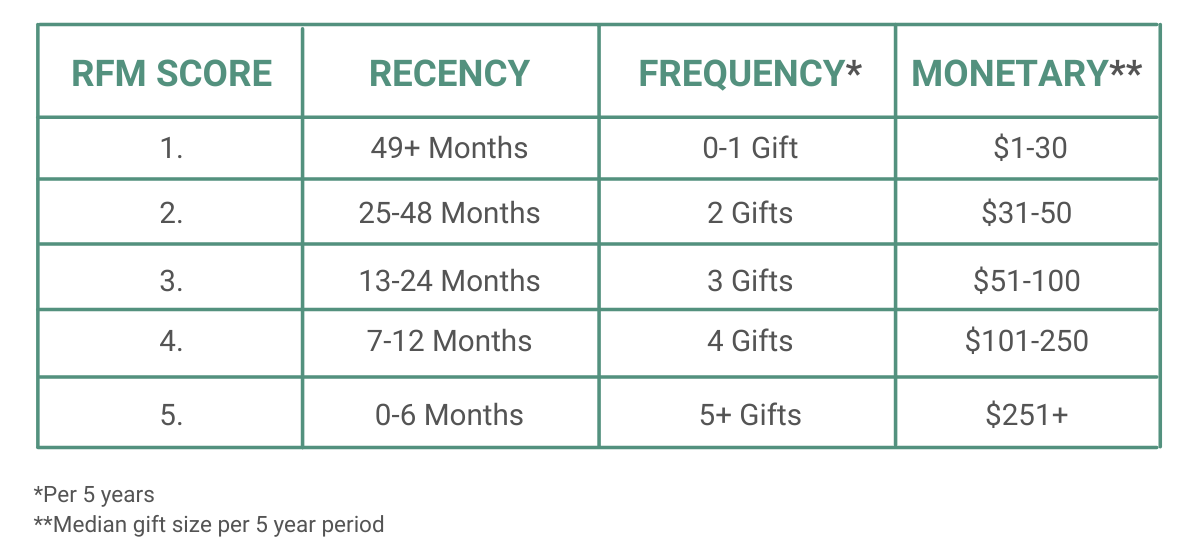
To help you create your own, here’s an example of what an RFM analysis scorecard should look like: 

Once you’ve developed a scorecard that’s right for your organization, you can score each donor. For example, a donor that’s given in the last six months, given four gifts in a year, and given an average of $150, would receive a score of 5-4-4. 

Then, you can group donors with similar scores to create donor segments. This will allow you to tailor your engagement efforts to specific donor groups. For example, you can send more frequent appeals to the donor group’s frequency score that you want to increase. 

Additionally, you can observe how the distribution of your segments changes over time to determine if your engagement strategies are working. 

  1. Fundraising Participation Rate 

There are many ways to measure donor engagement beyond just tracking donation activity. 

For example, donors can participate in campaigns by becoming a fundraiser themselves. This engagement is important to measure because peer-to-peer fundraising is becoming more popular. Facebook fundraising grew by 14% in 2021

Fundraiser Participation Rate tells you the percentage of donors who fundraised on your behalf by doing things such as being sponsored in a charity run, soliciting door-to-door, or accepting donations as birthday presents. 

You can measure this metric using the following equation: 

(# of P2P Fundraisers ÷ # of Donors) x 100 = Fundraiser Participation Rate

The higher you can make this percentage, the better. A high fundraising participation rate tells you that your donors are highly engaged because they are willing to take time out of their busy days to grow support for your cause. 

  1. Social Media Metrics 

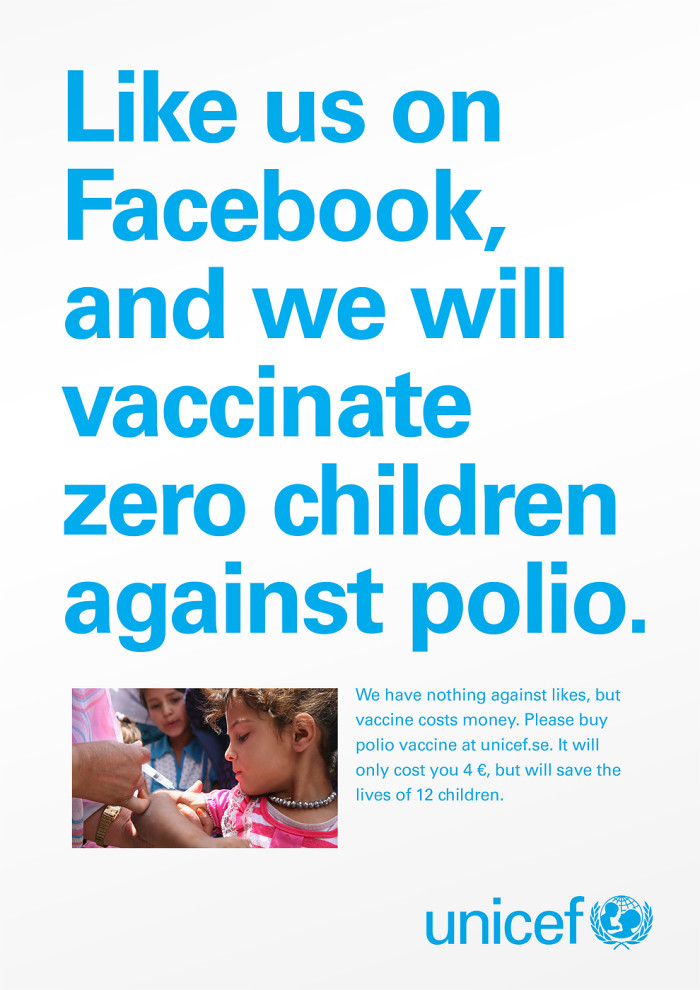
Social media engagement does not always mean donor engagement, just look at Unicef Sweden’s ad calling out “slacktivism”. Very bold!

But, if you are tracking the right social media metrics, they can help you measure donor engagement. We recommend focusing on conversion rates that tell you when social media engagement actually leads to donations. 

A great place to start is by tracking how many donations come directly from social media. Luckily, most social media platforms will be able to tell you your conversion rate.

However, you’ll also want to know how many people get to your website’s donation page from a social media post. You can track this using Google Analytics. 

To get started, there are lots of helpful Google Analytics resources for monitoring traffic that comes from social media. For example, check out Whole Whale’s video, which gives a great overview of Google Analytics for nonprofits. 

  1. Major Donor Contact Frequency

Measuring contact frequency tracks your touchpoints with a major donor or major donor prospect. Many interactions need to occur between meeting a potential donor and receiving a donation. These donor interactions are a part of donor relationship building and should be tracked to help you understand your progress towards a gift. 

You can track this as a metric by determining how many touchpoints you have with a donor in a given time period, such as a year or six months. Then, in your donor database or spreadsheet, track every communication you have with your major donor prospects, whether it’s a phone call or an email blast with a donation form attached. 

Not all contact efforts are created equal, so you may want to score communications differently. For example, if you have lunch with a donor, it may be worth five touchpoints, compared to an e-blast worth one. 

You can measure this metric using the following equation: 

(# of Touchpoints ÷ # of Months) = Major Donor Contact Frequency

While there’s no clear benchmark for Major Donor Contact Frequency, use your most engaged major donors’ scores as targets for success. And as always, don’t forget to use your fundraising common sense; if a donor doesn’t want to be contacted a lot, don’t contact them. 

—– 

As a fundraiser, you understand the value of building a deep and meaningful relationship with each donor. However, you can only tell how strong a relationship you’ve built is by tracking engagement indicators. Hopefully, these four metrics give you a good place to start!

Author Bio

Ally Smith | Content Writer at KIT

With a passion for nonprofit innovation, Ally has spent her career helping build community capacity and supporting social innovation as a customer success manager turned, youth worker, turned social researcher.

After leaving the tech start-up landscape, she pursued a Master’s in Philanthropy and Nonprofit Leadership and has since supported nonprofits to innovate and grow. A Canadian ex-pat and social entrepreneur based in Edinburgh, she enjoys hiking, baking bread in a panic, and pursuing the full Scottish experience- rain and rugby included!