How Your Nonprofit Can Ensure Success in 2024

Happy New Year! I hope you had a nice holiday. My vacation went by way too quickly.

I also hope 2023 was a successful year for your nonprofit organization. If it wasn’t, you can work to make 2024 a better year. As with personal New Year’s resolutions, you want your goals to be realistic and attainable. If you’re a small organization, you may not have much luck pulling off a huge gala.

Here are a few ways to help you ensure a more successful year.

Have a plan in place

You must have fundraising and communications/marketing plans. If you haven’t put together these plans yet, do that now! 

You know from past experience that you may need to make changes to your plans. In 2020, organizations that were able to make changes to a plan already in place were most successful.

Take a look back at 2023 to see what worked and what didn’t in your fundraising and communications/marketing. Incorporate what you’ve learned into your 2024 plans. 

Be sure your fundraising plan includes a diverse stream of revenue. Individual giving has proven to be successful. A lot of small donations can add up! Start or grow your monthly giving program (more on that below). Also, look into major and legacy giving. 

You can apply for grants and hold events, but those sometimes require more effort than it’s worth. Invest in strategies that make sense for your organization.

Revisit your fundraising and communications/marketing plans regularly and make changes as needed. Do this at least every two to three months.

Make sure that donor relations and donor retention are part of your fundraising plan. Those are key to your success.

Pay attention to your donor retention

Many donors have stepped up over the past few years to support nonprofit organizations. You don’t want to lose these valuable donors.

Donor retention should be a priority. You’ll have more success if you work to keep the donors you already have instead of focusing on getting new ones.

First, if you don’t already know it, figure out your retention rate. Do this after every fundraising campaign.

If it’s low, it’s something you can fix, usually with better communication. Donor retention is a huge problem for nonprofits. Your goal should be to have donors who support you for a long time.

It’s easier and less expensive to keep your current donors than to find new ones so once again, make donor retention a priority.

That said, you may have some new donors who saw a need and felt a connection to your cause. Don’t let these donors slip away either.

Go all in on monthly giving 

Speaking of retention, the retention rate for monthly donors is 90%. These donors are dedicated to your nonprofit. 

I’m a huge fan of monthly giving. It’s always made sense, but it’s been especially crucial over the last few years. Organizations that have monthly giving programs receive a steady stream of revenue throughout the year. Donors who opt for monthly giving find it’s easier on their finances. Even gifts of $5.00 or $10.00 a month can make a difference for your organization. Dedicated monthly donors have also stepped up and have given additional donations.

Work on starting or growing your monthly giving program so you can have a bunch of highly committed donors. A good way to start is to invite your current donors to become monthly donors.

Monthly donors are also potential major and legacy donors. Remember the importance of individual giving.

Do a better job of communicating with your donors 

There are many ways to do a better job of communicating with your donors. First, make this the year you say goodbye to boring, generic communication. Stop using jargon, such as at-risk and underserved. Tell more stories and go easy on the statistics. It makes a difference if you can put things in human terms, so you can do a better job of connecting with your donors.

Better communication also means more frequent communication. Donors want to  feel appreciated and know how they are helping you make a difference. Be sure to implement the ask, thank, report, repeat formula

You want to segment and personalize your communication, too. Address your donors by name (not Dear Friend) and recognize their past giving or if they’re a monthly donor.

Better, more frequent communication will help you raise more money. Having a communications calendar will help you with this. 

Work on building relationships

You may think the most important component of fundraising is raising money. While that’s important, so is building relationships with your donors. 

It’s hard to raise money year after year if you don’t build a good relationship with your donors. Every single interaction with your donors needs to focus on building relationships. That includes fundraising appeals. It’s possible to raise money and build relationships at the same time. 

Stop thinking of the donations you receive as a transaction and instead think of them as the start or continuation of a relationship. 

Good relationships with your donors will help you with retention.

Create an attitude of gratitude

A big part of building relationships is showing gratitude to your donors. Many nonprofits do a poor job of this. 

You need to start by sending a heartfelt thank you immediately after you receive a donation and then find ways to thank your donors throughout the year. Put together a thank you plan to help you with this.

Start the New Year off by making fundraising and communications/marketing plans, if you haven’t already done so. Prioritize donor retention, monthly giving, showing gratitude, and building relationships with your donors. This will help bring you more success in 2024.

Photo by Marco Verch

Using Donor Data to Personalize Your Text Donation Appeals

Data can help inform your nonprofit’s approach to text-to-give and drive greater fundraising results. Use these tips to boost your text messaging strategy

 By Mike Snusz

In order for your nonprofit to effectively reach supporters via a text donation campaign, you will need to simulate an authentic, one-on-one communication experience. The best way to personalize your messages and create highly tailored donation appeals is to leverage donor data. 

A text donation campaign informed by donor data is more likely to inspire donors to act and bring in greater fundraising results. By segmenting your contact lists into subgroups based on data insights, your nonprofit can produce relevant text messages and donation requests that will resonate with supporters. 

Use these donor insights to support your nonprofit’s text-to-give strategies and drive a greater ROI: 

  • Donation frequency
  • Donation recency
  • Donation amount
  • Demographics
  • Level of involvement

To track these metrics and set your text-to-give campaign up for success, you’ll need the right tools. Tatango’s guide to nonprofit text messaging recommends looking for a text fundraising platform that will readily sync with your nonprofit’s CRM and provide your organization with real-time campaign analytics and performance tracking. This way each donor action will provide more information about their behavior and persona, allowing your nonprofit to leverage this data in the future for more targeted communications. 

Explore the following donor insights to make your text donation campaigns more engaging. 

Donation frequency

How often do your donors give to your organization? Do they give on a recurring basis? Annually? Monthly? Or, perhaps your organization has donors who used to donate regularly, but you haven’t received a contribution from them in a while. On the other hand, you may have one-time donors who never renewed their support.

With the help of your donor management software and text fundraising platform, track and use these data insights to inform how you frame your donation requests. Donation frequency can guide the type of segments your organization makes. For instance, you might create text donation segments that target:

  • Lapsed donors. Re-engage donors who you have not heard from in a while by reminding them why they should support your cause. Create a text donation segment that discusses upcoming projects and how your nonprofit is making a difference in its community. 
  • Monthly donors. Your monthly donors are already avid supporters of your cause, so you should go beyond sending a generic request to give to your organization. Instead, you can encourage these donors to increase their monthly giving amount. 
  • Recurring annual donors. Your nonprofit likely has donors who only give once a year. Create a separate segment to motivate these donors to sign up for monthly giving to maximize their impact and make a greater difference. 

As you send requests to these different subgroups, track any changes that take place in the frequency or amount of their donations. These insights will let you know whether your strategies are working or if you need to rework your content and segmentation strategies to better appeal to donors. 

Donation recency

Tracking donation recency can indicate whether donors are actively engaged in your fundraising efforts or if they need more prompting to reconnect with your organization. Plus, donation recency lets you know when it might be the right time to solicit another donation.

For example, suppose you have a donor who submitted a text-to-give donation to your organization last week. Your nonprofit is now hosting a text fundraiser to coincide with your upcoming fundraising gala. It would not be optimal to immediately ask this donor for another donation, as this can overwhelm your donor and make them feel more like a source of revenue and less like a valued supporter. 

Instead, you might choose to send a reminder in the middle of your text-to-give campaign. Make sure to consistently express donor appreciation and explain how the funds from this campaign will be used; this will help donors stay engaged and foster strong relationships. NXUnite’s guide to donor recognition suggests thanking donors as soon as they give to assure them that their important contributions have not been overlooked.  

Donation amount

Create segments based on your donor tiers so your donation requests are more likely to be met. For example, your nonprofit should create separate segments for your:

  • Small donors. 
  • Mid-level donors.
  • Major donors.

This way, the donation amount you’re requesting in your text messages is tailored to the individual and makes sense based on their past giving amount. For instance, if a supporter gives $100 every year, it would be unreasonable to try to upgrade their giving amount to $500. Instead, you might ask them to give $15 a month instead of a lump sum of $100, which would give your organization $180 a year.

Demographics

Demographic data, such as age and location, can make it easier to build relationships with donors

For example, a higher education institution may take advantage of this data while using text-to-give to raise scholarship money for current students. To better target its messages to alumni, the university might create a segment based on milestone anniversaries, such as former students’ 5-, 10-, or 15-year anniversary since their graduation. In this instance, age data can help the university leverage relevant milestones to build an emotional connection and encourage alumni to give. 

Continuing with this example of a college text-to-give fundraiser, the university could also create segments based on the locations of its alumni. For example, they might create a segment for alumni who still live near campus so they could invite them to sporting events and alumni gatherings year-round. Then, they could create a separate segment for alumni living outside of the local area and send reminders for major events that often bring alumni back to campus, such as homecoming. 

Level of involvement

Keep track of supporters who attend your events, volunteer at your programs, or get involved in other key ways. By doing so, you can create segments that are relevant to your supporters and send them information they would be interested in. 

For example, your nonprofit could create a segment for volunteers. Here, you can highlight your volunteer needs and explain how volunteers can further their involvement by giving. 

You can also break down this volunteer segment into supporters who frequently volunteer and supporters who used to volunteer but have not done so in a while. This is a great opportunity to re-engage lapsed volunteers with your cause, either by inviting them to volunteer again or to donate revenue in lieu of donating their time.


By tracking donor insights with the help of your CRM and text messaging platform, your organization can develop compelling text-to-give campaigns, leading to stronger relationships and more revenue for your cause. Do your research to find the best technology solutions that will meet your nonprofit’s unique needs and streamline the data collection and fundraising processes. This way, your nonprofit can save time and focus on generating text messages that inspire giving. 

Mike Snusz brings 19 years of digital fundraising experience to his role as Director of Nonprofit Customer Experience at Tatango, a text messaging platform for nonprofits and political campaigns. Prior to Tatango, Mike spent 15 years at Blackbaud leading a team of digital consultants that helped nonprofits improve their online fundraising, monthly giving, email marketing, and peer-to-peer fundraising programs. Mike started his nonprofit career managing the Ride For Roswell from 2003 to 2005 in his hometown of Buffalo, NY. 

How to Build Your Recurring Giving Program: 4 Tips

Recurring donors can provide valuable sustainable revenue for your nonprofit. Tap into the vast potential of a recurring giving program with these four tips.

I’m a big fan of recurring giving. It’s a great way to both boost revenue and your retention rate. In this guest post, Philip Schmitz of CharityEngine lets you know how you can build your recurring giving program.

By Philip Schmitz 

Acquiring recurring donors for your nonprofit can revolutionize your fundraising progress, helping you efficiently and effectively achieve your goals. You’ll need to invest time and resources to attract new support for your mission, but chances are you already have untapped potential in your existing connections.

To help you secure a reliable source of funding with recurring gifts, we’ll walk through these four essential tips:

  1. Add a recurring giving option to your donation page.
  2. Market your recurring gifts program.
  3. Leverage your CRM to boost recurring giving.
  4. Report the impact of recurring donations.

From regular volunteers to small-level repeat donors, your organization already has people dedicated to driving your nonprofit’s impact. Give them the opportunity to invest in your cause for the long run by establishing a recurring giving program.

1. Add a recurring giving option to your donation page.

Your nonprofit’s donation page is the primary location for prospective donors to give in support of your mission. Therefore, it’s essential to design your online giving page with everything that supporters may need to maximize their contributions.

As you optimize your donation page for recurring gifts, consider the donor experience. Make it easy and convenient for them to participate. Your donation form should have a checkbox option that allows donors to turn their donations into monthly gifts. Additional ways to further optimize your donation page include:

  • Specifying the impact of each recurring gift amount. Inspire your supporters to take action by giving examples of how each recurring giving amount will contribute to your organization’s on-the-ground impact. This allows them to see how they can make a tangible difference in your cause. For example, an animal welfare nonprofit could write that $20 will provide a shelter dog’s meals for one month, while $50 will cover its medical treatments.
  • Allowing donors to manage their accounts. Offer your donors the flexibility to change their account profiles, recurring gift amounts, payment methods, and any other relevant information online. Your supporters will feel much more comfortable getting involved in your recurring giving program if they have the freedom to adjust their enrollment whenever they’d like.
  • Accepting multiple secure payment options. Facilitate recurring payments by having multiple payment options featured clearly on your nonprofit’s donation page. Donors should be able to pay for recurring gifts with their debit or credit cards, by direct deposit, or using mobile payment services like PayPal.
  • Ensuring your giving page is mobile-friendly. These days, much of the world’s online interactions occur on mobile devices. Whether they’re on the go or relaxing at home, make sure your potential donors can access a high-quality version of your donation page on their tablets or smartphones as well.

According to 360MatchPro’s fundraising statistics, recurring donors contribute 42% more per year than one-time donors. Make the most of this valuable opportunity by setting up your online giving page to promote recurring giving.

2. Market your recurring giving program.

The success of your nonprofit’s recurring giving program depends on how well you spread the word. It’s crucial to not only make your supporters aware of this option, but also motivate them to become recurring donors. Send email updates to your existing donors with information on how to enroll in recurring giving, along with how these gifts will benefit your nonprofit.

To notify as many potential donors as possible, disperse your communications across multiple channels. Appeal to younger donors by creating memorable and engaging social media posts that promote your program. And, as you approach the end of the year, CharityEngine’s year-end giving guide recommends checking back in with your recurring donors and encouraging new enrollment during this popular giving time.

Go further with your marketing by creating a page on your website specifically for your recurring giving program. This will ensure that your supporters have a single, authoritative resource on all there is to know about the program, including the steps for opting in and who to contact with any additional questions.

Tie together all of your web pages and communications with consistent branding and visuals such as your organization’s colors, logo, and photos related to your mission. This way, prospective donors can feel confident that enrolling in the program will directly benefit your nonprofit.

3. Leverage your CRM to boost recurring giving.

Aside from having a CRM with billing software to automatically process recurring donations, use its capabilities for data-driven outreach. The more you understand your supporters, the better you can appeal to them to participate in your recurring giving program.

Segment your donors based on the information in their profiles and tailor your communications to those who may be most interested in becoming recurring donors. Look for repeat donors who tend to give relatively small amounts. They’d likely be receptive to automated monthly payments to support your cause. Some common ways to segment your donors include:

  • Giving history
  • Relevant interests
  • Past involvement with your nonprofit
  • Communication preferences

With these donor segments, you’ll be able to boost the effectiveness of your communications by sending messages that are more relevant to your individual supporters. They’ll feel more valued if you acknowledge their preferences and interests when reaching out about your recurring giving program. 

Furthermore, you can use the recurring gift data you collect in your organization’s CRM to personalize messages to your existing recurring donors as well. For instance, if they tend to give $15 a month, your next email to them could suggest that they increase their monthly gift to $20 a month to power your upcoming initiatives.

4. Report the impact of recurring donations.

The key to maintaining long-lasting support for your nonprofit is regularly updating and thanking your supporters. Even though their gifts are automated, your recurring donors still need to be recognized for their contributions each time they give. 

Be sure to have automatic follow-up emails in place to confirm and express gratitude for every recurring donation you receive. Remember to personalize each message with the donor’s name to show them that your organization values them as an individual. For additional ways to appreciate your recurring donors, consider the following ideas:

  • Mail handwritten thank-you cards at least once a year.
  • Host exclusive monthly donor appreciation events.
  • Spotlight longtime recurring donors as part of your nonprofit social media strategy.
  • Send small gifts of branded merchandise.

By communicating the impact of their contributions and the goals you’ve been able to achieve with their help, you’ll ensure that supporters stay enthusiastic about supporting your mission. Incorporate key data points into a powerful impact story to help them emotionally connect with the positive change they’re contributing toward.


Take advantage of your CRM’s capabilities to guide your communications about recurring giving and more. Your current donor profiles are incredibly useful for identifying ways to encourage further engagement from your supporters. Prioritize your donors’ interests to maximize your fundraising results. With a data-driven approach, you’ll be able to build an optimized recurring giving program that opens up a source of sustainable revenue for your nonprofit.

Philip Schmitz is the CEO and founder of cloud-services leader BIS Global, creators of the CharityEngine fundraising & communications technology platform. Founded in 1999, Phil has managed the vision and strategy for BIS’s suite of integrated business applications & hosting tools used by more than 400 businesses & non-profits.

Making The Right Investments Can Help You Raise More Money

You may have heard that nonprofit giving declined in 2022. It’s been a tumultuous few years. Some organizations saw a COVID bump, but now we’re dealing with an uncertain economy. If you’re interested in the numbers, read the latest results from M + R Benchmarks and The Fundraising Effectiveness Project.

If your giving has gone down, you may have cut back on some expenses. While that’s understandable on one level, you need to be careful before you nix something you think you can’t afford. It may be something you should be investing in.

Instead of going on autopilot and saying “We can’t afford this,” think carefully about making the right investments. Stay away from the scarcity mindset.

Here are a few areas you should be investing more money in. The good news is if you do it well, these investments can help you raise more money.

Invest in a good CRM/database

Plain and simple, a good CRM (customer relationship management)/database can help you raise more money. You can segment your donors by giving amount and politely ask them to give a little more in your next appeal – $35 or $50 instead of $25. Many organizations don’t ask their donors to upgrade their gifts and you’re leaving money on the table when you neglect to do this.

A good database can help you with retention, which will save you money since it costs less to keep donors than to acquire new ones. Donor retention continues to be a huge problem.

You can personalize your letters and email messages. Make sure to invest in a good email service provider, too. Personalized letters and messages mean you can address your donors by name and not Dear Friend. You can welcome new donors and thank current donors for their previous support. You can send targeted mailings to lapsed donors to try to woo them back. You can send special mailings to your monthly donors. You can record any personal information, such as conversations you had with a donor and their areas of interest.

In short, you can do a lot with a good CRM/database. Invest in the best one you can afford, and Excel is not a database.

If you’re worried about spending $50 to $100 a month on a CRM/database, you may be able to recoup that expense if you can ask for an upgrade and personalize your communication.

Invest in direct mail

You may not use direct mail that much, especially over the last few years. Some organizations were never or rarely using it before the pandemic.

If that’s the case for you, you’re missing out on an effective and more personal way to communicate with your donors. Think of the enormous amount of email and social media posts you receive as opposed to postal mail. Your donors will be more likely to see your messages if you send them by mail.

Yes, direct mail is more expensive, but you don’t have to mail that often. Quality is more important than quantity but aim for at least three or four times a year.

Give a little thought to what you send. Some ideas, besides appeal letters, include thank you letters/cards; Thanksgiving, holiday, and/or Valentine’s Day cards; infographic postcards; two to four-page newsletters; and impact reports. You could put a donation envelope in your newsletter to raise some additional revenue, but do not put one in a thank you or holiday card. I wouldn’t  recommend putting one in an impact report either, especially if you only do one a year.

Shorter is better. Lengthy communication will cost more and your donors are less likely to read it. 

A few ways you can use direct mail without breaking your budget are to clean up your mailing lists to avoid costly duplicate mailings, spread thank you mailings throughout the year – perhaps sending something to a small number of donors each month, and look into special nonprofit mailing rates. You may also be able to get print materials done pro bono or do them in-house, as long as they look professional.

Of course, you can use email, but your primary reason for communicating that way shouldn’t be because it’s cheaper. Both direct mail and email have their place, but in many cases, direct mail is more effective.

Invest in monthly giving

If you don’t have a robust monthly giving program, you’re missing out on a great way to raise more money. Monthly giving is one of the few types of fundraising that saw an increase last year. It’s good for all nonprofit organizations, but it’s especially useful for small nonprofits.

All it takes is for someone to start giving $5.00 or $10.00 a month (hopefully more). These small gifts add up. Also, the retention rate for monthly donors is around 90%. Plus, they’re more likely to become major and legacy donors.

Don’t wait any longer to invest in this proven way to raise more money.

Invest in donor communications

By donor communications I mean thank you letters/notes, newsletters, and other updates. Some organizations don’t prioritize these and want to spend their time “raising money.” They don’t seem to realize they can raise more money with better donor communications. Remember this formula – ask, thank, report, repeat.

Don’t skimp on your communications budget. Creating thank you cards and infographic postcards is a good investment and a necessity, not a luxury. Thank you cards are a much better investment than mailing labels and other useless swag.

Maybe you need to reallocate your budget to cover some of these expenses. You could also look into additional sources of unrestricted funding. 

Of course, you can also use email and social media to communicate with donors. This reiterates the need for a good email service provider with professional looking templates for your email newsletter and other updates.

Invest in infrastrucure

We need to stop treating overhead or infrastructure as something bad. Some funders want us to spend our budget on programs, but how can we successfully run our programs if we don’t have enough staff and can barely afford to pay the people we do have? A rotating door of development staff makes it hard to maintain those important relationships. We also have to pay rent and other expenses.

Until these funders stop worrying so much about overhead, you may want to invest some time in finding unrestricted funding sources – often individual gifts, such as monthly donations and major gifts.

Don’t limit yourself by saying you can’t afford certain expenses. If you make the right investments, you should be able to raise more money.

Photo by creditdebitpro

Why Your Nonprofit Needs to Invest in Monthly Giving

Monthly giving is continuing to gain momentum and that’s always good, especially in this time of financial uncertainty. Let’s keep this up! If your organization doesn’t have a monthly/recurring giving program or it’s fairly small, now is a great time to start or grow your monthly giving.

In this post, I’ll tell you why monthly giving is so important for your nonprofit, how to start or grow your program, and how to nurture it going forward. 

Monthly giving helps you raise more money

Monthly or recurring donations can help donors spread out their gifts and it’s easier on their bank accounts. They might be apprehensive about giving a one-time gift of $50 or $100. But if you offer them the option of giving $5 or $10 a month, that may sound more reasonable. 

It can also give you a consistent stream of revenue throughout the year instead of at certain times, such as when you do individual appeals and (virtual) events and when grants come in.

Monthly gifts are smaller, but you can raise a lot of money with lots of small donations. Political candidates do it all the time. Also, monthly gifts aren’t as small as you think. The average is over $20 a month.

It can also be a more feasible way to get larger gifts. A gift of $100 a month may be more appealing to a donor than giving a large sum all at once. Even if they start with a smaller donation, monthly donors are more likely to become major donors and legacy donors.

It raises your retention rate, too

The retention rate for monthly donors is an impressive 90%. That’s significantly higher than other retention rates. 

One reason is that monthly gifts are ongoing. But your donors have agreed to that, so this shows they’re committed to your organization. 

These are long-term donors and long-term donors should always be one of your priorities.

How to get started

If you don’t already have a monthly giving program, make this the year you start one. Remember, it will help you raise more money, which is even more important during these uncertain times.

A good way to start is to invite your current donors to become monthly donors. Your best bet for monthly donors are people who’ve given at least twice. These are donors who have shown a commitment to you.

That doesn’t mean you can’t ask first-time donors. This could be a good way to connect with donors from your most recent campaign. And if you haven’t officially welcomed your new year-end donors, do that now. 

Make monthly giving the go-to option

Put monthly giving front and center in all your campaigns. It should be an easy option on your donation page. Include it on your pledge form and make it a prominent part of your appeal letter, maybe as a PS.

I can speak from personal experience that once I started giving monthly, that’s the way I wanted to give to all organizations. Your donors would probably agree. Each year I’m happier to see that more organizations are jumping on the monthly giving bandwagon.

Organizations that don’t offer a monthly giving option are making a mistake. Some have a minimum donation, which I would also not recommend, if possible. If you do have a minimum, make it $5 a month instead of $10. 

If your reason to have a minimum donation amount is to save money on your expenses, is that happening if your minimum deters someone from giving at all? You often have to invest a little to raise more money. And you should raise more money with a monthly giving program.

Make your monthly donors feel special

You need to do a good job of thanking your monthly donors. Go the extra mile and segment your monthly donors into new monthly donors, current monthly donors, and current donors who become monthly donors.

This way you can personalize their thank you letters to make them feel special. Be sure to mail a thank you letter, or even better, send a handwritten note. An email acknowledgment is not enough.

Many organizations send a monthly acknowledgment email or letter, and most are just okay. Some are basically only receipts, and as I mentioned in a recent post, your thank yous need to be more than a receipt. Yes, it’s helpful to know the organization received your donation, but you’re not practicing good donor stewardship if that’s all you do.

You could spiff up these monthly acknowledgments, both by making them sound like they were written by a human and not a robot, and by providing some engaging updates.

One thing you should do is send your donors an annual summary of their monthly gifts. This is extremely helpful for people who itemize deductions. Make this letter more than just a receipt and use this opportunity to connect with your donors. Pour on the gratitude and let them know how their monthly donations are helping you make a difference.

Reach out at least once a month

Your monthly donors made a commitment to you by giving every month. Make the same commitment to them by reaching out at least once a month.

You could create a special newsletter for monthly donors or include a cover letter referencing monthly donors. If that’s too much, you could give a shout out to your monthly donors and include information on how to become a monthly donor in your newsletter.

A thank you video is always welcome. Consider personalizing it, if you can. You could also provide other video content, such as a virtual tour, for your monthly donors.

You could include a list of your monthly donors in a newsletter, annual report, or on your website. Donor lists are just one of many ways to show appreciation and not the only one, so do much more than just that. Of course, honor any donor’s wish to remain anonymous.

Thank yous, newsletters, and updates are not a one-time time deal. Keep it up throughout the year. Many nonprofits start out communicating regularly with their monthly donors and then disappear after a couple of months. Always make a point to stay in touch with your donors.

Create a special section in your communications calendar specifically for monthly donors to help you with this.

Go all out for your monthly donors

I highly recommend a contact person for your monthly donors in case they need to update their credit card information or make a change to their gift, hopefully an upgrade. Include this information in their welcome letter or email. If you send a monthly acknowledgment email, be sure to include a link where your donor can make changes.

Another way to help out your monthly donors is to let them know when their credit cards are about to expire. Don’t rely on your donors to remember this, because most likely they won’t. You also don’t want to miss out on any revenue. Remember, small donations add up.

Set up a system where you can flag credit cards that will expire in the next month or two. Then send these donors a friendly reminder email/letter or give them a call. 

My monthly giving credit card expired last fall. Only a couple of organizations contacted me before the expiration date and one was quite adamant and even contacted me before I received my new card. Of course, a few slipped through the cracks and I didn’t hear from these organizations until after the donations didn’t go through. Remember to take the lead on this.

You could encourage donors to give via an electronic funds transfer from their bank account instead. Then neither you nor your donors need to worry about expiring credit cards.

Once a monthly donor, always a monthly donor

Once someone becomes a monthly donor, you must always recognize them as such. You most certainly should send fundraising appeals to monthly donors, but not the same ones you send to other donors.

You can ask your monthly donors for an additional gift during one of your fundraising campaigns, but you MUST recognize they’re monthly donors. For example – We really appreciate your gift of $10 a month. Could you help us out a little more right now with an additional gift? People in our community are having a hard time paying their heating bills because of rising fuel costs.

You can also ask your monthly donors to upgrade their gifts after a year or so. Be as specific as possible – We’re so happy you’re part of our family of monthly donors and are grateful for your gift of $5.00 a month. Many families are having trouble making ends meet and we’re serving triple the number of people at the Eastside Community Food Pantry right now. Could you help us out a little more with a gift of $7.00 or even $10.00 a month?

If you send the usual generic appeal, imagine your donor saying – “I already give you $10 a month and you don’t seem to know that.”

But if you let those committed monthly donors know you think they’re special, they’ll be more likely to upgrade or give an additional gift. Many monthly donors have stepped up and given additional donations over the last three years. That’s what you want. And, if they do give an additional donation, be sure to thank them for that. Here’s the opening from a great thank you card I received – “How generous of you to make a gift that goes above and beyond your monthly donations.“

Be sure to invest in this proven way to raise more money, boost donor retention rates, and provide an easier giving option for your donors. 

Steps You Can Take to Ensure a Successful 2023

Happy New Year! I hope you had a nice holiday and weren’t affected by severe weather and flight cancellations. My family rented a house on the Chesapeake Bay in Maryland that wasn’t well suited for temperatures in the teens, but fortunately our return flight on Southwest took place after they were “back to normal.”

Now that the New Year is here do you wonder what’s ahead for us? The last three years have brought about so much change and uncertainty. Sometimes it’s hard to predict what’s going to happen next. 

I’m sure your nonprofit continues to face challenges, but since the pandemic started many organizations were able to confront these challenges and make changes to the way they ran their programs and implemented their fundraising and communications. Some were successful and some weren’t.

If 2022 was not a successful year for your organization, you can work to make 2023 a better year. 

Here are some ways to ensure a more successful year.

Have a plan in place

You must have fundraising and communications/marketing plans. If you haven’t put together these plans yet, do that now! 

You know from past experience that you may need to make changes to your plans. In 2020, organizations that were able to make changes to a plan already in place were most successful.

Take a look back at 2022 to see what worked and what didn’t in your fundraising and communications/marketing. Incorporate what you’ve learned into your 2023 plans. 

Be sure your fundraising plan includes a diverse stream of revenue. Individual giving has proven to be successful. A lot of small donations can add up! Start or grow your monthly giving program (more on that below). Also, look into major and legacy giving. 

You can apply for grants and hold events, but those sometimes require more effort than its worth. Invest in strategies that make sense for your organization.

Revisit your fundraising and communications/marketing plans regularly and make changes as needed. Do this at least every two to three months.

Make sure that donor relations and donor retention are part of your fundraising plan. Those are key to your success.

Pay attention to your donor retention

Many donors have stepped up over the past three years to support nonprofit organizations. You don’t want to lose these valuable donors.

Donor retention should be a priority. You’ll have more success if you work to keep the donors you already have instead of focusing on getting new ones.

First, if you don’t already know it, figure out your retention rate. Do this after every fundraising campaign.

If it’s low, it’s something you can fix, usually with better communication. Donor retention is a huge problem for nonprofits. Your goal should be to have donors who support you for a long time.

It’s easier and less expensive to keep your current donors than to find new ones, so, once again, make donor retention a priority.

That said, you may have some new donors who saw a need and felt a connection to your cause. Don’t let these donors slip away either.

Ramp up your monthly giving program

Speaking of retention, the retention rate for monthly donors is 90%. These donors are dedicated to your nonprofit. 

I’m a huge fan of monthly giving. It’s always made sense, but it’s been especially crucial over the last three years. Organizations that had monthly giving programs saw a steady stream of revenue throughout the year. Donors who opt for monthly giving find it’s easier on their finances. Dedicated monthly donors have also stepped up and have given additional donations.

Work on starting or growing your monthly giving program so you can have a bunch of highly committed donors. A good way to start is to invite your current donors to become monthly donors.

Monthly donors are also potential major and legacy donors. Remember the importance of individual giving

Do a better job of communicating with your donors 

It’s time to say goodbye to boring, generic communication. Over the past three years, donors have seen real people with real problems in real time. They turned on the news and saw long lines at food pantries. They’ve witnessed a much-needed awareness of systemic racism in our society. They’re hearing stories about how families can barely make ends meet in the current economy.

It makes a difference if you can put things in human terms. Organizations that do this did a better job of connecting with their donors.

Don’t use jargon, such as at-risk and underserved. These terms are demeaning to your clients, especially if they’re people of color. Tell more stories and go easy on the statistics. If you’re making a difference, you have stories to tell.

Better communication also means more frequent communication. Donors want to hear from you and they want to feel appreciated, too. Better, more frequent communication will help you raise more money. A communications calendar will help you with this. 

Keep relationships front and center

You may think the most important component of fundraising is raising money. While that’s important, so is building relationships with your donors

It’s hard to raise money year after year if you don’t build a good relationship with your donors. Every single interaction with your donors needs to focus on building relationships. That includes fundraising appeals. It’s possible to raise money and build relationships at the same time.

Good relationships with your donors will help you with retention.

Don’t forget about gratitude

A big part of building relationships is showing gratitude to your donors. Many nonprofits do a poor job with this. 

You need to start by sending a heartfelt thank you immediately after you receive a donation and then find ways to thank your donors throughout the year. Put together a thank you plan to help you with this.

Start the New Year off by making fundraising and communications/marketing plans, if you haven’t already done so. Prioritize donor retention, monthly giving, showing gratitude, and building relationships with your donors. This will help bring you more success in 2023.

A Few Ways You Can Raise More Money This Year

It’s year-end fundraising time. You may have already started your campaign or are planning to soon. 

Nonprofit organizations rely on year-end for a good chunk of their revenue. Maybe you haven’t raised as much money as you planned this year and need to make up for that. Maybe your fundraising appeals never seem to perform as well as you would like.

Fundraising is hard and you can’t just send a bunch of generic appeals and hope the money comes in. If you want to raise more money, you need to put in some extra effort.

One way to raise more money is to segment your donors and send targeted appeals. You also need to have a good CRM/database and follow the ask, thank, update, repeat formula. 

Here are a few ways you can use these tactics to raise more money.

Ask for an upgrade

Many nonprofits don’t ask their donors to upgrade their gifts and they’re missing an opportunity to raise more money. You may be reluctant to ask donors to give more right now because of the uncertain economy, but that’s why you should ask. 

Your clients/community may be struggling and your need is growing. If you can relay this to your donors, some of them will give more. Many donors step up during tough times.

Of course, some of them won’t be able to give more now, but it’s unlikely any of them will upgrade if you don’t ask. They’ll also be more receptive to upgrading their gift if you’ve done a good job of thanking them and sharing updates throughout the year.

Target your upgrade asks based on past giving. Be reasonable. A donor who gave $50 is unlikely to give $500. Here’s an example.

We really appreciate your past gift of $50. Could you help us out a little more this time with a gift of $75?  We’re seeing more people at our food pantry right now because of rising food prices. Your generosity will help our community during this difficult time.

If your donors upgrade their gifts, do something special for them such as sending a handwritten thank you note or creating a personalized thank you video.

Promote monthly giving

Monthly donors are the backbone of nonprofit organizations. The retention rate is an impressive 90%.

The more monthly donors you have, the better. Promoting monthly giving is always a good way to raise additional revenue. You can also send targeted appeals to donors encouraging them to convert to monthly giving.

Your best bet is single gift donors who have supported you for at least two years. They’ve already shown some commitment to your organization. Now it’s time to take that to the next level.

You could do this at year-end, as well as other times of the year. You want to ask for gifts more than once a year, so this can be another opportunity to request an upgrade.

You could also reach out to your new donors in a few months to encourage them to join your family of monthly donors.

Here’s a sample ask. We really appreciate your past gift of $50. Could you make your generous support count even more by becoming a monthly donor? Five or 10 a month will help us serve more families at our food pantry.

Once your donors start giving monthly, they should always be acknowledged as monthly donors. Be sure to give them a special thank you (see above).

Get in touch with your lapsed donors

In January or whenever you finish a campaign, get in touch with your lapsed donors. Not all lapsed donors are the same. A donor who gave last year is more likely to give than the mother of a staff member who left your organization five years ago.

Donors who gave a year ago but not this year may have been too busy to give at year-end. Focus your efforts on more recent donors. If you have donors who haven’t given for several years, you may want to move them to an inactive file. It’s costing you money to mail appeals to donors who are unlikely to give.

You can create appeals based on how long a donor has lapsed. If that’s too complicated, try an ask like this.

We really appreciate the $50 gift you made in 2021. This helped us serve more families at our food pantry. We’re still seeing a growing number of people coming in because of rising food prices. Could you help us out again with another gift of $50 or more?

Some donors won’t give again. Maybe they can’t afford to. More likely it’s because of poor communication. Remember –  ask, thank, update, repeat.

If your lapsed donors give again, be sure to give them an extra special thank you, so they’ll continue to support you without interruption.

I know there’s a lot of economic uncertainty, but it’s important to be savvySpend some time segmenting your donors and sending targeted appeals. Don’t forget about showing appreciation and sharing updates, too. All of this can help you can raise more money 

How to Build Relationships With Your Monthly Donors

Over the summer I’ve written about the importance of building relationships and having a strong monthly giving program. This post combines both of these topics.

Specifically, I want to focus on building relationships with your current monthly donors. 

Don’t take these donors for granted. Monthly donors stepped up during the height of the pandemic and you should be able to rely on them during any economic uncertainty.

This doesn’t magically happen. You need to devote time to connecting with these valuable donors. 

Make a plan

First, create a plan for your monthly donor communication. Although I’m emphasizing summer, you need to communicate with your monthly donors (and all donors) throughout the year. I like to say because these donors support you every month, you should reciprocate by communicating with them at least once a month.

You can incorporate this into your communications calendar. Fill it with ways to show gratitude and share updates. You can use a variety of channels. Here are some ideas to get started.

Send something by mail

How often do you get something personal in the mail? Not often, right? And when you do, it stands out.

How about sending a handwritten note to your monthly donors? Another option is to create a postcard thank you and/or update. Your donors will really appreciate this nice gesture.

Create a video

Videos are a great way to connect and they’re not that hard to create. If you can personalize it, all the better. Otherwise, you can create a general one that thanks your monthly donors.

You can also create a video that gives a behind-the-scenes look at your organization or a virtual tour. 

Spruce up those automatic thank you emails

Those automatic thank you emails you may have set up don’t count as part of your monthly donor connection plan. It’s fine to create these, but you don’t have to. While these monthly acknowledgments offer donors reassurance that the organization received their gift, they’re often uninspiring. Many of these acknowledgments are just receipts and a receipt is not a thank you.

Spruce them up a little and change the content every few months. Use this as an opportunity to share some updates.

Here’s a timely example from Planned Parenthood.

Ann,

Thank you for supporting Planned Parenthood! Your tax-deductible monthly gift of ___has been processed.

The recent Supreme Court decision in Dobbs v. JWHO is horrifying and dangerous. But all of us at Planned Parenthood remain committed to working to ensure that every patient who needs high-quality, affordable health care can access it.

In this crisis for abortion access, independent providers, abortion funds, and Planned Parenthood health centers will do everything they can to connect anyone who wants an abortion with the care they need.

Your monthly gift to Planned Parenthood fuels our efforts to expand access to abortion and protect affordable sexual and reproductive health care.

With our gratitude for your support, we also want to uplift our partners — abortion funds and independent providers — who are also doing the necessary work to make sure people who need care can access it.

We know you’re invested in our movement because of your generous monthly gift, and, if you’re so inclined, we encourage you to take a few minutes in the next few days to find your local abortion fund or independent provider and connect with them to see how you can help.

On behalf of all of the individuals that your support has allowed us to help, thank you for standing with us.

If you need to change your credit card or billing information, please visit the Self-Service Portal, or contact our Donor Services team by submitting a question online or calling 1-800-430-4907.

Thank you again for your support.

With the exception of using the word processed, I think this is a good acknowledgment. They also include information on how to change your credit card by accessing a self-service portal. This can also give people the opportunity to easily upgrade their gifts.

Get noticed with an enticing subject line

Most likely you’ll communicate by email, which has its pros and cons. It’s easier and less expensive than a postal mailing, but since people get an enormous amount of email, they might miss your message.

One way to get noticed is to use an enticing subject line. Here’s one I like from Pet Partners – Your monthly gift in action 

It goes on to tell a story about a therapy dog who visits a school and interacts with kids who have been diagnosed with ADHD, who have been placed in foster care, and who are dealing with other difficult situations.

Keep your donors engaged with good content

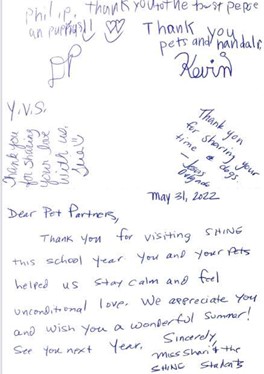
Congratulations, your donor opened your email message. You want to keep them engaged. Here’s the full message from Pet Partners, along with a picture of a thank you note from the kids and the therapy dog Dusty Rose.

Dear Ann,

Your monthly commitment to Pet Partners allows for stability within our organization that directly affects our volunteer experience and the visits they make. Without your support of the human-animal bond, the beautiful impact that our therapy animal teams make wouldn’t be felt. Thank you.

Many handlers partner with other local therapy animal teams to create local community-based groups, as is the case with Santa Clarita Pet Partners Therapy Dogs. Handler Sharon reflects on her time working with this group alongside her therapy dog Dusty Rose as they finish up their visits for the school year at the local elementary school:

“We visit at the school once a week during the school year with children who have been diagnosed with ADHD, who have been placed in foster care, and who are dealing with other difficult situations. They always look forward to our dogs. Typically we have three dogs visiting at a time, each assigned to a student by the school therapist. The students will sit on the floor with the therapy dogs to pet them, do tricks, talk, and relax together.

“Dogs create a nonjudgmental environment for these children. Many times during our visits they will share private information and feelings that they have never told anyone else. They might share that someone is being mean to them, or that when they were gone their parents gave away their dog. Life is difficult for many of these students, but they light up at the sight of their furry friends and the unconditional love the dogs offer.”

During one of the latest visits, the children showed their appreciation through a beautiful thank you note. Though this note is written directly to the therapy animal teams, it is because of your support that the children get to experience the heartwarming impact of therapy animal visits.

Make it personal

Be sure to address your donors by name, just like what you see in the examples above. I would also recommend separate communication for new donors and longer-term donors. 

Welcome new monthly donors. You can go a step further with different messages for brand new donors and single gift donors who have upgraded to monthly. Be sure to give special attention to longer-term donors. The average donor retention rate for monthly donors is 90% and you don’t want that to go down.

You can give shout outs in your newsletter and social media, but those won’t be as personal. Some organizations include a cover letter or note for their monthly donors in their newsletters. You could also create separate newsletters for monthly donors.

The key is to stay in touch and keep making connections. Remember to thank these donors every month

Don’t ignore your valuable monthly donors. Keep building those important relationships

We’re Halfway Through the Year – Are You Meeting Your Goals So Far?

It’s hard to believe we’re halfway through 2022, isn’t it? The mid-point of the year is always a good time to see if you’re meeting your fundraising and communications goals. In this continuous time of uncertainty, your fundraising may be down. Yes, we’re seeing inflation and a possible recession, but that doesn’t mean you should stop fundraising. Another important lesson from the pandemic – Never stop fundraising!  Donors will give if they can.

You may need to make some changes to your fundraising plan and other goals. And, if you never made a fundraising plan for this year, stop right there and put one together now and use it for the remainder of the year. Don’t fly blind.

Take a look at what’s working and what’s not. It will be different for every organization. If you’re doing okay, keep it up. If you’re falling short, figure out where you need to make changes.

If you’re relying too much on grants and events and those are not bringing in the revenue you need, focus more on individual giving. Many nonprofits raise the most money from individual giving. Here are a few other suggestions to help you stay on track this year.

Start or enhance your monthly giving program

Monthly giving is doable for all sizes of nonprofit organizations, even small ones. It’s a great way to raise more money, as well as your donor retention rate. Retention rates for monthly donors are 90%, much better than other retention rates. You’ll have a steady stream of income and it may be more feasible for your donors, especially if they’re feeling pinched financially.

If you don’t have a monthly giving program, get started now. To get more monthly donors, send a special targeted letter to current donors inviting them to become monthly donors. This is a good opportunity to upgrade smaller dollar donors, or any donors for that matter.

Also, do something special for your current monthly donors. Send them a thank you postcard or email. They’ve made a commitment to you, now make a commitment to them.

I’ve always been a fan of monthly giving, even more so over the last two years. Organizations with strong monthly giving programs did better at the height of the pandemic.

Look into higher levels of giving

Another advantage of monthly giving is that these donors are more likely to become mid-level and major donors. Starting a major gift program will take time, but it’s doable even for small organizations. Look into starting one soon. Organizations with strong major gift programs have also done better over the last two years.

Ramp up your donor engagement

My last post was all about how you can engage with your donors this summer. The summer is usually a slower time for fundraising, but it’s a good time to show some donor love and plan for fall.

Some donors will pull back on their giving, but that doesn’t mean ghosting them. Keep engaging with them to help ensure they’ll give again, if they can.

Make improvements to your donor communication

Look at metrics such as website visits and email open rates. I know these don’t always tell the whole story, but if you’re not seeing a lot of engagement, figure out why.

Often, it’s because your content isn’t great or it’s too long. Maybe it’s layout and design. You could also be targeting the wrong audience. Summer is a good time to make some changes.

It’s not too late, yet

If you’re falling short of your goals, you still have time to do better, but you have to make an effort.

Be sure to keep evaluating your progress for the rest of the year. Even if you’re doing okay now, circumstances can change. You may want to monitor your progress more frequently (once a month instead of once a quarter) so you can try to stay on track. You don’t want to get caught off guard. 

Keep monitoring your progress to help ensure a successful year.

Image via PlusLexia.com.

Are You Missing Out by Not Making Good Investments?

Your nonprofit organization may have cut back on some expenses over the past two years. When times are tough, some organizations, especially small ones with limited resources, veer towards trimming and often say “we can’t afford this.” This is known as the scarcity mindset.

Be careful before you nix something you think you can’t afford. It may be something you should be investing in.

This doesn’t mean going wild with your budget. You need to make good investments. Here are a few areas you should be investing more money in. The good news is if you do it right, these investments can help you raise more money.

Invest in a good CRM/database

Plain and simple, a good CRM (customer relationship management)/database can help you raise more money. You can segment your donors by amount and politely ask them to give a little more in your next appeal – $35 or $50 instead of $25. Many organizations don’t ask their donors to upgrade their gifts and you’re leaving money on the table when you neglect to do this.

A good database can help you with retention, which will save you money since it costs less to keep donors than to acquire new ones. You can personalize your letters and email messages. Make sure to invest in a good email service provider, too.

Personalized letters and messages mean you can address your donors by name and not Dear Friend. You can welcome new donors and thank current donors for their previous support. You can send targeted mailings to lapsed donors to try to woo them back. You can send special mailings to your monthly donors. You can record any personal information, such as conversations you had with a donor and their areas of interest.

In short, you can do a lot with a good CRM/database. Invest in the best one you can afford, and Excel is not a database.

Worried about spending $50 to $100 a month on a CRM/database? You may be able to make it back if you can ask for an upgrade and personalize your communication.

Nonprofit CRM Software

Invest in direct mail

You may not use direct mail that much, especially over the last two years. Some organizations were never or rarely using it before the pandemic.

If that’s the case for you, you’re missing out on an effective and more personal way to communicate with your donors. Think of the enormous amount of email and social media posts you receive as opposed to postal mail. Your donors will be more likely to see your messages if you send them by mail.

Yes, direct mail is more expensive, but you don’t have to mail that often. Quality is more important than quantity but aim for three or four times a year.

Give a little thought to what you send. Some ideas, besides appeal letters, include thank you letters/cards; Thanksgiving, holiday, or Valentine’s Day cards; infographic postcards; two to four-page newsletters; and annual/progress reports. You could put a donation envelope in your newsletter to raise some additional revenue, but do not put one in a thank you or holiday card.

Shorter is better. Lengthy communication will cost more and your donors are less likely to read it. 

A few ways you can use direct mail without breaking your budget are to clean up your mailing lists to avoid costly duplicate mailings, spread thank you mailings throughout the year – perhaps sending something to a small number of donors each month, and look into special nonprofit mailing rates. You may also be able to get print materials done pro bono or do them in-house, as long as they look professional.

Of course, you can use email and social media, but your primary reason for communicating that way shouldn’t be because it’s cheaper. It should be because that’s what your donors use. If your donors prefer you to communicate by mail, then that’s what you should do.

Direct Mail vs. Email Marketing for Nonprofits

Invest in monthly giving

If you don’t have a robust monthly giving program, you’re missing out on a great way to raise more money. Monthly giving is good for all nonprofit organizations, but it’s especially useful for small nonprofits.

All it takes is for someone to start giving $5.00 or $10.00 a month (hopefully more). These small gifts add up. The retention rate for monthly donors is an impressive 90%. Plus, they’re more likely to become major and legacy donors.

Why Monthly Giving is Important for Your Nonprofit Organization

Invest in donor communications

By donor communications I mean thank you letters/notes, newsletters, and other updates. Some organizations don’t prioritize these and want to spend their time “raising money.” They don’t seem to realize they can raise more money with better donor communications. Remember this cycle – ask, thank, report, repeat.

Don’t skimp on your communications budget. Creating thank you cards and infographic postcards is a good investment and a necessity, not a luxury. Thank you cards are a much better investment than mailing labels and other useless swag.

Maybe you need to reallocate your budget to cover some of these expenses. You could also look into additional sources of unrestricted funding. 

Remember, you can also use email and social media to communicate with donors. This reiterates the need for a good email service provider with professional looking templates for your e-newsletter and other updates.

Donor Communication for Nonprofits: Essentials & Best Practices

Invest in infrastrucure

We need to stop treating overhead or infrastructure as something bad. Some funders want us to spend our budget on programs, but how can we successfully run our programs if we don’t have enough staff and can barely afford to pay the people we do have? A rotating door of development staff makes it hard to maintain those important relationships. Even though some people may be working from home, we still have rent and other expenses.

Until these funders stop worrying so much about overhead, you may want to invest some time in finding unrestricted funding sources – often individual gifts, such as monthly donations and major gifts.

Why The Nonprofit Sector Can No Longer Dance Around Infrastructure Challenges

Don’t limit yourself by saying you can’t afford certain expenses. If you make the right investments, you should be able to raise more money.

Photo via www.hilltopfinance.co.uk/