Toolkit: Build a Content Calendar for Nonprofit Campaigns

Use this toolkit to create a content calendar for your nonprofit’s campaign season, fostering stronger donor connections and enhancing your fundraising efforts.

By Anne Stefanyk

Alt Text: Concept image of a calendar, with a pin on the 30th of the month

When building a nonprofit campaign, planning your fundraising strategies is only half the battle. You also need a clear plan for getting the word out about your fundraising efforts, and that begins with a content calendar.

A strategic content calendar is the single best tool for shifting your pre-campaign planning efforts from chaos to control. Research indicates that 69% of the most successful marketers have a documented content strategy, compared to just 16% of the least successful marketers. A calendar unifies your communication into a consistent, powerful message that helps engage and retain your audience members.

This toolkit provides a practical, step-by-step framework for building a content calendar. We will focus on anchoring your strategy to your website, integrating all your channels, and using targeted storytelling to inspire action.

Step 1: Map out your campaign phases.

Before you plan any specific content, you must map out the emotional and tactical journey you want your supporters to take. To ensure your team is aligned, use a shared tool for collaboration. A spreadsheet, a simple document, or a project management tool like Asana works perfectly.

Begin by outlining the key phases of your campaign. Most fundraising campaigns have four distinct stages. Let’s use a hypothetical “Giving Day” campaign for a wildlife sanctuary raising funds for its veterinary hospital as our example.

  1. The Priming Phase (Building Awareness). This is your educational warm-up. The goal is to set the stage and demonstrate your funding need without making a hard ask just yet. For example, two weeks before the Giving Day, you could publish a “Day in the Life of Our Sanctuary Vet” blog post. This article should include compelling photos and storytelling to illustrate the complexity and cost of daily animal care, subtly highlighting why a fully funded wildlife hospital is so crucial.
  2. The Launch Phase (The Big Push). This is the official kick-off. Your content shifts from education to a clear, direct, and exciting call to action. All your channels should activate at once with a unified message. For example, at 8 a.m. on the Giving Day, you can send an “It’s Live!” email blast. Simultaneously, your website’s homepage changes to a Giving Day “hub” with a live-tracker, and your first social media posts announce the start of the 24-hour campaign.
  3. The Momentum Phase (Maintaining Energy). This is the long middle of the campaign, where you need to fight a dip in attention. Demonstrate progress made to donors and use social proof to encourage others to join in. For instance, at 3 p.m., you could post a short, celebratory video saying, “We just passed the 50% mark! Your gifts have already funded the purchase of a new X-ray sensor. Thank you! Can we get to 75% by dinner time?” This type of message shows real-time impact and creates a new mini goal.
  4. The Final Call Phase (Creating Urgency). This is your final, high-energy push to close the gap. Your messaging must be clear, direct, and time-sensitive to motivate supporters who have been waiting to make a donation. For example, at 9 p.m., you may send a “Final 3-Hour Countdown” email that clearly states: “We are $5,000 away from our goal. If you haven’t given yet, now is the time. Don’t wait—your gift before midnight will be a lifeline for our animals.”

Defining these core stages will give you the overarching structure you need to pepper in specific content types and messages throughout your campaign.

Step 2: Layer in content streams.

Your strategic content calendar should help you visualize how you can repurpose one piece of content across your entire ecosystem. This is the key to a robust multichannel strategy that reaches donors where they are.

Focus on your website content first. Your website is the one digital platform you own completely. It is the central hub where all action, donation, and deep engagement should happen.

Place your “pillar” pieces, like blog posts, video uploads, and testimonial drops, on the calendar. Then, build your email and social content around them.

Think of your website as the “hub” and your other channels as the “spokes.” For example, one long-form testimonial published on your blog (the hub) becomes the source material for many other pieces. It can become a quote graphic for Instagram, a “story of the week” feature in your email newsletter, and the emotional hook for a targeted social media ad.

For each phase, define the content needed for each channel. Create columns in your calendar for:

  • The date when the content should be published
  • The content topic or headline
  • The primary channel (e.g., blog, email, Facebook)
  • The task owner

For instance, during your momentum phase, you might have one team member post a “progress update” blog post by 2:45 p.m. Then, another staffer will have the green light to share that blog post’s key message, like a new animal photo or quote, across Instagram, Facebook, and LinkedIn, at 3 p.m. sharp.

This step is where a comprehensive project management system will be your best friend. You can use it to automatically send email or text notifications when it’s time for each team member to complete their tasks, ensuring seamless communication throughout the campaign.

Step 3: Populate with your stories and segments.

Stories make your campaign feel more urgent, personal, and real to donors, especially when you personalize them to each individual’s interests. Review your donor segments and assign specific stories or messages to different email segments.

For example, in the Momentum phase, you might send Email A (featuring an impact story) to your list of brand-new donors, but Email B (featuring a financial breakdown of impact) to your major donor segment. Major donors will appreciate greater transparency into the inner workings of your campaign and its anticipated outcomes, while new supporters will benefit from learning more about the purpose of your fundraising.

Bloomerang Fundraising’s donor segmentation guide also recommends using donor segments to send donors messages on their favorite communication channels. For example, a supporter who prefers text messages is more likely to respond to a campaign text than an email. Your calendar helps you plan for this, sending the right story to the right person on the platform they choose.

Step 4: Review for gaps and accessibility.

Evaluate your calendar from a higher level to ensure you haven’t overlooked any key necessities. Ask yourself questions like: Are you posting too much on one channel and neglecting another? Is there a week with no website content? Are your calls to action clear?

This is also the final check to ensure all planned materials, especially website assets, are accessible. Accessibility is crucial to creating an inclusive nonprofit campaign that enables everyone to participate. Your mission is for everyone, and your campaign content should be, too.

Key accessibility elements to check for include:

  • Readable fonts
  • Alternative text for images
  • Video captions or transcripts
  • Clear website navigation
  • Hierarchical web page design
  • Keyboard navigability

Kanopi Studios’ nonprofit website design guide recommends using both automated and manual checks to ensure you don’t miss any accessibility issues. Automated tests use tools like Lighthouse or Axe to help identify accessibility issues. Manual testing involves someone engaging in user testing, often with the help of assistive technology like a keyboard or screen reader tool, to evaluate your site’s usability.

Step 5: Measure, adapt, and improve.

Your content calendar should be a living document, not a rigid set of rules. The launch of your campaign marks the beginning of your next discovery process, involving constant testing and iteration.

Use a combination of tools such as Google Analytics and your website builder to track key campaign metrics such as:

  • Website traffic
  • The time visitors spend on core web pages
  • Landing page conversion rates
  • Email click-through rates
  • Social media engagement (likes, comments, shares)

If one type of content clearly resonates with your audience, adjust your calendar to capitalize on that success. For instance, if your “Meet the Animals” testimonial series is leading to major donation conversions, center your social media and website content around that to maximize your outreach efforts.

This continuous improvement model ensures that your strategy gets smarter with every campaign you run. Additionally, you can apply this approach to major, multi-year campaigns, such as a capital campaign. These longer fundraising initiatives offer an incredible opportunity to test your messaging and organization efforts, taking you from a novice planner to an expert communicator over the course of the campaign.

Build on what works, and discard what doesn’t—that’s the key to long-term fundraising communications success.


A well-planned content calendar does more than just organize your posts. It frees your team from the daily panic of “what do we post?” and empowers you to focus on what truly matters: building connections.

With this mindset, you can transform your nonprofit website from a simple digital front door into a dynamic hub for promoting both your current campaigns and your mission as a whole.

Anne Stefanyk is the Founder and CEO of Kanopi Studios, a leading digital agency that designs and builds websites for mission-driven organizations. With deep expertise in strategy, user experience, and open-source technologies, Anne has guided Kanopi to become a trusted partner to nonprofits, higher education, and healthcare institutions.

Since launching Kanopi in 2010, Anne has fostered a people-first culture and a strong commitment to accessible, sustainable web practices. Her team creates inclusive digital experiences that help organizations make meaningful impact.

Follow Anne:

X

Drupal

LinkedIn


How to Turn Grant Funders into Long-Term Supporters

Securing grant funding is difficult and requires significant nonprofit resources. Fortify grant funder connections to minimize effort while attracting funding.

By Erin Murphy

Winning a grant is no small feat—it takes time, effort, and a compelling proposal to secure funding. But the real payoff lies in turning that one-time grant into a long-term partnership. Building strong, lasting relationships with grant funders not only saves your nonprofit valuable staff time but also stabilizes revenue and creates opportunities for greater mission impact.

With the right approach—one rooted in care, transparency, and a thoughtful communication strategy—you can transform grant funders into loyal supporters who champion your cause for years to come.

1. Align Proposals with Funder Priorities

The foundation of any strong funder relationship is alignment. Grant funders want to see that your nonprofit understands their mission and values, and that your programs directly support their priorities. This requires more than just a well-written proposal; it demands thorough research and a tailored approach.

Start by diving into each funder’s stated goals and past grantmaking. What types of projects have they supported in the past? What outcomes do they prioritize? By identifying the overlap between their mission and your nonprofit’s impact, you can frame your programs as mutually beneficial.

Then, you’ll have enough information to start creating your proposals. When crafting them, avoid the temptation to rely on generic templates. Instead, customize each proposal to reflect the funder’s unique priorities and demonstrate shared values. This not only builds trust but also sets the stage for a partnership that feels collaborative from the outset.

2. Demonstrate Impact Through Consistent Reporting

Winning a grant is just the beginning. Funders need to see that their investment is making a difference. According to Thompson Grants, transparent, timely reporting is essential for complying with funder requirements while also strengthening their confidence and trust in your organization. 

When reporting to funders, go beyond the basics. Provide both qualitative stories and quantitative data to paint a full picture of your impact. For example, an educational nonprofit could share a compelling story about a student who gained access to college through their scholarship program, alongside metrics showing increased graduation rates.

Also, don’t be afraid to highlight unexpected results or lessons learned. For example, if a housing initiative aimed to renovate 50 units but only completed 40 due to supply chain delays, explain how you adapted and built stronger vendor partnerships. Or if a workforce program discovered higher demand for digital skills training than anticipated, show how you pivoted resources to meet community needs. Funders appreciate this kind of honesty and value learning alongside you. 

3. Cultivate Relationships Beyond the Grant Cycle

A common mistake nonprofits make is only engaging with funders during the grant cycle. To turn funders into long-term supporters, you need to build relationships that extend beyond the check. Get started by:

  • Scheduling regular updates to keep funders informed about your work—not just when reports are due. These updates can take the form of emails, phone calls, or informal check-ins to share progress, challenges, and upcoming plans. Transparency in these communications builds trust and keeps your nonprofit top of mind.
  • Inviting funders to experience your work firsthand through site visits, events, or behind-the-scenes tours. Seeing your programs in action deepens their emotional connection and reinforces the value of their contributions.
  • Ensuring personalized communication. A thank-you call, handwritten note, or spotlight on their contribution in your newsletter can make funders feel appreciated and recognized. Tailoring your outreach to their preferences shows you value them as individuals, not just financial backers.

By treating funders as true collaborators in your mission, you can build trust, show gratitude, and turn first-time funders into long-term allies.

4. Involve Funders in Strategy and Storytelling

When funders feel like active partners in shaping your nonprofit’s future, they’re more likely to stay invested. Involving them in your strategy and storytelling deepens their connection to your mission and fosters a sense of shared purpose. You can do so by:

  1. Telling your story. Share compelling stories that highlight the human side of your impact—stories that make the outcomes of their funding tangible and relatable. These stories can be shared in newsletters, impact reports, or even during one-on-one conversations. Just ensure you use real human testimonials to strengthen your story’s emotional appeal.
  2. Soliciting their feedback on new initiatives or strategic plans. Asking for their input not only shows that you value their expertise but also helps them feel like collaborators in your work. This can be as simple as inviting them to brainstorming sessions or sharing drafts of upcoming projects for their review.
  3. Spotlight funders in your communications (with their permission) to publicly acknowledge their contributions. You can also invite them to share their expertise by serving as advisors or guest speakers at events. This not only gets existing funders more involved with your story but can also serve as social proof for potential funders.

By involving funders in both your strategy and storytelling, you create a deeper sense of partnership and ensure they feel personally connected to your nonprofit’s success. 

5. Strengthen Stewardship with Systems and Teamwork

Sustainable stewardship requires strong systems, clear processes, and a team-wide commitment to maintaining funder relationships. By building the right infrastructure, you can ensure no funder falls through the cracks.

Start by creating internal workflows for tracking funder interactions. A centralized system, such as a CRM or grants management platform, can help you keep records consistent and accessible. Use these tools to log communications, track deadlines, and monitor progress on grant deliverables.

Next, assign stewardship responsibilities to specific team members so funders have a clear point of contact. Whether it’s sending updates, scheduling check-ins, or preparing reports, having dedicated roles ensures funders feel prioritized.

Regardless of their exact role on your team, training your staff on stewardship best practices is also essential. Equip your team with the skills to communicate effectively, personalize outreach, and demonstrate gratitude via workshops and training resources. Additionally, educate your team on how to use your CRM data to strengthen stewardship with regular upskilling sessions.


Turning grant funders into long-term supporters is one of the most impactful steps your nonprofit can take to ensure reliable funding and lasting partnerships. With the right approach, you can transform one-time grants into enduring partnerships that drive your mission forward. 

Erin Murphy, MBA, is the Vice President of Marketing at Thompson Grants, where she leads strategic initiatives to expand the organization’s reach and impact. She leads initiatives that connect grant professionals with expert guidance, training, and tools designed to simplify compliance and strengthen funding strategies. Erin combines her background in marketing with a passion for supporting nonprofits, governments, and institutions as they navigate the complex world of grants management.

Why You Need to Share Stories With Your Donors

Stories come in many forms. You can tell a story with words, pictures, and videos. I like written stories (preferably on paper), but others are drawn to videos. Some people might not have the time or energy to look at anything but a photo or infographic.

Your nonprofit organization needs to share stories using all these forms. Sharing stories will help you connect with your donors and improve your engagement.

Donors want to hear your stories

I bet you’re not using stories as much as you should. That’s a mistake because people respond better to stories than a bunch of facts and statistics. Stories bring the work you do to life by using everyday language to create a scene.

You may be reluctant to use stories because it’s more work for your organization, but that shouldn’t stop you. Make time to come up with some engaging stories.

Your stories need to be relevant

Update your stories at least once a year. They need to take into account the everchanging current situations. There’s a lot going on. How is that impacting your clients/community? Many people are struggling right now.

Create a culture of storytelling

If you create a storytelling culture in your organization, you can make storytelling the norm instead of the exception.

Work with your program staff to create stories that will help you connect with your donors. Everyone needs to understand how important this is. Share stories at staff meetings and/or set up regular meetings with program staff to gather stories. 

When you put together a story, ask.

  • Why is this important?
  • Who is affected?
  • Why would your donors be interested in this story?
  • Are you using clear, everyday language (no jargon) to make sure your donors understand your story?
  • How are your donors helping you make a difference or How can your donors help you make a difference?
  • Client or program recipient stories are best. Remember, donors want to hear how they’re helping you make a difference for your clients/community.

Another way to find stories is to put a Share Your Story form on your website. This could be a good way to get some current, relevant stories.

Your stories aren’t about your organization

Keep in mind that your stories aren’t about your organization. Your story is about a need or problem that affects the people/community you work with, and how your donors can/did help with that.

Make your stories personal 

Tell a story of one (person or family). Use people’s names to make your stories more personal. I realize you might run into confidentiality issues, but you can change names to protect someone’s privacy. You could also do a composite story, but don’t make up anything.

Always be respectful to your subject(s). You may want to set up some ethical guidelines. 

Use different stories for different types of communication

Create a story bank to help you organize all your stories. You want to use stories as much as possible. Use them in your appeals, thank you letters, newsletters, updates, impact reports, website, blog, and other types of social media. You can also create a story calendar to help you consistently share stories throughout the year.

While you can come up with some core stories, they’ll be slightly different depending on the type of communication. 

In a fundraising appeal (all appeals should start with a story), you want to highlight a problem or need. Let’s say you run a food pantry. Here you can tell a story about Melanie, a working single mother with three kids who’s having trouble feeding her family because of rising food costs and cuts in benefits. Sometimes she has to choose between buying groceries and paying the heating bill. 

In your thank you letter, you can let your donor know that because of their generous gift, Melanie can get healthy food for her family at the Eastside Community Food Pantry.

Then, in your newsletter, impact report, or update, you can tell a success story that because of your generous donors, Melanie doesn’t have to worry so much about how she’ll be able to feed her family.

Tell a story in an instant with an engaging photo

You’ve probably heard the phrase a picture is worth a 1000 words. Cliche, yes, but it’s true.

You can capture your donors’ attention in an instant with an engaging photo. That doesn’t mean one of your executive director receiving an award. Use photos of your programs in action or something else that’s engaging.

Print newsletters and impact reports tend to be dominated by long-winded text. Most of your donors won’t want to read the whole thing. But if you share some engaging photos, they can get a quick glance at the impact of their gift without having to plow through a bunch of tedious text. You can share a little more information with a good photo caption.

Photos can enhance your print communication by breaking up the narrative. You can also complement your written stories with photos. If you’re worried about mailing costs, postcards and other short pieces with photos are the way to go. You could even do a Postcard Impact Report

If you use social media, you need to communicate several times a week. As your donors scroll through an endless number of posts, an engaging photo can stand out and get their attention.

Use photos everywhere – fundraising appeals, thank you letters/cards, newsletters, impact reports, updates, your website, and social media. Create a photo bank to help you with this.

It’s fine to use the same photos in different channels. It can help with your brand identity. Be sure to use high-quality pictures. Also, make sure your photos match your messages. If you’re writing a fundraising appeal about children who aren’t getting enough to eat every day, don’t use a picture of happy kids.

Work with your program staff to get photos and videos (more on videos below). Confidentiality issues may come up and you’ll need to get permission from your subjects or their guardians.

Highlight your work with a video

Videos are a popular way to connect. They can be used to show your programs in action, share an interview, give a behind-the-scenes look at your organization, or my favorite – thanking your donors. 

I would definitely recommend creating a personalized thank you video. If that’s not possible, you can make a general one.

Make your videos short and high quality. Short is key. If your video is more than a couple of minutes, your donors may not bother to watch it. 

You can use videos on your website, in an email message, on social media, and at an event.

Spiff up your statistics by using infographics

A typical impact report is loaded with statistics. You want to share these, along with your accomplishments, but you don’t want to overwhelm your donors with a lot of text.

Why not use an infographic in your impact report instead of including the usual laundry list of statistics and accomplishments? 

Infographics are also great in other types of communication, such as newsletters and updates. Good visuals will enhance both your print and electronic communication.

Connect with your donors and keep them engaged by using all types of stories.

Event Ideas to Strengthen Donor-Beneficiary Relationships

Explore top event ideas to strengthen relationships between donors and beneficiaries, enhance engagement, and maximize fundraising success for your nonprofit.

By Jen Wemhoff

Nonprofit fundraising is about more than just dollars—it’s about connections. Strong relationships between donors and beneficiaries can deepen donor engagement, build trust, and generate more meaningful support for your organization’s mission. For smaller nonprofits, these relationships are incredibly powerful. They humanize your work, turn statistics into human-driven stories, and can help transform one-time donors into long-term supporters.

When donors have the opportunity to see and hear the real-world impact of their giving and meet the people whose lives have been changed because of their contributions, it cultivates a deeper sense of purpose. One of the most effective ways to do this is through events that bring donors and beneficiaries together in intentional ways. Here are four event ideas that can help your nonprofit foster deeper connections between donors and the people they’re helping.

1. Charity Golf Tournament

A charity golf tournament offers a relaxed setting centered around an enjoyable event where meaningful conversations and connections happen naturally. Unlike more structured events, golf tournaments provide plenty of downtime between holes and during post-golf activities like a cocktail hour, reception, or banquet, which provides an organic interaction between donors, beneficiaries, volunteers, and staff. 

Why It Works:

  • Participation opportunities for beneficiaries. Invite beneficiaries to join foursomes or serve as event speakers. Their presence adds authenticity and helps donors connect their support to real stories.
  • Informal setting. The laid-back nature of the day encourages casual, authentic conversations that can’t be achieved with a formal program. 
  • Multi-purpose. You can integrate storytelling, donor recognition, and fundraising opportunities into one event.

Golf Tournament Pro Tips:

  • GolfStatus recommends getting creative by adding a theme to your tournament that helps drive home your mission to participants. 
  • Invite a beneficiary to share their story during opening remarks or the awards ceremony. 
  • Set up a casual “Meet and Greet” session over breakfast or lunch before the tournament begins or over drinks and appetizers after the round finishes, where donors and beneficiaries can connect.
  • Add additional fundraising elements like a raffle with items or experiences tied to your mission to spotlight beneficiary needs or milestones.

2. Storytelling Event

Storytelling events, whether hosted in person or online, center on experiences. Beneficiaries share their personal journeys, and donors see the direct results of their support. Both groups get to witness the people behind the mission.

Why It Works:

  • Emotional connection to your nonprofit. Stories humanize your work in ways that data and numbers simply can’t. Hearing someone describe how a program changed their life is more powerful than any campaign report.
  • Clarity and transparency. When donors hear directly from organizational beneficiaries, it reinforces your mission and impact in a tangible, memorable way. 
  • Flexibility. A storytelling event allows you to choose how and when to hold it. You might fold it into another event (like your golf tournament) or host a series of online sessions once a month.

Storytelling Events Pro Tips:

  • Use video, photos, and music to amplify the emotional impact of the beneficiary stories and your mission. 
  • Tie each story to a specific call to action, such as making a donation, volunteering to help with an event or initiative, or participating in an advocacy effort. 
  • To foster meaningful connections, make the event as interactive as possible. Offer live Q&A, breakout rooms, or discussion prompts to allow donors and beneficiaries to talk directly with one another.

3. Community Dinner or Picnic

Want a high-impact way to bring people together? Host a casual community dinner or picnic. These types of relaxed events invite people to gather together in a friendly, informal atmosphere to forge genuine connections and relationships. 

Why It Works:

  • Authenticity. A potluck or BBQ can feel more like a family reunion than a fundraising event. That kind of setting opens the door to real, heartfelt conversations.
  • Accessibility. These events are typically less expensive than a formal gala or corporate gathering, and are easy to host at a local park, community center, or even someone’s backyard.

Community Dinner Pro Tips:

  • Create a “meet the beneficiary” table or booth where willing beneficiaries can chat with attendees and share their experiences.
  • Include a special “thank you” segment at the dinner where beneficiaries personally express appreciation to donors. This could be as simple as a few brief testimonials or even thank-you cards distributed at tables.

4. Workshop or Educational Panel

Consider hosting a workshop, discussion panel, conference session, or series of open-table conversations where donors and beneficiaries participate. Center the discussions around topics relevant to your nonprofit’s mission and work, allowing both groups to engage with and learn from each other.

Why It Works:

  • Shared learning. These types of sessions position donors and beneficiaries as co-learners, fostering empathy, respect, and shared purpose of your organization’s mission.
  • Dialogue and insight. Donors hear firsthand about lived experiences from those who have benefited from the nonprofit’s services, and beneficiaries gain visibility and confidence by sharing their story and letting their voices be heard.

Discussion Event Pro Tips:

  • Choose discussion topics that matter to both audiences. You might invite representatives from each group to collaborate on designing the agenda and topics.
  • Use a skilled moderator to guide the discussion and ensure equal participation from both donors and beneficiaries. 
  • Consider hands-on workshops where beneficiaries and donors collaborate. For example, you might offer a session on financial literacy or resume writing led by a donor with expertise in those areas, which gives donors the chance to learn more about a beneficiary’s journey. 

Final Thoughts

You don’t need a huge staff or a big budget to pull off events like those mentioned in this guide. Think about strategic ways to stretch your resources, such as:

  • Leveraging partnerships. Tap into community organizations, schools, or local businesses that might donate space, catering, or supplies in exchange for recognition.
  • Securing sponsorships. Local businesses are often willing to sponsor nonprofit fundraising events, especially when they earn positive brand exposure and appreciate the community impact.
  • Aligning with corporate social responsibility goals. Reach out to companies already committed to giving back through corporate social responsibility initiatives.

The key to meaningful donor engagement isn’t just showing impact—it’s creating opportunities for donors to feel it firsthand. When donors and beneficiaries connect, it dissolves the distance between giving and receiving. For smaller nonprofits, these events are more than just good ideas, they can be powerful tools for transformation. So, whether it’s on the golf course, around a picnic table, or inside a community hall, start planning your next event with relationships in mind!

Jen Wemhoff came to GolfStatus in 2020 after 20 years in the nonprofit industry. Her favorite things about golf are its ability to bring people together and its capacity to raise money for important causes, and she is one of the co-founders of the Putt Putt Fore Puppies mini golf tournament. She can be found listening to the Interstellar soundtrack while writing content for GolfStatus’ educational guides, templates, blogs, case studies, webinars, and more. She likes to brag about sinking a 25-foot putt at Victoria National Golf Club during her first round of golf in years. Jen and her husband, Mark, have two daughters, Anna and Elsa (who are not named for the movie Frozen), and love to cheer on the Kansas City Chiefs and Nebraska Cornhuskers. 


How to Create an Engaging Nonprofit Impact Report

Is your nonprofit still producing one of those multi-page “annual reports”?  If so, why? Anything that’s more than four pages is too long. Besides that, they’re often boring, they focus too much on the organization and not on the donors, they require a lot of time and effort from staff, and there’s no guarantee donors will even look at them.

Now you have a dilemma. Organizations need to share accomplishments and show gratitude to their donors, but is the “annual report” the best way to do that? 

First, let’s stop calling it an annual report and call it an impact or gratitude report instead. Plus, sharing accomplishments and showing gratitude is something you can do more than once a year (more on that below). In this post, I’ll use the term impact report (but don’t forget about gratitude). I’ve also seen organizations use the term Donor Impact Report, which I like.

However, renaming it is just the first step. If you’re still creating one of those long, boring booklets, you’re not making much of an improvement.

It’s possible to make this a better experience for both donors and nonprofit organizations. Here’s how.

You don’t have to do an “annual report”

Nonprofit organizations aren’t required to do an annual report. This doesn’t let you off the hook for sharing accomplishments with your donors. You could send short impact reports a couple of times a year. This makes a lot of sense if taking on a big report sounds too overwhelming. Shorter, more frequent updates are better for your donors, too.

If you decide to do a report once a year, I encourage you to move away from the traditional multi-page one. Aim for something no longer than four pages. Bigger isn’t always better.

Your impact report is for your donors

Keep your donors in mind when you create your impact report and include information you know will interest them. Also, donors have a lot going on, so that’s another reason not to create a huge report they may or may not read. 

You might want to consider different types of impact reports for different donor groups. You could send an oversized postcard with photos and infographics or a one-to-two-page report to most of your donors. Your grant and corporate funders might want more detail, but not 20 pages. See if you can impress them with no more than four pages.

Keep in mind that the human attention span is about eight seconds. Granted, most of us can stay focused longer than that, but your impact report is competing with other pieces of mail and whatever else is going on in your donors’ lives, and right now there’s a lot. 

Imagine your donor receiving a traditional long report and thinking it might be interesting but she doesn’t have time to read it right now, so it sits in a pile for two months and then gets recycled, unread. But if you send a postcard or a short report, your donors can get a quick glimpse of how they’re helping you make a difference.

Pour on the gratitude

Donors want to feel good about giving to your nonprofit. Make sure your impact report is focused on thanking donors. You could go one step further and call it a gratitude report. If you decide to do three or four short reports a year (highly recommended), make at least one of them an all-out gratitude report.

Use phrases like Thanks to you or Because of you to show appreciation to your donors for their role in helping you make a difference. 

Tell a story

Donors want to hear about the people they’re helping. You can tell a story with words, a photo, or a video. 

For example – Mara, a single mother with three kids, has been struggling to make ends meet over the last few years. It’s been hard to find steady work and she’s having trouble affording groceries. She also wonders if she’ll have enough money to pay rent and utilities each month. 

Mara had never gone to a food pantry before and felt ashamed to have to do that. But when she reached out to the Westside Community Food Pantry, she was treated with respect and dignity. Now, thanks to donors like you, she’s able to bring home healthy food for her family.

An engaging story is one of the most important elements of your impact report.

How are you making a difference?

The theme of many reports is look how great we are. They’re organization-centered instead of being donor-centered and community-centered.

They also include a bunch of statistics, such as the number of clients served. You need to share specific accomplishments that show how you’re making a difference.

Focus on the why and not the what. Numbers don’t mean a lot without a story or example. For instance, Thanks to donors like you, we were able to serve more students in our tutoring program. X number of students are now getting better grades and can graduate from high school on time.

Make it visual

Remember, your donors have a lot going on and won’t have much time to read your report. Engage them with some great photos, which can tell a story in an instant. Choose photos of people participating in an activity, such as volunteers working at a food pantry or a one-to-one tutoring session. Be sure to get permission if you want to use pictures of clients.

Use colorful charts or infographics to highlight your financials. This is a great way to keep it simple and easy to understand. Include some quotes and short testimonials to help break up the text.

Be sure your report is easy to read (and scan). Use at least a 12-point font and black type on a white background. A colored background may be pretty, but it makes it hard to read. You can, however, add some color with photos, headings, charts, and infographics.

Write as if you’re having a conversation with a friend

Be careful about using jargon. Most of your donors don’t use words like underserved or at-risk, and neither should you. Use everyday language such as – Because of you, we found affordable housing for over 100 homeless families. Housing prices continue to skyrocket and a shelter or motel is no place to raise a family. Now, these families have a place to call home.

Write in the second person and use a warm, friendly tone. Use you much more than we.

Skip the donor list (and the letter from your executive director)

Think twice about including a donor list in your impact report. It takes up a lot of space and there are better ways to show appreciation. If you feel you must have a donor list, you could put one on your website or just include major funders. Including a QR code or link directing people to your website for more detailed information is a good way to ensure a shorter report.

Also, do you need a letter from the executive director as part of your report? These tend to be very organization-centered. If you must have one, make sure it focuses on thanking your donors. You could also include it as a cover letter if you’re mailing your report in an envelope.

Send it by mail

Be sure to send your impact report by mail. It’s more personal and donors are more likely to see it. Don’t let costs deter you from sending something by mail. Remember, you have the option of sending short impact reports.

You could also send an electronic version a few weeks later as a follow-up.

Planning is crucial

I know putting together a yearly impact report can be time-consuming. One way to make it easier is to set aside a time each month to make a list of accomplishments. This way you’re not going crazy at the end of the year trying to come up with a list. You can just turn to the list you’ve been working on throughout the year.

You also want to create a story and photo bank and you can draw from those when you put together your impact report.

Creating a shorter report or an infographic postcard will also help make this easier for you. Once again, you have the option of not doing a yearly impact report and sending periodic short updates instead.

Whatever you decide, put together an impact report that’s a better experience for everyone. 

Improve Your Donor Engagement by Creating Some Great Stories

Stories come in many forms. You can tell a story with words, pictures, and videos. I prefer written stories, but others are drawn to videos. Some people might not have the time or energy to look at anything but a photo or infographic.

Your nonprofit organization needs to share stories using all these forms. Sharing stories will help you connect with your donors and improve your engagement.

Donors want to hear your stories

I imagine you’re not using stories as much as you should. That’s a mistake because people respond better to stories than a bunch of facts and statistics. Stories bring the work you do to life by using everyday language to create a scene.

You may be reluctant to use stories because it’s more work for your organization, but that shouldn’t stop you. Make time to come up with some engaging stories.

Your stories need to be relevant

Update your stories at least once a year. They need to take the everchanging current situations into account. How are the economy, the influx of migrants, discrimination, climate change, etc. impacting your clients/community right now?

Create a culture of storytelling

If you create a storytelling culture in your organization, you can make storytelling the norm instead of the exception.

Work with your program staff to create stories that will help you connect with your donors. Everyone needs to understand how important this is. Share stories at staff meetings and/or set up regular meetings with program staff to gather stories. 

When you put together a story, ask.

  • Why is this important?
  • Who is affected?
  • Why would your donors be interested in this story?
  • Are you using clear, everyday language (no jargon) to make sure your donors understand your story?
  • How are your donors helping you make a difference or How can your donors help you make a difference?

Client or program recipient stories are best. Remember, donors want to hear how they’re helping you make a difference for your clients/community.

Another way to find stories is to put a Share Your Story form on your website. This could be a good way to get some current, relevant stories.

Your stories aren’t about your organization

Keep in mind that your stories aren’t about your organization. Your organization may have had to make a lot of changes over the last few years to do some of the work you do, but that’s not your story. Your story is why this is important for the people/community you work with. 

Maybe you had to change the way you run your food pantry, but what’s most important is that people in your community continue to have access to healthy food. 

Make your stories personal 

Tell a story of one (person or family). Use people’s names to make your stories more personal. I realize you might run into confidentiality issues, but you can change names to protect someone’s privacy. You could also do a composite story, but don’t make up anything.

Always be respectful to your subject(s). You may want to set up some ethical guidelines

Use different stories for different types of communication

Create a story bank to help you organize all your stories. You want to use stories as much as possible. Use them in your appeals, thank you letters, newsletters, updates, impact reports, website, blog, and other types of social media. You can also create a story calendar to help you consistently share stories throughout the year.

While you can come up with some core stories, they’ll be slightly different depending on the type of communication. 

In a fundraising appeal (all appeals should start with a story), you want to highlight a problem or need. Let’s return to the food pantry example. Here you can tell a story about Cara, a working single mother with three kids who’s having trouble feeding her family because of rising food costs. Sometimes she has to choose between buying groceries and paying the heating bill. 

In your thank you letter, you can let your donor know that because of their generous gift, Cara can get healthy food for her family at the Westside Community Food Pantry.

Then in your newsletter, impact report, or update, you can tell a success story that because of your generous donors, Cara doesn’t have to worry so much about how she’ll be able to feed her family.

Tell a story in an instant with an engaging photo

You’ve probably heard the phrase a picture is worth a 1000 words. Cliche, yes, but it’s true.

You can capture your donors’ attention in an instant with an engaging photo. That doesn’t mean one of your executive director receiving an award. Use photos of your programs in action or something else that’s engaging.

Print newsletters and impact reports tend to be dominated by long-winded text. Most of your donors won’t want to read the whole thing. But if you share some engaging photos, they can get a quick glance at the impact of their gift without having to plow through a bunch of tedious text. You can share a little more information with a good photo caption.

Photos can enhance your print communication by breaking up the narrative. You can also complement your written stories with photos. If you’re worried about mailing costs, postcards and other short pieces with photos are the way to go. You could even do a Postcard Impact (Annual) Report

If you use social media, you need to communicate several times a week. As your donors scroll through an endless number of posts, an engaging photo can stand out and get their attention.

Use photos everywhere – fundraising appeals, thank you letters/cards, newsletters, impact reports, updates, your website, and social media. Create a photo bank to help you with this.

It’s fine to use the same photos in different channels. It can help with your brand identity. Be sure to use high-quality pictures. Also, make sure your photos match your messages. If you’re writing a fundraising appeal about children who aren’t getting enough to eat every day, don’t use a picture of happy kids.

Work with your program staff to get photos and videos (more on videos below). Confidentiality issues may come up and you’ll need to get permission from your subjects or their guardians.

Highlight your work with a video

Videos are a popular way to connect. They can be used to show your programs in action, share an interview, give a behind-the-scenes look at your organization, or my favorite – thanking your donors. 

I would definitely recommend creating a personalized thank you video. If that’s not possible, you can make a general one.

Make your videos short and high quality. Short is key. If your video is more than a couple of minutes, your donors may not bother to watch it. 

You can use videos on your website, in an email message, on social media, and at an event.

Spruce up your statistics by using infographics

A typical impact report is loaded with statistics. You want to share these, along with your accomplishments, but you don’t want to overwhelm your donors with a lot of text.

Why not use an infographic in your impact report instead of including the usual laundry list of statistics and accomplishments? 

Infographics are also great in other types of communication such as newsletters and updates. Good visuals will enhance both your print and electronic communication.

Connect with your donors and keep them engaged by using all types of stories.

How to Improve Your Communication for Better Donor Engagement

In my last post, I wrote about potential missed opportunities for donor engagement. You may think you’re practicing donor engagement by sending thank you letters and an e-newsletter, but is the content actually engaging? It’s often formulaic and just downright dull.

Many nonprofits send all their donors the same appeal and thank you letters. In these letters, they never thank a donor for their past support or acknowledge they’re a monthly donor.

If that’s not bad enough, many of these letters use vague and impersonal language and even worse, jargon.

It sounds obvious, but your donor engagement should be engaging. If it’s not, it’s time to move away from generic and impersonal communication. Your donors deserve better. Here are a few suggestions to help you improve your donor communication.

Segment your donors

Your donors aren’t the same, so they shouldn’t all get the same letter or other types of communication. Segment your donors into different groups as much as you can. At the very least, create different letters for new donors, repeat donors, and monthly donors. You can also personalize letters to lapsed donors, event attendees, volunteers, etc.

I emphasize segmenting your donors a lot in my posts because it’s so important. Both because it allows you to send your messages to the right audience and you can personalize those messages. Donors like it if you recognize their past giving or anything that shows them this is more than a generic, one-size-fits-all message. 

Also, please stop sending Dear Friend letters. You’re not being a good friend if you don’t even use your donors’ names.

I know this will take more time, but it’s worth the investment. So is a good CRM/database to help you with this. Your donors will feel appreciated and are more likely to give again, possibly at a higher level.

Use language your donors will understand

If you use vague, generic language and jargon, you’re going to instantly bore and/or confuse your donors. Most of your donors don’t have a medical or social services background. They don’t use terms like food insecurity, at-risk populations, and underserved communities – and neither should you. Stay away from insider language

Connect with your donors by using language they’ll understand. Instead of writing about food insecurity, give an example of a single mother choosing between buying groceries and paying the heating bill.

What do you mean by at-risk or underserved? Are high school students less likely to graduate on time? Do residents of a certain community not have good health care nearby? Is housing too expensive? Get specific, but at the same time, keep it simple. Also, terms like at-risk and underserved undermine your clients/community. Remember, these are human beings you’re writing about.

A great way to break free from generic language and jargon is to tell stories. Most people respond better to a human-interest story than a bunch of boring statistics.

Make time for improvement

You may be between fundraising campaigns right now and have a little more time (or maybe not). If so, work on segmenting the donors in your database, if you haven’t already done that. Segment your donors on an ongoing basis. For example, some of your single-gift donors may have upgraded to monthly. If you can do this after every campaign, you should have fairly up-to-date information on your donors.

In addition, dust off those templates and freshen up your appeal letters and thank you letters. Situations throughout the world keep changing and your communication needs to be relevant. Create letter templates for different donor groups and replace your vague, generic language with something clear, conversational, and specific.

You can also use this time to add new stories to your story bank or start putting one together, if you don’t already have one.

Have someone outside of your organization, a friend or family member, look at your messages. Something that’s clear to you may confuse others.

Create communication that shows your donors how much you appreciate them by recognizing who they are and giving them engaging content they can relate to.

The Problem with “Annual Reports”

Time for a quick quiz (don’t worry it should be easy). 

What’s the problem with “annual reports”?

A. They’re too long.

B. They’re boring.

C. They focus too much on the organization and not on the donors.

D. They require a lot of time and effort from staff and there’s no guarantee donors will even look at them.

E. All of the above

If you answered E, you would be right! This poses a dilemma. Organizations need to share accomplishments and show gratitude to their donors, but is the “annual report” the way to do that? 

First, let’s stop calling it an annual report and call it an impact or gratitude report instead. Plus, sharing accomplishments and showing gratitude is something you can do more than once a year (more on that below). In this post, I’ll use the term impact report (but don’t forget about gratitude). One organization recently sent me something called 2023 Donor Impact Report (yes!).

However, renaming it is just the first step. If you’re still creating one of those long, boring booklets, you’re not making much of an improvement.

It’s possible to make this a better experience for both donors and nonprofit organizations. Here’s how.

You don’t have to do an “annual report”

Nonprofit organizations aren’t required to do an annual report. This doesn’t let you off the hook for sharing accomplishments with your donors. You could send short impact reports a couple of times a year. This makes a lot of sense if taking on a big report sounds too overwhelming. Shorter, more frequent updates are better for your donors, too.

If you decide to do a report once a year, I encourage you to move away from the traditional multi-page one. Aim for something no longer than four pages. Bigger isn’t always better.

Your impact report is for your donors

Keep your donors in mind when you create your impact report and include information you know will interest them. Also, donors have a lot going on, so that’s another reason not to create a huge report that they may or may not read. 

You might want to consider different types of impact reports for different donor groups. You could send an oversized postcard with photos and infographics or a one-to-two-page report to most of your donors. Your grant and corporate funders might want more detail, but not 20 pages. See if you can impress them with no more than four pages.

Keep in mind that the human attention span is about eight seconds. Granted, most of us can stay focused longer than that, but your impact report is competing with other pieces of mail and whatever else is going on in your donors’ lives. 

Imagine your donor receiving a traditional long report and thinking it might be interesting but she doesn’t have time to read it right now, so it sits in a pile for two months and then gets recycled, unread. But if you send a postcard or a short report, your donors can get a quick glimpse of how they’re helping you make a difference.

Pour on the gratitude

Donors want to feel good about giving to your nonprofit. Make sure your impact report is focused on thanking donors. You could go one step further and call it a gratitude report. If you decide to do three or four short reports a year (highly recommended), make at least one of them an all-out gratitude report.

Use phrases like Thanks to you or Because of you to show appreciation to your donors for their role in helping you make a difference. 

Tell a story

Donors want to hear about the people they’re helping. You can tell a story with words, a photo, or a video. 

For example – Leah, a single mother with three kids, has been struggling to make ends meet over the last few years. It’s been hard to find steady work and rising food costs make it difficult to afford groceries. She also wonders if she’ll have enough money to pay rent and utilities each month. 

Leah had never gone to a food pantry before and felt ashamed to have to do that. But when she reached out to the Eastside Community Food Pantry, she was treated with respect and dignity. Now, thanks to donors like you, she’s able to bring home healthy food for her family.

An engaging story is one of the most important elements of your impact report.

How are you making a difference?

The theme of many reports is look how great we are. They’re organization-centered instead of being donor-centered and community-centered.

They also include a bunch of statistics, such as the number of clients served. You need to share specific accomplishments that show how you’re making a difference.

Focus on the why and not the what. Numbers don’t mean a lot without a story or example. For instance, Thanks to donors like you, we were able to serve more students in our tutoring program. X number of students are now getting better grades and are able to graduate from high school on time.

Make it visual

Remember, your donors have a lot going on and won’t have much time to read your report. Engage them with some great photos, which can tell a story in an instant. Choose photos of people participating in an activity, such as volunteers working at a food pantry or a one-to-one tutoring session. Be sure to get permission if you want to use pictures of clients.

Use colorful charts or infographics to highlight your financials. This is a great way to keep it simple and easy to understand. Include some quotes and short testimonials to help break up the text.

Be sure your report is easy to read (and scan). Use at least a 12-point font and black type on a white background. A colored background may be pretty, but it makes it hard to read. You can, however, add some color with photos, headings, charts, and infographics.

Write as if you’re having a conversation with a friend

Be careful about using jargon. Most of your donors don’t use words like underserved or at-risk, and neither should you. Use everyday language such as – Because of you, we found affordable housing for over 100 homeless families. Housing prices continue to skyrocket and a shelter is no place to raise a family. We’re also seeing an influx of migrants who need housing. Now, these families have a place to call home.

Write in the second person and use a warm, friendly tone. Use you much more than we.

Skip the donor list (and the letter from your executive director)

Think twice about including a donor list in your impact report. It takes up a lot of space and there are better ways to show appreciation. If you feel you must have a donor list, you could put one on your website or just include major funders. Including a QR code directing people to your website for more detailed information is a good way to ensure a shorter report.

Also, do you need a letter from the executive director? These tend to be very organization-centered. If you must have one, make sure it focuses on thanking your donors.

Send it by mail

Be sure to send your impact report by mail. It’s more personal and donors are more likely to see it. Don’t let costs deter you from sending something by mail. Remember, you have the option of sending short impact reports.

You could also send an electronic version a few weeks later as a follow up.

Planning is crucial

I know putting together a yearly impact report can be time-consuming. One way to make it easier is to set aside a time each month to make a list of accomplishments. This way you’re not going crazy at the end of the year trying to come up with a list. You can just turn to the list you’ve been working on throughout the year.

You also want to create a story and photo bank and you can draw from those when you put together your impact report.

Creating a shorter report or an infographic postcard will also help make this easier for you. Once again, you have the option of not doing a yearly impact report and sending periodic short updates instead.

Whatever you decide, put together an impact report that’s a better experience for everyone. 

Sharing Donor Stories on Your Nonprofit Website: 4 Tips

Donor stories and testimonials help show appreciation for supporters and encourage others to get involved. Use these tips to write better donor stories. 

By Anne Stefanyk 

Donors want to know that their contributions matter to your nonprofit. According to Double the Donation’s donor retention guide, not receiving a proper thank-you is one of the top reasons donors stop giving. One way to effectively thank supporters while encouraging others to get involved is to incorporate donor stories and testimonials into your website. 

Often, nonprofits share donor stories to promote participation in planned and legacy giving programs. However, you can incorporate donor stories on other fundraising pages too, like peer-to-peer fundraising information pages or your ways to support page. You can even create a dedicated donor stories page to highlight a variety of supporters.

With that being said, here are a few tips to create better online donor stories: 

  1. Include rich details
  2. Show impact
  3. Ensure stories are engaging
  4. Include a call to action

Throughout this post, we’ll highlight examples of effective donor stories from the best nonprofit websites, including some best practices used and ways to emulate each example in your content strategy.  

1. Include rich details

Your donor stories should paint a detailed picture of who donors are, how they became involved with your cause, and what motivates them to continue participating. Use the following strategies to infuse your donor stories with informative detail: 

  • Incorporate facts about your donors’ lives. Help website visitors understand your donors on a personal level by including information about their interests and backgrounds in addition to their giving motivations. For instance, you could mention their hobbies, job histories, or family information. This helps potential donors find more in common with your current supporters, generating a stronger sense of community. 
  • Make the stories relatable. Choose a wide array of diverse stories that resonate with different audience segments. For example, The Michael J. Fox Foundation website includes donor stories that cover all types of giving, including supporters who participated in peer-to-peer fundraising, donated through their estates, gave in tribute to their loved ones, and more. 
  • Use donor-focused language. Make sure the text on your donor stories page uses supporter-focused language. For example, the CARE donor stories page includes a “Supporters Like You” title to inspire a sense of belonging to a community. 

When you provide plenty of details and relatable information about your current donors, you’ll make it easier for prospects to envision themselves becoming part of your donor community. For example, if a wealthy prospect feels connected to a donor testimonial because of a shared interest in your volunteer program, they might feel inspired to leave your organization a bequest in their will. 

2. Show impact

Another common reason donors stop supporting nonprofits is because they didn’t receive any information about how their gift was used. Ensure your donor stories include information about the impact of your donors’ gifts to show supporters that your nonprofit uses donations effectively. 

The Santa Clara University “Why We Give”page offers a few helpful examples of ways to show impact. For example, a story about a recent grad details the positive impact of receiving an endowed scholarship. The story includes direct quotes from the grad about how the support allowed her to become the first member of her family to graduate from college. 

Showcase your donors’ impact on your website by including:

  • Direct quotes or audio clips from beneficiaries
  • Statistics, charts, graphs, or maps that demonstrate the extent of your donors’ impact
  • Before and after comparisons via images or videos that visually demonstrate the power of donations

Impact updates give current donors a greater sense of fulfillment from their involvement. Meanwhile, prospective supporters will be able to see how your organization has put past donations to good use, reassuring them that you’ll also make the most of their gift. 

3. Ensure stories are engaging

By making your donor stories interesting and fun to read, you’ll encourage more website visitors to engage with them. This can increase the chances that they’ll connect with your mission and be inspired to give. 

Write interactive and intriguing stories by taking these steps: 

  • Include multimedia elements. Photos, videos, audio clips, infographics, and other multimedia content help break up text blocks and add more visual intrigue to your donor stories. Check out the University of Georgia’s donor recognition stories for some examples. These gratitude stories feature photos, videos of donor interviews, information about donors’ impact, and more. 
  • Naturally incorporate stories throughout your web design. Your donor stories don’t have to be limited to a page of links to testimonials. You can incorporate shorter snippets or features on pages like your online donation page or ways to give page. For example, look at how the Girls Who Code Ways to Support page features a short donor story and image seamlessly incorporated into the page’s layout. 

An example of a donor story on the Girls Who Code website, with a short text description and image

  • Keep your stories fresh and up to date with a regular posting schedule. Maintaining content freshness shows potential supporters that your organization is successful at continually bringing new donors on board. Freshness is also one of many factors that can help your content rank higher on search engines. Create a schedule for your content team to follow that provides deadlines for writing new donor stories, gathering images and other visuals, publishing the stories, and promoting them on social media and other marketing channels. Assign clear task owners to each step of the process to promote accountability. 

Kanopi’s WordPress for Nonprofits guide recommends writing for the web as you develop your content to make your testimonials more readable and accessible to all. Avoid jargon, use simple language, and incorporate more “you” pronouns rather than “I or “our.” Keeping the focus on the reader helps promote donor-centricity, making supporters and constituents the heroes of your stories.  

4. Include a call to action

Your donor stories should end on an inspiring, uplifting note that encourages readers to take action immediately. 

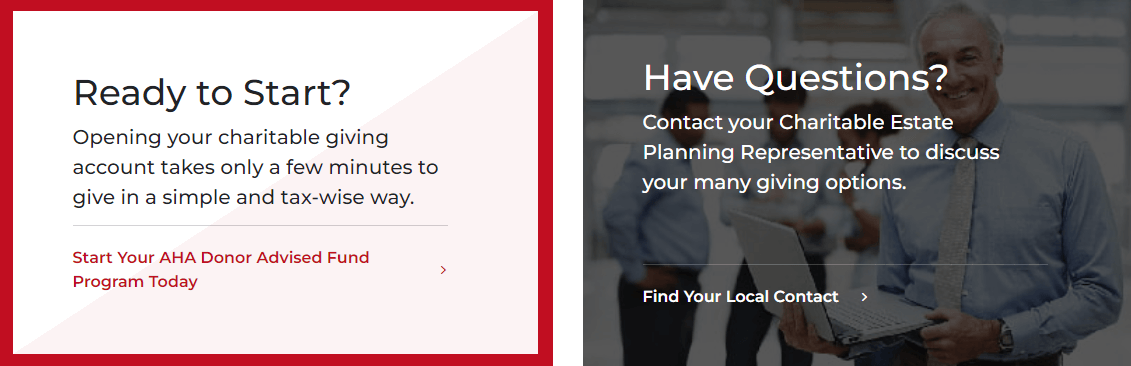
For example, the American Heart Association offers an effective example of useful calls to action (CTAs) for healthcare websites. Their donor stories end with CTAs that help visitors open a charitable giving account or reach out to a local representative with any questions. 

American Heart Association CTAs for opening a charitable giving account or contacting a representative

Welcome new donors with clear CTAs that allow website visitors to take the next step that aligns with their interests and needs. For example, your CTAs could say:

  • Support our scholarship fund today to help other students in need.
  • Leave a positive legacy with a planned gift.
  • Contact a local representative for more information about the impact of your gift.
  • Find the giving opportunity that works for you.

Your CTAs should be specific and welcoming, and they should lead to a user-friendly form or information page where supporters can take the next steps toward becoming donors or getting more involved in your cause. 


After optimizing your donor stories, promote them across multiple channels, including social media, email, and your printed newsletter. This will help reach a wider potential donor audience and ensure as many current donors as possible see your gratitude efforts. 

As Founder and CEO of Kanopi Studios, Anne Stefanyk helps create clarity around project needs, and turns client conversations into actionable outcomes. She enjoys helping clients identify their problems, and then empowering the Kanopi team to execute great solutions.

Anne is an advocate for open source and co-organizes the Bay Area Drupal Camp. When she’s not contributing to the community or running her thoughtful web agency, she enjoys yoga, meditation, treehouses, dharma, cycling, paddle boarding, kayaking, and hanging with her nephew.

Lights, Camera, Action! 5 Tips to Engage Donors with Video

The right video has the power to spark an emotional connection between your nonprofit and its donors. Learn how to engage donors through video in this guide. 

By Doug Scott

Imagine a donor is searching online for charitable causes to support. With a desire to make a difference, they scroll through various nonprofit websites, reading about their missions and impact. Suddenly, something catches their eye. It’s a compelling and emotionally charged video showcasing your nonprofit’s work. Impressed by the video, they immediately sign up for your mailing list and follow you on social media.

Video has the unparalleled ability to grab people’s attention. By combining visuals, music, and storytelling techniques into one unique package, nonprofits can resonate with donors in a way that’s difficult to achieve through other mediums.

In this guide, we’ll explore five ways you can use video to engage, inspire, and leave a lasting impact on the hearts and minds of donors.

1. Film for each stage of the donor journey

The donor journey refers to the process by which individuals progress from being unaware of your nonprofit to becoming engaged and committed donors. When you know which stage of the donor journey an individual is at, you can more effectively appeal to their interests and solicit their support.

For each stage of the donor journey, you can create engaging videos:

  • Awareness stage: At this stage, donors are learning about your organization for the first time. Create compelling “Who We Are” videos that introduce them to your mission, values, and impact. 
  • Consideration stage: Here, donors are evaluating whether or not they have a connection to your cause. Produce educational videos that explain how your programs address specific issues and share success stories of those you’ve helped, emphasizing positive outcomes. 
  • Decision stage: As donors prepare to give, they need assurance that their support will make a real impact. Create testimonial videos featuring past donors that reinforce their decision to give. Have them share their experiences and the impact they have witnessed. 
  • Retention Stage: After donating, donors want to stay engaged and see the impact of their gift. Update them through video, demonstrating the progress you have made and thank donors for their contributions. Highlight upcoming projects and events to encourage ongoing involvement.

Track engagement at each of these stages to gain insight into the content that resonates with donors and adjust your communication strategies accordingly. 

2. Create a compelling story

Whether you’re creating content for donors in the awareness or retention stage, it’s important to use storytelling techniques to create an emotional connection with donors and transport them to the heart of your mission. To tell a compelling video story, follow these steps:

  1. Set the scene. Decide where your video will take place, whether that’s behind the scenes of your facility, through the communities you serve, or in front of a plain backdrop. 
  2. Showcase character development. Introduce relatable characters, such as beneficiaries, volunteers, staff members, or other donors. Share their personal challenges, aspirations, and journeys. Through their experiences, viewers can emotionally connect to the cause and the impact your organization makes.
  3. Highlight conflict and resolution. Present the challenge that your beneficiaries face. Then, showcase how your organization’s efforts and your donors’ support lead to resolution and positive change. 

Let’s explore how these elements can be translated into a campaign video. Opening with a close-up of volunteer Sarah’s passionate smile, the scene expands to show her engaging with beneficiaries at a community center. As Sarah narrates the food insecurity challenges faced by her community, she shares the transformative story of a young girl who receives free, nutritious meals due in part to the donations of generous viewers.

3. Keep it short and sweet. 

Attention spans are declining, so keep your videos short and sweet. According to Tectonic Video, the ideal length of a nonprofit video is around two to three minutes, meaning you have a small window of opportunity to grab people’s attention and get them invested in your cause. 

Write a script in advance to outline key points and ensure that the video stays focused. Make sure to read the script out loud and time it before filming to verify it’s the right length. Then, after filming, use editing tools to remove any redundant or repetitive information.

If you have more information to share, create a series of videos related to the same topic and stagger their release over a longer period of time. This will help you maintain a steady stream of engagement.

4. Include a call to action

Add a call to action to the final scene of your video to provide clear and immediate next steps for donors feeling inspired by the content. Encourage them to take specific actions, such as visiting your website to explore involvement opportunities, following you on social media for updates, or sharing the video to spread awareness. 

This can be accomplished through narration, on-screen text, and buttons. For instance, the narrator could say, “Join us in our mission to provide clean drinking water to communities in need.” Then, on-screen text could appear that says, “Visit our website to contribute to the construction and maintenance of water infrastructure,” pointing viewers to a large donation button. 

5. Share it widely 

Once you have created a compelling video, publish it on Vimeo or YouTube. Then, Double the Donation recommends sharing the content across several channels, which may include:

  • Direct mail: Include a QR code or a short URL in your direct mail materials that recipients can scan or type to access the video online. Use a compelling image from the video on the mailer to pique interest. 
  • Email: Embed the video directly in targeted email campaigns or your email newsletter for easy viewing. Craft a captivating subject line that hints at the video’s content. Then, use a short, attention-grabbing preview image that encourages recipients to click and watch. 
  • Social media: Customize the video for each platform’s specifications. For instance, videos must be vertical for Instagram Stories and square for Facebook. Write engaging captions that highlight the purpose of the video and use relevant hashtags to increase visibility. 
  • Website: Embed the video prominently on your website’s homepage and relevant landing pages, such as your donation page. For optimal performance, compress videos to reduce load time and use responsive video players that adapt to different screen sizes.

With multiple touchpoints, you can reach people on their preferred platforms and grab the attention of as many donors as possible. In turn, you’ll see higher engagement rates.


Now that you know how to engage donors with video, it’s time to create content! If you want to ensure the highest level of quality and engagement, partner with a nonprofit video production company. Their teams of experts will work alongside your nonprofit to get to know your mission, target audience, and goals, before translating these insights into a compelling video concept. Together, you can harness the power of video to leave a lasting impact on donors, one frame at a time.

Doug Scott is the Founder & CEO of Tectonic Video. He has more than 20 years of nonprofit communications experience as a filmmaker, communications director, chief marketing officer, and leader of two creative agencies for nonprofits. Doug is a global citizen having traveled to more than 50 countries. He earned his B.A. in Strategic Communications from DePaul University, and he’s a frequent guest lecturer at Stanford University on topics related to nonprofit storytelling and storytelling ethics.