How You Can Create a Thank You Plan

Thanking your donors is just as important, if not more important than fundraising. Yet many organizations spend a lot of time putting together a fundraising campaign and treat thanking their donors as an afterthought.

We’re still in a time of uncertainty. While some people have been generous over the last two years, we don’t know how long that will continue.

Prioritizing gratitude and donor relations will help. If you don’t do a good job of thanking your donors, as well as building relationships throughout the year, you’ll have a hard time getting people to people to donate again, which is one of the keys to your success.

This is why having a thank you plan is crucial. It’s not only important when you’re running a fundraising campaign, but also during the “between times.”

Many organizations just thank their donors after they receive a gift and then disappear until the next fundraising appeal. Your donors deserve better than that. 

Thanking your donors is something you need to do throughout the year – at least once a month, if you can. A thank you plan will help you stay focused on gratitude all year round.  

Here’s what you need to include in your thank you plan.

Plan to make a good first impression with your thank you landing page

Your landing page is your first chance to say thank you and it shouldn’t resemble Amazon checkout. It should make a person feel good about giving a donation.

Open with Thank you, Susan! or You’re amazing! Include an engaging photo or video and a short, easy-to-understand description of how the donation will help your clients/community right now. Put all the tax-deductible information after your message or in the automatically generated thank you email.

If you use a third-party giving site, you might be able to customize the landing page. If not, follow up with a personal thank you email message within 48 hours.

Plan to write a warm and personal automatic thank you email

Set up an automatic thank you email to go out after someone donates online. This email thank you is more of a reassurance to let your donor know you received her donation. You still need to thank her by mail or phone.

Just because your thank you email is automatically generated, doesn’t mean it needs to sound like it was written by a robot. Write something warm and personal.

Give some thought to the email subject line, too. At the very least make sure it says Thank You or You did something great today and not anything boring like Your Donation Receipt or Donation Received. And please stop using words like transaction and processed. A donation is not a transaction. It’s the start or continuation of a relationship.

Plan to thank your donors by mail or phone

I’m a firm believer that every donor, no matter how much she’s given or whether she donated online, gets a thank you card or letter mailed to her or receives a phone call.

Try to thank your donors within 48 hours or within a week at the latest. It might be hard to do that right now, but it will be easier if you plan to carve out some time to thank your donors each day you get a donation. Remember, thanking your donors should be a priority. If you wait too long, you’re not making a good impression.

Instead of sending the usual generic thank you letter, mail a handwritten card or call your donors. Making thank you calls or writing thank you notes is something your board can do. 

Find board members, staff, and volunteers to make phone calls or write thank you notes. Come up with sample scripts. You may want to conduct a short training. Make sure to get your team together well before your next fundraising campaign so you’re ready to go when the donations come in. 

Here’s a sample phone script, which you can modify for a thank you note/letter/email. 

Hi Ben, this is Laura Kramer and I’m a board member at the Riverside Community Food Bank. I’m calling to thank you for your generous donation of $50. Thanks to you, we can continue to provide neighborhood families with healthy food. This is great. We’re seeing more people come in right now because of rising food costs, so we really appreciate your support.

You’ll stand out if you can send a handwritten thank you card. I get a few of these a year and they tend to come from the same organizations, which shows you what they prioritize! 

If you can’t send handwritten cards or call all your donors, send them a personal and heartfelt letter. If you’ve been using the same letter template for a while, take time to freshen it up. Don’t start your letter with On behalf of X organization, we thank you for your donation of…. 

Open your letter with You’re incredible or Because of you, the Sanders family can finally move into their own home. Create separate letters for new donors, renewing donors, and monthly donors.

Add a personal handwritten note to the letter, preferably something that pertains to that particular donor. For example, if the donor has given before, mention that. Hand sign the letters, if you can.

Let your donors know how much you appreciate them and highlight what your organization is doing with their donations.

In addition, write your thank you letter at the same time you write your appeal letter. Make sure they’re ready to go as soon as the donations come in. Don’t wait three weeks.

Plan to keep thanking your donors all year round

This is where having a thank you plan makes a difference because as I mentioned before – thanking your donors is something you must do all year round.

You can use your communications calendar to incorporate ways to thank your donors, but why not go one step further and create a specific thank you calendar?

Remember to try to say thank you at least once a month. Here are some ways to do that. 

  • Send cards or email messages at Thanksgiving, during the holidays, on Valentine’s Day, or mix it up a little and send a note of gratitude in June or September when your donors may not be expecting it. Try to send at least one or two gratitude messages a year by mail, since your donors will be more likely to see those. And you don’t need a holiday or special occasion to thank your donors. Thank them just because….
  • Invite your donors to connect with you via email and social media. Keep them updated with accomplishments and success stories, as well as how the current situations are impacting your work. Making all your communications donor-centered will help convey an attitude of gratitude. Be sure to keep thanking your donors in your newsletter and other updates. Emphasize that you wouldn’t be able to do the work you do without your donors’ support.
  • Create a thank you video and share it on your thank you landing page, by email, and on social media. Go one step further and personalize it. 
  • Send a warm-up letter or email about a month before your next campaign (no ask). This is a great way to show appreciation BEFORE you send your appeals.
  • COVID makes it tricky to plan an open house or tours right now, but you could do something virtual to let your donors see your nonprofit up close and personal. Also, a virtual gathering or tour may be easier to pull off. 
  • Keep thinking of other ways to thank your donors. You can repeat some of the ones listed above over the year.

The tactics that work best are going to differ for each organization. I would definitely send something by mail a few times a year. Email and social media may not be as successful, especially if your donors don’t use electronic communication very much. You could survey them to find out their communication preferences, as well as their interests. This will help with your engagement.

Creating a thank you plan will make it easier to keep showing appreciation to your donors all year round. You need your donors right now, so don’t hold back on that always-important gratitude.

How Are You Sharing Stories With Your Donors?

People have been sharing stories of various kinds for centuries. I’m a big reader and always appreciate a good story.

Your nonprofit organization also needs to share stories in order to connect with your donors.

Donors want to hear your stories

I imagine you’re not using stories as much as you should. That’s a mistake because people respond better to stories than a bunch of facts and statistics. Stories bring the work you do to life by using everyday language to create a scene.

You may be reluctant to use stories because it’s more work for your organization, but that shouldn’t stop you. Summer is a good time to come up with some new stories.

Your stories need to be relevant

I don’t need to tell you the world has changed over the last two years. Your stories need to take the everchanging current situations into account. We may be done with COVID, but COVID isn’t done with us. We’re also seeing inflation and a possible recession. Let your donors know how all this is impacting your clients/community right now.

Create a culture of storytelling

If you create a storytelling culture in your organization, you can make storytelling the norm instead of the exception.

Work with your program staff to create stories that will help you connect with your donors. Everyone needs to understand how important this is. Share stories at staff meetings and/or set up regular meetings with program staff to gather stories. 

When you put together a story, ask.

  • Why is this important?
  • Who is affected?
  • Why would your donors be interested in this story?
  • Are you using clear, everyday language (no jargon) to make sure your donors understand your story?
  • How are your donors helping you make a difference or How can your donors help you make a difference?

Client or program recipient stories are best. Remember, donors want to hear how they’re helping you make a difference for your clients/community.

Another way to find stories is to put a Share Your Story page on your website. This could be a good way to get some current, relevant stories.

Language is important

Please stop using jargon such as at-risk and underserved. These terms undermine your clients/community. These aren’t terms your donors use, anyway. Use language they’ll understand. 

You also don’t want to give the impression that your organization is coming in to save someone. This is especially important if the majority of your staff and donors are white, but your clients are people of color. This is known as white savior complex. Most likely that’s not intentional on your part, but watching how you tell your stories will help you avoid that. Be respectful of your clients/community.

Your stories aren’t about your organization

Keep in mind that your stories aren’t about your organization. Your organization may have had to make a lot of changes over the last two years to do some of the work you do, but that’s not your story. Your story is why this is important for the people/community you work with. 

Maybe you had to change the way you run your food pantry, but what’s most important is that people in your community continue to have access to healthy food. 

Make your stories personal 

Tell a story of one (person or family). Use people’s names to make your stories more personal. I realize you might run into confidentiality issues, but you can change names to protect someone’s privacy. You could also do a composite story, but don’t make up anything.

Use different stories for different types of communication

Create a story bank to help you organize all your stories. You want to use stories as much as possible. Use them in your appeals, thank you letters, newsletters, updates, annual reports, website, blog, and other types of social media. 

While you can come up with some core stories, they’ll be slightly different depending on the type of communication. 

In a fundraising appeal, you want to highlight a problem or need. Let’s return to the food pantry example. Here you can tell a story about Lisa, a working single mother with three kids who’s having trouble feeding her family because of rising food costs. 

In your thank you letter, you can let your donors know that because of their generous gift, Lisa can get healthy food for her family at the Westside Community Food Bank.

Then in your newsletter, annual report, or update, you can tell a success story that because of your generous donors, Lisa doesn’t have to worry so much about how she’ll be able to put food on the table.

Make connections with your donors by sharing stories. In my next post, I’ll write about sharing visual stories.

How to Build Relationships With Your Monthly Donors

Over the summer I’ve written about the importance of building relationships and having a strong monthly giving program. This post combines both of these topics.

Specifically, I want to focus on building relationships with your current monthly donors. 

Don’t take these donors for granted. Monthly donors stepped up during the height of the pandemic and you should be able to rely on them during any economic uncertainty.

This doesn’t magically happen. You need to devote time to connecting with these valuable donors. 

Make a plan

First, create a plan for your monthly donor communication. Although I’m emphasizing summer, you need to communicate with your monthly donors (and all donors) throughout the year. I like to say because these donors support you every month, you should reciprocate by communicating with them at least once a month.

You can incorporate this into your communications calendar. Fill it with ways to show gratitude and share updates. You can use a variety of channels. Here are some ideas to get started.

Send something by mail

How often do you get something personal in the mail? Not often, right? And when you do, it stands out.

How about sending a handwritten note to your monthly donors? Another option is to create a postcard thank you and/or update. Your donors will really appreciate this nice gesture.

Create a video

Videos are a great way to connect and they’re not that hard to create. If you can personalize it, all the better. Otherwise, you can create a general one that thanks your monthly donors.

You can also create a video that gives a behind-the-scenes look at your organization or a virtual tour. 

Spruce up those automatic thank you emails

Those automatic thank you emails you may have set up don’t count as part of your monthly donor connection plan. It’s fine to create these, but you don’t have to. While these monthly acknowledgments offer donors reassurance that the organization received their gift, they’re often uninspiring. Many of these acknowledgments are just receipts and a receipt is not a thank you.

Spruce them up a little and change the content every few months. Use this as an opportunity to share some updates.

Here’s a timely example from Planned Parenthood.

Ann,

Thank you for supporting Planned Parenthood! Your tax-deductible monthly gift of ___has been processed.

The recent Supreme Court decision in Dobbs v. JWHO is horrifying and dangerous. But all of us at Planned Parenthood remain committed to working to ensure that every patient who needs high-quality, affordable health care can access it.

In this crisis for abortion access, independent providers, abortion funds, and Planned Parenthood health centers will do everything they can to connect anyone who wants an abortion with the care they need.

Your monthly gift to Planned Parenthood fuels our efforts to expand access to abortion and protect affordable sexual and reproductive health care.

With our gratitude for your support, we also want to uplift our partners — abortion funds and independent providers — who are also doing the necessary work to make sure people who need care can access it.

We know you’re invested in our movement because of your generous monthly gift, and, if you’re so inclined, we encourage you to take a few minutes in the next few days to find your local abortion fund or independent provider and connect with them to see how you can help.

On behalf of all of the individuals that your support has allowed us to help, thank you for standing with us.

If you need to change your credit card or billing information, please visit the Self-Service Portal, or contact our Donor Services team by submitting a question online or calling 1-800-430-4907.

Thank you again for your support.

With the exception of using the word processed, I think this is a good acknowledgment. They also include information on how to change your credit card by accessing a self-service portal. This can also give people the opportunity to easily upgrade their gifts.

Get noticed with an enticing subject line

Most likely you’ll communicate by email, which has its pros and cons. It’s easier and less expensive than a postal mailing, but since people get an enormous amount of email, they might miss your message.

One way to get noticed is to use an enticing subject line. Here’s one I like from Pet Partners – Your monthly gift in action 

It goes on to tell a story about a therapy dog who visits a school and interacts with kids who have been diagnosed with ADHD, who have been placed in foster care, and who are dealing with other difficult situations.

Keep your donors engaged with good content

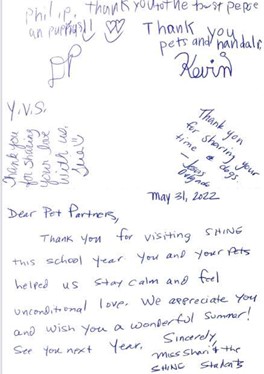
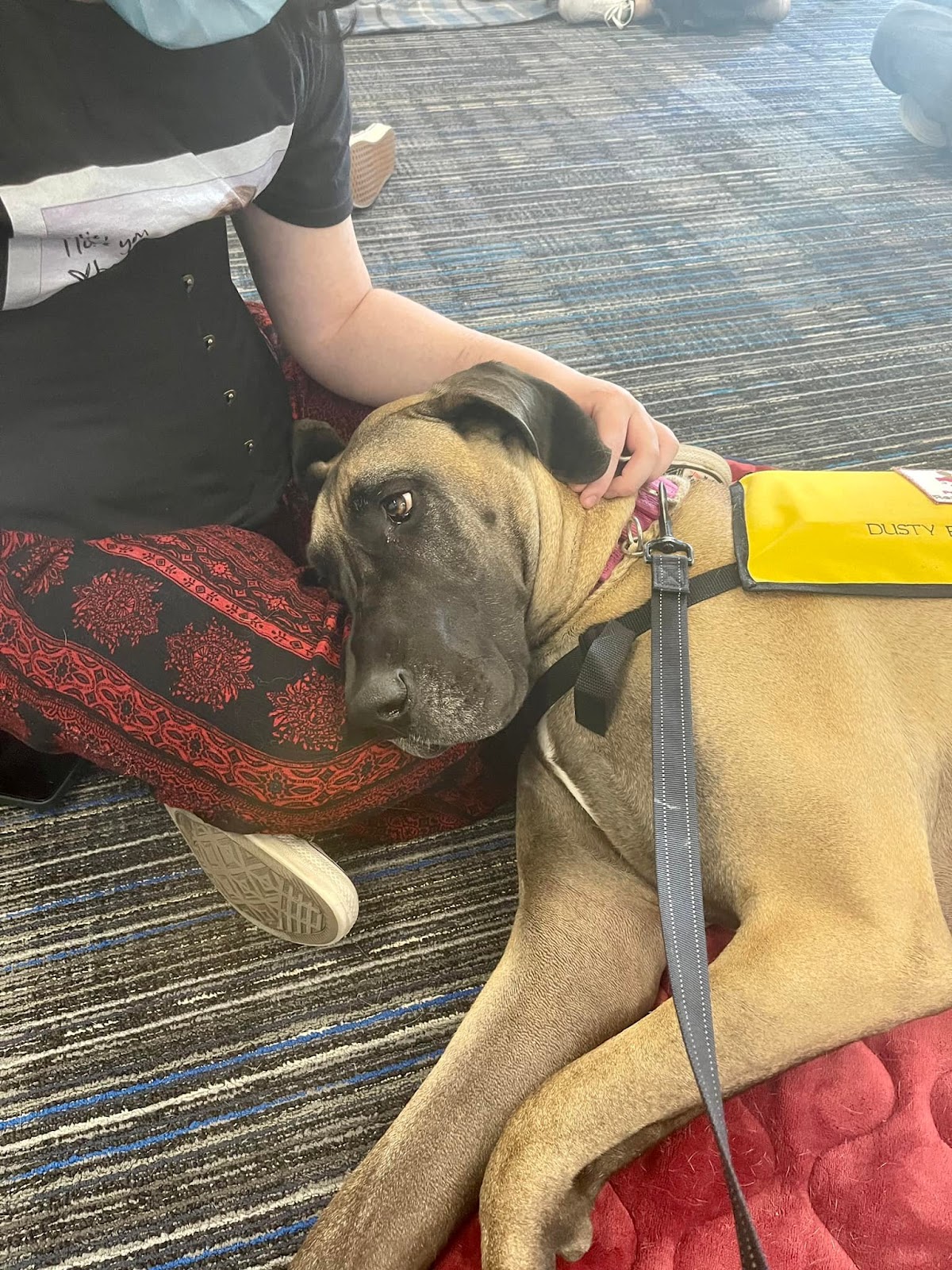
Congratulations, your donor opened your email message. You want to keep them engaged. Here’s the full message from Pet Partners, along with a picture of a thank you note from the kids and the therapy dog Dusty Rose.

Dear Ann,

Your monthly commitment to Pet Partners allows for stability within our organization that directly affects our volunteer experience and the visits they make. Without your support of the human-animal bond, the beautiful impact that our therapy animal teams make wouldn’t be felt. Thank you.

Many handlers partner with other local therapy animal teams to create local community-based groups, as is the case with Santa Clarita Pet Partners Therapy Dogs. Handler Sharon reflects on her time working with this group alongside her therapy dog Dusty Rose as they finish up their visits for the school year at the local elementary school:

“We visit at the school once a week during the school year with children who have been diagnosed with ADHD, who have been placed in foster care, and who are dealing with other difficult situations. They always look forward to our dogs. Typically we have three dogs visiting at a time, each assigned to a student by the school therapist. The students will sit on the floor with the therapy dogs to pet them, do tricks, talk, and relax together.

“Dogs create a nonjudgmental environment for these children. Many times during our visits they will share private information and feelings that they have never told anyone else. They might share that someone is being mean to them, or that when they were gone their parents gave away their dog. Life is difficult for many of these students, but they light up at the sight of their furry friends and the unconditional love the dogs offer.”

During one of the latest visits, the children showed their appreciation through a beautiful thank you note. Though this note is written directly to the therapy animal teams, it is because of your support that the children get to experience the heartwarming impact of therapy animal visits.

Make it personal

Be sure to address your donors by name, just like what you see in the examples above. I would also recommend separate communication for new donors and longer-term donors. 

Welcome new monthly donors. You can go a step further with different messages for brand new donors and single gift donors who have upgraded to monthly. Be sure to give special attention to longer-term donors. The average donor retention rate for monthly donors is 90% and you don’t want that to go down.

You can give shout outs in your newsletter and social media, but those won’t be as personal. Some organizations include a cover letter or note for their monthly donors in their newsletters. You could also create separate newsletters for monthly donors.

The key is to stay in touch and keep making connections. Remember to thank these donors every month

Don’t ignore your valuable monthly donors. Keep building those important relationships

The 5 C’s of Good Nonprofit Communication

I’d like to revisit a topic I’ve written about in the past and that’s the 5 C’s of good nonprofit communication. You can think of this as a summer rerun. Some of you will remember the time networks (and even longer ago there were just a few of them) didn’t release new TV shows in the summer and we just watched reruns. But I digress….  

It’s important to keep these 5 C’s in mind when you’re writing a fundraising appeal, thank you letter, update, or any type of donor communication.  

Is it Clear?

What is your intention? What message are you sending to your donors? Are you asking for a donation, thanking them, or sharing an update? 

Whatever it is, make sure your message is clear. If you have a call to action, that needs to be clear as well. You also want to stick to one call to action. If you ask your donors to make a donation, volunteer, and contact their legislators in the same message, you run the risk of them not doing any of those.

You want your message to produce results. Plain and simple, your fundraising appeal should entice someone to donate. Your thank you letter should thank your donors (no bragging or explaining what your organization does) and make them feel good about donating.

Use language your donors will understand (no jargon). Keep out terms like food insecurity and underserved communities. Just because something is clear to you, doesn’t mean it will be clear to others. 

Is it Concise?

Can you say more with less? Eliminate any unnecessary adverbs, adjectives, and filler. Make your point right away. Concise writing doesn’t mean you need to be terse or all your print communication has to be one page. Sometimes it will need to be longer, but the same rules apply. 

Nonprofit organizations like to pack a lot of information into their monthly/quarterly newsletters and annual reports, but many donors won’t read something if it looks like it will be too long. 

Shorter, more frequent communication is better. This applies to the example I gave above about not putting more than one call to action in a message. You’ll have better results if you send separate messages for each call to action.

Also, most people skim, so use short paragraphs and lots of white space, especially for electronic communication.

Make all your words count.

Is it Conversational?

Write as if you’re having a conversation with a friend and be personable. Use the second person – where you refer to your donors as you and your organization as we. Remember to use you much more than we. 

Avoid using jargon, cliches, multi-syllable words, and the passive voice. Is that the way you talk to your friends? I hope not.

You may think you’re impressing your donors by using jargon and big words, but most likely you’re confusing them or even worse, alienating them. Connect with your donors by using language they’ll understand.

Is it Compelling?

Is whatever you’re writing going to capture someone’s attention right away and keep them interested? The average human attention span is eight seconds, so the odds are stacked against you.

Start with a good opening sentence. Leading with a question is often good. Stories are also great. 

Put a human face on your stories and keep statistics to a minimum. Start a fundraising appeal with a story that leads to a call to action.

Are you establishing a connection?

Donors are drawn to your organization because they feel a connection to your cause. You also need to establish a connection with them. You can start by segmenting your donors by different types, such as new donors, current donors, and monthly donors. 

Get to know your donors better and give them content you know they’ll be interested in. Hint – it’s not bragging about your organization. They want to know how they’re helping you make a difference for your clients/community. They also want to feel appreciated. Focus on building and sustaining relationships.

Keep these 5 C’s in mind to help ensure good communication with your donors.

How Your Nonprofit Can Keep Things Simple

Over the years I’ve realized the importance of keeping things simple. For some of us, the pandemic forced us to keep things simple since we were limited in what we could do, especially outside the house. I found pleasure in simple things such as taking a walk, reading, and doing yoga, all of which I continue to make time for, if I can. 

Keeping it simple doesn’t have to mean a bare-bones existence. There’s a Swedish term called lagom meaning everything in moderation or not too much, not too little. Or think of Goldilocks and choose what’s “just right.” This can apply to how much information we take in about the pandemic, the economy, politics, the war in Ukraine, etc. – enough to know what’s going on, but not too much so it’s overwhelming. 

Keeping things simple is also important for your nonprofit organization. I feel like we are in a constant vortex of change. I know you’re continuing to navigate this uncertain climate.

That said, you need to continue to raise money and communicate fairly regularly with your donors, while not taking on too much. Donors are also navigating the changing situations, but they want to help if they can and they want to hear from you. What they don’t want is a lot of complex content.

Here are a few ways to simplify your donor communication without making it too difficult for you.

Keep it simple by planning ahead

If communicating regularly with your donors sounds overwhelming, plan ahead by using a communications calendar. You should be in touch every one to two weeks, if possible. Otherwise, aim for once a month. Fill your calendar with different ways to do that and update it as needed. A good rule of thumb is – ask, thank, update/engage, repeat. And as I mention below, you can keep it simple with shorter communication.

Keep it simple by sticking to one call to action

Your communication needs to be clear. Before you send an email message or letter, ask what is your intention? Is it to ask for a donation, say thank you, or send an update?

Stick to one call to action. Suppose you send a message that includes requests for a donation, volunteers, and for people to contact their legislators. It’s likely your donors won’t respond to all of your requests and may not respond to any of them. Send separate messages for each request.

In your fundraising appeals, don’t bury your ask. You can start with a story, followed by a clear, prominent ask. Recognize your reader. Thank previous donors and invite potential donors to be a part of your family of donors.

Your thank you letter or email should thank the donor. Simple, right? Make them feel good about giving to your organization. Welcome new donors and welcome back returning donors. You don’t need a lot of wordy text explaining what your organization does.

Keep your messages simple, yet sincere, and include a clear call to action.

Keep it simple with shorter, easy-to-read messages

Plain and simple, if your communication is too long, most people won’t read it. 

Limit print communication, such as newsletters and annual reports, to four pages or less. Your email messages should be just a few paragraphs. On the other hand, you don’t want to be terse or say too little.

“I didn’t have time to write a short letter, so I wrote a long one instead.” Mark Twain

Be sure your communication is easy to read and scan. Use short paragraphs, especially for electronic communication, and include lots of white space. Don’t clutter up the page.

Keep it simple by using conversational language

I find it annoying when I read an appeal letter or newsletter article that sounds like a Ph.D. thesis. Write at a sixth to eighth-grade level. That’s what most major newspapers do. This is not dumbing down. You’re being smart by ensuring your donors will understand you. There are programs out there that can help you determine the reading level. Plus, you can raise more money if your messages are easy to read.

Keep out jargon and other confusing language. Instead of saying something like – We’re helping underserved communities who are experiencing food insecurity, say  – Thanks to donors like you, we can serve more families at the Eastside Community Food Bank. 

We’re seeing real people being affected by real problems. Don’t diminish this with jargon and other vague language.

Use the active voice and there’s no need to get fancy by using a lot of SAT vocabulary words. Again, you want your donors to understand you.

Keep it simple by creating a clutter-free website

Your website is still a place where people will go to get information. Make sure it’s clear, clutter-free, and easy to read and navigate. Don’t forget about short paragraphs and lots of white space.

One of the most important parts of your website is your donation page. It needs to be easy to use and collect enough information without overwhelming your donors. If it’s too cumbersome, they may give up and leave.

If it’s a branded page (e.g. not a third-party site like PayPal), make sure it’s consistent with your messaging and look. Don’t go too minimalistic, though. Include a short description of how a donor’s gift will help you make a difference, as well as an engaging photo.

Make it easier for your nonprofit and your donors by keeping things simple.

Photo via One Way Stock

Are You Still Using Jargon?

Over the last two years, we’ve seen many examples of real problems affecting real people. We’ve also seen more authenticity. So why are some nonprofit organizations still using jargon in their donor communication?

They may be using the same, boring templates they’ve used for years or they’re so used to some of these terms they don’t realize they fall flat with their donors. I think people use jargon because it’s insider language that makes them feel like they’re “in the know” in their professional community. It’s easy to slip into jargon mode in your work environment (whether that’s in person, virtual, or hybrid). But the danger comes when jargon creeps outside of your insular world and into your donor communication.

People need to understand you to connect with you

Sometimes we get lazy and use jargon when we can’t think of anything fresh and original. Instead, you see appeal letters, thank you letters, newsletter articles, and annual reports laced with cringe-worthy terms such as food insecurity, at-risk youth, underserved communities, and impactful. While donors may know what some of these terms mean, they’re vague, impersonal, and can come across as demeaning.

Are You Speaking The Same Language As Your Donors?

How to do better

You may know you need to freshen up some of your messages, but aren’t sure how to start. You may also have a lot going on and feel pressed for time. 

Sometimes you need to give a little more information. Let’s look at these problem terms and what you can say instead. You may use some of these terms internally and they might be in your mission statement, but please try to limit them when you communicate with your donors.

  • Food insecurity The USDA defines it as “a household-level economic and social condition of limited or uncertain access to adequate food.” That’s a mouthful! I’ve never liked the term food insecurity because it’s so impersonal. We’re hearing this term a lot right now because it continues to be a big problem. Let’s go a step further and put it in human terms by describing a situation where a single mother has to choose between buying groceries and paying the heating bill.
  • At-risk means there’s a possibility something bad will happen. Instead of just saying at-risk students or youth, tell a story or give specific examples of something bad that could happen or has happened. Our tutoring program works with high school students who are more likely to fail their classes, be held back, and drop out of school. Remote learning didn’t work for many of the students in our community and they have fallen behind. 
  • Underserved means not receiving adequate help or services. Instead of saying we work with underserved communities, explain what types of services these residents don’t receive. Maybe it’s healthcare, affordable housing, decent preschool education, or all of the above. Tell a story or give a specific example. Mara has to take two buses to see a doctor for her diabetes because there isn’t a good healthcare facility in her community. This makes her feel anxious because not everyone on the bus wears a mask, so sometimes she skips her appointments.
  • Impact means having an effect on someone or something. How are you doing that and why is it important? Again, give a specific example. Thanks to donors like you, we’ve helped families find affordable housing so they don’t have to live in a shelter, with other family members, or in their car. Now they have a place to call home. And, let’s please all agree to stop using the word impactful.

Tell a story

This is why stories are so important. You can get beyond that vague, impersonal jargon and let your donors see firsthand how they’re helping you make a difference for your clients/community.

Make Connections With Your Donors by Sharing Stories

What would Aunt Shirley or Uncle Ted think?

I always like to use this analogy. Imagine you’re at a family gathering and you’re explaining what your organization does to your 75-year-old Aunt Shirley, or maybe it’s Uncle Ted. Does she look confused and uninterested when you use words like underserved and at-risk, or does he perk up and want you to tell him more when you mention you’ve been able to help homeless families move into their own homes?

Stop using jargon in your work environment

Another way to help you transition from jargon to understandable language is to stop using it in your work environment. That means at staff meetings and in interoffice written communication. Maybe you go so far as to re-write your mission statement to make it more conversational. And telling staff and board members to recite your mission statement as an elevator pitch is a bad idea unless you can make it conversational.

Let’s stop using jargon when we can use clear, conversational language instead. Keep reading for more examples of why you should stop using jargon.

Too Much Jargon, Too Little Time: 3 Easy Tips to Simplify Your Copy

Nonprofit Jargon: Do Your Supporters Understand Your Fundraising?

How Jargon Destroys Nonprofit Fundraising & Marketing

How You Can Make Your Messages Stand Out

Do you feel as if information overload is getting worse every year? There’s so much going on right now. Getting your messages out is never easy, but like everything else, it’s gotten a whole lot harder over the past two years.

Your nonprofit organization needs to continue communicating regularly with your donors and you need to do it well. With everything that’s going on, it’s possible they’ll miss your messages. 

Here are a few ways you can make your messages stand out. 

What’s your intention?

What’s the purpose of your message? What do you want your reader to do? Are you asking for a donation? Maybe you’re thanking your donor or sharing an update.

Think from your reader’s perspective. What would she be interested in or what would make him take action?

Don’t muddle your messages with too much information. Keep it simple and stick to one call to action or type of message. 

Choose the right channels

Most likely you’ll use more than one channel to communicate. Pay attention to the channels your donors are using and focus your efforts there.

Email may be the primary way you’re communicating right now and there’s a reason for that. It’s fast, easy, relatively inexpensive, and almost everyone has an email address. You can quickly get a message out to a lot of people. Also, unlike social media, it’s something you can control. You don’t have to rely on a social media algorithm to hope your message ends up in your donor’s feed.

The downside is people get a huge amount of email from a variety of different sources. Plus, the average open rate is around 20%. I don’t know what’s going on in the conservative world, but some liberal political groups send way too much email, which I pretty much ignore. And, social media is often just a lot of of a lot.  

It’s easy for your electronic messages to get lost in the shuffle. Your donors may just tune things out, even if you have something engaging to share. 

While you’ll likely use electronic communication pretty regularly, don’t discount direct mail. Your donors are more likely to see these messages. We get far less postal mail than electronic communication. Also, someone can put a piece of mail aside and look at it later. Don’t count on that happening with any type of electronic communication. You can also communicate by phone. This is a great way to thank your donors.

Going multichannel is usually your best bet. This is very common for fundraising campaigns and inviting people to events, as well as including a link to your e-newsletter on your social media platforms. This way if people miss your initial message on one platform, they may see it on a different one. You’ll also want to send regular reminders for fundraising appeals and event invitations.

Get noticed right away

Remember, your donors have a lot going on and you need to capture their attention right away.

Your fundraising letters and anything else you send by mail needs to look appealing enough to open. You could put a tagline on the envelope. That doesn’t mean something like It’s Our Annual Appeal. Try something like – How you can help families put food on the table. Your envelope should look personal and not resemble a bill or junk mail.

“Dale’s” mail

Once your donor opens your fundraising appeal, lead with a story followed by a clear, prominent ask. When they open your thank you letter, they should be greeted with gratitude.

A good subject line is the key to getting someone to open your email message. Keep in mind that your donor’s inbox is bursting with messages. Don’t use something boring like April e-newsletter or Donation Received. Entice them with Find out how you helped families put food on the table or You just did something amazing today!  

Keep them engaged once they open your message.

Keep it short

In many cases, a shorter message is best. You want a good balance between saying too much and saying too little. All your words should count, so be careful about adding too much filler. That often includes bragging about your organization and explaining what you do.

Keep in mind the average human attention span is a mere eight seconds.

What’s in My Inbox | Shorter attention spans means you need to deliver with your enews

Your goal is to get your donors to read your messages. If it looks long and boring, they probably won’t bother.

Make it easy to read and scan

Besides sending a short message, use short paragraphs and lots of white space, too. Your messages need to be easy to read and scan in an instant. Most people aren’t going to read something word for word. Be sure they can quickly get the gist of what you want to say. Don’t use microscopic font either – use 12 point or higher.

Be personal and conversational

Write directly to your reader using clear, conversational language – no jargon. Don’t confuse your donors with generic messages.

Don’t cast a wide net

It’s important that you send your messages to the right audience and your audience isn’t everyone.

You’ll have more luck with a fundraising appeal when you send it to past donors or people who have a connection to your cause. The same is true for event invitations or recruiting volunteers.

You may want to reach out to as many people as possible, but that won’t guarantee you’ll get more donations or event attendees. Segmenting and engaging with the right audience will bring you better results.

Be a welcome visitor

If you communicate regularly and do it well, your donors should recognize you as a reputable source and are more likely to read your messages. If all you do is send them generic fundraising appeals, then it’s time for a change.

When you send email, make sure people know it’s coming from your organization. In the from field, put DoGood Nonprofit or Brenda Davis, DoGood Nonprofit. If you just put a person’s name or info@dogoodnonprofit.org, people may not know who it’s from and ignore your message.

Only send email to people who have opted into your list. Otherwise, you’re spamming them. Some people will choose not to receive email from you and that’s okay. The ones who do are interested in hearing from you. Give people the option to unsubscribe, too.

Even though people only get a few pieces of mail a day, most of it’s junk mail. You never want any of your letters, newsletters, or postcards to be perceived as junk mail (see above).

By putting in a little time and effort, you can help ensure that your messages stand out.

3 Strategies for Nonprofit Messages that Stand Out in Donors’ Mailboxes

How to Write Awesome Emails Your Donors Want to Read

Your Nonprofit Newsletter Should Engage Your Donors, Not Bore Them

A newsletter can be a great way to engage with your donors. Unfortunately, that doesn’t often happen because most donor newsletters can put you right to sleep. They’re too long and filled with boring articles that brag about how wonderful the organization is.

The good news is you can create an engaging newsletter your donors will want to read. Here’s what you need to do.

Think about what your donors want

You need to include content that will interest your donors. You also need to reference the current situations. Do you think your donors would rather read an article about your CEO receiving an award or one about Marla, a single mother who is having trouble making ends meet, but is grateful she can get food for her family at the Eastside Community food bank? 

The answer should be obvious. Your donors want to hear about how they’re helping you make a difference for your clients/community.

If you’re a larger organization, you could create different newsletters for different programs or one specifically for monthly donors.

Don’t shy away from a print newsletter 

You may opt not to do a print newsletter because it’s expensive and takes too much time, but you’re making a mistake if many of your donors prefer print.

I think you’ll have more success if you can do both print and electronic newsletters. I recommend a short e-newsletter once or twice a month and one to four print newsletters a year.

Many organizations put a donation envelope in their print newsletter. This is a proven way to raise additional money and you may be able to recoup your expenses.

You can also save money by creating a shorter print newsletter (maybe two pages instead of four) or only mailing once or twice a year. You can print them in-house, as long as it looks professional.

Be sure you have a clean mailing list. If you can get rid of duplicate and undeliverable addresses, that’s another way to save a little money.

Donors are more likely to read a print newsletter. But ask them what they like, and listen to what they say. If a majority of them prefer print, then you need to find a way to accommodate them.

Share your stories

Each newsletter needs to begin with a compelling story. If you’re making a difference, you have stories to tell.

Client stories are best, but you could also do profiles of volunteers, board members, and donors. Focus on what drew them to your mission (more on that below).

Create a story bank that includes at least four client stories to use every year.

Make Connections With Your Donors by Sharing Stories

Don’t stray from your mission

A common article I see in many nonprofit newsletters is one about a foundation or major donor giving a large gift. This may be accompanied by a picture of someone holding a giant check. Of course, you should recognize these donors (and all donors), but why is this gift important? How will it help your clients/community?

For example – This generous $50,000 grant from the Eastside Community Foundation will help us serve more students in our tutoring program. Many students have fallen behind since the pandemic started.

Something else I see a lot is a profile of a new board member. Instead of focusing so much on their professional background, let your donors know what drew them to your organization. We welcome Lisa Clark, Vice President of First National Bank, to our board. Lisa has a brother with autism and is very passionate about finding ways for people with autism to live independent lives. 

Write to your donors

Write your newsletter in the second person, emphasizing you much more than we. Be personal and conversational. Say – You helped Marla feed her family or Because of donors like you, X number of families have been able to get healthy food every week. 

Leave out the jargon and other language your donors won’t understand. Write as if you’re having a conversation with a friend.

I’m not a fan of the letter from the CEO because those tend to be organization-centered instead of donor-centered.  

Pour on the gratitude 

Never miss an opportunity to thank your donors. Many donors have stepped up over the last two years and they deserve to be thanked as often as possible. Every one of your newsletters needs to show gratitude and emphasize how much you appreciate your donors.

Make it easy to read (and scan)

Most of your donors aren’t going to read your newsletter word for word, especially your e-newsletter. Include enticing headlines and email subject lines (if you don’t, your donors may not read it at all), at least a 12-point font, and lots of white space so your donors can easily scan your newsletter.

Stick to black type on a white background as much as possible. Colors are pretty, but not if it’s hindering your donor’s ability to read your newsletter. Photos can be a great way to add some color, as well as tell a story in an instant.

Use the inverted pyramid and put the most important story first (client story or profile), keeping in mind your donors may not get to all the articles.

Keep it short

Your print newsletter should be no more than four pages. Limit your monthly e-newsletter to four articles. Some organizations send an e-newsletter twice a month. Those should be even shorter – maybe just two articles. People have a lot going on and don’t want to be bombarded with too much information.

Do the best you can

For some of you, putting together a newsletter may be too much to take on right now. You don’t have to do an actual newsletter, but you do need to keep your donors updated.

Do what you can, but be sure to update your donors at least once a month. You may find you have more success with shorter, more frequent email updates and postcards with an infographic a few times a year.

Create an engaging newsletter that won’t bore your donors.

Keep reading for more information on how to create a great donor newsletter.

Nonprofit Donor Newsletters | Print or Enews?

Worthwhile Nonprofit Newsletters: Content Donors Adore 

Tips for Using your Nonprofit Newsletter to Get More Donations Without Even Asking

10 Nonprofit Newsletter Ideas and Examples to Save for Later

Time for a Little Nonprofit Spring Cleaning 

It’s spring here in the Northern Hemisphere, although depending on where you live, it may or may not feel like it. 

A lot of people use this time of the year to do some spring cleaning. I know, groan. I envy the people who have taken on a bunch of cleaning and decluttering projects since the pandemic started. I’m not one of them. 

I know I should do more. As much as I dislike cleaning and organizing, I’m happy once it gets done. Often getting started is the hardest part.

Your nonprofit organization may have put off some version of your own spring cleaning and decluttering. It’s been a tumultuous two years and counting.

Take some time to tackle these so-called cumbersome tasks. Just think how happy you’ll be when you’re done. You’ll also make some much-needed improvements to your infrastructure and donor communication.

Here are a few suggestions to help you get started.

Clean up your mailing lists and database/CRM

Has it been a while since you’ve updated your mailing lists? Did you have an influx of address changes, returned mail, and bounced emails after you sent your year-end appeal? This is a good time to clean up and update both your direct mail and email mailing lists.

Don’t wait until right before your next mailing to clean up your donor data. If it’s been a while since you’ve done this, then you really need to do what is known as data hygiene.

Even though it’s tedious, have someone who’s familiar with your donors (your development director?) go through your mailing lists and database/CRM (customer relationship management) to see if you need to make any additions, changes, and deletions.

Be meticulous. No donor wants to see her name misspelled, be addressed as Mrs. when she prefers Ms., or receive three mailings because you have duplicate records.

Your donor database is an important tool and it needs to be up-to-date and filled with accurate information about your donors.

CLEAN UP YOUR ACT: DONOR DATA MANAGEMENT FOR NONPROFITS

Donor Database Best Practices To Care For Your Data Like You Care For Your Donors

Run your donor list through the National Change of Address database. It may cost some money to do this, but it’s worth it if you come out with squeaky clean data. Do this at least once a year.

Also, if you haven’t already done this, segment your donors into different groups – new donors, returning donors, monthly donors, etc. You may need to make some changes. For example, if a single gift donor starts giving monthly.

Make This the Year You Segment Your Donors

You might also want to move some lapsed donors who haven’t donated for several years into an inactive file. Don’t do this until you’ve sent targeted, personalized appeals asking them to donate again. And if you’ve never gotten in touch with any lapsed donors from 2021, you could reach out to them now.

Do the same thing with your email list. It doesn’t make sense to send email to people who don’t respond to it. Give these people a chance to re-engage, and if they’re not even opening your emails, move them to an inactive file. Don’t worry if people unsubscribe. You’re better off with an email list of engaged subscribers.

What’s in My Inbox | The Benefits of Cleaning Your Email List

Maybe you need a better CRM/database. If you’re using a spreadsheet to store your donor records, then you need an actual database. Get the best one you can afford.

Choosing a Donor Database: The Ultimate Guide for Nonprofits

Spring is about bringing in the new and a better database would be a wise investment. It can help you raise more money. You can also save money by having clean mailing lists.

Freshen up your messages

Now that you’ve cleaned up your mailing lists and segmented your donors, it’s time to freshen up your messages, if you haven’t done that for a while. I’ve written about this in a couple of recent posts, emphasizing that your donor communication needs to reference the current situations and steer clear of generic language and jargon. If you’re still using templates from before March 2020, you need a refresh.

Your thank you letters need to actually thank your donors, not brag about your organization. Make sure your automatically generated thank you emails and landing pages don’t look like boring receipts. Create separate templates for new donors, current donors, and monthly donors.

Why You Need a Thank You Plan

Let go of what you don’t need

The pandemic forced many organizations to rethink the way they did certain things. You may have held an in-person event for years, but in the spring of 2020 had to switch to virtual or run an emergency campaign. Maybe this worked better for you.

In-person events take a lot of staff time and don’t always bring in that much money. It’s also not clear they’re safe to put on right now. Just like those old clothes taking up room in your closet or a file cabinet stuffed with years of paperwork, it may be time to let go of this event (or anything else that doesn’t serve you) and find a different way to raise money.

Think better rather than new

In uncertain times, it’s better to focus on what’s going to work for your nonprofit instead jumping onto the latest craze. Focus on what you can do better. Instead of going on TikTok, think about growing your monthly giving program and building relationships with your donors. These are proven ways to help you raise more money.

Don’t wait too long

I know you have a lot going on, but you need to take on these initiatives sooner rather than later. Just like the clutter and dust in your home won’t disappear on their own, the longer you ignore it, the worse it gets. 

Get started on these spring cleaning projects as soon as you can. You’ll be happy once they’re done. Your donors will also be happy if they don’t get duplicate mailings and a fundraising letter laced with jargon, but do receive a personalized appeal and a stellar thank you letter.

Image by Marco Verch

Steer Clear of Generic Communication

Are you still sending all your donors the same appeal and thank you letters? In these letters, you never thank a donor for their past support or acknowledge they’re a monthly donor.

If that’s not bad enough, many of these letters use vague and impersonal language and even worse, jargon.

Since the pandemic started, some nonprofits have done better and have created more nuanced, personal communication. Let’s keep this up and all do better. Your donors deserve that.

Steer clear of anything generic and create something more personal. Here’s what you can do.

Segment your donors

Your donors aren’t the same, so they shouldn’t all get the same letter. Segment your donors into different groups as much as you can. At the very least, create different letters for new donors, repeat donors, and monthly donors. You can also personalize letters to lapsed donors, event attendees, volunteers, etc.

I emphasize segmenting your donors a lot in my posts because it’s so important. Donors like it if you recognize their past giving or anything that shows them this is more than a generic, one-size-fits-all message.

Make This the Year You Segment Your Donors

Donor Segmentation | Comprehensive Guide + Tips For Success

And while we’re on the subject of personalization, please stop sending Dear Friend letters, as well. You’re not being a good friend if you don’t even use your donors’ names.

I know this will take more time, but it’s worth the investment. So is a good database to help you with this. Your donors will feel appreciated and are more likely to give again, possibly at a higher level.

Use language your donors understand

If you use vague, generic language and jargon, you’re going to instantly bore and/or confuse your donors. Most of your donors don’t have a medical or social services background. They don’t use terms like food insecurity, at-risk populations, and underserved communities, and neither should you.

Connect with your donors by using language they’ll understand. Instead of talking about food insecurity, give an example of a family choosing between buying groceries and paying the heating bill.

What do you mean by at-risk or underserved? Are high school students less likely to graduate on time? Do residents of a certain community not have good health care nearby? Is housing too expensive? Get specific, but at the same time, keep it simple. Also, terms like at-risk and underserved undermine your clients/community. Remember, these are human beings you’re talking about.

Let’s Try to Stop Using Jargon So Much

How Jargon Destroys Nonprofit Fundraising & Marketing

A great way to steer clear of generic language and jargon is to tell stories. Most people respond better to a human-interest story than a bunch of boring statistics.

Make Connections With Your Donors by Sharing Stories

Why your good story leads to a better world

Make time for improvement

You may be between fundraising campaigns right now and have a little more time (maybe). If so, work on segmenting the donors in your database, if you haven’t already done that. Segmenting your donors isn’t a one-time deal. Make changes as needed. For example, some of your single-gift donors may have upgraded to monthly. If you can do this after every campaign, you should have fairly up-to-date information on your donors.

In addition, dust off those templates and freshen up your appeal letters and thank you letters. We’re living in an ever-changing world and you need to acknowledge current situations in your communication. Create letter templates for different donor groups and replace your vague, generic language with something clear, conversational, and specific.

You can also use this time to add new stories to your story bank or start putting one together, if you don’t already have one

Have someone outside your organization, a friend or family member, look at your messages. Something that’s clear to you may mean nothing to others.

Steer clear of your generic communication with something that shows your donors how much you appreciate them by recognizing who they are and giving them engaging content they can relate to.