What’s Keeping You From Starting or Growing Your Monthly Giving Program?

Monthly giving is one of the few types of fundraising that did well last year. If your organization doesn’t have a monthly/recurring giving program or it’s fairly small, what’s keeping you from starting or growing your monthly giving program?

Whether you’re a big or a smaller organization or you had a good fundraising year or you didn’t, monthly giving makes so much sense (or cents).

In this post, I’ll tell you why monthly giving is important for your nonprofit, how to start or grow your program, and how to nurture it going forward. 

Monthly giving helps you raise more money

Monthly or recurring donations can help donors spread out their gifts and it’s easier on their bank accounts. They might be apprehensive about giving a one-time gift of $50 or $100. But if you offer them the option of giving $5 or $10 a month, that may sound more reasonable. 

It can also give you a consistent stream of revenue throughout the year instead of at certain times, such as when you do individual appeals and events and when grants come in.

Monthly gifts are smaller, but you can raise a lot of money with lots of small donations. Political candidates do it all the time. Also, monthly gifts aren’t as small as you think. The average is $25 a month.

It can also be a more feasible way to get larger gifts. A gift of $100 a month may be more appealing to a donor than giving a large sum all at once. Even if they start with a smaller donation, monthly donors are more likely to become major donors and legacy donors.

It raises your retention rate, too

The retention rate for monthly donors is around 90%. That’s significantly higher than other retention rates. 

One reason is that monthly gifts are ongoing. But your donors have agreed to that, so this shows they’re committed to your organization. 

These are long-term donors and long-term donors should always be one of your priorities.

How to get started

If you don’t already have a monthly giving program, make this the year you start one. Remember, it will help you raise more money and shouldn’t be too hard to set up.

A good way to start is to invite your current donors to become monthly donors. Your best bet for monthly donors are people who’ve given at least twice. These are donors who have shown a commitment to you.

That doesn’t mean you can’t ask first-time donors. This could be a good way to connect with donors from your most recent campaign. And if you haven’t officially welcomed your new year-end donors, do that now. Create a series of welcome messages and conclude it by inviting people to become monthly donors.

You could create testimonials from current monthly donors in order to entice future monthly donors.

Make monthly giving your go-to option

Put monthly giving front and center in all your campaigns. It should be an easy option on your donation page. Include it on your pledge form and make it a prominent part of your appeal letter.

I can speak from personal experience that once I started giving monthly, that’s the way I wanted to give to all organizations. Your donors would probably agree. Each year I’m happy to see that more organizations are going all in on monthly giving.

Organizations that don’t offer a monthly giving option are making a mistake. Some have a minimum donation, which I would also not recommend, if possible. If you do have a minimum, make it $5 a month instead of $10. 

If your reason for having a minimum donation amount is to save money on your expenses, is that happening if your minimum deters someone from giving at all? You often have to invest a little to raise more money. And you should raise more money with a monthly giving program.

Make your monthly donors feel special

You need to do a good job of thanking your monthly donors. Go the extra mile and segment your monthly donors into new monthly donors, current monthly donors, and current donors who become monthly donors.

This way you can personalize their thank you letters to make them feel special. Be sure to mail a thank you letter, or even better, send a handwritten note. An email acknowledgment is not enough.

Many organizations send a monthly acknowledgment email or letter, and most are just okay. Some are basically only receipts, and as I’ve mentioned many times in the past, your thank yous need to be more than a receipt. Yes, it’s helpful to know the organization received your donation, but you’re not practicing good donor stewardship if that’s all you do.

You could spruce up these monthly acknowledgments, both by making them sound like they were written by a human and not a robot, and by providing some engaging updates.

You can include a list of your monthly donors in a newsletter, impact report, or on your website. Donor lists are just one of many ways to show appreciation and not the only one, so do much more than just that. Of course, honor any donor’s wish to remain anonymous.

One thing you should do is send your donors an annual summary of their monthly gifts. This is extremely helpful for people who itemize tax deductions. Make this letter more than just a receipt and use this opportunity to connect with your donors. Pour on the appreciation and let them know how their monthly donations are helping you make a difference. If you send one by mail, go one step further with a Thank You teaser on the outer envelope.

Reach out at least once a month

Your monthly donors made a commitment to you by giving every month. Make the same commitment to them by reaching out at least once a month.

You could create a special newsletter for monthly donors or include a cover letter referencing monthly donors. If that’s too much, you could give a shout out to your monthly donors and include information on how to become a monthly donor in your newsletter.

A thank you video is a great way to connect. Consider personalizing it, if you can. You could also provide other video content, such as a virtual tour, for your monthly donors.

Thank yous, newsletters, and updates are not a one-and-done scenario. Keep it up throughout the year. Many nonprofits start out communicating regularly with their monthly donors and then disappear after a couple of months. Always make a point to stay in touch with your donors.

Create a special section in your communications calendar specifically for monthly donors to help you with this.

Go all out for your monthly donors

I highly recommend a contact person for your monthly donors in case they need to update their credit card information or make a change to their gift, hopefully an upgrade. Include this information in their welcome letter or email. If you send a monthly acknowledgment email, be sure to include a link where your donor can make changes. 

If you change your payment processor, make it easy for donors to transfer their information. For one organization I give to, all I had to do was click on a link they provided and presto…..

Another way to help out your monthly donors is to let them know when their credit cards are about to expire. Don’t rely on your donors to remember this, because most likely they won’t. You also don’t want to miss out on any revenue. Remember, small donations add up.

If your payment processor doesn’t automatically update credit cards, set up a system where you can flag cards that will expire in the next month or two. Then send these donors a friendly reminder email/letter or give them a call. 

When my monthly giving credit card expired in the fall of 2022, only a couple of organizations contacted me before the expiration date. Of course, a few slipped through the cracks and I didn’t hear from these organizations until after the donations didn’t go through. There were also a few instances when I checked my credit card statement and realized the donations weren’t getting charged. Remember to take the lead on this and pay attention, or once again, you’ll miss out on receiving this important revenue.

You could encourage donors to give via an electronic funds transfer from their bank account instead. Then neither you nor your donors need to worry about expiring credit cards.

Once a monthly donor, always a monthly donor

Once someone becomes a monthly donor, you must always recognize them as such. You most certainly should send fundraising appeals to monthly donors, but not the same ones you send to other donors.

You can ask your monthly donors for an additional gift during one of your fundraising campaigns, but you MUST recognize they’re monthly donors. For example – We really appreciate your gift of $10 a month. Could you help us out a little more right now with an additional gift? People in our community are having a hard time paying their heating bills because of rising fuel costs.

You can also ask your monthly donors to upgrade their gifts after a year or so. Be as specific as possible – We’re so happy you’re part of our family of monthly donors and are grateful for your gift of $5.00 a month. Many families are having trouble making ends meet and we’re serving more people at the Westside Community Food Pantry right now. Could you help us out a little more with a gift of $7.00 or even $10.00 a month?

If you send the usual generic appeal, imagine your donor saying – “I already give you $10 a month and you don’t seem to know that.”

But if you let those committed monthly donors know you think they’re special, they’ll be more likely to upgrade or give an additional gift. Many monthly donors have stepped up and given additional donations over the last few years. That’s what you want. And, if they do give an additional donation, be sure to thank them for that. Here’s the opening from a great thank you card I received – “How generous of you to make a gift that goes above and beyond your monthly donations.“

Be sure to invest in this proven way to raise more money, boost donor retention rates, and provide an easier giving option for your donors. 

Need more inspiration, get some ideas here.

Photo by Marco Verch

Why It’s Important to Build Relationships With Your Donors

Why does making a donation often feel like a transaction? Organizations get so caught up in the raising money part that they forget about building relationships with their donors.

Giving Tuesday is the worst example of this, with Year End close behind. Generally, it happens way too often.

Remember this – Building relationships is just as important as raising money. 

The concept of relationship fundraising has been around for a while, even though it’s not always put into practice. Many nonprofits seem focused too much on meeting their revenue goals, which don’t get me wrong, is important.

That said, it’s hard to keep raising money if you don’t build a good relationship with your donors. The two go together. Every single interaction with your donors needs to focus on building relationships. That includes fundraising appeals. It’s possible to raise money and build relationships at the same time.

Follow this formula – ask, thank, update, repeat. Thanking and updating should naturally evolve into building relationships, although that doesn’t always happen.

Nonprofit giving continues to decline. If that’s the case for your organization, you’ll have more success if you can move away from transactional fundraising and focus on building relationships. Here are some ways to do that.

Stop using transactional language

First, the word transaction should not appear anywhere in your fundraising. Sometimes I see the words “Transaction complete” after I make an online donation. That’s not giving me a nice, warm, fuzzy feeling at all. I made a gift, not a transaction.

Even more prevalent is the word receipt, which is often used in lieu of thank you. After a donor makes a gift, they should feel appreciated. 

An email subject line is one of your first chances to connect with your donor. How would you feel if this is what you saw? 

“Your recurring donation has been processed”

“Donation tax receipt”

This again emphasizes the transaction. Payment information should not be the lead of any type of thank you. Where are the words thank you?

It’s not easy to find good thank you email subject lines. Here are some that are better.

“Thank you for your generous monthly gift”

“Thank you for investing in Peace!”

“Thank you for supporting Malala Fund, Ann”

“Your monthly gift in action” 

That last subject line leads into an email message that emphasizes how the donor is helping that organization make a difference, which is a good example of building relationships.

Make a point to change your thank you email subject lines so they include these very important words – Thank You.

When organizations lead their fundraising appeals by saying “It’s our year-end appeal” or “It’s GivingTuesday,” they’re not connecting with their donors by concentrating on why donors give. 

Many donors don’t care that it’s your year-end appeal. They care about your work and want to help. Instead, say something like – How you can help families in the community put food on the table

Make relationship building part of your fundraising campaigns

You need to build relationships before, during, and after each of your fundraising campaigns. Keep this in mind – Your Fundraising IS Your Relationship.

Before your next appeal, send your donors an update to let them know how they’re helping you make a difference. This is especially important if you do more than one fundraising campaign a year. You don’t want your donors to think the only time they hear from you is when you’re asking for money.

Segment your donors

One way to help ensure you’re focusing on relationships is to segment your donors and personalize your appeal letters and other types of donor communication. 

Don’t send the same appeal to everyone on your mailing list. What is your relationship with these individuals? Maybe they’ve given once or many times. Perhaps they’re event attendees, volunteers, e-newsletter subscribers, or friends of board members. Mention your relationship in your appeal letter. For example, thank a long-time donor for supporting you these past five years.

Monthly donors get their own appeal letter. This doesn’t happen enough and it’s one of my biggest pet peeves. Build relationships with these committed donors. Recognize they’re monthly donors and either invite them to upgrade their gift or give an additional donation.

Let your donors know how much you appreciate them

Your focus on building relationships continues when you thank your donors. Many organizations do a poor job of this. Send a handwritten note or make a phone call, if you can.

Welcome your new donors. Let them know how much you appreciate this new relationship. If you don’t, it’s likely to be a short relationship.

Be sure to also shower your current donors with appreciation so you can keep your relationship going. Recoginize the value of your long-time donors and do something special for people who have supported you for several years. 

Make sure your donors get a heartfelt thank you, not something that resembles a receipt.

Thanking donors is something you can do at any time of the year. I think one of the best ways to connect is by sending a handwritten card. These cards can be generated electronically, if it’s not feasible to actually write them. This will make more sense for large organizations. I just received a nice card thanking me for giving a year-end gift in addition to my monthly donations. It makes a difference if you can connect in a more personal way.

Holiday cards are also a good way to reach out, but don’t put a donation envelope in one. You have other opportunities to make appeals. Make it 100% about showing appreciation.

You can send thank you cards at other times of the year, too. If money is tight, spread out your mailings over the year so each donor gets at least one card.

Don’t miss out on opportunities to build relationships

There are many ways you can build relationships with your donors throughout the year. 

You can give donors other opportunities to connect, such as volunteering, participating in advocacy alerts, signing up for your email mailing list, and following you on social media. You could also offer tours of your organization (either in person or create a video tour).

Newsletters and impact reports that focus too much on the organization are the equivalent of being at a party where someone just talks about himself and you may as well not even be there. If you do it well, a newsletter, impact report, or another form of an update can be a good relationship-building tool.

I’m amazed that after I attend an event, support someone in a walkathon, or give a memorial gift, most organizations don’t do a good job of building a relationship. I could be a potential long-time donor. Personally, I would never give a memorial gift or support someone in a charity walk if I didn’t believe in that organization’s cause. Don’t miss out on a potential opportunity to build longer-term relationships.

It takes time to build relationships, which is why you need to include donor engagement and stewardship as part of your fundraising strategy. Organizations with strong major giving and legacy programs see more success, but these initiatives don’t happen without good donor relationships

Hold a relationship-building day

My main objection to giving days, such as GivingTuesday, is they focus so much on asking. What if we put all the time and energy we focus on giving days into a relationship-building day?

I’m not saying you can’t participate in giving days, but instead of the relentless begging, follow the formula above and build relationships before, during, and after your campaign.

Of course, you could choose not to participate in a giving day and have an all-out relationship-building day instead.

Build relationships all year round

It’s easier to stay focused on donors when you’re sending an appeal or thank you, but this is just the beginning. Many organizations go on communication hiatus at certain times of the year and that’s a huge mistake. Ideally, you should keep in touch with your donors every one to two weeks, once a month at the most.

Always stay focused on relationships. Good relationships with your donors will help you raise more money and keep your donors for a long time. 

Sharing Donor Stories on Your Nonprofit Website: 4 Tips

Donor stories and testimonials help show appreciation for supporters and encourage others to get involved. Use these tips to write better donor stories. 

By Anne Stefanyk 

Donors want to know that their contributions matter to your nonprofit. According to Double the Donation’s donor retention guide, not receiving a proper thank-you is one of the top reasons donors stop giving. One way to effectively thank supporters while encouraging others to get involved is to incorporate donor stories and testimonials into your website. 

Often, nonprofits share donor stories to promote participation in planned and legacy giving programs. However, you can incorporate donor stories on other fundraising pages too, like peer-to-peer fundraising information pages or your ways to support page. You can even create a dedicated donor stories page to highlight a variety of supporters.

With that being said, here are a few tips to create better online donor stories: 

  1. Include rich details
  2. Show impact
  3. Ensure stories are engaging
  4. Include a call to action

Throughout this post, we’ll highlight examples of effective donor stories from the best nonprofit websites, including some best practices used and ways to emulate each example in your content strategy.  

1. Include rich details

Your donor stories should paint a detailed picture of who donors are, how they became involved with your cause, and what motivates them to continue participating. Use the following strategies to infuse your donor stories with informative detail: 

  • Incorporate facts about your donors’ lives. Help website visitors understand your donors on a personal level by including information about their interests and backgrounds in addition to their giving motivations. For instance, you could mention their hobbies, job histories, or family information. This helps potential donors find more in common with your current supporters, generating a stronger sense of community. 
  • Make the stories relatable. Choose a wide array of diverse stories that resonate with different audience segments. For example, The Michael J. Fox Foundation website includes donor stories that cover all types of giving, including supporters who participated in peer-to-peer fundraising, donated through their estates, gave in tribute to their loved ones, and more. 
  • Use donor-focused language. Make sure the text on your donor stories page uses supporter-focused language. For example, the CARE donor stories page includes a “Supporters Like You” title to inspire a sense of belonging to a community. 

When you provide plenty of details and relatable information about your current donors, you’ll make it easier for prospects to envision themselves becoming part of your donor community. For example, if a wealthy prospect feels connected to a donor testimonial because of a shared interest in your volunteer program, they might feel inspired to leave your organization a bequest in their will. 

2. Show impact

Another common reason donors stop supporting nonprofits is because they didn’t receive any information about how their gift was used. Ensure your donor stories include information about the impact of your donors’ gifts to show supporters that your nonprofit uses donations effectively. 

The Santa Clara University “Why We Give”page offers a few helpful examples of ways to show impact. For example, a story about a recent grad details the positive impact of receiving an endowed scholarship. The story includes direct quotes from the grad about how the support allowed her to become the first member of her family to graduate from college. 

Showcase your donors’ impact on your website by including:

  • Direct quotes or audio clips from beneficiaries
  • Statistics, charts, graphs, or maps that demonstrate the extent of your donors’ impact
  • Before and after comparisons via images or videos that visually demonstrate the power of donations

Impact updates give current donors a greater sense of fulfillment from their involvement. Meanwhile, prospective supporters will be able to see how your organization has put past donations to good use, reassuring them that you’ll also make the most of their gift. 

3. Ensure stories are engaging

By making your donor stories interesting and fun to read, you’ll encourage more website visitors to engage with them. This can increase the chances that they’ll connect with your mission and be inspired to give. 

Write interactive and intriguing stories by taking these steps: 

  • Include multimedia elements. Photos, videos, audio clips, infographics, and other multimedia content help break up text blocks and add more visual intrigue to your donor stories. Check out the University of Georgia’s donor recognition stories for some examples. These gratitude stories feature photos, videos of donor interviews, information about donors’ impact, and more. 
  • Naturally incorporate stories throughout your web design. Your donor stories don’t have to be limited to a page of links to testimonials. You can incorporate shorter snippets or features on pages like your online donation page or ways to give page. For example, look at how the Girls Who Code Ways to Support page features a short donor story and image seamlessly incorporated into the page’s layout. 

An example of a donor story on the Girls Who Code website, with a short text description and image

  • Keep your stories fresh and up to date with a regular posting schedule. Maintaining content freshness shows potential supporters that your organization is successful at continually bringing new donors on board. Freshness is also one of many factors that can help your content rank higher on search engines. Create a schedule for your content team to follow that provides deadlines for writing new donor stories, gathering images and other visuals, publishing the stories, and promoting them on social media and other marketing channels. Assign clear task owners to each step of the process to promote accountability. 

Kanopi’s WordPress for Nonprofits guide recommends writing for the web as you develop your content to make your testimonials more readable and accessible to all. Avoid jargon, use simple language, and incorporate more “you” pronouns rather than “I or “our.” Keeping the focus on the reader helps promote donor-centricity, making supporters and constituents the heroes of your stories.  

4. Include a call to action

Your donor stories should end on an inspiring, uplifting note that encourages readers to take action immediately. 

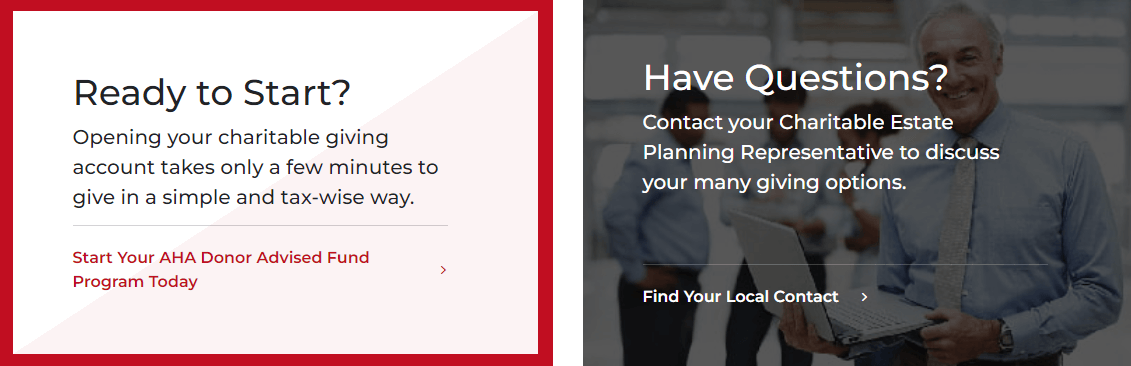
For example, the American Heart Association offers an effective example of useful calls to action (CTAs) for healthcare websites. Their donor stories end with CTAs that help visitors open a charitable giving account or reach out to a local representative with any questions. 

American Heart Association CTAs for opening a charitable giving account or contacting a representative

Welcome new donors with clear CTAs that allow website visitors to take the next step that aligns with their interests and needs. For example, your CTAs could say:

  • Support our scholarship fund today to help other students in need.
  • Leave a positive legacy with a planned gift.
  • Contact a local representative for more information about the impact of your gift.
  • Find the giving opportunity that works for you.

Your CTAs should be specific and welcoming, and they should lead to a user-friendly form or information page where supporters can take the next steps toward becoming donors or getting more involved in your cause. 


After optimizing your donor stories, promote them across multiple channels, including social media, email, and your printed newsletter. This will help reach a wider potential donor audience and ensure as many current donors as possible see your gratitude efforts. 

As Founder and CEO of Kanopi Studios, Anne Stefanyk helps create clarity around project needs, and turns client conversations into actionable outcomes. She enjoys helping clients identify their problems, and then empowering the Kanopi team to execute great solutions.

Anne is an advocate for open source and co-organizes the Bay Area Drupal Camp. When she’s not contributing to the community or running her thoughtful web agency, she enjoys yoga, meditation, treehouses, dharma, cycling, paddle boarding, kayaking, and hanging with her nephew.

How Your Nonprofit Can Ensure Success in 2024

Happy New Year! I hope you had a nice holiday. My vacation went by way too quickly.

I also hope 2023 was a successful year for your nonprofit organization. If it wasn’t, you can work to make 2024 a better year. As with personal New Year’s resolutions, you want your goals to be realistic and attainable. If you’re a small organization, you may not have much luck pulling off a huge gala.

Here are a few ways to help you ensure a more successful year.

Have a plan in place

You must have fundraising and communications/marketing plans. If you haven’t put together these plans yet, do that now! 

You know from past experience that you may need to make changes to your plans. In 2020, organizations that were able to make changes to a plan already in place were most successful.

Take a look back at 2023 to see what worked and what didn’t in your fundraising and communications/marketing. Incorporate what you’ve learned into your 2024 plans. 

Be sure your fundraising plan includes a diverse stream of revenue. Individual giving has proven to be successful. A lot of small donations can add up! Start or grow your monthly giving program (more on that below). Also, look into major and legacy giving. 

You can apply for grants and hold events, but those sometimes require more effort than it’s worth. Invest in strategies that make sense for your organization.

Revisit your fundraising and communications/marketing plans regularly and make changes as needed. Do this at least every two to three months.

Make sure that donor relations and donor retention are part of your fundraising plan. Those are key to your success.

Pay attention to your donor retention

Many donors have stepped up over the past few years to support nonprofit organizations. You don’t want to lose these valuable donors.

Donor retention should be a priority. You’ll have more success if you work to keep the donors you already have instead of focusing on getting new ones.

First, if you don’t already know it, figure out your retention rate. Do this after every fundraising campaign.

If it’s low, it’s something you can fix, usually with better communication. Donor retention is a huge problem for nonprofits. Your goal should be to have donors who support you for a long time.

It’s easier and less expensive to keep your current donors than to find new ones so once again, make donor retention a priority.

That said, you may have some new donors who saw a need and felt a connection to your cause. Don’t let these donors slip away either.

Go all in on monthly giving 

Speaking of retention, the retention rate for monthly donors is 90%. These donors are dedicated to your nonprofit. 

I’m a huge fan of monthly giving. It’s always made sense, but it’s been especially crucial over the last few years. Organizations that have monthly giving programs receive a steady stream of revenue throughout the year. Donors who opt for monthly giving find it’s easier on their finances. Even gifts of $5.00 or $10.00 a month can make a difference for your organization. Dedicated monthly donors have also stepped up and have given additional donations.

Work on starting or growing your monthly giving program so you can have a bunch of highly committed donors. A good way to start is to invite your current donors to become monthly donors.

Monthly donors are also potential major and legacy donors. Remember the importance of individual giving.

Do a better job of communicating with your donors 

There are many ways to do a better job of communicating with your donors. First, make this the year you say goodbye to boring, generic communication. Stop using jargon, such as at-risk and underserved. Tell more stories and go easy on the statistics. It makes a difference if you can put things in human terms, so you can do a better job of connecting with your donors.

Better communication also means more frequent communication. Donors want to  feel appreciated and know how they are helping you make a difference. Be sure to implement the ask, thank, report, repeat formula

You want to segment and personalize your communication, too. Address your donors by name (not Dear Friend) and recognize their past giving or if they’re a monthly donor.

Better, more frequent communication will help you raise more money. Having a communications calendar will help you with this. 

Work on building relationships

You may think the most important component of fundraising is raising money. While that’s important, so is building relationships with your donors. 

It’s hard to raise money year after year if you don’t build a good relationship with your donors. Every single interaction with your donors needs to focus on building relationships. That includes fundraising appeals. It’s possible to raise money and build relationships at the same time. 

Stop thinking of the donations you receive as a transaction and instead think of them as the start or continuation of a relationship. 

Good relationships with your donors will help you with retention.

Create an attitude of gratitude

A big part of building relationships is showing gratitude to your donors. Many nonprofits do a poor job of this. 

You need to start by sending a heartfelt thank you immediately after you receive a donation and then find ways to thank your donors throughout the year. Put together a thank you plan to help you with this.

Start the New Year off by making fundraising and communications/marketing plans, if you haven’t already done so. Prioritize donor retention, monthly giving, showing gratitude, and building relationships with your donors. This will help bring you more success in 2024.

Photo by Marco Verch

The Importance of Creating a Nonprofit Communications Calendar

I always like to emphasize the importance of keeping in touch with your donors throughout the year. I hope that’s a priority for you, too.

Your donors want to hear from you and don’t just want to be blasted with fundraising appeals. The good news is that better donor communication (thank yous and updates) can help you raise more money. This is especially important if you’re falling behind in your revenue goals. Remember the ask thank report formula.

Ideally, you should communicate with your donors at least once or twice a month throughout the year. I know that might sound impossible, but it will be a whole lot easier if you put together a communications calendar (also known as an editorial calendar).

I like the term communications calendar because it emphasizes the importance of communicating with your donors and other supporters all year round.

Some of you may already have a communications calendar, which is great. Now is a good time to update yours for 2024. For the rest of you, here are some suggestions to help you get started. Even though it will take a little time to put together, it will be worth it in the end because you’ll be able to do a better job of communicating with your donors.

This is not just a job for your marketing department. All departments need to work together. Figure out what information you need to share and when you need to share it. You want a consistent stream of information – not three email messages in one day and nothing for three weeks.

As you put together your communications calendar, think about how you will use different channels and which audience(s) should receive your messages. You may only send direct mail a few times a year (and I hope you do use direct mail), but send an e-newsletter once a month and communicate by social media several times a week. You’ll often use several different channels when you send a fundraising appeal or promote an event.

Start big by looking at the entire year and then break it down by months and weeks. You’ll keep adding to your communications calendar throughout the year.

Your communications calendar is a fluid document and these past few years are a good example of how our world is constantly changing. It’s important to keep things current.

Here are some categories you can use in your communications calendar. Some items will be time-sensitive and others won’t be.

Updates

Your donors want to hear how they’re helping you make a difference. Your print and e-newsletters should be included in your communications calendar. If you don’t do a newsletter, make a plan to share updates another way – maybe by postcard, email, and/or social media. Sometimes short updates are more effective.

Current events/News stories

At the beginning of 2020, most of us couldn’t predict the year we were about to have. There’s still so much going on, almost too much. Who knows what next year will bring.

Many donors will expect you to address current situations. Keep them apprised of how all this is affecting your clients/community. Sometimes staying silent isn’t the best option.

Legislation

Advocacy alerts are a wonderful way to engage with your supporters. Be on the lookout for any federal or state legislation that’s relevant to your organization. Encourage people to contact their legislators about an issue or a bill. Then report back to them with any updates and thank them for getting involved.

Time of year

Is there something going on during a particular month that’s pertinent to your organization? Perhaps it’s homelessness or mental health awareness month.

Thanksgiving, the holidays, and winter can be a difficult time for some people. How can you weave that into an engaging story to share with your supporters? This may be another hard winter for many people.

Keep in mind your organization’s anniversary doesn’t mean much to your donors unless you can tie that in with how they’re helping you make a difference. You could, however, reach out to your donors on the anniversary of their giving.

Fundraising and recruitment

Be sure to add your fundraising campaigns to your communications calendar. You’ll want to have a separate fundraising calendar, too. Of course, your campaigns are important, but you also want to show gratitude and send updates during this time without inundating your donors with too many messages. Planning ahead will help you strike this balance.

If your organization has specific times it needs to recruit volunteers, add that to your calendar, as well. 

Thank your donors

Make this a priority! Find different ways to let your donors know how much you appreciate them. You can combine a thank you with an update. Do this at least once a month. Create a separate set of thank yous for your monthly donors, too.

Events

Perhaps your organization holds events, either in-person, hybrid, or virtual. Besides your events, are there other events in your community that would be of interest to your supporters? If so, you could share that on social media.

Ongoing content

If you’re making a difference, you have stories to tell. Share a story at least once a month. Client stories (either in the first or third person) are best. Your stories need to be relevant to the ever-evolving current situations, so you may need to create some new ones.

You could also profile a board member, volunteer, donor, or staff member. Be sure to highlight what drew them to your organization.

Put together a story bank to help you with this.

Don’t stop communicating with your donors

As you hear about other relevant information, add it to your calendar, so you can stay connected with your donors/supporters throughout the year.

Here’s more information to help you create a communications/editorial calendar. A couple of these links also include templates.

Nonprofit Editorial Calendars

Get your nonprofit organized with an editorial calendar

How to create and use a nonprofit editorial calendar

3 Tips for Marketing Your Organization on a Limited Budget

Marketing your organization on a budget is easy when you know the right strategies and tools to use. Explore these top tips to step up your marketing strategy. 

By Melissa Mendez

Picture this: your organization is about to host another fundraising event. You’ve assembled a fundraising team, booked a venue, and put together the perfect program agenda. Once it comes time to get the word out about your event, you quickly realize you don’t have that much money left in your budget to create promotional materials and decide to deprioritize marketing. However, this results in low attendance numbers, causing you to miss the mark on your fundraising goal. 

If this sounds like a situation your organization has been in before, you need to update your approach to marketing. Even if you’re strapped for cash, there are a variety of ways to get the word out about your events, campaigns, and current initiatives without spending a single dollar! 

In this article, we’ll go over three money-saving tips that you can use to market your organization and get the support you need: 

  • Keep your website content fresh
  • Generate quality social media content
  • Create compelling email newsletters 

Whether you’re a dance studio hoping to promote your donation form for your year-end campaign or a nonprofit that wants to market its monthly giving program, the right marketing strategies and tools can help. Let’s dig into the essentials.

Keep your website content fresh

Your website is a rich information hub that acts as the focal point of your digital presence, but are you harnessing its full potential? By updating your website regularly and using it to spotlight your upcoming events, campaigns, projects, and more, you can successfully expand your reach and bring in new audiences for your organization. 

Leverage these cost-effective strategies to shape your website into a powerful marketing tool: 

  • Create event and campaign landing pages: Dedicated landing pages can help you dive deep into the details of your upcoming events and spotlight why it’s worth your audience’s time to register, donate, or take another relevant action. Cover all the logistical details, including the date and time of your event or campaign, its purpose, and how to get involved. Be sure to embed your registration or donation form directly into your landing page to help drive conversions and streamline your users’ actions. 
  • Share testimonials: Testimonials can provide great social proof that drives prospective audience members to support your organization. Create a testimonials page that features varied quotes from community members explaining why they support your organization or are eager to receive your services. For example, a dance studio might collect testimonials from students, parents, and alumni to show the value in signing up for classes. Similarly, nonprofits can feature testimonials from beneficiaries, explaining how your organization has made a difference in their lives. 
  • Generate blog content: Consistent blog content can keep community members tapped into your organization and eager to sign up for your upcoming events. Write content regularly, such as posting every other week to communicate important updates about your organization. To help offload the burden of creating content, you can also ask your beneficiaries, volunteers, donors, or loyal customers to create content reflecting on their experiences. 

As you refresh your website and create new content, make sure to widely promote these links to your audience. For example, if you recently created an event landing page to spotlight your upcoming peer-to-peer fundraising event, you could summarize the purpose of this event in your email newsletter and include a link to your landing page for people to learn more and register. 

Keep in mind that taking a multichannel approach, such as sharing links on social media or through QR codes in your direct mail, can help you direct multiple audiences to your website and keep your organization at top of mind. 

You might also leverage a dedicated communication app so you can more easily reach your target audience and ensure you have their support for your upcoming project. There are many cost-effective marketing platforms available that have built-in communication tools, so do your research to find the best solution for your organization. While investing in a marketing solution might seem like a big expense upfront, you’ll be able to derive a high ROI from it year over year, ensuring your organization can make back its investment and more. 

Generate quality social media content

With audiences spending more time on social media than ever before, regularly posting social media content is an easy money-saving strategy to ensure your content gets in front of your target audience. However, spamming content about your upcoming event or campaign can have the opposite effect, turning prospective audiences away from your organization and decreasing your engagement levels. 

Instead, construct a quality and intentional social media strategy that is tailored to your audience and supports your marketing goals. Use these tips to get started: 

  • Share a variety of visuals: Posting the same type of content over and over can quickly bore your audience. Generate a variety of visuals, such as photos from your latest event or infographics that highlight your organization’s impact, to grab your followers’ attention. You could also tap into the power of video, which can help you convey important information in an easily digestible format. Double the Donation’s guide to fundraising videos recommends keeping your video short and sweet and ending in a firm call to action so audiences know how to get involved. 
  • Use catchy hashtags to expand your reach: Hashtags can open up your community to new audiences and boost brand visibility. For example, if you’re a dance studio hosting a dance-a-thon, you might use the hashtag #DancingForACause or #DancingForDollars to create interest. You can also feature your dance studio name or city in your hashtag to draw local audiences to your event, such as #YourCityDanceAThon or #YourStudioNameDanceAThon. When participants post about your event, encourage them to pair it with your dedicated hashtag. 
  • Consider hosting social media contests: A social media contest is a great way to rally your whole community around your organization while growing your reach. You might ask supporters or customers to post videos about why they support your organization, and then award the audience member with the greatest number of likes or comments with a prize. Pair a hashtag with your contest and ask audiences to tag your account in their post so people in their personal networks can learn more about your organization. 

As you share content on social media, track metrics, like impressions and likes, to assess your performance. You may have to make adjustments to your content to better appeal to your audiences and drive greater engagement levels. 

Create compelling email newsletters

Your email newsletter is the perfect place to remind people of your upcoming activities and include links to your website and social media accounts. To strengthen your email newsletters and maximize their value, use these best practices: 

  • Include an eye-catching subject line: Your audience receives anywhere from tens to hundreds of emails a day. To stand out from the crowd you’ll need to create a brief, yet compelling subject line that piques your subscribers’ interests. For example, a subject line like “Don’t Miss Out On Our Annual Halloween Fundraiser!” or “Register Tonight for the Event Of the Season!” summarizes the central purpose of the newsletter while drawing the reader in so they feel motivated to open your email. 
  • Break up your content with visuals: Make your email newsletters even more engaging by adding a variety of visuals, like photos, videos, and graphics. Ensure these elements are reasonably sized to create a positive user experience and avoid using too many visuals so your audience isn’t overwhelmed. 
  • Use clear calls to action: Firm calls to action direct your audience to their next step so they can easily complete it. Create call-to-action buttons that stand out from the rest of your newsletter content and ensure they are hyperlinked to the relevant resource, like your donation page or event registration form. You’ll also want to use succinct, clear language that creates a sense of immediacy. For instance, a call to action like “Donate by midnight to get your gifts matched!” gets to the point quickly while using time-bound language to spur action. 

DanceStudio-Pro’s guide to dance studio marketing also recommends using email to show appreciation to your audience. Once your supporters complete a target action like donating or registering for an event, automate a thank-you email conveying your gratitude for their continued support. This practice will help you develop strong relationships with your audience that will benefit your organization for years. 

Wrapping Up

Marketing your organization doesn’t have to cost your team an arm and a leg when you have the right tools and strategies! Assess your existing toolkit and make adjustments to your marketing plan as needed to optimize your promotional strategies. Keep in mind that adding an all-in-one marketing platform to your tech stack can streamline your approach and help you save money in the long run. 

Melissa Mendez is the Operations Manager at Studio Pro, where she leads the Support, Customer Success, and Professional Services teams. Since 2019, Melissa has helped thousands of dance, cheer, gymnastics, and performing arts studio owners streamline enrollment, recital and showcase planning, ticketing, and accounting automation. She and her team deliver personalized onboarding, expert training, and ongoing support to make running a studio smoother and more sustainable.

A lifelong dancer who started at age three, Melissa built a successful mobile dance company that expanded to four locations across multiple states. Now based in San Antonio, Texas, she brings firsthand studio experience and operational expertise to every interaction—empowering studio owners to grow their businesses, strengthen their communities, and focus on what they love most: their students.

Welcome Your New Donors With Open Arms

Year-end fundraising is underway. I hope your campaign is going well so far. Perhaps you also participated in Giving Tuesday. The latter often brings in new donors and that’s never something you want to take for granted. 

These donors saw a need and found a connection to your cause. Or maybe they were drawn into whatever Giving Tuesday promotion you initiated, but I like to think they wanted to help you make a difference. 

Unfortunately, it’s unlikely these donors will stick with you. The retention rate for first-time donors is around 20%. We can and have to do better.

This is why it’s so important to get a second donation, also known as a golden donation. Once you get that golden donation, you’re more likely to have long-time donors who will stick with you. One way to ensure this is to make your new donors feel welcome.

Start with a special thank you

According to fundraising expert, Dr. Adrian Sargeant, “The thank you is the single most important piece of communication that your donors get. They have a higher recall of it than the appeal that generated the gift.”

Keep that in mind, especially for your new donors.

If someone donates online, it’s hard to tailor the thank you email specifically to new donors. But you can do that with a phone call, handwritten note, or thank you letter.

Try to call your new donors or send a handwritten note. This will make a great impression on them. Get together a group of board members, other volunteers, and staff to help you. If that’s not possible, create a thank you letter specifically for your new donors.

*Make sure these are actually new donors. A good CRM/database will help you avoid any missteps.*

Create a welcome plan

A week or two after the initial thank you, send a welcome package. You can do this by mail, email, or a combination of both. Try to send at least one welcome message by mail. Mail is always more personal and your donors will be more likely to see it.

Welcome your new donors. Thank them again and show them other ways they can connect with you. Invite them to subscribe to your newsletter, join you on social media, and volunteer.

Your welcome package should include a warm introductory message and a few facts about your organization, but don’t brag too much. Keep it donor-centered and be personable. You could also direct people to your website for more information about your organization.

Be careful about how much information you send. Donors want to feel welcome, not overwhelmed.

I don’t recommend sending unsolicited swag. Personally, I don’t like it, but some donors might. You could offer your new donors a gift and they can let you know if they want to receive it, but it’s not necessary. What donors really want from you is to know how they’re helping you make a difference.

Create a series of messages, also known as a drip campaign. Set a timeline. The first sequence of messages can be sent about once a week. After that, you should continue to communicate regularly (at least once a month) and follow the ask, thank, update formula. In a few months, you could invite your new donors to give monthly. Monthly donors are committed donors.

Welcome emails have high open rates. Impress your new donors right away, so they’ll be more likely to donate again.

Who are your new donors?

They could be event attendees, volunteers, or newsletter subscribers. If you know, refer to that in your thank you note, letter, or phone call. If not, send a short survey with your welcome package and ask, “How did you hear about us?” or “What drew you to our organization?” 

Another question to ask is whether your donors prefer print or electronic communication. Short surveys are also a good way to connect throughout the year. The more you know about your donors the easier it will be to communicate with them.

Make your current donors feel special, too

While I’ve been focusing on new donors in this post, retention rates for current donors aren’t anything to celebrate. The overall donor retention rate is around 45%, so we have some work to do.

Remember the golden donation, but don’t stop there. You want a third (would that be platinum?) and a fourth, etc. donation.  

If you’re not acknowledging a donor’s past support, you’re making a huge mistake. Imagine how you would feel if you gave to an organization for over five years and they never thank you for your long-time support.  

These valuable, long-time donors could leave at any time, so ignore them at your own peril. Make sure they also get a special thank you from you.

Keep it up throughout the year

It’s so important to communicate with your donors regularly. Plan on special mailings or emails specifically targeted to new donors. Remember to try to send something by mail if you can. 

Think of other ways to do something special for your new donors too, such as an open house or a tour of your facility, either in person or virtual.

Of course, don’t ignore your other donors. You could do something special when you get that all-important second gift. Keep reaching out – at least once or twice a month. 

Show appreciation and share updates. A huge factor in donor retention is a good donor relations plan that you’ll carry out regularly as long as your donors support you, which hopefully will be for many years.

Do Your Giving Tuesday Messages Look Like Spam?

What’s the difference between messages you get for Cyber Monday, Black Friday, political candidates, and Giving Tuesday? Unfortunately, it seems like not a whole lot, and many of them look like spam.

According to the Giving Tuesday website, “Giving Tuesday is a global generosity movement unleashing the power of radical generosity.” In theory, that sounds nice, but in reality, it’s a day when nonprofit organizations unleash an onslaught of transactional fundraising appeals by email and social media.

Starting in 2012, Giving Tuesday has taken place the Tuesday after Thanksgiving. This year it will be on November 28.

I’m not going to tell you whether or not you should participate in Giving Tuesday. Perhaps you’ve participated in the past and it’s been successful (one way to measure if it was successful is if those donors give again), or maybe it wasn’t. Perhaps you’re planning to participate for the first time. Maybe you’re on the fence. 

Whether you participate or not, Giving Tuesday is part of the nonprofit landscape and if you’re doing a year-end appeal, you’ll need to factor it into your campaign. If you do participate, you want to make it a better experience for your donors instead of the usual barrage of generic, transactional appeals. And, you don’t want your messages to resemble spam.

Here are a few things to keep in mind as Giving Tuesday approaches.

Just because it’s Giving Tuesday isn’t a compelling reason to give

I see so many email messages that say donate because it’s Giving Tuesday. Many donors don’t care if it’s Giving Tuesday or if it’s your “annual appeal.” That’s often not why they donate. They give because they care about your cause and want to help make a difference. 

Let them know that with their help, Kara doesn’t have to go to bed hungry or Daniel can boost his reading skills.

People and communities are still struggling. You need to acknowledge this in your appeals.

It’s not just about the money

A successful Giving Tuesday campaign is about more than just raising a lot of money. You also want to build relationships and make your donors feel good about supporting your organization. This is where it often falls short.

I’m not a huge fan of Giving Tuesday or any giving days, for that matter, because they focus too much on getting donations. Many of these donors are first-time donors who don’t give again. The end result is you’ve just spent a lot of time and effort on getting one-time gifts. That’s not what you want. You need donors who will support you for many years.

Make it personal and segment your donors

Don’t just blast a bunch of generic, transactional appeals that resemble Cyber Monday ads or those relentless requests for political donations. I receive so many political emails, which are just “noise” that I end up ignoring. You don’t want that. You want to attract your donors’ attention in a good way. A more relationship-oriented subject line can help.

You also don’t want to send all your donors the same appeal. If someone donated last year on GivingTuesday, this is the perfect opportunity to thank them for that gift and ask them to donate again this year. If they donated two weeks ago, maybe they shouldn’t get an appeal right now.

Segment your donors. Acknowledge past donors and make a connection with potential donors. 

Focus on building relationships with your donors instead of just begging for donations.

Also, if you’re sending an appeal to your monthly donors, recognize them as monthly donors and ask them to give an additional gift (many of them will). They get their own thank you, too. Monthly donors are one of your most loyal types of donors. Be sure to make them feel special.

If you’re one of the few organizations that sends more personalized appeals, then kudos to you because that’s what everyone needs to do.

Use Giving Tuesday as a way to follow up with your donors

If you don’t want to launch a full Giving Tuesday campaign (understandable), it can be a great opportunity to follow up with people who haven’t donated to your year-end appeal. You should be sending regular reminders, anyway.

Send email and social media messages before and on Giving Tuesday encouraging people to donate. You can use the Giving Tuesday logos, etc. if you’d like. Obviously, you’ll want to keep following up with anyone who didn’t donate on Giving Tuesday.

Remember, your donors will be barraged with email and social media messages on Giving Tuesday. Make yours stand out and be prepared to keep following up.

Put gratitude front and center

Your donors should be feeling the love right after they make their donation.

Make sure you have an engaging thank you landing page and thank you email for your online donors. You could even create ones especially for Giving Tuesday. Then you need to follow that with a phone call, handwritten note, or thank you letter.

Send welcome packages to new donors or welcome back messages to current donors. 

Go the extra mile and do a good job of thanking these donors – both right after they’ve made their donation and throughout the year.

We’re going to skip Giving Tuesday 

Maybe you’ll decide you’re going to skip Giving Tuesday altogether. If that’s the case, you may want to hold off on sending email on Giving Tuesday, as well as Black Friday and Cyber Monday. Remember, other organizations will be participating and any messages you send will be competing with the onslaught of Giving Tuesday appeals. 

Before and after Giving Tuesday, use this opportunity to stand out by keeping your fundraising campaign focused on gratitude and relationship building. Year-end is a good time to ramp up your donor communication (examples include thank you messages, holiday greetings, and updates) so people don’t think you’re only asking them for money.

Give back to your donors

I think you’ll find your Giving Tuesday campaign, or any fundraising campaign, will be more successful if you focus on more than just the giving part. And a big part of a successful campaign is getting repeat donations. This means giving back to your donors, as well.

Always focus on relationships, not the transaction, and make sure your messages don’t look like spam.

Show Some Appreciation to Your Donors During the Gratitude Season

Year-end fundraising coincides with the gratitude season, which includes Thanksgiving in the U.S. and the December holidays. This is appropriate since thanking your donors is part of the fundraising equation, even though many nonprofits don’t seem to realize this.

Now is a great opportunity to show some gratitude to your donors. You could hold a thankathon, especially if you haven’t launched your appeal yet. Traditionally, thankathons are done by phone, but you can use other channels, too.

You may be laser-focused on your year-end campaign and think you’re too busy to spend much time thanking your donors, but that’s precisely why you need to get on the thank you train. Showing some appreciation to your donors right now can help you raise more money for your year-end appeal.

You’re never too busy to thank your donors. Besides, don’t they deserve some special attention?

Showing gratitude doesn’t happen nearly as often as it should, but you need to spend just as much time thanking your donors and building relationships as you do on fundraising.

Here are a few ways to incorporate gratitude into your year-end fundraising campaign.

Say thank you in your appeal

Does your appeal thank donors for their past or potential gifts? It should. Remember, you need to be showing gratitude while you’re trying to raise money.

This is especially important around GivingTuesday and I’ll write more about that in my next post.

Wish your donors a Happy Thanksgiving

One way to show gratitude right now is to send your donors a special Thanksgiving message. A lot of nonprofits already do this. If you’re not one of them, make this the year you start. If you can send a card or postcard, that’s great, but an email message is also fine. If you use email, be sure to address the donor by name to make it more personal and send it the day before when they’ll be more likely to see it.

In a recent post about running a multichannel campaign, I suggested skipping the reminder during Thanksgiving week and pour on the gratitude instead. 

We’re still living in a time of uncertainty and your donors will appreciate a heartfelt message from you. Let them know how grateful you are to have them as part of your donor family. 

Don’t stop with Thanksgiving

Thanksgiving isn’t the only time to show some appreciation. The holidays and New Year’s are coming up soon (sooner than you think) and that’s a good opportunity, especially for those of you outside the U.S., to express gratitude. But you don’t need a holiday or other special occasion. Just thank your donors and do it often. 

Whatever you decide, DO NOT include a donation envelope or any other type of ask with your thank you message. This is known as a thask and it’s guaranteed to deflate your donor’s good feelings in an instant.

Be ready to thank your donors as soon as you receive a donation

Every single donor, no matter how much they’ve given or whether they donated online, gets a thank you card/letter mailed to them or receives a phone call.

Planning ahead will help you thank your donors as soon as possible. I’m sure you’re spending a lot of time and effort getting your fundraising appeal out. Perhaps you’ve recruited other staff or volunteers to help you.

You need to do the same thing when you thank your donors. Get your board, other staff, and volunteers to help make phone calls, write thank you notes, or include a handwritten note on a thank you letter. This is another opportunity for a thankathon.

Make thanking your donors a priority

Your donors deserve more than just the same boring, generic thank you letter. The initial thank you right after you receive a donation is important. So is the next one and the one after that and the one after that….

Thanking your donors is not something you just do after you receive a donation. You want to thank your donors at least once a month. Here are some ways you can show gratitude throughout the year.

  • Send a handwritten note.
  • Create a thank you video and share it on your website, by email, and on social media. Better yet, personalize it.
  • Send welcome packages to your new donors.
  • Invite your donors to connect with you via email and social media. Keep them updated on your success and challenges. Making all your communications donor-centered will help convey an attitude of gratitude.
  • Thank your donors in your newsletters and other updates. Emphasize that you wouldn’t be able to do the work you do without their support.
  • Hold an open house or offer tours. You can also create a virtual tour or other engaging video content to let your donors see your nonprofit up close and personal.
  • Thank your donors just because they’re great.
  • Keep thinking of other ways to thank your donors.

Create a thank you plan to help you with this.

Always choose kindness 

The world could use some more kindness right now. There’s so much going on and the divisiveness doesn’t help. As long as you’re sincere, I don’t think there’s such a thing as being too nice.

In the spirit of kindness, show some gratitude to your donors and make them feel special.

Fundraising Efficiently: 3 Ways to Improve Your Operations

Let’s take a look at three areas where nonprofits can drive increased fundraising efficiency: staff retention, donor qualification, and campaign planning.

By Chelsey Newmyer

What first comes to mind when you think about increasing your nonprofit’s fundraising efficiency?

Cutting expenses? Making bigger asks of more of your donors? Sending more emails and appeals to keep your mission on their minds?

These methods can work, but they shouldn’t be your first or only steps. 

Cutting expenses can soon become unsustainable. Asking more from larger segments of your donors will ultimately make your fundraising less efficient if you’re not asking the right donors. Otherwise, you’re just wasting time and potentially hurting relationships. Blasting your messages too frequently can also have the unintended consequence of making your audience tune you out.

The key to success lies in fundraising smarter, not just leaner or more aggressively, with an eye on the long-term sustainability of your strategies. Learning to do more with what you already have will grow your ability to drive impact into the future. 

Many nonprofits understand the value of sustainable fundraising streams like recurring giving programs, but how can you go further? What are some foundational ways to build efficiency into your efforts from the ground up? Let’s take a look at three fundamental ways to get started.

  1. Minimize employee churn.

To make the most of your resources, start by preserving them. Any organization’s most important resources are the people who keep it running.

The average employee turnover rate for nonprofits hovers around 19%, consistently higher than for-profit companies. It’s a common problem battled by organizations of all sizes. Churn is also costly for nonprofits and can create major hurdles to growth. There are several reasons why internal churn can be so harmful:

  • Churn creates new costs. Hiring new team members to replace those who leave takes time and money. Not to mention, there’s the opportunity cost to consider since new staff won’t operate as effectively right away.
  • Churn decreases overall engagement and morale, leading to worse outcomes across the organization.
  • Churn can harm your nonprofit’s relationships. Fundraising programs thrive on relationships with donors, businesses, and other partners. When experienced fundraisers leave, there’s a risk of losing all the valuable relationships they’ve built.

Altogether, these impacts can slow or derail your organization’s growth, making it harder to generate meaningful returns on your fundraising work. It can also become a harmful cycle if left unchecked, with remaining employees more likely to leave as well if they’re feeling burnt out from picking up the slack.

If fundraiser retention has been a challenge for your nonprofit, work to improve it before diving deeper into other fundraising efficiency improvements. Graham-Pelton’s guide to nonprofit staff retention outlines the essential elements of an effective strategy and 15 steps organizations can take to get started.

With a stable, engaged team ready to drive your mission forward, you’ll then be able to implement new changes that help them work more efficiently.

  1. Refine your donor qualification process.

Prioritization is a key part of efficient fundraising. For nonprofit fundraising teams, this means focusing on your donor qualification strategies.

Qualification is the process of prioritizing your major donors and prospects for outreach based on how likely they are to give at the current moment. It relies on sets of criteria that either qualify or disqualify a prospect for outreach, for example:

  • Qualified: Active donor, hasn’t been solicited in the last X months, proven giving capacity at the intended level, etc.
  • Disqualified: No proven giving capacity, lapsed donor, or was recently solicited and declined to give, etc.

Qualification is used specifically for major giving. Relationships with major donors need to be thoughtfully grown over time—which is a time-intensive process—hence the increased need to effectively prioritize outreach. When a major gift is secured, it can represent a significant return on the investment of that time. By focusing your efforts on where it’s most likely to drive impact, you’ll increase the overall ROI of your efforts without cutting costs or making bigger asks.

If your nonprofit hasn’t refreshed its approach to qualification (or doesn’t yet have one), there are a few immediate steps you can take. 

First, review your data to learn more about the donors who’ve given large or major gifts. Find trends in their characteristics and in the cultivation and solicitation strategies you used to ask them for gifts—use these trends to establish updated qualification criteria. Using these criteria, take a first pass at generating a new prospect list. 

From there, keep refining your approach as you talk to donors, ask for gifts, and learn more about them. Just be sure to consistently revisit your prioritized prospect list to ensure it’s as fresh as possible based on your most recent (and well-maintained) data. This efficient approach makes it possible to present fully customized appeals to your donors and boost your chances of securing a gift.

  1. Thoroughly plan ahead for your fundraising campaigns.

Like major gift fundraising, large-scale campaigns are time-intensive, but they can also deliver high ROIs.

Following capital campaign best practices can be incredibly efficient, despite these fundraising goals being among the highest your organization ever pursues. Focusing on major gifts and following a strategic order of solicitations allows you to pack a punch, securing large sums in a very targeted way.

But you’ll also need to ensure that your campaign plans are designed to be truly achievable. Goals need to strike the right balance of being ambitious but realistic. This will help maximize your ROI (while ensuring you’re not pursuing a goal that’s too high or leaving money on the table by aiming too low).

To set the perfect goal and minimize wasted time and effort during a major campaign, conduct a feasibility study early in the planning process. This can be done for any big initiative that will rely on major gifts, not just capital campaigns.

A feasibility study or planning study seeks the input of major donors, prospects, and stakeholders on your initial campaign plans and goals. Since these are the supporters who’ll ultimately help drive the campaign to success, the idea is to use their input to help shape your finalized goal and approach. It’s also a helpful way to secure early buy-in on your project by allowing key donors to become more closely involved.

If a large campaign is coming up for your organization, develop a case for support and begin mentioning the campaign to your donors so that it’s on their radar. Develop initial lists of who to include in your study and whose gifts would be essential for success based on your qualification process.

Once you’ve conducted a planning study and analyzed your findings, make adjustments to your plan as needed and move forward with your campaign. Look for ways to keep donors engaged with the project beyond just inviting them to a luncheon or grand finale gala. Have a plan in place early for thanking and recognizing donors. This will not only lead to a more successful campaign but also strengthen your relationships for more effective fundraising in the future.


Increasing your efficiency shouldn’t mean trimming your operations down to the bare essentials or stretching your donor relationships to their limits. 

Instead, look for ways to do more with what you already have. Across all areas of your work, including internal management processes, donor stewardship, and campaign planning, you can drive greater impact by preserving your time and prioritizing your work.

Chelsey Newmyer is a Senior Consultant at Graham-Pelton. An analytical problem solver, Chelsey uses a data-driven approach fostered by her engineering background to conduct multipronged annual giving campaigns, manage leadership-level prospects and volunteers, and enhance cross-departmental relationships.