Google Grant Compliance: What You Need to Know

Complying with Google’s guidelines will help you maintain a healthy Ad Grant account. Here’s what any nonprofit needs to know about Google Grant compliance.

Google Grants have transformed the nonprofit marketing landscape. By meeting eligibility requirements, you can receive $10,000 every month to promote your cause through Google Ads. However, nonprofits must follow certain requirements to remain eligible.

Nonprofit fundraising professionals are likely familiar with the process of seeking grants and following compliance standards. Grantmaking organizations create standards to award money to nonprofits that will spend it in line with the program’s goals. Google Grants are no exception!

To keep your Google Grant account compliant, we’ll cover everything you need to know about the program’s rules, starting with why they were created.

Why Does Google Implement Compliance Requirements?

Every grantmaking organization, including Google, strives to fund responsible organizations and advance worthwhile missions. That’s why they require nonprofits to undergo an intricate vetting process and meet ongoing requirements.

For the Google Grants program, the primary purpose of compliance regulations is for nonprofits to create meaningful conversions, not just maximize ad spend.

When the program first launched, there weren’t many compliance rules. Instead of concentrating on connecting with likely prospects, nonprofits focused on spending as much as possible to increase search visibility. This led to nonprofits:

  • Advertising any content on their website, including pages that people wouldn’t find useful.
  • Targeting keywords that didn’t align with the searcher’s intent and brought unqualified prospects.

This decreased the program’s value and led to users encountering content they weren’t searching for. To counteract this, Google’s team created a list of compliance rules, requiring nonprofits to create meaningful ads for mission-centric topics.

A Rundown of Google’s Compliance Rules

To comply with Google’s regulations, you need to understand them. Getting Attention’s Google Grants eligibility guide explores them in-depth, but for now, here’s an overview of the program’s rules:

  • No single-word or generic keywords are permitted.
  • Keywords must have a quality score of at least three. 
  • Maintain a 5% click-through rate.
  • Have at least one conversion each month.
  • Include at least two ads per ad group and two ad groups per campaign. The official guidelines have indicated two ads per group in the past; however, Google has recently moved to RSAs and indicated that each ad group must have at least one RSA. This may replace the need for two ads in the future, but Google’s official guidelines haven’t changed.
  • Include at least two sitelink ad extensions (which link to additional landing pages within your ad).
  • Respond to the annual program survey.

Complying with these rules will also optimize your campaigns. For example, choosing high-quality keywords will display your ads to qualified prospects, while sitelink extensions will provide users with alternative ways to engage with your cause.

Tips for Complying with the Google Grant Rules

While it’s one thing to understand the program’s rules, it’s another thing to put them into practice. Let’s walk through ways to develop a healthy Google Grant account.

1. Set Meaningful Conversion Goals.

As mentioned above, Google requires nonprofits to have at least one conversion per month. A conversion is when a user completes an action that’s valuable to your nonprofit. 

While Google gives you free rein over your conversion goals, common ones include:

  • Online donations
  • Volunteer registrations
  • Event sign-ups
  • Newsletter sign-ups

The idea behind conversion goals is to ensure each ad serves a role in advancing your mission. So think about what will push your cause forward. 

For instance, an animal shelter might view adoption inquiry form submissions as meaningful. On the other hand, a community organization might track newsletter subscriptions. Also, remember different ad groups can track different conversions, so you’re not tied to one specific goal for the entire account.

2. Choose Valuable Keywords.

Another essential component of a healthy Google Grant account is keywords. Keywords should be relevant to your cause and connect you with people searching for content in line with what you’re promoting.

To comply with Google’s keyword standards, here’s what we recommend:

  • Leverage keyword research tools. As part of the program, you can access Google Keyword Planner. Brainstorm what prospects might search to find your organization. Put these terms into Keyword Planner to view estimated search traffic, how much you should bid, and keyword suggestions.
  • Check your keyword quality regularly. Google assigns a Quality Score to each keyword. A higher score means the ad and landing page are relevant to users searching that term. Regularly review your account and pause any underperforming keywords (i.e. those with a score below three).
  • Center each ad group around similar keywords. Focus each group on a specific theme and related keywords. For a wildlife sanctuary, one ad group might focus on generating volunteer registrations and include terms like “wildlife rescue volunteer opportunities” and “animal sanctuary volunteering.” Then, another ad group might focus on driving donations and target terms like “donate to wildlife rescue” and “animal sanctuary donations.”

Keyword research is critical for Google Grant compliance. Failure to choose relevant keywords can result in account suspension, so consistently revisit your performance.

3. Assign a Knowledgeable Google Grants Manager

Consider designating a specific person to manage your account, respond to performance data, and follow Google’s compliance standards. In addition to building relationships with monthly donors, that individual can reach new audiences as they refine your campaigns. 

However, many organizations don’t have the staff capacity to devote an internal team member’s time. Instead, they outsource the work to a Google Grants agency. Typically, a professional will manage the following areas related to compliance:

  • Keyword research. Backed by search engine marketing knowledge, an agency can pick keywords that meet Google’s quality standards.
  • Landing page optimization. Optimized landing pages will drive more campaign conversions. An agency will help pick and create promotable landing pages.
  • Valid conversion tracking. A professional agency will have experience with Google Analytics and can pick the right conversion goals for your nonprofit.

A professional’s expertise extends beyond basic Google Grant rules. They may also create ad copy and choose meaningful conversions.

Whether you assign someone internally or outsource the work, assigning a grant manager lays a foundation for maintaining Google Grant compliance. 


Google Grants empower nonprofits to share their stories online. Don’t waste this opportunity by not following compliance guidelines. Using the guidance we shared, you can start improving your strategies and getting more out of your grant every month.

Getting Attention contributed to the content of this post.

How to Incorporate Gratitude Into Your Year-End Fundraising Campaign

Year-end fundraising coincides with the gratitude season, which includes Thanksgiving in the U.S. and the December holidays. Maybe it’s just me, but it seems as if stores go into holiday mode earlier each year.

Now is a great opportunity to show some gratitude to your donors. You could hold a thankathon, especially if you haven’t launched your appeal yet. Traditionally, thankathons are done by phone, but you can use other channels, too.

If you’re thinking you’re too busy with your year-end campaign to spend much time thanking your donors right now, that’s precisely why you need to get on the thank you train.

You’re never too busy to thank your donors. Showing gratitude and building relationships should help you raise more money. Plus, many donors stepped up to support you over the last two and half years. Don’t they deserve some extra attention?

Showing gratitude doesn’t happen nearly as often as it should, but you need to spend just as much time thanking your donors and building relationships as you do on fundraising.

Here are a few ways to incorporate thanking your donors into your year-end fundraising campaign.

Say thank you in your appeal

Does your appeal thank donors for their past or potential gifts? It should. Remember, you need to be showing gratitude while you’re trying to raise money.

This is especially important around #GivingTuesday and I’ll write more about that in my next post.

Wish your donors a Happy Thanksgiving

One way to show gratitude right now is to send your donors a special Thanksgiving message. A lot of nonprofits already do this. If you’re not one of them, make this the year you start. If you can send a card or postcard, that’s great, but an email message is also fine.

In a recent post about running a multichannel campaign, I suggested skipping the reminder during Thanksgiving week and pour on the gratitude instead. That can also be beneficial if you’re planning to send appeals on #GivingTuesday, which tends to be very transactional.

We’re still living in a time of uncertainty and your donors will appreciate a heartfelt message from you. Let them know how grateful you are to have them as part of your donor family. 

Don’t stop with Thanksgiving

Thanksgiving isn’t the only time to show some appreciation. The holidays and New Year’s are coming up soon and that’s a good opportunity, especially for those of you outside the U.S., to express gratitude. But you don’t need a holiday or other special occasion. Just thank your donors and do it often. 

Whatever you decide, DO NOT include a donation envelope or any other type of ask with your thank you message. This is known as a thask and it’s guaranteed to deflate your donor’s good feelings in an instant.

Be ready to thank your donors as soon as you receive a donation

Every single donor, no matter how much they’ve given or whether they donated online, gets a thank you card/letter mailed to them or receives a phone call.

Planning ahead will help you thank your donors as soon as possible. I’m sure you’re spending a lot of time and effort getting your fundraising appeal out. Perhaps you’ve recruited other staff or volunteers to help you.

You need to do the same thing when you thank your donors. Get your board, other staff, and volunteers to help make phone calls, write thank you notes, or include a handwritten note on a thank you letter. This is another opportunity for a thankathon.

Make thanking your donors a priority

Your donors deserve more than just the same boring, generic thank you letter. The initial thank you right after you receive a donation is important. So is the next one and the one after that and the one after that….

Thanking your donors is not something you just do after receiving a donation. You want to thank your donors at least once a month. Here are some ideas to show gratitude throughout the year.

  • Send a handwritten note.
  • Create a thank you video and share it on your website, by email, and on social media. Better yet, personalize it.
  • Send welcome packages to your new donors.
  • Invite your donors to connect with you via email and social media. Keep them updated on your success and challenges. Making all your communications donor-centered will help convey an attitude of gratitude.
  • Thank your donors in your newsletters and other updates. Emphasize that you wouldn’t be able to do the work you do without their support.
  • Create a virtual tour or other engaging video content so your donors can see your nonprofit up close and personal.
  • Thank your donors just because they’re great.
  • Keep thinking of other ways to thank your donors.

Create a thank you plan to help you with this.

Always choose kindness 

The world could use some more kindness right now. We’re all still dealing with a lot and the divisiveness doesn’t help. In the spirit of kindness, show some gratitude to your donors and make them feel special.

A Few Ways You Can Raise More Money This Year

It’s year-end fundraising time. You may have already started your campaign or are planning to soon. 

Nonprofit organizations rely on year-end for a good chunk of their revenue. Maybe you haven’t raised as much money as you planned this year and need to make up for that. Maybe your fundraising appeals never seem to perform as well as you would like.

Fundraising is hard and you can’t just send a bunch of generic appeals and hope the money comes in. If you want to raise more money, you need to put in some extra effort.

One way to raise more money is to segment your donors and send targeted appeals. You also need to have a good CRM/database and follow the ask, thank, update, repeat formula. 

Here are a few ways you can use these tactics to raise more money.

Ask for an upgrade

Many nonprofits don’t ask their donors to upgrade their gifts and they’re missing an opportunity to raise more money. You may be reluctant to ask donors to give more right now because of the uncertain economy, but that’s why you should ask. 

Your clients/community may be struggling and your need is growing. If you can relay this to your donors, some of them will give more. Many donors step up during tough times.

Of course, some of them won’t be able to give more now, but it’s unlikely any of them will upgrade if you don’t ask. They’ll also be more receptive to upgrading their gift if you’ve done a good job of thanking them and sharing updates throughout the year.

Target your upgrade asks based on past giving. Be reasonable. A donor who gave $50 is unlikely to give $500. Here’s an example.

We really appreciate your past gift of $50. Could you help us out a little more this time with a gift of $75?  We’re seeing more people at our food pantry right now because of rising food prices. Your generosity will help our community during this difficult time.

If your donors upgrade their gifts, do something special for them such as sending a handwritten thank you note or creating a personalized thank you video.

Promote monthly giving

Monthly donors are the backbone of nonprofit organizations. The retention rate is an impressive 90%.

The more monthly donors you have, the better. Promoting monthly giving is always a good way to raise additional revenue. You can also send targeted appeals to donors encouraging them to convert to monthly giving.

Your best bet is single gift donors who have supported you for at least two years. They’ve already shown some commitment to your organization. Now it’s time to take that to the next level.

You could do this at year-end, as well as other times of the year. You want to ask for gifts more than once a year, so this can be another opportunity to request an upgrade.

You could also reach out to your new donors in a few months to encourage them to join your family of monthly donors.

Here’s a sample ask. We really appreciate your past gift of $50. Could you make your generous support count even more by becoming a monthly donor? Five or 10 a month will help us serve more families at our food pantry.

Once your donors start giving monthly, they should always be acknowledged as monthly donors. Be sure to give them a special thank you (see above).

Get in touch with your lapsed donors

In January or whenever you finish a campaign, get in touch with your lapsed donors. Not all lapsed donors are the same. A donor who gave last year is more likely to give than the mother of a staff member who left your organization five years ago.

Donors who gave a year ago but not this year may have been too busy to give at year-end. Focus your efforts on more recent donors. If you have donors who haven’t given for several years, you may want to move them to an inactive file. It’s costing you money to mail appeals to donors who are unlikely to give.

You can create appeals based on how long a donor has lapsed. If that’s too complicated, try an ask like this.

We really appreciate the $50 gift you made in 2021. This helped us serve more families at our food pantry. We’re still seeing a growing number of people coming in because of rising food prices. Could you help us out again with another gift of $50 or more?

Some donors won’t give again. Maybe they can’t afford to. More likely it’s because of poor communication. Remember –  ask, thank, update, repeat.

If your lapsed donors give again, be sure to give them an extra special thank you, so they’ll continue to support you without interruption.

I know there’s a lot of economic uncertainty, but it’s important to be savvySpend some time segmenting your donors and sending targeted appeals. Don’t forget about showing appreciation and sharing updates, too. All of this can help you can raise more money 

Your Fundraising Campaign Will be More Successful if You Go Multichannel

Year-end fundraising season is starting to gear up. I’m already seeing appeal letters in my mailbox and this is just the beginning.

Speaking of appeal letters, you should plan to send one by mail. I know email is easier and less expensive, but people respond better to mail and it’s well worth the investment. 

However, if you just send one fundraising letter and wait for the donations to come in, you’ll be disappointed. Your donors have a lot going on and may put your letter aside to handle later, and then never get to it.

Of course, you can also send email appeals, but you’ll need to plan to send more than one appeal due to the enormous volume of email people receive. Some donors will respond to the first appeal, but most are going to need a few reminders.

Your fundraising campaign will be more successful if you use a combination of mail, email, social media, and phone calls. Some donors may respond to your direct mail piece but will donate online. This is what I usually do. Others will see your email message but prefer to send a check. You could also include a text to give option.

You’ll have a lot of competition since you’re not the only organization seeking year-end donations. Most nonprofits rely on year-end for the bulk of their fundraising. Plus, donors may be overwhelmed with everything that’s going on in the world, but they still want to help.

This is why you need a multichannel fundraising campaign with a series of asks.

BEFORE YOU START

Clean up your mailing lists/database

If you haven’t already done this, clean up and organize your mailing lists/database. Do you have both postal and email addresses for all your donors? Be sure to segment your donors into different groups (current, monthly, etc), as well. Having good donor data is a must.

Make it easy to donate online

You need to have a donation page that’s engaging and easy to use on all platforms, including mobile. Test all links in email messages and social media posts. The last thing you want is a donor contacting you about a broken link or have to hunt around on your website for a link to your donation page.

When you’re ready to launch your campaign, include a blurb on your homepage that says your appeal is underway. Make sure your donate button is in a prominent place.

Which channels do your donors use?

Don’t spend a lot of time on channels your donors aren’t using. Figure out in advance where you want to focus your efforts.

SAMPLE SCHEDULE AND STRATEGY

Come up with a schedule of when the appeals will go out. I’ve created a sample schedule below. Of course, you can adjust the time frame as needed and use this for campaigns at other times of the year. 

That said, I do recommend starting your year-end campaign sooner than later. Remember, you’re not the only game in town. If you’ve already mailed your appeal, you can start planning your reminders.

Also, if you haven’t already done this, you could send your donors a warm-up letter or email before you launch your campaign.

October 26

Give your supporters a heads-up by email and social media. Let them know your year-end appeal is underway and they should receive a letter from you soon, provided you have their mailing address. Encourage them to donate online right now. This means your donation page needs to be in great shape.

Keep in mind the fact your year-end appeal is going on will matter to some donors and not to others. Use an enticing subject line such as  – How you can help local families put food on the table.  

Make sure it’s obvious your message is coming from your organization so you have a better chance of getting it opened. 

Week of October 31

Mail your appeal letters. I know mid-term elections are coming up in the U.S., but that doesn’t always affect nonprofit fundraising.

Week of November 7

Start sending follow-up reminders via email and social media. Weekly or regular reminders are a proven way to help you raise more money. If possible, don’t send reminders to people who have already donated. Otherwise, be sure to thank your recent donors. You can even phrase your reminders as more of a thank you or an update.

Thank you so much to all of you who donated to our year-end appeal. We’re well on our way to serving more families at the Eastside Community Food Pantry. This is crucial. We’re still seeing more people coming in because of rising food costs.

If you haven’t donated yet, please help us out today by visiting our website (include a link to your donation page) or sending us a check (provide address).

Week of November 14

Send another round of reminders. A reminder this week is important, especially if your donors have been blasted with political emails and may not have seen your earlier messages.

Week of November 21

Send a reminder, along with a Happy Thanksgiving message. You could skip the reminder and make this week all about gratitude.

Week of November 28 

November 29 is #GivingTuesday so you could tie that into a reminder message. You may already have a campaign planned.

Your donors’ inboxes will be bursting at the seams on #GivingTuesday and your messages can easily get lost in the chaos. Make your messages stand out and remember to show some gratitude, too. 

Also, not all of your donors will care that it’s #GivingTuesday. Focus on how they can help you make a difference.

Make sure your reminders don’t look like spam. And, keep it positive. Don’t make your donors feel bad because they haven’t donated yet.

Week of December 5

Start making reminder calls, along with sending electronic messages. If time is an issue, you could just call people who have donated before. That’s probably most effective. Leaving a voice mail message is fine. 

It’s a busy time of the year and your donors may need a gentle prompt.

The rest of December and beyond

Keep sending reminders throughout December. It’s tricky because you want to get your messages across without being annoying. This is another reason why you should only send reminders to people who haven’t donated yet.

Be sure to keep up with your donor communication (newsletter and other updates). You don’t want the only messages your donors receive to be fundraising appeals. December is also a great time to show some appreciation and send holiday greetings.

The end of December is the busiest time of this already busy fundraising season. Send a reminder email on December 29th, 30th, and 31st. This is also proven to be an effective strategy. And, it’s especially relevant if your fiscal year ends on December 31 or your donor wants to give before the end of the calendar year.

Even though you’re trying to raise money, don’t forget about building relationships, too. That’s just as important.

Look to see who hasn’t contributed yet. Concentrate on people who are most likely to donate, such as past donors. You may need to send another letter or a reminder postcard to donors who don’t use electronic communication. The more you can personalize it, the better.

You can continue following up in the New Year when donors aren’t as busy.

Once is not enough. Your fundraising campaign will be more successful with multiple asks and by using multiple channels. Good luck!

  •                                                

Improve Your Fundraising and Communications by Segmenting Your Donors

Do you send all your donors the same appeal and thank you letter? Do you also feel your appeals aren’t bringing you the donations you need?

Hmm, there may be a correlation here. If you’re not segmenting your donors into different groups, you’re missing a chance to raise more money and let your donors know you recognize them for who they are.

Your donors are not the same. Some donors have given for at least five years (these donors should get a lot of attention). Some are monthly donors. Yet, nonprofit organizations fail to recognize that and send everyone the same letter. 

I often receive generic, one-size-fits-all communication from organizations that don’t acknowledge I’m a longtime donor or recognize that I’m a monthly donor. Um, hello!

These organizations are missing opportunities to do a better job of connecting with their donors. Unfortunately, this happens way too often.

Don’t you think it’s time to start segmenting your donors? If you’re already segmenting your donors, kudos to you!

You may be worried about how much time this will take. Plus, you don’t think your current CRM/database can handle it and it will cost too much to get a better one. 

In reality, it may cost you more not to segment. A good CRM/database is worth the investment. Segmenting your donors will help you with retention, which costs less than trying to find new donors. 

You also don’t need to create a 100 different types of letters. Four or five should be sufficient. Your appeals and thank you letters will stand out if you can personalize them and not send everyone the same generic letter.

Here are a few different types of donor groups to help get you started. Remember, investing in a good CRM/database will help you with this.

Current single gift donors

An appeal letter to current single gift donors (Monthly donors get their own appeal. More on that below.) must acknowledge their past support. This is also a good opportunity to ask for an upgrade. Many organizations don’t do this, but it’s a good way to increase your revenue.

Your donors will be more receptive to upgrading their gifts if you’ve been doing a good job of thanking them and staying in touch throughout the year.

If these donors give again, they should get a handwritten note, phone call, or letter letting them know how much you appreciate their continued support. If they’ve upgraded their gift, be sure to acknowledge that, too. 

Potential/new single gift donors

If you’re sending an appeal to someone who’s never donated to your nonprofit before, what is your connection to them? Are they volunteers, event attendees, or people on a list you purchased?

The more you can establish a connection, the better chance you have of getting a donation.

The retention rate for first-time donors is horrible. One of the reasons is poor communication. You can help boost your retention rate by making your new donors feel special.

New donors should get a handwritten note, phone call, or letter welcoming them as donors. Invite them to connect with you in other ways such as signing up for your newsletter, following you on social media, and volunteering.

Then a week or so later, send them a welcome package by mail or email. Personalization is crucial with new donors.

One of the biggest hurdles nonprofits face is ensuring first-time donors give a second time. If they keep giving after that, they’re showing their commitment to your organization. That’s why the second gift is called a golden donation. Don’t blow it by ignoring this.

New monthly donors

Brand new donors who opt for monthly or other recurring donations get the same special thank you treatment mentioned above. Welcome them to your family of monthly donors. 

Current monthly donors

Your current monthly donors must get their own appeal that recognizes them as monthly donors. In this appeal, you can either ask them to upgrade their gift or give an additional gift. 

When your donors renew or upgrade their monthly gifts, they, of course, get an amazing thank you.

Current donors who become monthly donors

Your current donors who decide to become monthly donors are also showing their commitment to you. They get a handwritten note, phone call, or letter thanking them for their continued support and for joining your family of monthly donors. From now on they should get specialized appeals and other communications targeted to monthly donors. 

Segment as much as you can

While I’ve suggested a few ways you can segment, there are many more options. You can segment by gift amount and number of years someone has been a donor. You can segment volunteers, event attendees, and non-donors. You can also use segmentation in other types of communications, such as creating a special newsletter for monthly donors (or at the very least including a cover letter for monthly donors with your newsletter) and sending handwritten thank you notes to donors who have given for over two years.

Segmenting your donors makes a difference

As we continue to navigate through uncertain times, some donors may cut back on their giving. Don’t let them choose between organizations that communicate throughout the year with engaging personalized appeals, thank yous, and updates and organizations that just send generic, one-size-fits-all communications. People like personal connection.

Spending some extra time segmenting your donors and personalizing your communications will be worth it if you can raise additional revenue and boost your retention rate.

In a future post, I’ll highlight specific ways segmenting your donors can help you raise more money.

How You Can Create a Thank You Plan

Thanking your donors is just as important, if not more important than fundraising. Yet many organizations spend a lot of time putting together a fundraising campaign and treat thanking their donors as an afterthought.

We’re still in a time of uncertainty. While some people have been generous over the last two years, we don’t know how long that will continue.

Prioritizing gratitude and donor relations will help. If you don’t do a good job of thanking your donors, as well as building relationships throughout the year, you’ll have a hard time getting people to people to donate again, which is one of the keys to your success.

This is why having a thank you plan is crucial. It’s not only important when you’re running a fundraising campaign, but also during the “between times.”

Many organizations just thank their donors after they receive a gift and then disappear until the next fundraising appeal. Your donors deserve better than that. 

Thanking your donors is something you need to do throughout the year – at least once a month, if you can. A thank you plan will help you stay focused on gratitude all year round.  

Here’s what you need to include in your thank you plan.

Plan to make a good first impression with your thank you landing page

Your landing page is your first chance to say thank you and it shouldn’t resemble Amazon checkout. It should make a person feel good about giving a donation.

Open with Thank you, Susan! or You’re amazing! Include an engaging photo or video and a short, easy-to-understand description of how the donation will help your clients/community right now. Put all the tax-deductible information after your message or in the automatically generated thank you email.

If you use a third-party giving site, you might be able to customize the landing page. If not, follow up with a personal thank you email message within 48 hours.

Plan to write a warm and personal automatic thank you email

Set up an automatic thank you email to go out after someone donates online. This email thank you is more of a reassurance to let your donor know you received her donation. You still need to thank her by mail or phone.

Just because your thank you email is automatically generated, doesn’t mean it needs to sound like it was written by a robot. Write something warm and personal.

Give some thought to the email subject line, too. At the very least make sure it says Thank You or You did something great today and not anything boring like Your Donation Receipt or Donation Received. And please stop using words like transaction and processed. A donation is not a transaction. It’s the start or continuation of a relationship.

Plan to thank your donors by mail or phone

I’m a firm believer that every donor, no matter how much she’s given or whether she donated online, gets a thank you card or letter mailed to her or receives a phone call.

Try to thank your donors within 48 hours or within a week at the latest. It might be hard to do that right now, but it will be easier if you plan to carve out some time to thank your donors each day you get a donation. Remember, thanking your donors should be a priority. If you wait too long, you’re not making a good impression.

Instead of sending the usual generic thank you letter, mail a handwritten card or call your donors. Making thank you calls or writing thank you notes is something your board can do. 

Find board members, staff, and volunteers to make phone calls or write thank you notes. Come up with sample scripts. You may want to conduct a short training. Make sure to get your team together well before your next fundraising campaign so you’re ready to go when the donations come in. 

Here’s a sample phone script, which you can modify for a thank you note/letter/email. 

Hi Ben, this is Laura Kramer and I’m a board member at the Riverside Community Food Bank. I’m calling to thank you for your generous donation of $50. Thanks to you, we can continue to provide neighborhood families with healthy food. This is great. We’re seeing more people come in right now because of rising food costs, so we really appreciate your support.

You’ll stand out if you can send a handwritten thank you card. I get a few of these a year and they tend to come from the same organizations, which shows you what they prioritize! 

If you can’t send handwritten cards or call all your donors, send them a personal and heartfelt letter. If you’ve been using the same letter template for a while, take time to freshen it up. Don’t start your letter with On behalf of X organization, we thank you for your donation of…. 

Open your letter with You’re incredible or Because of you, the Sanders family can finally move into their own home. Create separate letters for new donors, renewing donors, and monthly donors.

Add a personal handwritten note to the letter, preferably something that pertains to that particular donor. For example, if the donor has given before, mention that. Hand sign the letters, if you can.

Let your donors know how much you appreciate them and highlight what your organization is doing with their donations.

In addition, write your thank you letter at the same time you write your appeal letter. Make sure they’re ready to go as soon as the donations come in. Don’t wait three weeks.

Plan to keep thanking your donors all year round

This is where having a thank you plan makes a difference because as I mentioned before – thanking your donors is something you must do all year round.

You can use your communications calendar to incorporate ways to thank your donors, but why not go one step further and create a specific thank you calendar?

Remember to try to say thank you at least once a month. Here are some ways to do that. 

  • Send cards or email messages at Thanksgiving, during the holidays, on Valentine’s Day, or mix it up a little and send a note of gratitude in June or September when your donors may not be expecting it. Try to send at least one or two gratitude messages a year by mail, since your donors will be more likely to see those. And you don’t need a holiday or special occasion to thank your donors. Thank them just because….
  • Invite your donors to connect with you via email and social media. Keep them updated with accomplishments and success stories, as well as how the current situations are impacting your work. Making all your communications donor-centered will help convey an attitude of gratitude. Be sure to keep thanking your donors in your newsletter and other updates. Emphasize that you wouldn’t be able to do the work you do without your donors’ support.
  • Create a thank you video and share it on your thank you landing page, by email, and on social media. Go one step further and personalize it. 
  • Send a warm-up letter or email about a month before your next campaign (no ask). This is a great way to show appreciation BEFORE you send your appeals.
  • COVID makes it tricky to plan an open house or tours right now, but you could do something virtual to let your donors see your nonprofit up close and personal. Also, a virtual gathering or tour may be easier to pull off. 
  • Keep thinking of other ways to thank your donors. You can repeat some of the ones listed above over the year.

The tactics that work best are going to differ for each organization. I would definitely send something by mail a few times a year. Email and social media may not be as successful, especially if your donors don’t use electronic communication very much. You could survey them to find out their communication preferences, as well as their interests. This will help with your engagement.

Creating a thank you plan will make it easier to keep showing appreciation to your donors all year round. You need your donors right now, so don’t hold back on that always-important gratitude.

It’s Time to Plan Your Year-End Fundraising Campaign

Wow, this summer is flying by. September will be here before you know it. I know that may be hard to believe since many of us have been suffering through record-breaking temperatures, especially in areas where it’s usually not that hot, such as parts of Europe and the Pacific Northwest.

Despite all this, now is a good time to start planning your year-end fundraising campaign. If you’re behind in your revenue goals, you may even want to launch it earlier. Our current state of uncertainty makes it more important to plan ahead.

I’ve put together a checklist to help you get started. You can also use this for fundraising campaigns at other times of the year.

How much money do you need to raise?

You may have already set a goal for your year-end campaign in your 2022 fundraising plan (at least I hope you did) and maybe that has changed. 

You must determine how much money you need to raise before you start your campaign, and raising as much as we can is not a goal.

Do you have a plan?

Put together a plan for your campaign that includes a timeline, task list, and the different channels you’ll use. Make it as detailed as possible.

When do you want to launch your appeal? Plan on everything taking longer than you think it will, so earlier is better. Keep in mind you’ll be competing with many other organizations who are doing appeals. 

I strongly encourage you to mail an appeal letter. Direct mail appeals are more successful. You can also send an email appeal and follow up with email, as well (more on that in future posts). 

Maybe you want to send your appeal letters the first week in November. Maybe it’s better to send them out in October. Whenever it is, make your goal to have the letters done at least a week before that. 

Also, how are you mailing your appeal? Do you use a mail house or get staff and volunteers together to stuff envelopes? Either way, plan ahead, so you’re not scrambling at the last minute.

Do you have a good story and photo to share?

If you’ve been using the same boring, generic appeal letter template for the last few years, stop. You need a new one. Your appeal must address the current situations, which I know are always changing.

A good way to start is to create an engaging story for your appeal. How are the pandemic, systemic racism, and economic challenges impacting your clients/community right now? Focus on them, not your organization. This year is different than last year, which was different than 2020, but not the same as pre-pandemic times. This is why you need new stories.  

You’ll want some good photos for your letter and donation page, too. Quotes from clients will also enhance your appeal.

How can your donors help you make a difference?

Your appeal letter should focus on a need and let your donors know how they can help you make a difference. You might want to start by creating a brief and an outline.

You may be seeing more people at your food pantry because of rising food costs. Maybe your clients are struggling to find affordable housing.

You can also highlight some of the accomplishments you’ve made recently and state what you would like to do in the coming year, although these are usually more appropriate for a newsletter or annual report. One way to frame this is to describe a situation where students are falling behind in school. You can mention the success of your tutoring program and the need to keep that going and serve more students.

Remember to focus on your clients/community and don’t brag about your organization.

Are your mailing lists in good shape?

Make sure your mailing lists are up-to-date. Check for duplicate addresses and typos. Your donors don’t want to receive three letters at the same time or have their names misspelled. Take a little time to do some data hygiene. Give your email list some attention, too.

Also, now is a good time to segment your mailing lists – current donors, monthly donors, lapsed donors, event attendees, etc. This is so important. Your current donors are your best source of donations. You should have more success if you can personalize your appeal letters. You can also ask donors to upgrade their gifts (more on this to come).

Do you have enough letterhead, envelopes, and stamps?

Don’t wait until September or October to check your supply of letterhead and envelopes. Make sure you have enough. Perhaps you want to produce a special outer envelope. You may also want to create some thank you cards. 

We’re still dealing with paper shortages and may be for a while, so plan ahead!

Even though many people donate online, you want to make it easy for donors who prefer to mail a check. Include a pledge envelope or a return envelope and a preprinted form with the donor’s contact information and the amount of their last gift.

Stamps are more personal, so you might want to find some nice ones to use. 

Is it easy to donate online?

Be sure your donation page is user-friendly and consistent with your other fundraising materials. Highlight your year-end appeal on your homepage and include a prominent Donate Now button.

One way to ensure a good experience is to have someone on your staff or, even better, someone outside of your organization make a donation on your website. If they want to tear their hair out, you have some work to do.

Do you offer a monthly or recurring giving option?

I’m a huge fan of monthly giving. It’s a win-win for your organization. You can raise more money, boost your retention rate, receive a steady stream of revenue, and allow your donors to spread out their gifts.

If you don’t have a monthly giving program or you have a small one, don’t wait any longer to start one or grow the one you have.

Do you want to find a major funder who will give a matching gift?

One way to raise additional revenue is to find a major funder to match a portion or all of what you raise in your year-end appeal. If you want to go down this route, now would be a good time to reach out to these potential funders.

How will you thank your donors?

Spend as much time on your thank you letter/note as you do on your appeal letter and write them at the same time. You need to thank your donors, and thank them well, as soon as you receive their gifts, so have a thank you letter/note ready to go.

Handwritten notes and phone calls are much better than a preprinted letter. Create or buy some thank you cards (see above) and start recruiting board members and volunteers to make thank you calls or write notes. 

How will you keep up with your donor communication?

Even though you’ll be busy with your appeal, you want to ramp up your donor communication this fall. Keep engaging your donors and other supporters (who may become donors) by sharing updates and gratitude. Pour on the appreciation! 

Send at least one warm-up letter or email. You could create a thank you video or a video that gives a behind-the-scenes look at your organization right now. Just don’t disappear until appeal time.

Don’t let stories about donors giving less scare you. Some donors may not give as much or at all, but others will give more. They won’t give anything if you don’t ask.

There’s still plenty of time to go to the beach and get ice cream, but right now find an air-conditioned space and start planning your year-end campaign.

Best of luck!

Get Noticed in an Instant by Sharing Visual Stories

In my last post, I wrote about the importance of sharing stories with your donors. Written stories are great, but donors may not have the time or energy to read a story.

This is why you also need to use visual stories. Some people respond better to visual stimuli, anyway. Here are a few ways to tell visual stories.

Tell a story in an instant with an engaging photo

You’ve probably heard the phrase a picture is worth a 1000 words. Cliche, yes, but it’s true.

You can capture your donors’ attention in an instant with an engaging photo. That doesn’t mean one of your executive director receiving an award. Use photos of your programs in action or something else that’s engaging.

Print newsletters and annual reports tend to be dominated by long-winded text. Most of your donors won’t want to read the whole thing. But if you share some engaging photos, they can get a quick glance at the impact of their gift without having to plow through a bunch of tedious text.

Photos can enhance your print communication by breaking up the narrative. You can also complement your written stories with photos. If you’re worried about mailing costs, postcards and other short pieces with photos are the way to go. You could even do a Postcard Annual Report.

If you use social media, you need to communicate several times a week. As your donors scroll through an endless number of posts, an engaging photo can stand out and get their attention.

Use photos everywhere – fundraising appeals, thank you letters/cards, newsletters, annual reports, updates, your website, and social media. Create a photo bank to help you with this.

It’s fine to use the same photos in different channels. It can help with your brand identity. Be sure to use high-quality pictures. Also, make sure your photos match your messages. If you’re writing a fundraising appeal about children who aren’t getting enough to eat each day, don’t use a picture of happy kids.

If you use a caption with a photo, make sure it emphasizes the donor’s role in what’s happening in the picture.

Work with your program staff to get photos and videos (more on videos below). Confidentiality issues may come up and you’ll need to get permission to use pictures of kids.

Highlight your work with a video

Videos are becoming a more popular way to connect. They can be used to show your programs in action, share an interview, give a behind-the-scenes look at your organization, or my favorite – thanking your donors. 

You can share videos that are relevant to our current situations. You could talk about how the pandemic, inflation, or systemic racism is impacting the people/community you work with. 

I would definitely recommend creating a personalized thank you video. If that’s not possible, you can make a general one.

Make your videos short and high quality. Short is key. If your video is more than a couple of minutes, your donors may not bother to watch it. 

You can use videos on your website, in an email message, on social media, and at an event (virtual or in person, if it’s safe).

Spruce up your statistics by using infographics

A typical annual report is loaded with statistics. You want to share these, along with your accomplishments, but you don’t want to overwhelm your donors with a lot of text.

Why not use an infographic in your annual report instead of including the usual laundry list of statistics and accomplishments? 

Infographics are also great in other types of communication such as newsletters and updates.

Good visuals will enhance both your print and electronic communication. Keep your donors engaged with all types of stories.

How Are You Sharing Stories With Your Donors?

People have been sharing stories of various kinds for centuries. I’m a big reader and always appreciate a good story.

Your nonprofit organization also needs to share stories in order to connect with your donors.

Donors want to hear your stories

I imagine you’re not using stories as much as you should. That’s a mistake because people respond better to stories than a bunch of facts and statistics. Stories bring the work you do to life by using everyday language to create a scene.

You may be reluctant to use stories because it’s more work for your organization, but that shouldn’t stop you. Summer is a good time to come up with some new stories.

Your stories need to be relevant

I don’t need to tell you the world has changed over the last two years. Your stories need to take the everchanging current situations into account. We may be done with COVID, but COVID isn’t done with us. We’re also seeing inflation and a possible recession. Let your donors know how all this is impacting your clients/community right now.

Create a culture of storytelling

If you create a storytelling culture in your organization, you can make storytelling the norm instead of the exception.

Work with your program staff to create stories that will help you connect with your donors. Everyone needs to understand how important this is. Share stories at staff meetings and/or set up regular meetings with program staff to gather stories. 

When you put together a story, ask.

  • Why is this important?
  • Who is affected?
  • Why would your donors be interested in this story?
  • Are you using clear, everyday language (no jargon) to make sure your donors understand your story?
  • How are your donors helping you make a difference or How can your donors help you make a difference?

Client or program recipient stories are best. Remember, donors want to hear how they’re helping you make a difference for your clients/community.

Another way to find stories is to put a Share Your Story page on your website. This could be a good way to get some current, relevant stories.

Language is important

Please stop using jargon such as at-risk and underserved. These terms undermine your clients/community. These aren’t terms your donors use, anyway. Use language they’ll understand. 

You also don’t want to give the impression that your organization is coming in to save someone. This is especially important if the majority of your staff and donors are white, but your clients are people of color. This is known as white savior complex. Most likely that’s not intentional on your part, but watching how you tell your stories will help you avoid that. Be respectful of your clients/community.

Your stories aren’t about your organization

Keep in mind that your stories aren’t about your organization. Your organization may have had to make a lot of changes over the last two years to do some of the work you do, but that’s not your story. Your story is why this is important for the people/community you work with. 

Maybe you had to change the way you run your food pantry, but what’s most important is that people in your community continue to have access to healthy food. 

Make your stories personal 

Tell a story of one (person or family). Use people’s names to make your stories more personal. I realize you might run into confidentiality issues, but you can change names to protect someone’s privacy. You could also do a composite story, but don’t make up anything.

Use different stories for different types of communication

Create a story bank to help you organize all your stories. You want to use stories as much as possible. Use them in your appeals, thank you letters, newsletters, updates, annual reports, website, blog, and other types of social media. 

While you can come up with some core stories, they’ll be slightly different depending on the type of communication. 

In a fundraising appeal, you want to highlight a problem or need. Let’s return to the food pantry example. Here you can tell a story about Lisa, a working single mother with three kids who’s having trouble feeding her family because of rising food costs. 

In your thank you letter, you can let your donors know that because of their generous gift, Lisa can get healthy food for her family at the Westside Community Food Bank.

Then in your newsletter, annual report, or update, you can tell a success story that because of your generous donors, Lisa doesn’t have to worry so much about how she’ll be able to put food on the table.

Make connections with your donors by sharing stories. In my next post, I’ll write about sharing visual stories.

How to Build Relationships With Your Monthly Donors

Over the summer I’ve written about the importance of building relationships and having a strong monthly giving program. This post combines both of these topics.

Specifically, I want to focus on building relationships with your current monthly donors. 

Don’t take these donors for granted. Monthly donors stepped up during the height of the pandemic and you should be able to rely on them during any economic uncertainty.

This doesn’t magically happen. You need to devote time to connecting with these valuable donors. 

Make a plan

First, create a plan for your monthly donor communication. Although I’m emphasizing summer, you need to communicate with your monthly donors (and all donors) throughout the year. I like to say because these donors support you every month, you should reciprocate by communicating with them at least once a month.

You can incorporate this into your communications calendar. Fill it with ways to show gratitude and share updates. You can use a variety of channels. Here are some ideas to get started.

Send something by mail

How often do you get something personal in the mail? Not often, right? And when you do, it stands out.

How about sending a handwritten note to your monthly donors? Another option is to create a postcard thank you and/or update. Your donors will really appreciate this nice gesture.

Create a video

Videos are a great way to connect and they’re not that hard to create. If you can personalize it, all the better. Otherwise, you can create a general one that thanks your monthly donors.

You can also create a video that gives a behind-the-scenes look at your organization or a virtual tour. 

Spruce up those automatic thank you emails

Those automatic thank you emails you may have set up don’t count as part of your monthly donor connection plan. It’s fine to create these, but you don’t have to. While these monthly acknowledgments offer donors reassurance that the organization received their gift, they’re often uninspiring. Many of these acknowledgments are just receipts and a receipt is not a thank you.

Spruce them up a little and change the content every few months. Use this as an opportunity to share some updates.

Here’s a timely example from Planned Parenthood.

Ann,

Thank you for supporting Planned Parenthood! Your tax-deductible monthly gift of ___has been processed.

The recent Supreme Court decision in Dobbs v. JWHO is horrifying and dangerous. But all of us at Planned Parenthood remain committed to working to ensure that every patient who needs high-quality, affordable health care can access it.

In this crisis for abortion access, independent providers, abortion funds, and Planned Parenthood health centers will do everything they can to connect anyone who wants an abortion with the care they need.

Your monthly gift to Planned Parenthood fuels our efforts to expand access to abortion and protect affordable sexual and reproductive health care.

With our gratitude for your support, we also want to uplift our partners — abortion funds and independent providers — who are also doing the necessary work to make sure people who need care can access it.

We know you’re invested in our movement because of your generous monthly gift, and, if you’re so inclined, we encourage you to take a few minutes in the next few days to find your local abortion fund or independent provider and connect with them to see how you can help.

On behalf of all of the individuals that your support has allowed us to help, thank you for standing with us.

If you need to change your credit card or billing information, please visit the Self-Service Portal, or contact our Donor Services team by submitting a question online or calling 1-800-430-4907.

Thank you again for your support.

With the exception of using the word processed, I think this is a good acknowledgment. They also include information on how to change your credit card by accessing a self-service portal. This can also give people the opportunity to easily upgrade their gifts.

Get noticed with an enticing subject line

Most likely you’ll communicate by email, which has its pros and cons. It’s easier and less expensive than a postal mailing, but since people get an enormous amount of email, they might miss your message.

One way to get noticed is to use an enticing subject line. Here’s one I like from Pet Partners – Your monthly gift in action 

It goes on to tell a story about a therapy dog who visits a school and interacts with kids who have been diagnosed with ADHD, who have been placed in foster care, and who are dealing with other difficult situations.

Keep your donors engaged with good content

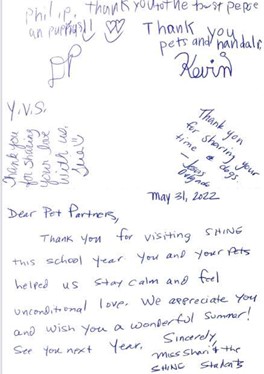
Congratulations, your donor opened your email message. You want to keep them engaged. Here’s the full message from Pet Partners, along with a picture of a thank you note from the kids and the therapy dog Dusty Rose.

Dear Ann,

Your monthly commitment to Pet Partners allows for stability within our organization that directly affects our volunteer experience and the visits they make. Without your support of the human-animal bond, the beautiful impact that our therapy animal teams make wouldn’t be felt. Thank you.

Many handlers partner with other local therapy animal teams to create local community-based groups, as is the case with Santa Clarita Pet Partners Therapy Dogs. Handler Sharon reflects on her time working with this group alongside her therapy dog Dusty Rose as they finish up their visits for the school year at the local elementary school:

“We visit at the school once a week during the school year with children who have been diagnosed with ADHD, who have been placed in foster care, and who are dealing with other difficult situations. They always look forward to our dogs. Typically we have three dogs visiting at a time, each assigned to a student by the school therapist. The students will sit on the floor with the therapy dogs to pet them, do tricks, talk, and relax together.

“Dogs create a nonjudgmental environment for these children. Many times during our visits they will share private information and feelings that they have never told anyone else. They might share that someone is being mean to them, or that when they were gone their parents gave away their dog. Life is difficult for many of these students, but they light up at the sight of their furry friends and the unconditional love the dogs offer.”

During one of the latest visits, the children showed their appreciation through a beautiful thank you note. Though this note is written directly to the therapy animal teams, it is because of your support that the children get to experience the heartwarming impact of therapy animal visits.

Make it personal

Be sure to address your donors by name, just like what you see in the examples above. I would also recommend separate communication for new donors and longer-term donors. 

Welcome new monthly donors. You can go a step further with different messages for brand new donors and single gift donors who have upgraded to monthly. Be sure to give special attention to longer-term donors. The average donor retention rate for monthly donors is 90% and you don’t want that to go down.

You can give shout outs in your newsletter and social media, but those won’t be as personal. Some organizations include a cover letter or note for their monthly donors in their newsletters. You could also create separate newsletters for monthly donors.

The key is to stay in touch and keep making connections. Remember to thank these donors every month

Don’t ignore your valuable monthly donors. Keep building those important relationships