How Your Nonprofit Can Be More Successful in 2026

Happy New Year! It’s hard to believe another year has gone by. 2025 was a difficult year in many ways. It may have also been a tough year for your nonprofit organization, especially if you were affected by funding cuts and the U.S. government shutdown. Most likely, we will see more uncertainty in 2026, but don’t despair. If you do a good job of planning and make the right decisions, you should be more successful. 

Many individuals make New Year’s resolutions and set goals. Your nonprofit should do the same. As with personal resolutions, you want your goals to be realistic and attainable. If you’re a small organization, you may not have much luck pulling off a huge gala.

Here are a few ways to help you ensure a more successful year.

Have a plan in place

You must have fundraising and communications/marketing plans. If you haven’t put together these plans yet, do that now! Go one step further and create a fundraising calendar, as well. 

Your plans need to be specific, too. I know you want to raise more money and hopefully improve your donor engagement, but how will you do that?

You know from past experience that you may need to make changes to your plans. There’s always a possibility of disruptions. In 2020, it was the pandemic. Last year, it was funding cuts and the government shutdown. Organizations that were able to make changes to a plan already in place were most successful.

Take a look back at 2025 to see what worked and what didn’t in your fundraising and communications/marketing. Incorporate what you’ve learned into your 2026 plans. 

It’s absolutely crucial that your fundraising plan includes a diverse stream of revenue (remember those federal funding cuts last year). Individual giving has proven to be successful. A lot of small donations can add up! Start or grow your monthly giving program (more on that below). Also, look into mid-level, major, and legacy giving. 

You can apply for grants and hold events, but those sometimes require more effort than it’s worth. Invest in strategies that make sense for your organization.

Revisit your fundraising and communications/marketing plans regularly and make changes as needed. Do this at least every two to three months.

Make sure that donor relations and donor retention are part of your fundraising plan. Those are key to your success.

Pay attention to your donor retention

Donor retention continues to be a problem when it should be a priority. You’ll have more success if you work to keep the donors you already have instead of focusing on getting new ones.

First, if you don’t already know it, figure out your retention rate. Do this after every fundraising campaign.

If it’s low, you can fix it, usually with better communication. It’s easier and less expensive to keep your current donors than to find new ones, so once again, make donor retention a priority.

That said, you may have some new donors who saw a need and felt a connection to your cause. Don’t let these donors slip away either. 

Your goal should be to have donors who support you for a long time.

Make monthly giving a priority

I’m a huge fan of monthly giving and think every nonprofit needs to make it a priority.

Why? First, the retention rate for monthly donors is around 90%. These donors are committed to your nonprofit. 

Organizations that have monthly giving programs receive a steady stream of revenue throughout the year. Donors who opt for monthly giving find it’s easier on their finances. Even gifts of $5.00 or $10.00 a month can make a difference for your organization. Dedicated monthly donors also step up and give additional donations.

It’s doable for organizations of all sizes, especially small ones. Work on starting or growing your monthly giving program so you can have a bunch of highly committed donors. A good way to start is to invite your current donors to become monthly donors.

Monthly donors are also potential mid-level, major, and legacy donors. Remember the importance of individual giving and that small donations can add up.

Do a better job of communicating with your donors 

There are many ways to do a better job of communicating with your donors. Start by making this the year you say goodbye to boring, generic communication. Stop using jargon, such as at-risk and underserved. Tell more stories and go easy on the statistics. It makes a difference if you can put things in human terms so you can do a better job of connecting with your donors.

Better communication also means more frequent communication. Donors want to feel appreciated and know how they are helping you make a difference. Be sure to implement the ask, thank, report, repeat formula

You want to segment and personalize your communication, too. Address your donors by name (not Dear Friend) and recognize their past giving or if they’re a monthly donor.

Better, more frequent communication will help you raise more money. Having a communications calendar will help you with this. 

Build relationships with your donors

You may think the most important component of fundraising is raising money. While that’s important, so is building relationships with your donors

It’s hard to raise money year after year if you don’t build a good relationship with your donors. Every single interaction with your donors needs to focus on building relationships. That includes fundraising appeals. It’s possible to raise money and build relationships at the same time. 

Stop thinking of the donations you receive as a transaction and instead think of them as the start or continuation of a relationship. 

Good relationships with your donors will help you with retention.

Create an attitude of gratitude

A big part of building relationships is showing gratitude to your donors. Many nonprofits do a poor job of this. 

You need to start by sending a heartfelt thank you immediately after you receive a donation and then find ways to thank your donors throughout the year. Put together a thank you plan to help you with this.

Start the New Year off by making fundraising and communications/marketing plans, if you haven’t already done so. Prioritize donor retention, monthly giving, showing gratitude, and building relationships with your donors. This will help bring you more success in 2026.

Why Your Nonprofit Needs to Make the Right Investments

With all the economic uncertainty right now, you may be worried about your nonprofit’s finances.

Maybe your giving has gone down and you’ve cut back on some expenses. While that’s understandable on one level, you need to be careful before you nix something you think you can’t afford. It may be something you should be investing in.

Instead of going on autopilot and saying “We can’t afford this,” think about how you can make the right investments. Stay away from the scarcity mindset. It’s often not helpful.

Here are a few areas you should invest more money in, even in a down economy. The good news is that if you do it well, these investments can help you raise more money.

Invest in a good CRM/database

Plain and simple, a good CRM (customer relationship management)/database can help you raise more money. You can segment your donors by giving amount and politely ask them to give a little more in your next appeal – $35 or $50 instead of $25. Many organizations don’t ask their donors to upgrade their gifts and you’re leaving money on the table when you don’t do this.

A good database can help you with retention, which will save you money since it costs less to keep donors than to acquire new ones. Donor retention continues to be a huge problem. Having a good database also helps with donor engagement.

Many CRMs have built-in payment processors. If not, invest in a good one

Your CRM will let you personalize your letters and email messages. Make sure to invest in a good email service provider, too. Personalized letters and messages mean you can address your donors by name and not Dear Friend. You can welcome new donors and thank current donors for their previous support. You can send targeted mailings to lapsed donors to try to woo them back. You can send special mailings to your monthly donors. You can record any personal information, such as conversations you had with a donor and their areas of interest.

In short, you can do a lot with a good CRM/database. Invest in the best one you can afford, and Excel is not a database.

If you’re worried about spending $50 to $100 a month on a CRM/database, you may be able to recoup that expense if you can ask for an upgrade and personalize your communication.

Invest in direct mail

You may not use direct mail that much. If that’s the case for you, you’re missing out on an effective and more personal way to communicate with your donors. Think of the enormous amount of email and social media posts you receive as opposed to postal mail. Your donors will be more likely to see your messages if you send them by mail.

Yes, direct mail is more expensive, but you don’t have to mail that often. Quality is more important than quantity, but aim for at least three or four times a year, and don’t just send fundraising appeals.

Give some thought to what you send. Some ideas, besides appeal letters, include thank you letters/cards; Thanksgiving, holiday, and/or Valentine’s Day cards; infographic postcards; two-to-four-page newsletters; and impact reports. You could put a donation envelope in your newsletter to raise some additional revenue, but do not put one in a thank you or holiday card. I wouldn’t recommend putting one in an impact report either, especially if you only do one a year.

Shorter is better. Lengthy communication will cost more and your donors are less likely to read it. 

A few ways you can use direct mail without breaking your budget are to clean up your mailing lists to avoid costly duplicate mailings, spread thank you mailings throughout the year – perhaps sending something to a small number of donors each month, and look into special nonprofit mailing rates. You may also be able to get print materials done pro bono or do them in-house, as long as they look professional.

Of course, you can use email, but your primary reason for communicating that way shouldn’t be because it’s cheaper. Both direct mail and email have their place, but in many cases, direct mail is more effective. They also work well when you use them together.

Invest in monthly giving

If you don’t have a robust monthly giving program, you’re missing out on a great way to raise more money. Monthly giving is one of the few types of fundraising that has increased over the last few years. It’s good for all nonprofit organizations, but it’s especially beneficial for small nonprofits.

Monthly giving will provide you with a steady stream of revenue throughout the year. This is important during this time of economic uncertainty and funding cuts. It can also be a more feasible option for donors if they can spread out their gifts over the year.

All it takes is for someone to start giving $5.00 or $10.00 a month (hopefully more). These small gifts add up. Also, the retention rate for monthly donors is around 90%. Plus, they’re more likely to become mid-level, major, and legacy donors.

This is why having a good CRM is so important. It will help you find potential monthly donors and segment your current monthly donors so you can send them specialized donor communications. 

Don’t wait any longer to invest in this proven way to raise more money. If you already have a strong monthly giving program (kudos to you), take the next step and invest in mid-level donors and so on.

Invest in donor communications

By donor communications I mean thank you letters/notes, newsletters, and other updates. Some organizations don’t prioritize these and want to spend their time “raising money.” They don’t seem to realize they can raise more money with better donor communications. Remember this formula – ask, thank, report, repeat.

Don’t skimp on your communications budget. Creating thank you cards and infographic postcards is a good investment and a necessity, not a luxury. Thank you cards are a much better investment than mailing labels and other useless swag.

Maybe you need to reallocate your budget to cover some of these expenses. You could also look into additional sources of unrestricted funding. 

Of course, you can also use email and social media to communicate with donors. This reiterates the need for a good email service provider with professional looking templates for your email newsletter and other updates.

Invest in infrastrucure

We need to stop treating overhead or infrastructure as something negative. Most individual donors don’t care about overhead, anyway. However, some funders want us to spend our budget on programs, but how can we successfully run our programs if we don’t have enough staff and can barely afford to pay the people we do have? A rotating door of development staff makes it hard to maintain those important relationships. We also have to pay rent and other expenses (including a CRM, direct mail communication, etc.).

Until these funders stop worrying so much about overhead, you may want to invest some time in finding unrestricted funding sources – often those important individual gifts, such as monthly donations and mid-level/major gifts. Plus, weaning yourself off grant funding isn’t a bad idea.

Don’t limit yourself by saying you can’t afford certain expenses. If you make the right investments, you should be able to raise more money.

5 Revenue Streams to Strengthen Nonprofit Sustainability

Diverse revenue streams provide a sustainable financial foundation for nonprofits. Explore revenue streams your nonprofit should pursue in this guide.

It’s important for you to diversify your revenue sources. This is especially important now because of the current chaos of eliminating (and then not eliminating, at least for now) federal grant funding. We also saw disruption five years ago when the COVID-19 pandemic started.

This guest post by John Killoran covers a variety of revenue sources to help you diversify your funding. I’d like to emphasize the importance of recurring/monthly giving. This is a great way for nonprofits of all sizes to bring in a steady stream of revenue.

By John Killoran

Leaders across the nonprofit sector face a common challenge: striving to serve a growing community of beneficiaries with constrained budgets. The good news? Revenue diversification unlocks financial sustainability for nonprofits, providing a powerful alternative to relying on limited funding for your mission.

With various funding sources, your organization can develop dependable revenue flows that not only sustain your organization’s day-to-day operations but also enable it to grow. In this guide, we’ll explore five revenue streams your nonprofit can access to strengthen its financial sustainability.

1. Mobile Giving Campaigns

The future of fundraising is mobile, with a growing number of donors using their smartphones to find new nonprofits, complete transactions, and tell their friends about their experiences. That’s what makes mobile giving campaigns so successful—these fundraisers make contributing convenient for donors.

According to Snowball Fundraising’s mobile giving guide, there are five steps nonprofits should follow to start a mobile giving campaign:

[Alt text: The steps to start a mobile giving campaign, which are explained in the following text.]

  1. Evaluate your mobile fundraising logistics. Begin by defining the basics of your fundraiser, such as which staff members will oversee the campaign and how you’ll promote it to donors.
  2. Choose mobile giving channels. Determine which mobile giving strategies resonate most with your supporters, such as a mobile-responsive donation page on your website or a text-to-give campaign.
  3. Select a mobile giving provider. Connect with relevant software providers to streamline your mobile giving strategy. For example, you’ll need to partner with a text-to-donate provider before launching a text campaign to receive a shortcode and accept donations.
  4. Incorporate mobile giving into your fundraising plan. Plan how you’ll integrate mobile giving campaigns into your existing fundraising initiatives, such as by adding a QR code to your flyers so direct mail donors can easily donate online.
  5. Track and adjust your strategies. Monitor key performance indicators (KPIs) as donors interact with your mobile giving campaigns to determine the most effective strategies.

Since mobile giving is self-sustaining—meaning donors can contribute to these campaigns with little intervention from your nonprofit—these campaigns allow you to collect revenue in the “background” of your other initiatives. In other words, you can focus on your mission while revenue pours in from your mobile donation page or text-to-give campaign!

2. Fundraising Events

While your nonprofit can host countless types of profitable fundraising events, focus on the ideas that are most likely to appeal to your target audience. Create an event calendar to plan the timing of each fundraiser, including time before and after for event planning and follow-up.

Follow these best practices to maximize your event revenue:

  • Invest in event-specific technology. Tools with capabilities specific to the type of event you’re hosting are purpose-built to maximize your event’s success. For example, event registration software can help with ticketing for an auction. However, your nonprofit will unlock other functionalities by choosing auction software, such as an item inventory, mobile bidding, and other auction-specific tasks.
  • Offer tiered ticket pricing. Create flexible ticketing options that cater to a range of budgets so your event remains accessible to a broad audience. Encourage greater contributions by offering perks to higher-priced tickets, such as exclusive access or premium seating.
  • Plan events in various formats. Donors prefer different event formats for various reasons. Perhaps the majority of your donors are local, but others want to participate from another geographical location. Some of your supporters are excited for an outing, while others don’t want to leave their house. Plan a mix of in-person, virtual, and hybrid events to maximize event participation.

The best part? Fundraising events pair perfectly with more passive forms of fundraising, such as your mobile giving campaigns. Promote your text-to-give shortcode at an auction or feature QR codes on event posters that link to your mobile donation page for increased donations.

3. Recurring Donations

While securing new donors is crucial, most nonprofit leaders know that acquisition is more costly (and less reliable) than retention. In fact, research from the Fundraising Effectiveness Project shows that only 23% of first-time donors ever make another gift, while 58% of repeat donors stick around for another year.

Successfully encouraging your existing supporters to give again, especially on a recurring basis, creates a stable financial foundation of predictable revenue. The most effective way to secure continued support is through a formal monthly giving program, which includes:

  • Defining tiers and benefits. Attach benefits to specific giving levels to incentivize repeated donations. For example, donors giving $10 each month could receive quarterly impact updates, while those giving $50 monthly are invited to exclusive events.
  • Emphasizing the impact of small, regular contributions. Use real-world impact to demonstrate the value of monthly donations. For example, $10 monthly might feed a family for a week, while $50 monthly funds one day of emergency shelter for a family in crisis.
  • Automating communications to retain recurring donors. Send regular messages to thank donors for their repeated support, acknowledge their commitment, and celebrate milestones regarding their involvement.

In addition to the steps outlined above, remember to highlight the convenience of recurring gifts. Once donors join your monthly giving program, the process will run automatically, eliminating the need to donate manually. They can even opt-in to recurring donations through your text-to-give campaign for an easier sign-up process!

4. Corporate Contributions

While it’s tempting to think of individual donors as your nonprofit’s target audience, revenue can come from other sources, too. Companies and businesses often contribute to nonprofits as part of corporate social responsibility (CSR), or a company’s efforts toward improving society.

According to Double the Donation’s CSR guide, there are five main facets of CSR:

  • Philanthropic, which involves a company directly supporting a nonprofit through charitable contributions, such as matching gifts
  • Volunteerism, in which a company encourages employees to engage with nonprofits by offering grants or paid time off
  • Environmental, in which a company adjusts its values and practices to be more environmentally conscious
  • Ethical, which involves companies looking after the welfare of their employees
  • Economic, through which companies invest in their communities

Collaborating with businesses can unlock new revenue and boost visibility since your nonprofit will gain the attention of a company’s employees and customers. To get started, identify companies with values that align with your mission and pitch mutually beneficial opportunities for them to support your cause. For example, request the company sponsor a fundraising event and offer to promote their brand at the fundraiser in exchange for their support.

5. Grants

Grants provide substantial funding for both general operations and specific projects. When your nonprofit secures a grant to cover an essential cost, you’ll have more room in your budget for other financial needs, like funding your programs and services.

Start by researching foundations or programs that align with your mission. You can also search according to your nonprofit’s needs. For example, search for marketing grants if you spend too much on marketing. Follow the grantor’s instructions for applying while highlighting your nonprofit’s unique need for funding.

For support with the application process and grant usage (if awarded), enlist the help of a professional grant agency. Their expertise is especially useful for grants with extensive eligibility and usage requirements. For example, a grant agency might be helpful when applying for the Google Ad Grant, especially if your nonprofit has never participated in the program or created a Google Ad.


Each revenue diversification strategy mentioned in this article offers unique benefits. Implementing numerous ideas provides multiple revenue streams and allows your nonprofit to tap into more benefits than possible with just one or two fundraising ideas. Plus, promoting these giving opportunities via multiple channels ensures you reach the largest audience possible with fundraisers that appeal to them. 

John Killoran is an inventor, entrepreneur, and the Chairman of Clover Leaf Solutions, a national lab services company. He currently leads Clover Leaf’s investment in Snowball Fundraising, an online fundraising platform for nonprofit organizations. 

Snowball was one of John’s first public innovations; it’s a fundraising platform that offers text-to-give, online giving, events, and peer-to-peer fundraising tools for nonprofits. By making giving simple, Snowball increases the donations that these organizations can raise online. The Snowball effect is real! John founded Snowball in 2011. Now, it serves over 7,000 nonprofits and is the #1 nonprofit fundraising platform.

Go All In on Monthly Giving

Monthly giving is one of the few types of fundraising that does well. If your organization doesn’t have a monthly/recurring giving program or it’s fairly small, why is that?

Whether you’re a big or a smaller organization or your fundraising went well last year or it didn’t, monthly giving makes so much sense (or cents).

In this post, I’ll tell you why monthly giving is important for your nonprofit, how to start or grow your program, and how to nurture it going forward. 

In short, you need to go all in on monthly giving.

Monthly giving helps you raise more money

Monthly or recurring donations can help donors spread out their gifts and it’s easier on their bank accounts. They might be apprehensive about giving a one-time gift of $50 or $100. But if you offer them the option of giving $5 or $10 a month, that may sound more reasonable. 

It can also give you a consistent stream of revenue throughout the year instead of at certain times, such as when you do individual appeals and events and when grants come in.

Monthly gifts are smaller, but you can raise a lot of money with lots of small donations. Political candidates do it all the time. Also, monthly gifts aren’t as small as you think. The average is around $25 a month.

It can also be a more feasible way to get larger gifts. A gift of $100 a month may be more appealing to a donor than giving a large sum all at once. Even if they start with a smaller donation, monthly donors are more likely to become mid-level, major, and legacy donors.

It raises your retention rate, too

The retention rate for monthly donors is around 90%. That’s significantly higher than other retention rates. 

One reason is that monthly gifts are ongoing. But your donors have agreed to that, so this shows they’re committed to your organization. 

Monthly donors are long-term donors and long-term donors should always be one of your priorities.

How to get started

If you don’t already have a monthly giving program, make this the year you start one. Remember, it will help you raise more money and shouldn’t be too hard to set up.

A good way to start is to invite your current donors to become monthly donors. Your best bet for monthly donors are people who’ve given at least twice. These are donors who have shown a commitment to you.

That doesn’t mean you can’t ask first-time donors. This could be a good way to connect with donors from your most recent campaign. And if you haven’t officially welcomed your new year-end donors, do that now. Create a series of welcome messages and conclude it by inviting people to become monthly donors.

You could create testimonials from current monthly donors to entice future monthly donors.

If you’re having trouble getting donors to commit to monthly giving, maybe you need to do a better job of thanking and updating them.

Make monthly giving your go-to option

Put monthly giving front and center in all your campaigns. It should be an easy option on your donation page. Include it on your pledge form and make it a prominent part of your appeal letter.

I can speak from personal experience that once I started giving monthly, that’s the way I wanted to give to all organizations. Your donors would probably agree. Each year I’m happy to see that more organizations are going all in on monthly giving.

Organizations that don’t offer a monthly giving option are making a mistake. Some have a minimum donation, which I would also not recommend, if possible. If you do have a minimum, make it $5 a month instead of $10. 

If your reason for having a minimum donation amount is to save money on your expenses, is that happening if your minimum deters someone from giving at all? You often have to invest a little to raise more money. And you should raise more money with a monthly giving program.

Make your monthly donors feel special

You need to do a good job of thanking your monthly donors. Start by segmenting your monthly donors into new monthly donors, current monthly donors, and current donors who become monthly donors.

This way you can personalize their thank you letters to make them feel special. Be sure to mail a thank you letter, or even better, send a handwritten note. An email acknowledgment is not enough.

Many organizations send a monthly acknowledgment email or letter, and most are just okay. Some are basically only receipts, and as I’ve mentioned many times in the past, your thank yous need to be more than a receipt. Yes, it’s helpful to know the organization received your donation, but you’re not practicing good donor stewardship if that’s all you do.

You could spruce up these monthly acknowledgments, both by making them sound like they were written by a human and not a robot or AI, and by providing some engaging updates.

You can include a list of your monthly donors in a newsletter, impact report, or on your website. Donor lists are just one of many ways to show appreciation and not the only one, so do much more than just that. Of course, honor any donor’s wish to remain anonymous.

One thing you should do is send your donors an annual summary of their monthly gifts. This is extremely helpful for people who itemize tax deductions. Make this letter more than just a receipt and use this opportunity to connect with your donors. Pour on the appreciation and let them know how their monthly donations are helping you make a difference. If you send one by mail, go one step further with a Thank You teaser on the outer envelope.

Reach out at least once a month

Your monthly donors made a commitment to you by giving every month. Make the same commitment to them by reaching out at least once a month.

You could create a special newsletter for monthly donors or include a cover letter referencing monthly donors. If that’s too much, you could give a shout out to your monthly donors and include information on how to become a monthly donor in your newsletter.

A thank you video is a great way to connect. Consider personalizing it, if you can. You could also provide other video content, such as a virtual tour, for your monthly donors.

Thank yous, newsletters, and updates are not a one-and-done situation. Keep it up throughout the year. Many nonprofits start out communicating regularly with their monthly donors and then disappear after a couple of months. Always make a point to stay in touch with your donors.

Create a special section in your communications calendar specifically for monthly donors to help you with this.

Go the extra mile for your monthly donors

I highly recommend a contact person for your monthly donors in case they need to update their credit card information or make a change to their gift, hopefully an upgrade. Include this information in their welcome letter or email. If you send a monthly acknowledgment email, be sure to include a link where your donor can make changes. 

If you change your payment processor, make it easy for donors to transfer their information. For one organization I give to, all I had to do was click on a link they provided and presto…..

Another way to help your monthly donors is to let them know when their credit cards are about to expire. Don’t rely on your donors to remember this, because most likely they won’t. You also don’t want to miss out on any revenue. Remember, small donations add up.

If your payment processor doesn’t automatically update credit cards, set up a system where you can flag cards that will expire in the next month or two. Then send these donors a friendly reminder email/letter or give them a call. 

When my monthly giving credit card expired a few years ago, only a couple of nonprofits contacted me before the expiration date. Of course, a few slipped through the cracks and I didn’t hear from these organizations until after the donations didn’t go through. There were also a few instances when I checked my credit card statement and realized the donations weren’t getting charged. Remember to take the lead on this and pay attention, or once again, you’ll miss out on receiving this important revenue.

You could encourage donors to give via an electronic funds transfer from their bank account instead. Then neither you nor your donors need to worry about expiring credit cards.

Once a monthly donor, always a monthly donor

Once someone becomes a monthly donor, you must always recognize them as such. You most certainly should send fundraising appeals to monthly donors, but not the same ones you send to other donors.

You can ask your monthly donors for an additional gift during one of your fundraising campaigns, but you MUST recognize they’re monthly donors. For example – We really appreciate your gift of $10 a month. Could you help us out a little more right now with an additional gift? People in our community are having a hard time paying their heating bills.

You can also ask your monthly donors to upgrade their gifts after a year or so. Be as specific as possible – We’re so happy you’re part of our family of monthly donors and are grateful for your gift of $5.00 a month. Many families are having trouble making ends meet and we’re serving more people at the Eastside Community Food Pantry right now. Could you help us out a little more with a gift of $7.00 or even $10.00 a month?

If you send the usual generic appeal, imagine your donor saying – “I already give you $10 a month and you don’t seem to know that.”

But if you let those committed monthly donors know you think they’re special, they’ll be more likely to upgrade or give an additional gift. Many monthly donors have stepped up and given additional donations over the last few years. That’s what you want. And, if they do give an additional donation, be sure to thank them for that. Here’s the opening from a great thank you card I received – “How generous of you to make a gift that goes above and beyond your monthly donations.

Be sure to invest in this proven way to raise more money, boost donor retention rates, and provide an easier giving option for your donors. 

Need more inspiration, get some ideas here.

How to Make 2025 a Successful Year for Your Nonprofit

Happy New Year! It’s hard to believe it’s already 2025. I hope 2024 was a successful year for your nonprofit organization. If it wasn’t, you can work to make 2025 a better year. And if you were successful, you want that to continue.

Many individuals make New Year’s resolutions and set goals. Your nonprofit should do the same. As with personal resolutions, you want your goals to be realistic and attainable. If you’re a small organization, you may not have much luck pulling off a huge gala.

Here are a few ways to help you ensure a more successful year.

Have a plan in place

You must have fundraising and communications/marketing plans. If you haven’t put together these plans yet, do that now! Go one step further and create a fundraising calendar, as well. 

Your plans need to be specific, too. I know you want to raise more money and hopefully improve your donor engagement, but how will you do that?

You know from past experience that you may need to make changes to your plans. In 2020, organizations that were able to make changes to a plan already in place were most successful.

Take a look back at 2024 to see what worked and what didn’t in your fundraising and communications/marketing. Incorporate what you’ve learned into your 2025 plans. 

Be sure your fundraising plan includes a diverse stream of revenue. Individual giving has proven to be successful. A lot of small donations can add up! Start or grow your monthly giving program (more on that below). Also, look into mid-level, major, and legacy giving. 

You can apply for grants and hold events, but those sometimes require more effort than it’s worth. Invest in strategies that make sense for your organization.

Revisit your fundraising and communications/marketing plans regularly and make changes as needed. Do this at least every two to three months.

Make sure that donor relations and donor retention are part of your fundraising plan. Those are key to your success.

Pay attention to your donor retention

Donor retention continues to be a problem when it should be a priority. You’ll have more success if you work to keep the donors you already have instead of focusing on getting new ones.

First, if you don’t already know it, figure out your retention rate. Do this after every fundraising campaign.

If it’s low, you can fix it, usually with better communication. It’s easier and less expensive to keep your current donors than to find new ones so once again, make donor retention a priority.

That said, you may have some new donors who saw a need and felt a connection to your cause. Don’t let these donors slip away either. 

Your goal should be to have donors who support you for a long time.

Go all in on monthly giving

I’m a huge fan of monthly giving and think every nonprofit needs to go all in on it.

Why? First, the retention rate for monthly donors is around 90%. These donors are committed to your nonprofit. 

Organizations that have monthly giving programs receive a steady stream of revenue throughout the year. Donors who opt for monthly giving find it’s easier on their finances. Even gifts of $5.00 or $10.00 a month can make a difference for your organization. Dedicated monthly donors also step up and give additional donations.

It’s doable for organizations of all sizes, especially small ones. Work on starting or growing your monthly giving program so you can have a bunch of highly committed donors. A good way to start is to invite your current donors to become monthly donors.

Monthly donors are also potential mid-level, major, and legacy donors. Remember the importance of individual giving.

Do a better job of communicating with your donors 

There are many ways to do a better job of communicating with your donors. Start by making this the year you say goodbye to boring, generic communication. Stop using jargon, such as at-risk and underserved. Tell more stories and go easy on the statistics. It makes a difference if you can put things in human terms so you can do a better job of connecting with your donors.

Better communication also means more frequent communication. Donors want to feel appreciated and know how they are helping you make a difference. Be sure to implement the ask, thank, report, repeat formula

You want to segment and personalize your communication, too. Address your donors by name (not Dear Friend) and recognize their past giving or if they’re a monthly donor.

Better, more frequent communication will help you raise more money. Having a communications calendar will help you with this. 

Work on building relationships

You may think the most important component of fundraising is raising money. While that’s important, so is building relationships with your donors. 

It’s hard to raise money year after year if you don’t build a good relationship with your donors. Every single interaction with your donors needs to focus on building relationships. That includes fundraising appeals. It’s possible to raise money and build relationships at the same time. 

Stop thinking of the donations you receive as a transaction and instead think of them as the start or continuation of a relationship. 

Good relationships with your donors will help you with retention.

Create an attitude of gratitude

A big part of building relationships is showing gratitude to your donors. Many nonprofits do a poor job of this. 

You need to start by sending a heartfelt thank you immediately after you receive a donation and then find ways to thank your donors throughout the year. Put together a thank you plan to help you with this.

Start the New Year off by making fundraising and communications/marketing plans, if you haven’t already done so. Prioritize donor retention, monthly giving, showing gratitude, and building relationships with your donors. This will help bring you more success in 2025.

How to Encourage Donations on Your Nonprofit’s Website

Your website can be a great marketing tool, but it can also help your nonprofit raise funds. Learn how to encourage donations on your nonprofit website. 

By Ira Horowitz

Your nonprofit’s website is more than just a hub for your online presence—it’s a versatile platform that can help you connect with supporters, amplify your mission, and make a lasting impact. 

However, one of its most important functions is as a tool for fundraising. If designed correctly, your website can be an unstoppable force in driving donations. When your website is optimized for online giving, it can make donating a seamless and rewarding experience for your supporters. This is essential because 63% of donors prefer to give online!

Below we will explore actionable tips and strategies to help you design or revamp your website to turn it into an effective fundraising powerhouse. Whether you’re looking to inspire first-time donors or make recurring donations easier, these insights will guide you toward creating a site that encourages generosity. 

1. Create prominent donation buttons. 

Donation buttons are a critical part of a well-designed nonprofit website. They act as clear calls to action, guiding visitors toward supporting your cause. A strategically placed, well-designed button can simplify the donation process, reduce hesitation, and increase conversion rates. The more prominent and appealing the button, the more likely visitors are to notice it and act.

How to Create Effective Donation Buttons 

  • Use contrasting colors. Choose colors that stand out from the rest of your website but still align with your branding. For instance, if your site has a neutral color palette, a bright green or orange button can grab attention. High-contrast buttons improve click-through rates because they are easier for users to spot.
  • Write clear and action-oriented text. Use direct language that tells users exactly what to do, such as “Donate Now,” “Support Our Mission,” or “Give Today.” Avoid vague terms like “Click Here.” Action-oriented text creates urgency and communicates purpose.
  • Place buttons with care. Place donation buttons in high-visibility areas, such as your website header, at the top of your homepage, and near impactful content like success stories or impact videos. Repeat them in the footer and on pages dedicated to your programs. Consistency ensures users can donate no matter where they are on your site.
  • Ensure all buttons work and lead to the correct place. Test each button regularly to confirm it works and links directly to your donation form. Broken or misdirected links can frustrate visitors and lead to lost donations. 

Regular website maintenance is crucial to ensuring all donation buttons are functional and optimized. Schedule time each month or quarter to conduct a review of your website and make necessary improvements. 

2. Simplify the donation process. 

A smooth, quick donation process can significantly increase conversion rates. When potential donors face a complicated or time-consuming form, they’re more likely to abandon the process. By reducing friction and making it as easy as possible for someone to give, you encourage more people to complete their donations.

How to Improve Your Online Donation Process 

  • Ensure your donation form is user-friendly. The design and functionality of your donation form are key. It should load quickly, be visually appealing, and work seamlessly across all types of devices. Intuitive forms with clear instructions create a positive user experience and encourage completion.
  • Only ask for necessary information. Keep the fields to a minimum. For instance, instead of requesting detailed personal information, stick to essentials like name, email, and payment details. The simpler the form, the quicker donors can complete it, reducing drop-offs.
  • Keep the form to one page. Avoid making users click through multiple steps to finish their donation. A single-page form keeps the process straightforward and ensures donors aren’t overwhelmed or confused by navigating between pages.
  • Test the form before pushing it live. Before launching your form, test it thoroughly to ensure it works flawlessly. Check for broken links, errors, and compatibility issues across different browsers and devices. Simulate user scenarios to confirm that the process is as smooth as possible.

3. Provide multiple donation options. 

Donors come from diverse financial backgrounds and have unique preferences when it comes to supporting causes. A one-size-fits-all approach can alienate potential donors who may need options tailored to their giving capacity and circumstances. By offering multiple ways to give, you make it easier for everyone to contribute, increasing donor satisfaction and your chances of securing ongoing support.

How to Offer Different Opportunities for Donors 

  • Provide suggested giving amounts. Include preset donation amounts, such as $25, $50, or $100, to guide donors and simplify decision-making. Highlight what each amount accomplishes (e.g., “$50 feeds a family for a week”) to create a tangible connection between their contribution and your impact.
  • Add the option to give a recurring gift. Allow donors to set up monthly, quarterly, or annual gifts. Recurring donations provide a stable income stream for your nonprofit while making it easier for donors to contribute smaller, manageable amounts over time.
  • Enable donors to give in honor or memory of someone. Offer an option for donors to dedicate their gift to a loved one. This personalization adds an emotional element to the donation and creates an opportunity for them to share their contribution with others, further expanding your reach.
  • Include multiple payment options. Make it easy for donors to pay by offering a variety of methods, such as debit and credit cards, PayPal, Venmo, Apple Pay, and other digital wallets. The more flexible your payment options, the fewer barriers donors face when contributing.

4. Be transparent about how donations will be used. 

Transparency is key to building and maintaining trust with donors. When people understand exactly how their contributions are used, they feel more confident about giving and are more likely to continue supporting your organization over the long term. 

Tips for Donation Transparency 

  • List current needs or priorities on your donation page. Clearly outline your immediate funding priorities, such as specific programs, campaigns, or goals. For example, detail how a $50 donation supports educational programming or how $100 provides meals for families. This specificity shows donors how their contributions directly address your mission.
  • Share financial information on your website. Include access to annual reports, IRS Form 990 filings, or detailed financial summaries. Offering insight into how funds are allocated demonstrates accountability and reassures donors that their money is being used effectively.
  • Include elements of social proof. Add donor testimonials, photos, or videos showing how previous contributions have been used. Quotes from past donors about their positive experiences or stories from beneficiaries create a compelling narrative about your impact. This social proof can influence potential donors to trust and contribute.
  • Publish an annual impact report. An annual impact report is a powerful tool for showcasing your achievements and financial transparency. Highlight metrics, success stories, and detailed breakdowns of how donations were used to further your mission. Make this report visually engaging and easy to find on your website.

Transparency is essential to growing trust amongst your audience. It can be enhanced by sharing impactful donor stories and expressing gratitude

5. Leverage matching gifts. 

Matching gift programs allow your organization to capitalize on donors’ generosity without requiring them to give more out of pocket. These programs, offered by many employers, will match an employee’s charitable contributions, effectively doubling (or even tripling) the impact of each gift. 

Steps to Securing a Matching Gift 

  1. Educate donors about matching gifts. Make donors aware that many employers offer matching gift programs. Include information about these programs on your website, in email campaigns, and during donation drives. Use phrases like, “Your donation could go twice as far!” to spark interest and encourage participation.
  1. Embed a matching gift database on your website. Simplify the process by integrating a matching gift database directly into your website. These tools allow donors to quickly check if their employer offers a matching gift program and learn the steps to apply. Many databases also include details on company policies, eligibility requirements, and submission deadlines. 

Creating a nonprofit website that drives donations effectively is not just about design—it’s about understanding donor behavior and meeting their needs with intentional features. From compelling calls-to-action and simplified donation processes to flexible giving options and transparent communication, every element plays a role in fostering trust and inspiring generosity. Additionally, leveraging tools like matching gift programs can further amplify the impact of individual contributions.

Not only will you enhance the donor experience, but you’ll also cultivate long-term supporters who feel connected to your mission and confident in your stewardship of their contributions.

With 15 years of experience, Ira Horowitz is an expert in nonprofit online communications and online fundraising. His work has resulted in increased funds and resounding supporter engagement for hundreds of organizations.

Ira oversees Cornershop Creative’s project management team and works with clients to provide them with the best possible final product. He also manages all of their strategic engagements and helps guide nonprofits to determine their long-term strategy goals for online communications.

How Making Wise Investments Can Help You Raise More Money

In most instances, nonprofit giving declined again in 2023. If you’re interested in the numbers, here are the latest results from M + R Benchmarks.

If your giving has gone down, you may have cut back on some expenses. While that’s understandable on one level, you need to be careful before you nix something you think you can’t afford. It may be something you should be investing in.

Instead of going on autopilot and saying “We can’t afford this,” think about how you can make wise investments. Stay away from the scarcity mindset. It’s often not helpful.

Here are a few areas you should be investing more money in. The good news is if you do it well, these investments can help you raise more money.

Invest in a good CRM/database

Plain and simple, a good CRM (customer relationship management)/database can help you raise more money. You can segment your donors by giving amount and politely ask them to give a little more in your next appeal – $35 or $50 instead of $25. Many organizations don’t ask their donors to upgrade their gifts and you’re leaving money on the table when you neglect to do this.

A good database can help you with retention, which will save you money since it costs less to keep donors than to acquire new ones. Donor retention continues to be a huge problem.

Many CRMs have built-in payment processors. If not, invest in a good one

Your CRM will let you personalize your letters and email messages. Make sure to invest in a good email service provider, too. Personalized letters and messages mean you can address your donors by name and not Dear Friend. You can welcome new donors and thank current donors for their previous support. You can send targeted mailings to lapsed donors to try to woo them back. You can send special mailings to your monthly donors. You can record any personal information, such as conversations you had with a donor and their areas of interest.

In short, you can do a lot with a good CRM/database. Invest in the best one you can afford, and Excel is not a database.

If you’re worried about spending $50 to $100 a month on a CRM/database, you may be able to recoup that expense if you can ask for an upgrade and personalize your communication.

Invest in direct mail

You may not use direct mail that much, especially over the last few years. Some organizations were never or rarely using it before the pandemic.

If that’s the case for you, you’re missing out on an effective and more personal way to communicate with your donors. Think of the enormous amount of email and social media posts you receive as opposed to postal mail. Your donors will be more likely to see your messages if you send them by mail.

Yes, direct mail is more expensive, but you don’t have to mail that often. Quality is more important than quantity but aim for at least three or four times a year, and don’t just send fundraising appeals.

Give some thought to what you send. Some ideas, besides appeal letters, include thank you letters/cards; Thanksgiving, holiday, and/or Valentine’s Day cards; infographic postcards; two-to-four-page newsletters; and impact reports. You could put a donation envelope in your newsletter to raise some additional revenue, but do not put one in a thank you or holiday card. I wouldn’t recommend putting one in an impact report either, especially if you only do one a year.

Shorter is better. Lengthy communication will cost more and your donors are less likely to read it. 

A few ways you can use direct mail without breaking your budget are to clean up your mailing lists to avoid costly duplicate mailings, spread thank you mailings throughout the year – perhaps sending something to a small number of donors each month, and look into special nonprofit mailing rates. You may also be able to get print materials done pro bono or do them in-house, as long as they look professional.

Of course, you can use email, but your primary reason for communicating that way shouldn’t be because it’s cheaper. Both direct mail and email have their place, but in many cases, direct mail is more effective. They also work well when you use them together.

Invest in monthly giving

If you don’t have a robust monthly giving program, you’re missing out on a great way to raise more money. Monthly giving is one of the few types of fundraising that saw an increase last year. It’s good for all nonprofit organizations, but it’s especially beneficial for small nonprofits.

All it takes is for someone to start giving $5.00 or $10.00 a month (hopefully more). These small gifts add up. Also, the retention rate for monthly donors is around 90%. Plus, they’re more likely to become mid-level, major, and legacy donors.

This is why having a good CRM is so important. It will help you find potential monthly donors and segment your current monthly donors so you can send them specialized donor communications. 

Don’t wait any longer to invest in this proven way to raise more money. If you already have a strong monthly giving program (kudos to you), take the next step and invest in mid-level donors and so on.

Invest in donor communications

By donor communications I mean thank you letters/notes, newsletters, and other updates. Some organizations don’t prioritize these and want to spend their time “raising money.” They don’t seem to realize they can raise more money with better donor communications. Remember this formula – ask, thank, report, repeat.

Don’t skimp on your communications budget. Creating thank you cards and infographic postcards is a good investment and a necessity, not a luxury. Thank you cards are a much better investment than mailing labels and other useless swag.

Maybe you need to reallocate your budget to cover some of these expenses. You could also look into additional sources of unrestricted funding. 

Of course, you can also use email and social media to communicate with donors. This reiterates the need for a good email service provider with professional looking templates for your email newsletter and other updates.

Invest in infrastrucure

We need to stop treating overhead or infrastructure as something negative. Most individual donors don’t care about overhead, anyway. However, some funders want us to spend our budget on programs, but how can we successfully run our programs if we don’t have enough staff and can barely afford to pay the people we do have? A rotating door of development staff makes it hard to maintain those important relationships. We also have to pay rent and other expenses (including a CRM, direct mail communication, etc.).

Until these funders stop worrying so much about overhead, you may want to invest some time in finding unrestricted funding sources – often those important individual gifts, such as monthly donations and mid-level/major gifts. 

Don’t limit yourself by saying you can’t afford certain expenses. If you make wise investments, you should be able to raise more money.

Future-proof your fundraising: 3 ways to thrive long-term

Is your nonprofit poised for long-term growth? Check out these future-proof nonprofit fundraising strategies based on today’s top philanthropic trends.

By Patrick Schmitt

Achieving your mission takes time and resources. As a nonprofit professional, you know this all too well and likely implement all kinds of cost-saving and efficiency-boosting practices into your work.

But can you be more proactive and go beyond mitigation? Do your fundraising practices look forward and actively build a foundation for long-term success? Are you missing opportunities to engage with donors in new ways?

This often means investing in new forms of fundraising or making significant updates to existing practices. But for many small nonprofits, making these changes can feel less than feasible.

However, as we’re constantly reminded, we’re living in unpredictable times—economic turbulence, heightened political and social tensions, the rise of AI, changing donor habits and preferences – the list goes on. There’s no telling what the future may bring, but your nonprofit needs to be there to shine a light and help lead your community.

Let’s explore some forward-thinking and (perhaps surprisingly) accessible ways for small nonprofits to drive sustained success and reduce the need for constant cost-cutting and budget anxiety.

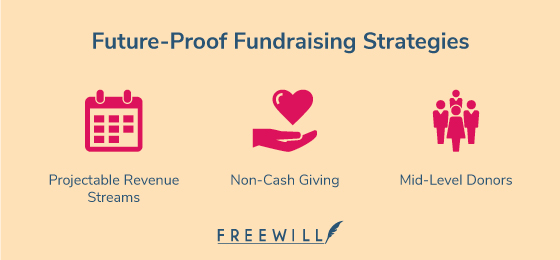
The three future-proof nonprofit fundraising strategies explained in this article:  projectable revenue streams, non-cash giving, and mid-level donor stewardship.

1. Build more projectable revenue sources.

Building a pipeline of future giving is massively helpful—it fuels your operations and growth and it’s predictable, allowing you to plan more effectively.

There are two key types of projectable future giving to keep in mind:

  • Deferred giving
  • Recurring giving

Deferred giving, also called planned or legacy giving, is often neglected by small shops but is increasingly understood as a game-changer for nonprofits of all sizes. It’s an especially smart choice now as we begin to see “the Great Wealth Transfer” unfold, with shifting demographic trends resulting in large amounts of saved assets being disbursed to heirs and beneficiaries. 

But planned giving is also very accessible—any donor, regardless of wealth, can easily create bequests. And since these gifts are given from assets rather than cash on hand, they give donors the chance to drive sustained impact without impacting day-to-day finances (while also tapping into tax benefits here and now). The FreeWill guide to planned giving programs covers the essential steps nonprofits of all sizes should take to get started.

You’re likely more familiar with the ins and outs of recurring giving, facilitated through recurring giving programs or membership programs. It’s easy to get started—simply add a recurring giving option to your donation form, create a new web page and other materials that explain why repeat gifts are so impactful for your mission, and begin promoting the option.

As always, anchor your messaging about new forms of giving with impact, and don’t be afraid to be transparent. As a growing nonprofit, your committed supporters will be motivated by messages that clearly explain why you’re prioritizing these initiatives to ensure your mission’s long-term future.

2. Take more (or your first) steps into the world of non-cash gifts.

Donor preferences are rapidly diversifying. Tax code changes, the state of the economy, and ever-increasing financialization and digitization all point to increased interest in non-cash gifts.

By tapping into these trends and offering more flexibility to donors, nonprofits have seen substantial long-term growth. One study found that nonprofits that accept non-cash gifts grow six times faster than those that don’t.

Key types of non-cash gifts that should be on nonprofits’ radar include:

  • Grants from donor-advised funds (DAFs). These philanthropic quasi-savings accounts allow donors to put away funds for future giving to be saved and grown.
  • Gifts of stock. This includes stock from public and private companies and mutual funds and is a savvy choice for donors looking to rebalance their portfolios and secure added tax benefits.
  • In-kind gifts. These are any non-financial gifts, including materials and equipment, real estate, cars, you name it. Donors may seek to offload unneeded tangible assets to secure tax benefits, and you never know who among your community may have something they’d like to donate.
  • Cryptocurrency donations. Steadily rising in popularity among younger and more diverse groups of donors, gifts of crypto are new but certainly worth exploring if you think your donor base may be a good match.

If you’re prioritizing non-cash giving for the first time, we recommend starting with DAFs simply because their growth in popularity and volume has been explosive. Payouts to nonprofits from DAFs grew a record 28.2% in 2021, hitting $45.74 billion. Nonprofits also received 32% more DAF grants and 56% more grant dollars in 2022 than in 2021.

However, DAF fundraising is notoriously opaque—the names of DAF account owners aren’t disclosed, and these accounts are managed by a wide range of organizations including banks, financial service providers, and community foundations. 

To get started, try a simple survey. Ask donors if they’ve heard of, have, or are interested in donor-advised funds, and use your findings as the basis for future outreach. Contact local community foundations to introduce your organization and ask if they sponsor DAFs so they might recommend you as a grantee to their account holders. Add DAF giving as a new section on your Ways to Give page.

3. Invest in your mid-level donors.

Mid-level donors, often defined as those who give between $1,000 and $10,000 a year, are the key to long-term growth due to their high levels of loyalty and engagement. These supporters also tie together many of the trends that we’re currently seeing play out for nonprofits. Check out these statistics from Seachange Strategies’ most recent Missing Middle Report:

  • 31% of mid-level donors have made a bequest and another 23% say they plan to make one in the future.
  • 20% have donor-advised funds (DAF) and another 8% are considering starting one.
  • The majority of these donors say that in the past two years, their giving stayed the same or even grew amid political and cultural polarization (94%), global instability (94%), and economic uncertainty (87%).

What steps does your nonprofit currently take to steward and retain these donors?

For many organizations, the answer is “not enough,” and that’s understandable—fostering relationships with the highest-impact donors and running broad campaigns naturally take center stage for busy teams. But consider these easy steps you can take to better engage with them.

Start by understanding who these donors are. Revisit your segmentation strategies and rethink your donor pyramid or pipeline frameworks. The report cited above highlights that mid-level donors generally don’t demonstrate the same characteristics as major donors, so they’re easily missed if your focus is elsewhere.

Identify this segment of donors for your nonprofit and reach out to express your gratitude for their past support. If you want to prioritize deferred, recurring, or non-cash giving, try focusing on this group first. Develop tailored messaging to drive engagement, make asks, and retain their support, whether that’s through joining a membership program, creating a bequest, signing up to volunteer, or another action that will push your mission forward in the long run.


To work toward your mission effectively and responsibly, you need to do more than just trim expenses and seek new ways to be efficient. You also must proactively look forward and build a solid runway for your organization to grow.

With all the trends discussed above, it’s an exciting time for growing nonprofits. Take stock of your current practices and donor preferences, and weigh your options. While there’s no one-size-fits-all growth strategy, there are tons of easy first steps you can take to find the perfect route for your unique organization.

Patrick Schmitt and fellow co-CEO Jenny Xia founded FreeWill at Stanford University’s Graduate School of Business in 2016. FreeWill’s charitable giving platform makes it easier for nonprofit fundraising teams to unlock transformational gifts, and to date has generated over $6.6 billion in new gift commitments for thousands of nonprofit organizations. Patrick hosts FreeWill’s popular webinar series, educating thousands of nonprofit fundraising professionals each month about planned and non-cash giving strategies.

Before FreeWill, Patrick was the Head of Innovation at Change.org, where he helped grow the organization to 100 million users in four years. Prior to that, he ran email marketing for President Obama and served as Campaign Director for MoveOn.org.

Are You Missing Out On Opportunities To Engage With Your Donors?

I recently finished tallying last year’s donations for our taxes. Always a fun task. Going through all the donation letters and emails triggered a few insights I’d like to share. Chances are, you’re missing out on opportunities to engage with your donors.

Sending a yearly donation summary is very helpful

Most of the gifts I make are monthly donations and organizations that sent a summary of all those gifts made it so much easier for me. I also made additional contributions to some of those organizations.  

You may not need to send a summary if someone just made one gift. Your thank you letter can include the important tax information, but there’s no guarantee your donors will keep that.

My suggestion is to send all your donors a yearly summary of their gifts the following January. Send it by mail, if you can. This is also an opportunity to reach out. Make it more than just a receipt. Thank your donors and let them know how their gift(s) helped your clients/community during the past year. Some organizations send two pages – one is a thank you letter and the other is a list of all the donations.

If you don’t send a summary, donors have to go through their donation records and credit card statements and that’s just tedious. 

The Case of the Missing Monthly Donations

One organization mailed me a yearly summary letter that included a short handwritten note and a list of my monthly donations from last year, which was good. What wasn’t so good was it didn’t include any donations from November and December. When I went online to check my credit card records, I discovered I wasn’t charged for January and February either.

I’m not sure why that happened. I set up the monthly donation in November 2022, so maybe it expired after a year. My credit card is good for a few more years. Maybe they changed their payment processor. Sometimes monthly gifts mysteriously stop.

I wonder why someone from the organization didn’t notice this and contact me about it. 

The lesson here is to pay attention to what’s going on with your monthly donors. Put a system in place where you can flag expiring credit cards. Better yet, invest in a payment processor that automatically updates credit cards. And, if you do change your payment processor, make it easy for donors to switch to the new one.

You don’t want any of these donations to slip through the cracks. Even though many monthly donations are $5.00 or $10.00 a month, these small donations make a difference. The organization I mentioned above missed out on four months of revenue from me. Most likely I wasn’t the only one.

Monthly donors are some of your most valuable donors. Ignore them at your peril.

Donor communication is a mixed bag

My folder of donation acknowledgment letters was bursting from the seams, so I recycled ones that were a few years old. I also keep thank you cards and print pieces I like to use as examples of good donor engagement. I recycled some of those too, although there weren’t as many of them (read on). 

It shouldn’t surprise you that some organizations do a better job of communicating with their donors than others. A few knock it out of the park, but most range from okay to nonexistent.  

Some examples of good print communication from my folder include postcards, handwritten thank you notes, short impact reports, a welcome package, holiday cards, and a note from a child with cancer. You’ll notice most of these are relatively short pieces. There’s no need to create something long (and often boring).

If you’re not communicating by mail, you’re missing out on a great opportunity to engage with your donors. Mail is more personal and your donors are more likely to see it. Good communication also includes content that focuses on how your donors helped you make a difference and not on your organization. Try to mail something besides fundraising appeals at least three or four times a year.

Of course, you’ll use email and social media more often. Unfortunately, a lot of electronic communication is not inspiring. I noticed that when I was going through my email gift acknowledgments. 

If you use PayPal for your monthly donations, they send a receipt each month, and all it is is a receipt. In some cases, that’s the only time I hear about that gift. Are you letting PayPal do your work for you?

Other organizations do send their own automated monthly gift acknowledgments/receipts and that’s about it. I’ve mentioned before that these can be helpful, but don’t count as a legitimate thank you or any type of donor communication.

Here’s another missed opportunity. There’s no reason your automatic thank you email, whether it’s for a monthly or one-time gift, can’t be warm and personal. If you send monthly gift acknowledgments, update the content periodically. Kelly McLaughlin of From Scratch Fundraising recommends blind copying a staff person on those automatically generated emails and having that person send an additional more personal email. At the very least, you can differentiate between new gifts and repeat gifts. 

And while you’re at it, make your email subject line more engaging. Say something like Thank you, Julie! or Look at the difference you made and not Donation Received or anything that includes the word transaction.

I’ve found it’s often the same few organizations that go the extra mile, so the rest of you need to step up. Don’t miss out on these opportunities to engage with your donors. Always remember that better donor communication will help you raise more money.

Image Credit: www.epictop10.com

What’s Keeping You From Starting or Growing Your Monthly Giving Program?

Monthly giving is one of the few types of fundraising that did well last year. If your organization doesn’t have a monthly/recurring giving program or it’s fairly small, what’s keeping you from starting or growing your monthly giving program?

Whether you’re a big or a smaller organization or you had a good fundraising year or you didn’t, monthly giving makes so much sense (or cents).

In this post, I’ll tell you why monthly giving is important for your nonprofit, how to start or grow your program, and how to nurture it going forward. 

Monthly giving helps you raise more money

Monthly or recurring donations can help donors spread out their gifts and it’s easier on their bank accounts. They might be apprehensive about giving a one-time gift of $50 or $100. But if you offer them the option of giving $5 or $10 a month, that may sound more reasonable. 

It can also give you a consistent stream of revenue throughout the year instead of at certain times, such as when you do individual appeals and events and when grants come in.

Monthly gifts are smaller, but you can raise a lot of money with lots of small donations. Political candidates do it all the time. Also, monthly gifts aren’t as small as you think. The average is $25 a month.

It can also be a more feasible way to get larger gifts. A gift of $100 a month may be more appealing to a donor than giving a large sum all at once. Even if they start with a smaller donation, monthly donors are more likely to become major donors and legacy donors.

It raises your retention rate, too

The retention rate for monthly donors is around 90%. That’s significantly higher than other retention rates. 

One reason is that monthly gifts are ongoing. But your donors have agreed to that, so this shows they’re committed to your organization. 

These are long-term donors and long-term donors should always be one of your priorities.

How to get started

If you don’t already have a monthly giving program, make this the year you start one. Remember, it will help you raise more money and shouldn’t be too hard to set up.

A good way to start is to invite your current donors to become monthly donors. Your best bet for monthly donors are people who’ve given at least twice. These are donors who have shown a commitment to you.

That doesn’t mean you can’t ask first-time donors. This could be a good way to connect with donors from your most recent campaign. And if you haven’t officially welcomed your new year-end donors, do that now. Create a series of welcome messages and conclude it by inviting people to become monthly donors.

You could create testimonials from current monthly donors in order to entice future monthly donors.

Make monthly giving your go-to option

Put monthly giving front and center in all your campaigns. It should be an easy option on your donation page. Include it on your pledge form and make it a prominent part of your appeal letter.

I can speak from personal experience that once I started giving monthly, that’s the way I wanted to give to all organizations. Your donors would probably agree. Each year I’m happy to see that more organizations are going all in on monthly giving.

Organizations that don’t offer a monthly giving option are making a mistake. Some have a minimum donation, which I would also not recommend, if possible. If you do have a minimum, make it $5 a month instead of $10. 

If your reason for having a minimum donation amount is to save money on your expenses, is that happening if your minimum deters someone from giving at all? You often have to invest a little to raise more money. And you should raise more money with a monthly giving program.

Make your monthly donors feel special

You need to do a good job of thanking your monthly donors. Go the extra mile and segment your monthly donors into new monthly donors, current monthly donors, and current donors who become monthly donors.

This way you can personalize their thank you letters to make them feel special. Be sure to mail a thank you letter, or even better, send a handwritten note. An email acknowledgment is not enough.

Many organizations send a monthly acknowledgment email or letter, and most are just okay. Some are basically only receipts, and as I’ve mentioned many times in the past, your thank yous need to be more than a receipt. Yes, it’s helpful to know the organization received your donation, but you’re not practicing good donor stewardship if that’s all you do.

You could spruce up these monthly acknowledgments, both by making them sound like they were written by a human and not a robot, and by providing some engaging updates.

You can include a list of your monthly donors in a newsletter, impact report, or on your website. Donor lists are just one of many ways to show appreciation and not the only one, so do much more than just that. Of course, honor any donor’s wish to remain anonymous.

One thing you should do is send your donors an annual summary of their monthly gifts. This is extremely helpful for people who itemize tax deductions. Make this letter more than just a receipt and use this opportunity to connect with your donors. Pour on the appreciation and let them know how their monthly donations are helping you make a difference. If you send one by mail, go one step further with a Thank You teaser on the outer envelope.

Reach out at least once a month

Your monthly donors made a commitment to you by giving every month. Make the same commitment to them by reaching out at least once a month.

You could create a special newsletter for monthly donors or include a cover letter referencing monthly donors. If that’s too much, you could give a shout out to your monthly donors and include information on how to become a monthly donor in your newsletter.

A thank you video is a great way to connect. Consider personalizing it, if you can. You could also provide other video content, such as a virtual tour, for your monthly donors.

Thank yous, newsletters, and updates are not a one-and-done scenario. Keep it up throughout the year. Many nonprofits start out communicating regularly with their monthly donors and then disappear after a couple of months. Always make a point to stay in touch with your donors.

Create a special section in your communications calendar specifically for monthly donors to help you with this.

Go all out for your monthly donors

I highly recommend a contact person for your monthly donors in case they need to update their credit card information or make a change to their gift, hopefully an upgrade. Include this information in their welcome letter or email. If you send a monthly acknowledgment email, be sure to include a link where your donor can make changes. 

If you change your payment processor, make it easy for donors to transfer their information. For one organization I give to, all I had to do was click on a link they provided and presto…..

Another way to help out your monthly donors is to let them know when their credit cards are about to expire. Don’t rely on your donors to remember this, because most likely they won’t. You also don’t want to miss out on any revenue. Remember, small donations add up.

If your payment processor doesn’t automatically update credit cards, set up a system where you can flag cards that will expire in the next month or two. Then send these donors a friendly reminder email/letter or give them a call. 

When my monthly giving credit card expired in the fall of 2022, only a couple of organizations contacted me before the expiration date. Of course, a few slipped through the cracks and I didn’t hear from these organizations until after the donations didn’t go through. There were also a few instances when I checked my credit card statement and realized the donations weren’t getting charged. Remember to take the lead on this and pay attention, or once again, you’ll miss out on receiving this important revenue.

You could encourage donors to give via an electronic funds transfer from their bank account instead. Then neither you nor your donors need to worry about expiring credit cards.

Once a monthly donor, always a monthly donor

Once someone becomes a monthly donor, you must always recognize them as such. You most certainly should send fundraising appeals to monthly donors, but not the same ones you send to other donors.

You can ask your monthly donors for an additional gift during one of your fundraising campaigns, but you MUST recognize they’re monthly donors. For example – We really appreciate your gift of $10 a month. Could you help us out a little more right now with an additional gift? People in our community are having a hard time paying their heating bills because of rising fuel costs.

You can also ask your monthly donors to upgrade their gifts after a year or so. Be as specific as possible – We’re so happy you’re part of our family of monthly donors and are grateful for your gift of $5.00 a month. Many families are having trouble making ends meet and we’re serving more people at the Westside Community Food Pantry right now. Could you help us out a little more with a gift of $7.00 or even $10.00 a month?

If you send the usual generic appeal, imagine your donor saying – “I already give you $10 a month and you don’t seem to know that.”

But if you let those committed monthly donors know you think they’re special, they’ll be more likely to upgrade or give an additional gift. Many monthly donors have stepped up and given additional donations over the last few years. That’s what you want. And, if they do give an additional donation, be sure to thank them for that. Here’s the opening from a great thank you card I received – “How generous of you to make a gift that goes above and beyond your monthly donations.“

Be sure to invest in this proven way to raise more money, boost donor retention rates, and provide an easier giving option for your donors. 

Need more inspiration, get some ideas here.

Photo by Marco Verch