Monthly Giving Mistakes

16185149128_a4db78e711_m

Monthly giving is a great way to raise additional revenue and boost your retention rate. If you don’t have a monthly giving program, start one now. How to Create a Monthly Giving Program for Your Nonprofit

Many organizations do have a monthly or recurring giving option, which is great. What’s not great are some of the mistakes I see nonprofits making with their monthly giving.

Here are few of those monthly giving mistakes and how you can avoid them.

Sending generic appeals to monthly donors

I’m a firm believer that once someone becomes a monthly donor, they get their own appeal. You should be segmenting your appeals anyway (by current donors, potential donors, etc) and that rarely happens.

Recognizing that you know your donors can help you raise more money. Some organizations have special names for their monthly donors. All donors are special, but monthly donors are extra special because they made a commitment to support you long-term.

Therefore, you’re not showing the love when they get a one-size-fits-all appeal that doesn’t recognize they’re monthly donors.

I mentioned before that monthly giving allows you to raise extra money. Another way to raise additional revenue is to ask for a larger gift. Most organizations don’t do this and that’s one of the perils of generic appeals.

Here’s a way to craft an appeal to ask monthly donors to upgrade their gifts.

Thank you so much for your donation of $5.00 a month. We really appreciate your support. You can help us out even more by increasing your gift to $7.00 or even $10.00 a month.

Be reasonable. One organization did ask me to increase from $5.00 to $7.00 a month. Another asked me to become a Sustainer at $25.00 a month, which is a bit of a jump.

Not paying attention and letting monthly gifts expire

A little over a year ago, I started making monthly donations. Some organizations let you choose how many months you want to donate, although most don’t have that option. When given an option to choose, I picked 12 months. I didn’t keep track of which organizations had “expiration dates.” Neither did these organizations.

It wasn’t until I went through my credit card statements at the beginning of January, that I discovered three of my monthly donations had stopped charging. I did renew these donations and now I’m keeping track of which donations will expire in a year.

But how much of this is my responsibility? Donors are busy, especially at the end of the year. Help them out a little. These organizations missed two months of donations because they weren’t paying attention. I wonder how many other monthly donations they missed as well.

You can avoid this by keeping track of when monthly donations are set to expire. A month ahead of time, send donors a friendly reminder letting them know it’s time to renew their monthly donation. You can use the example above to thank donors and ask for an upgrade as well.

Monthly donors are not the same as single gift donors. I did receive generic appeals from some of these organizations but ignored them because I figured my monthly gift would continue.

Your thank you acknowledgments are boring  

Given that some organizations don’t bother to thank their donors at all, I should be happy that I get thank you acknowledgments each month for my monthly gifts. But many of these organizations send exactly the same thank you letter (most by email, a few by mail) every time. Sometimes it’s sporadic – thank yous one month, nothing another.

Here’s the text of one thank you I get every month.

Thank you very much for your ongoing support and your sustainer donation of $5.00 to X

Your next donation is scheduled for 1/31/18.

If you need to change your credit card or billing information, please visit the Gift Service Center or contact our Member Services team at …….

Your ongoing commitment will make a real difference, and we are deeply grateful for your support. It’s good to know you’re with us.

At the bottom, there’s a Donation Transaction Summary. Oh, that dreaded word transaction.

Kind of boring, isn’t it? Monthly giving expert, Erica Waasdorp recommends sending one thank you letter for the tax year and not sending monthly thank you letters. Is Your Monthly Donor Tax-Letter Ready? This way you can send one super-fabulous thank you letter instead of 12 boring ones.

However, it is possible to create 12 interesting updates. If you want to send a thank you each month, then give a specific example of how a donor’s gift is helping you make a difference. Or take Erica’s advice and nix the monthly thank you. Instead you could create a newsletter or send updates specifically for monthly donors.

Either way, be sure to stay in touch with your monthly donors at least once a month. They’ve made a commitment to support you once a month. You can do the same for them by pouring on the gratitude and showing these donors how they’re helping you make a difference.

A monthly/recurring giving program can be a great opportunity for your organization. Don’t blow it by making these mistakes.


I Expected More

9436653177_fd00cc9d2c_m

I didn’t feel a lot of donor love after I made my year-end gifts at the end of November. I thought maybe it’s coming later. Okay, now it’s later – the middle of January. Let’s see how things are going.

How long do I have to wait for a thank you letter?

The Whiny Donor (@thewhinydonor) always shares spot on fundraising tweets, and one of her best is “Seriously. How long are you going to make me wait for that thank you letter?” I’ve been thinking the same thing over the last several weeks.

It’s recommended that organizations thank their donors within 48 hours. I made all my donations online, so technically most of these organizations did that, even though their automatically generated thank you emails weren’t laced with donor love. This is an easy fix. There’s no reason why you can’t create a warm and personal thank you email.

But you’re not off the hook. Even if someone donates online, she should get a thank you by mail or phone.

Only three organizations sent me thank you letters, and two of them came in mid-January. One was from a new organization, that due to recent events, I felt compelled to give to last year. I had been disappointed that the only thing I received from them were PayPal receipts for my monthly donation. Therefore, I was quite pleased that they welcomed me as a monthly donor and let me know that “none of our work would be possible without caring donors like you.”

The phrase better late than never applies here, but don’t wait too long. If you haven’t sent a thank you by mail do that now!  And in the future, be ready to send thank you letters/handwritten notes or make phone calls right after you receive a donation.

Naughty and nice

Thank you letters are just the beginning. You need to stay in touch throughout the year. Some organizations sent me holiday and New Year’s greetings by email. One of the holiday emails included the subject line “Celebrating Ann this season.” Several included year-end updates, one with the subject line“Here’s how we put your gift to work.” These organizations are on the nice list.

I also received a couple of holiday cards in the mail. Unfortunately, these organizations are going straight to the naughty list since they included donation envelopes with their cards. A couple of holiday emails included a donate button at the bottom of the message, but that wasn’t as obvious.

I get that you’re trying to raise money, but there are times when you should just show gratitude. Also, I had recently donated to one of the organizations that sent me a “thask”

But I just donated

Speaking of raising money, most of the communication I received from nonprofits in December were fundraising requests. I was barraged with generic fundraising appeals, even though I already gave in November or give a recurring monthly donation.

Sometimes it seems these organizations don’t know me as a donor. Do you expect me to give another gift in December even though I just gave a month earlier? If so, acknowledge my previous donation and let me know why I should give again. If I give monthly, why am I getting a request for a one-time gift? If there’s a specific need, let me know.

Again, I get that you’re trying to capitalize on year-end giving. But try not to send appeals to people who have just donated. If you can’t do that, then include a thanks to people who’ve already donated. One organization ended their appeal with “P.S. — If you’ve already made your gift, THANK YOU. We’ve had an outpouring of support and are busy processing donations.”

Monthly donors should get separate appeals recognizing that they’re monthly donors. Only a couple of organizations acknowledged me as a monthly donor.

Fundraising is more than just raising money. It’s also about building relationships. This means framing your appeal to sound less like you’re begging for money and more like you recognize your donors for who they are.

Focus on what’s important to your donors

I mentioned before the importance of staying in touch with your donors throughout the year. I do hear from some organizations through their newsletters, updates, and advocacy alerts. All the organizations I support should be staying in touch and that’s not happening. I tend to hear from the same handful of organizations.

Just sending a newsletter or an update is not enough. You need to focus on how your donors are helping you make a difference and not on your organization. I like PetPartners and what they do, and they generally create a good newsletter. But in a recent e-newsletter, they fell into the look at how great we are trap by including this organization-centered subject line – “Pet Partners Chosen As 2017 Best Animal Therapy Nonprofit!”

Looking at other articles in the newsletter, I would have used “Meet Swoosh, a cancer therapy dog” as the email subject line to help draw me in. To their credit, three out of the four articles were about therapy dogs. I’m much more interested in hearing stories about how therapy animals are helping people. That’s what drew me to the organization in the first place.

When choosing articles for your newsletter or sharing an update, think about why someone donates to your organization. It’s usually because they care about your cause and not because you’re number one in something.

Don’t leave your donors with the feeling they should be expecting more. Let your donors know how much you appreciate them and share information that shows them how they’re helping you make a difference.


Increasing Donations: The Essential Ingredients of Effective Nonprofit Web Design

2474481532_2493a0b1c3_m

By Dishan Jay

Good web design is a bit like clean air. You never really think of it, until the garbage truck passes you by and you realize how indispensable it is. It’s often dismissed until lack of it becomes a hazard. The same thing happens with nonprofits and design. It gets overlooked, downright ignored in favor of something basic just to “get things out there,” because often“there simply isn’t a budget for fancy stuff.”

But that’s the biggest – and to be fair – the easiest mistake to make, thinking that an effective design is also fancy. Good design has a purpose without it being obvious. Great design drives people’s attention to the right details, steers the visitor’s eyes to the donate button, or gives the visitor a subconscious impulse help out.

The truth is, as human beings, we want to identify with something, or we want to be distracted by the things we access online, and if that doesn’t happen within the first few seconds, we’re going to go somewhere else to get that.

And we do. Social media, AI, augmented reality, and virtual reality are all becoming parts of a larger new design trend with some more common, yet very effective and useful concepts and design patterns, a few of which you could call proven recipes for success in getting more user engagement and thus more donations.

There are a number of straight-forward concepts you can use on your nonprofit’s site, so you’ll increase donation chances every time a website visitor lands on it.

Tell your story right from the start: on your Homepage

While there are other nonprofits with a similar mission as yours, your story can differentiate you from the crowd. You are the only one who can share your story, so why not draw web visitors’ attention to the “story” part of your website?

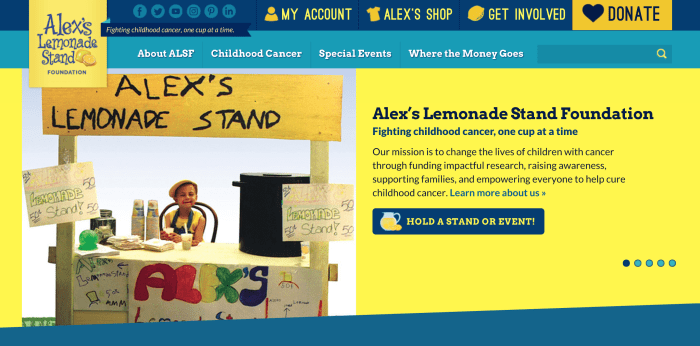
Alex’s Lemonade Stand’s homepage does not go unnoticed. They convey the right message while using lively colors to grab a visitor’s attention.

They also support their story with images and testimonials, which demonstrate their hard work, so that visitors won’t feel they are being taught about how great their cause is. After all, stories appeal much more to the emotional side of human nature.

Alex's Lemonade Stand

Additionally, a nonprofit might feature bright colors to grab a visitor’s attention, just like The GETTS Foundation does, portraying their story in an easy to follow way.

Getts Foundation


Takeaways: Choose beautiful color palettes that grab attention and convey your story using facts combined with an emotional connection.

Your donation form – keep it simple

Due to their hidden donation forms, usually tucked under menus or other pages, many nonprofits reduce the number of donations they could receive, making it a difficult and time-consuming activity for users who are generally on the hunt for specific information.

Furthermore, they complicate their donation forms by adding too many fields, and donors really hate completing long forms.

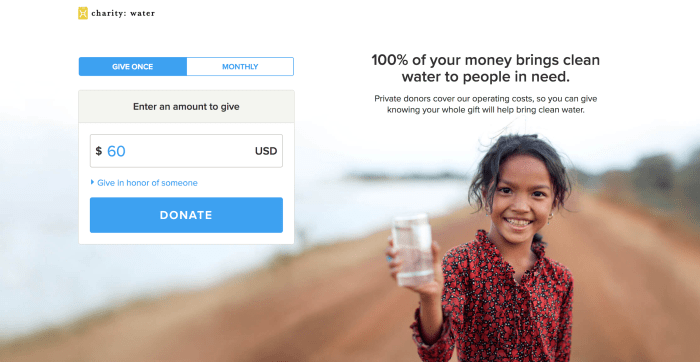
So, grab their attention right from the start and make sure to limit your donation form to only a few important fields. Charity water’s donation form is a perfect “How to”example.

With a minimalist design, its strong imagery and message supports their reason for giving.


Charity Water

Furthermore, it is limited to a small number of fields, which appeals to donors who want to donate right away rather than being forced to complete multiple required fields, which would only increase the chances of someone abandoning the process and never end up donating.

So, don’t distract donors by overfilling your form with useless information and keep both your donation form and page simple and straightforward.

Also, don’t forget to make it even simpler for mobile devices. Reduce the donor’s need to zoom by optimizing it with easy-to-click buttons and a vertical layout.

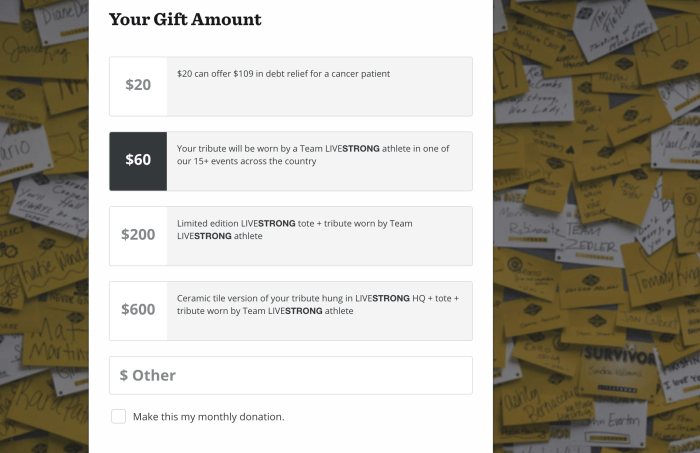
Another great way to improve your donation form is to use giving levels. Take Livestrong’s donation form for example. Your goal is to get people to give larger amounts of money than they’d donate if they wouldn’t receive suggested giving amounts.

If you start your giving levels from $20, $30 and so forth, the donor might round up and give $20 instead of $15. You can also include a box for “other” if people decide to donate a different amount.

Livestrong

Takeaways: Simplify. Make the action of donating easy: for the best user experience possible, stick to one image situated at the top of the form or in the background, add a few sentences of reasons to donate, and keep your donation form concise.

Add social proof and gain more donors

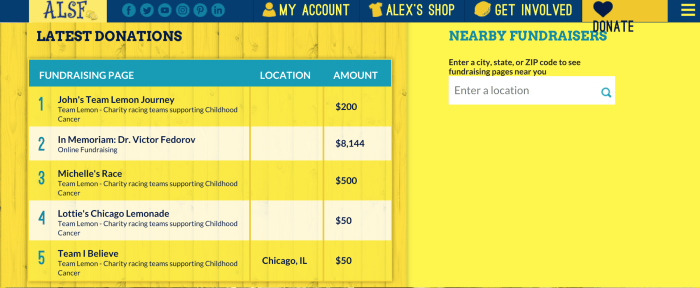
By placing a social proof, you can persuade a prospective donor to join others who have already supported your cause. Alex’s Lemonade Stand is definitely attracting new donors with this tactic. It’s simple, people care about what others recommend.

ALSF

Takeaways: You can increase the visibility of your nonprofit and its credibility by tapping into social proof to also gain new donors.

Stop neglecting your website’s footer   

Your ultimate goal is not only to gain trust, but also continuing support from your visitors, so you have to pay attention to your website’s footer as well.

The footer is your last opportunity to get users to where you need them to go, while also giving them important information. The Case Foundation connects with their visitors by letting them receive ongoing information on several topics if they subscribe.

Case Foundation

Takeaways: Stick to relatively minimal information in your footer to convert into subscriptions.

What actions would you like your visitors to take? Be it donating, signing up for your newsletter, or Social Media appreciations, your nonprofit website should be designed around these specific actions. So, be sure you make those “calls to action” obvious. Also, don’t forget to tell your story simply and clearly. Hopefully, these tips will help you maximize the value you can get from each person who visits your website.

Dishan Jay is the founder of DG Studio, a Los Angeles based digital agency that develops websites and apps, and executes marketing strategies plus storytelling and design techniques around them. Dishan Jay

How to Do Better in 2018

27638260149_81bb7264b4_m

Happy New Year! I hope you had a good holiday. I just returned from my family’s annual trip to Florida. It’s quite a contrast from the frigid, wintery weather we’re having in Boston.

I also hope 2017 was a good year for your organization, and 2018 will be even better. If things didn’t go so well last year, here are a few ways to help you do better.

Evaluate and plan

Take a look back at 2017 to see what worked and what didn’t in your fundraising and communications. Incorporate what you’ve learned into your 2018 plans.

If you haven’t made fundraising and communications plans yet, do that now! Don’t go too far into the New Year without plans in place. Be sure to include donor engagement and donor retention in your fundraising plan (see the first link below for more information). Also, make sure you evaluate your progress at least once a quarter.

Nonprofit Fundraising Plan: 6 Must-Do Steps For Success

COMMUNICATION PLAN TEMPLATE

How to Integrate Your Nonprofit Fundraising Plan With Your Marketing Plan

5 FUNDRAISING SUCCESS METRICS TO START TRACKING

Figure out your retention rate

As you’re doing your year-end evaluation, figure out your donor retention rate.

A Guide to Donor Retention

If it’s low, it’s something you can fix, usually with better communication. It’s easier and less expensive to keep your current donors than to find new ones, so make retention a priority.

Why you should care about donor retention

One Thing Most Nonprofits Stink at (Donor Retention) and How You Can Change It

Get in touch with your lapsed donors

If you fell short of your year-end fundraising goal, one way to raise extra revenue is to get in touch with donors who have given in the last two years, but not this past year. Call them or send a personalized note. Let them know you miss them and want them back.

They may not have given to your year-end campaign for a variety of reasons including being too busy or not wanting to spend too much in December. The New Year could be the perfect time to reach out.

We Want You Back! A Simple Strategy for Reactivating Lapsed Donors

Start or enhance your monthly giving program

Monthly or recurring giving is also an excellent way to raise more money and boost your retention rate as well. If you don’t have a monthly giving program, start one this year. If you have one, but people aren’t taking advantage of it, work on promoting it more. Invite current donors to become monthly donors and make it a prominent option on your donation page and pledge form.

Making the Most of Monthly Giving

Do a better job of thanking your donors

I hope you thanked your donors after your year-end appeal and I hope you didn’t send one of those boring, generic letters. If you never sent a thank you letter, do that now!

Either way, the New Year is a great time to thank your donors. You want to show gratitude at least once a month. Wish your donors a Happy New Year, thank them again, and share a success story. You can do this by email or social media.

I haven’t been impressed with the thank yous I received after I made my year-end donations. You can stand out if you make a resolution to do a better job of thanking your donors this year.

Thank You 101

Stay in touch throughout the year

Your donors want to hear how they’re helping you make a difference. Don’t let them down.

It will be a whole lot easier to stay in touch with your donors if you use a communications (aka editorial) calendar. When you do communicate, remember to be donor-centered and focus on building relationships.

Stay in Touch Throughout the Year by Using a Communications Calendar

Here’s wishing you a successful 2018!

Don’t Brag So Much

113532111_8479d80294_m

I’m sure you’ve been to a party and ended up stuck in a conversation with someone who talks too much about himself or brags about all the wonderful things she’s done. It’s exasperating and you can’t get away fast enough.

Imagine your donors having the same reaction when all your communications sound like one big bragfest that have nothing to do with them. Then imagine all your hard work going to waste when your boring appeal or newsletter goes straight to the recycle bin.

Yes, you want to share your accomplishments, but you don’t don’t want to sound like that annoying person at the party. It’s possible to do this without bragging. Here’s how.

Be donor-centered

You don’t need to tell your donors your organization is great. They wouldn’t have given you money if they didn’t think highly of you.

Let your donors know they’re great because they helped you make a difference for the people or community you serve. Give specific examples. Because of donors like you, the Smith family doesn’t have to choose between buying groceries and paying the heating bill.

All your communications should be donor or audience-centered. One way to ensure this is to use the word you more than we or us. Can Your Organization Pass the Donor-Centered Test?

Tell a story

Telling a story is a great way to share accomplishments. Whether it’s in the first or third person, you can give a personal account of how you’re making a difference. Remember to focus on the people you serve and keep your organization in the background. Connect With Your Donors by Telling Stories

Photos and videos featuring the people you serve is another good way to share accomplishments.

Why is what you do important

Instead of the usual laundry list you see in annual reports, such as we served over X number of students in our tutoring program, focus on why that’s important, too. Students in our tutoring program are now reading at their grade level and have a better chance of graduating from high school on time.

Instead of focusing on what you do, let your donors know why it’s important.

Show don’t tell

Too many newsletters and annual reports ramble on about how an organization is number one in such and such, or there was a crisis and Y organization came in to solve it.

Go back to stories and examples. You can’t ignore your organization altogether, but instead of saying we were the first organization to come in and help the hurricane victims or we’re the number one hospital in the community, say Thanks to you, the hurricane victims now have access to clean drinking water and can start rebuilding their homes or Thanks to you, Westside residents have a new outpatient clinic within walking distance of their homes, so they have easy access to all their health care providers.

How you made a difference is more important than being first or best.

Current donors want to see the results of their gift. Potential donors may be more interested in your reputation, but they also want to see how their donation will make a difference.

Your anti-bragging checklist

Before you share accomplishments in an appeal letter, thank you letter, newsletter article, social media update, annual report, etc, ask yourself these questions:

  • Is this donor/audience-centered?
  • Are we focusing on the people/community we serve?
  • Are we showing results?
  • Are we saying why this is important?
  • Are we bragging too much about ourselves?

Read on for more about the perils of bragging.

Bragging is not fundraising

Bragging Versus Mission

Are You Thankful for Your Donors?

Thanksgiving is coming up and it’s a time of year in the U.S. when we show gratitude to the special people in our lives. Do you extend this same gratitude to your donors? Sometimes it doesn’t seem that way.

Nonprofit organizations tend to treat thanking their donors as an afterthought.But you need to spend just as much time thanking your donors as you do on fundraising.

Here are some ways you can show that you are thankful for your donors.

Wish your donors a Happy Thanksgiving

Send your donors a special Thanksgiving message. If you can send a card or postcard, that’s great, but an email message is also fine.

Let your donors know how grateful you are to have them as part of your family. Share a success story and photo or video. Your donors will appreciate a heartfelt message, especially when they’re being deluged with year-end appeals.

Of course, you can also send cards or email messages during the holidays, Valentine’s Day, or any time of the year. DO NOT include a donation envelope or any other type of ask with your thank you message. This will deflate your donor’s good feelings in an instant.

Be ready to thank your donors right away

If you’re doing a year-end appeal (or any other fundraising campaign), you need to thank your donors right away, within 48 hours if you can.

Every single donor, no matter how much they’ve given or whether they donated online, gets a thank you card/letter mailed to them or receives a phone call.

Make this a priority. You need to start planning how you will thank your donors at the same time you plan your fundraising appeal. Don’t do this alone. Get your board, other staff, and volunteers together to make phone calls, write thank you notes, or include a handwritten note on a thank you letter.

Give your donors an unforgettable thank you experience

When was the last time you received a thank you letter that knocked your socks off? Maybe a couple of times. Maybe never.

Nonprofits often relegate thanking donors to a last-minute process. If you donate online, you get taken to a boring, generic thank you landing page and receive an equally boring thank you email. If you’re lucky, you’ll get a letter, but it’s usually impersonal and filled with mind-numbing jargon that doesn’t make you feel good about your donation.

Start off by sounding like a human and not a robot. Don’t open with On behalf of X organization we thank you for your donation of…. Open with You’re amazing! or Thanks to you, David won’t go to bed hungry tonight.

The second example above gets to the heart of a good thank you.Your donors need to feel valued and know how they’re helping you make difference. This isn’t the time to explain what your organization does or brag about how great you are. The donor is the one who’s great.

Make your thank yous personal. Write as if you’re having a conversation with a friend and leave out any jargon or other information your donors won’t understand.

Create an experience for your donors –  an experience that will last as long as your donors support your organization.

5 Thank You Letters Donors Will Love Gratitude and Results Keep Donors Coming Back

How to Craft a Killer Thank You Letter

Don’t make this one and done

The thank you letter you send after your appeal is just the beginning. You must thank your donors all year round. You can make this easier by creating a thank you plan, which you can incorporate into your communications calendar.

Find ways to say thank you at least once a month. Here are some ideas.

  • Create a thank you video and share it on your website, by email, and on social media.
  • Send welcome packets to new donors.
  • Invite your donors to connect with you via email and social media. Keep them updated with accomplishments and success stories. Making all your communications donor-centered will help convey an attitude of gratitude.
  • Always thank your donors in your newsletter and social media updates. Emphasize that you wouldn’t be able to do the work you do without their support.
  • Hold an open house at your organization or offer tours so your donors can see your nonprofit up close and personal.
  • Thank your donors just because they’re great.
  • Keep thinking of other ways to thank your donors.

This Thanksgiving and throughout the year, be thankful for your donors. Treat them well so you can ensure a long-term relationship.


How to Plan a Multichannel Fundraising Campaign

9302746500_abac718b17

Year-end fundraising season is upon us. This is the busiest time of the year for most organizations and you need to plan carefully.

If you just send one fundraising letter and then wait for the donations to pour in, you’re in for a rude awakening. Your donors are busy and may put your letter aside to handle later, and then never get to it.

You may be thinking of bypassing direct mail altogether because it’s too expensive, and only sending email appeals. That’s a mistake. Direct mail is still very much a viable way to communicate and worth the investment.

Of course, you can also send email appeals, but you will need to plan to send more than one appeal due to the immense volume of email people receive. Some donors will respond to the first appeal, but most are going to need a few reminders.

Your fundraising campaign will be more effective if you use a combination of mail, email, social media, and phone calls. Some donors may respond to your direct mail piece but donate online. Others will see your email message but prefer to send a check.

You’ll have a lot of competition since you’re not the only organization seeking year-end donations. Plus you’re competing with a deluge of email and social media posts from a variety of sources.

This is why you need a multichannel campaign with a series of asks.

BEFORE YOU START

Clean up your mailing lists

If you haven’t already done so, clean up and organize your mailing lists. Do you have both postal and email addresses for all your donors?

Make it easy to donate online

You must have a donation page that’s engaging and easy to use on all platforms, including mobile. Test all links in email messages and social media posts. The last thing you want is a donor contacting you about a broken link or have to hunt around on your website for a link to your donation page.

When you’re ready to launch your campaign, include a blurb on your homepage that your appeal is underway. Make sure your donate button is in a prominent place and stand out even more by including an engaging photo to draw people in.

Which channels do your donors use?

Don’t spend a lot of time on channels your donors aren’t using. Figure out in advance where you want to focus your efforts.

SAMPLE SCHEDULE AND STRATEGY

Come up with a schedule of when the appeals will go out. I’ve created a sample schedule below. Of course, you can adjust the timeframe as needed, and use this for campaigns at other times of the year. That said, I do recommend starting your year-end campaign sooner than later.

October 25

Give your supporters a heads up by email and social media. Let them know your year-end appeal is underway and they should receive a letter from you soon, provided you have their mailing address. Encourage them to donate online right now. This means your donation page needs to be in great shape.

Keep in mind that the fact your year-end appeal is going on will matter to some donors and not to others. Use an enticing subject line such as How You Can Help Kids Learn to Read.

Make sure it’s obvious your message is coming from your organization so you have a better chance of getting it opened. Get noticed on social media by using an engaging photo.

Week of October 30

Mail your appeal letters.

Week of November 6

Start sending follow-up reminders via email and social media. If possible, don’t send reminders to people who have already donated. Otherwise, be sure to thank your recent donors. You can even phrase your reminders as more of a thank you or an update.

Thanks so much to all of you who donated to our year-end appeal. We’re well on our way to our goal of serving more kids in our tutoring program. If you haven’t donated yet, please help us out today by visiting our website (include a link to your donation page) or sending us a check (provide address).

Week of November 13

Send another reminder. Your donors are busy and may need a gentle prompt. Keep it positive. Don’t make your donors feel bad because they haven’t donated yet.

If you’re doing most of your reminders by email, remember you want your message to stand out. Sending generic weekly reminders is not enough.

Don’t Be Part of the Noise – Make Your Email Messages Stand Out

Week of November 20

Send a Happy Thanksgiving message along with a friendly reminder. Share a success story in your appeal.

Week of November 27

Start making reminder calls, along with your electronic messages. If time is an issue, you could just call people who have donated before. That’s probably most effective.

Also, November 28 is #GivingTuesday so you could tie that into a reminder message.

December and beyond

Keep sending reminders throughout December. It’s tricky because you want to get your message across without being annoying. Be sure to keep sending your newsletter and other updates. You don’t want the only messages your donors receive to be fundraising appeals. December is also a great time to show some #donorlove.

The end of December is the busiest time of the fundraising season. Network for Good recommends sending an email reminder on December 23, 29 or 30, and 31. This is especially relevant if your fiscal year ends on December 31 or your donor wants to give before the end of the calendar year.

Even though you’re trying to secure donations, don’t forget about building relationships, too.

Look to see who hasn’t contributed yet. Concentrate on people who are most likely to donate, such as past donors. You may need to send another letter or a reminder postcard to donors who don’t use electronic communication.

Your fundraising campaign will be more successful with multiple asks and by using multiple channels. Good luck!

More on multichannel fundraising.

How to Make a Multichannel Fundraising Ask: the Basics

Channeling Real Human Beings in Multichannel Fundraising


How About a Relationship Building Day?

8001510315_cfb3eacf57_m

By now you’ve all heard about GivingTuesday, the annual giving day that takes place the Tuesday after Thanksgiving. We’re saturated with information about participating. Perhaps you’ve participated in the past and it’s been successful or maybe it wasn’t. Perhaps you’re thinking about participating for the first time.

My problem with GivingTuesday and any giving days, for that matter, is they focus too much on getting donations. Many of these donors are first-time donors who don’t give again. That may be because they were drawn into whatever gimmicks the organizations were using to get donations or the organizations failed to build relationships afterward.

Speaking of building relationships, instead of focusing so much time and energy on GivingTuesday, focus more on thanking your donors and building those important relationships.

Building relationships before you send your appeal

I know you have a lot on your plate before a big appeal, but you need to include relationship building in the mix. Send a thank you/update at least a few weeks before your appeal.

Here’s a great example from Reach Out & Read. They sent a postcard with a picture of cute kindergartners and the caption “Meet the Class of 2030!” On the back was a list of accomplishments and it ended with “All because you cared enough to support Reach Out & Read, Thank You!”

Reach Out & Read Side 1

Reach Out & Read Side 2

You can do something like this, too. Create a postcard with an engaging photo and show your donors how they helped you make a difference for the people you serve.

You could also send a Thanksgiving card or email. Donors are going to get a lot of appeals from you at year-end or whenever you do an appeal. You also want to use this time to communicate in ways in which you’re not asking for money.

Building relationships instead of participating in GivingTuesday

I’ll let you decide if you want to participate in GivingTuesday or not. You may want to go for a Gratitude or Relationship Building Day instead. #GivingTuesday or #Gratitude Tuesday? Choose!  

I suggest you do your Relationship Building Day on a day other than GivingTuesday because you’ll be competing with a ton of email messages that day and your donors may not see your message.

Building relationships after your appeal and throughout the year

After you’ve sent your appeal, whether it’s on GivingTuesday or any other time, your work is far from over. You need to thank your donors and build relationships throughout the year. We think of these things around Thanksgiving and the end of the year, but most of the time there’s a relationship building drought. Gratitude and Relationship Building Days are just as important in May as they are in November. See if you can do at least one relationship building activity a month, every one to two weeks is even better.

You can build relationships with welcome packets for new donors, heartfelt thank you notes, a thank you video, updates by mail, email, and social media, advocacy alerts, surveys, tours, and open houses. Remember to keep your messages donor-centered and use the channels your donors prefer.

Building good relationships with your donors is the key to keeping them for a long time.

3 Ways To Build Authentic Donor Relationships

Stop Fundraising, Start Relationship-Building


Give Your New Donors a Warm Welcome


2504910532_2315cd5597_z

After you send your year-end appeal, you’ll most likely gain some brand new donors, which is good news. The bad news is over 70% of these first-time donors won’t make a second gift.

Don’t let that happen to you. Nonprofit organizations don’t spend enough time trying to keep their current donors. You want to pay attention to your retention because it’s easier and less expensive to keep your current donors rather than finding new ones.

As you work on your year-end appeal, put together a welcome plan and be ready to shower your new donors with love as soon as their gifts come in.

Give your new donors an extra special thank you

Research by fundraising expert Penelope Burk states that first-time donors who receive a thank you call are more likely to donate again and give at a higher level the next year. Get a group of board members, staff (especially your executive director), and volunteers to call your new donors, or send them a handwritten thank you card.

If you can’t make phone calls or send a handwritten note, send a thank you letter that specifically recognizes that someone is a new donor.

*Make sure these are actually new donors. A good database will help you avoid any embarrassment.*

Send a welcome package

A week or two after the initial thank you, send a welcome package. You can do this by mail, email, or a combination of both.

Welcome your new donors. Thank them again and show them other ways they can connect with you. Invite them to subscribe to your newsletter and join you on social media. Your welcome package can include a warm introductory message and a brochure or fact sheet.

Send seperate welcome packets to one-time donors and new monthly donors. You could invite new one-time donors to become monthly donors. For monthly donors, send different messages to brand new donors and existing donors who’ve become monthly donors.

How to Welcome New Donors and Keep Them Engaged

What does a new donor welcome pack look like?

Bring-’Em-Close Welcome Packs

Get to know your new donors

Get to know your new donors better. Include a short survey with your welcome packet to find out how they heard about you, what issues are important to them, and if they prefer print or electronic communication. You could also direct people to your website for more information about your organization.

Be careful about how much information you send. Donors want to feel welcome not overwhelmed.

Give your donors the gift of appreciation

I don’t recommend sending unsolicited swag. You could offer your new donors a gift and they can let you know if they want to receive it, but it’s not necessary. You want donors who care about your work, not getting a free coffee mug.

Instead of spending your resources securing premiums, invest in creating thank you cards or making a welcome video.

What donors really want from you is to know how they’re helping you make a difference.

Stay in touch

Don’t let the welcome packet be the last time your donors hear from you until your next appeal. Use a communications calendar to help you plan to stay in touch throughout the year.

Donors stop giving for a variety of reasons, some of which you can’t control. One that you can control is poor or nonexistant communication. Making your new donors feel welcome and staying in touch throughout the year will help you keep your donors.

Here is more information on the importance of treating new donors well.

3 Ways to Make a Lasting Impression with First-Time Donors

10 ways you may be chasing away new donors

Appeal Letter Writing 101


9705535524_3a72228701_z

September is here and you know that means. Yes, it’s year-end appeal season – the time many nonprofits rely on to raise a good chunk of their revenue.

While your donors will be receiving a multitude of appeal letters, many organizations seem to go on autopilot and send a generic, boring appeal.

You can make yours stand out by giving some thought to it. Let’s get back to basics with a little appeal letter writing 101.

Make a good first impression

First, you need to get your donors to open your letter. If you can’t get them to do that, then all your hard work has gone to waste.

Perhaps you’d like to include a teaser on the outer envelope. That doesn’t mean one that says 2017 Annual Appeal. Instead, say something like Learn how you can help the Stevens family find their own home.

You want to be both personal and professional. If hand addressing the envelopes isn’t feasible, make sure your mailing labels look clean, are error-free, and aren’t crooked. Use stamps if you can.

Create an inviting piece of mail.

Share a story

Start your letter with a compelling story. Focus on a person or family and not your organization. Your donors want to hear about the people they’re helping. For example, you could tell a story about the Stevens family and their struggle to find affordable housing.

Include a photo

Include an engaging color photo in your letter or on your pledge form. Photos can tell a story in an instant.

Here’s more information on creating stories and photos.

Connect With Your Donors by Telling Stories

Get Noticed in an Instant with a Visual Story

Next, comes the ask

Ask for a donation at the beginning of the next paragraph (after the story). Make sure it’s  prominent and clear. Also, ask your current donors if they can give a little more this year.

Phrase your ask like this – We’re so grateful for your previous gift of $50. Could you help us out a little more this time with a gift of $75?

If you’ve been doing a good job of engaging your donors throughout the year, they shouldn’t mind if you ask for a larger gift. Including the amount of your donor’s previous gift is helpful since people often don’t remember what they gave before.

Be donor-centered

Don’t make your letter all about your organization. Show how you’re making a difference and how much you appreciate your donor’s role in that. Make your donors feel good about supporting your nonprofit.

Share your success

Highlight a few accomplishments from the year and show how you plan to continue your good work with your donor’s help. Remember to stay donor-centered!

Get personal

Send different letters to people who have donated before and thank them for supporting you. You can also tailor letters to other groups such as monthly donors, lapsed donors, people on your mailing list who haven’t donated yet, event attendees, volunteers, and friends of board members.

Your appeal will stand out if you can personalize it. Make every effort to do this, especially for people who have given before. Go the extra mile for your donors, so they’ll continue to support you.

Your letter should also have a personal salutation and not be addressed to Dear Friend, which is really more like Dear Anonymous Stranger.

Make it easy for your donors

Include a return envelope with amounts to check off or an envelope and a pledge form. Show what each amount will fund. Do this on your donation page, too. Using Giving Levels to Drive Donations

Some donors may prefer to donate online. Direct them to a user-friendly donation page on your website. The Top 10 Most Effective Donation Form Optimizations You Can Make

Offer a monthly or recurring giving option

Monthly gifts can generate more revenue. Encourage your donors to give $10 or $20 a month. If they do, you’re getting gifts over $100 each! How to Create a Monthly Giving Program for Your Nonprofit

Your letter must be easy to read (or scan)

Use short paragraphs and bulleted lists, along with bold or color for key words, but keep it tasteful. Make it easy to read and scan. Most people won’t read your letter word for word. Use a simple font and 14-point type.

It’s fine to go over a page, especially if you’re breaking up the text with a photo and short paragraphs, but I wouldn’t go over four pages. You can also add a quote or short testimonial. These can be powerful and it helps break up the narrative.

Think of your letter as a conversation with a friend

Please skip the formalities. Use a conversational tone and keep out jargon like at-risk youth and underserved communities. Be specific and use everyday language. Refer to your reader as you and use you a lot more than we. How to Perform the “You” Test for Donor-Centered Communications – Do You Pass?

Too many editors spoil the appeal

Generally, the more people you involve in writing your letter, the worse it becomes. Fundraising Consultant Tom Ahern refers to this as letter writing by committee.

Your best writer should craft it and then turn it over to your best editor. Whoever signs the letter (your Executive Director?) can take a quick look at it, but don’t send it to a committee.

Besides weakening the content, involving more people takes extra time.

Final impressions matter, too

Repeat your ask at the end of the letter. Don’t forget to say please and thank you.

Be sure to add a PS. People often gravitate to the PS as they scan the letter, so include something that will capture their attention. Here you could emphasize monthly giving, ask if their company provides matching gifts, or thank them for being a donor.

Get your pens out

Include a short handwritten note, if you can. Make it relevant to each donor, such as thanking her for a previous donation or letting him know it was nice to see him at a recent event. Hand sign the letters in blue ink.

Are you ready?

Stand out with an appeal letter that will capture your donors’ attention and bring you the donations you need. Good luck!

Read on for more advice on writing a great appeal letter.

4 Ways to Spice Up Your Fall Fundraising Appeal

Fundraising Letter: How To Write A Compelling Appeal (+ Examples)

8 Steps to Writing Successful Fundraising Letters

8 Ways to Write a Better Fundraising Letter

Image by Howard Lake