Why You Need to Share Stories With Your Donors

Stories come in many forms. You can tell a story with words, pictures, and videos. I like written stories (preferably on paper), but others are drawn to videos. Some people might not have the time or energy to look at anything but a photo or infographic.

Your nonprofit organization needs to share stories using all these forms. Sharing stories will help you connect with your donors and improve your engagement.

Donors want to hear your stories

I bet you’re not using stories as much as you should. That’s a mistake because people respond better to stories than a bunch of facts and statistics. Stories bring the work you do to life by using everyday language to create a scene.

You may be reluctant to use stories because it’s more work for your organization, but that shouldn’t stop you. Make time to come up with some engaging stories.

Your stories need to be relevant

Update your stories at least once a year. They need to take into account the everchanging current situations. There’s a lot going on. How is that impacting your clients/community? Many people are struggling right now.

Create a culture of storytelling

If you create a storytelling culture in your organization, you can make storytelling the norm instead of the exception.

Work with your program staff to create stories that will help you connect with your donors. Everyone needs to understand how important this is. Share stories at staff meetings and/or set up regular meetings with program staff to gather stories. 

When you put together a story, ask.

  • Why is this important?
  • Who is affected?
  • Why would your donors be interested in this story?
  • Are you using clear, everyday language (no jargon) to make sure your donors understand your story?
  • How are your donors helping you make a difference or How can your donors help you make a difference?
  • Client or program recipient stories are best. Remember, donors want to hear how they’re helping you make a difference for your clients/community.

Another way to find stories is to put a Share Your Story form on your website. This could be a good way to get some current, relevant stories.

Your stories aren’t about your organization

Keep in mind that your stories aren’t about your organization. Your story is about a need or problem that affects the people/community you work with, and how your donors can/did help with that.

Make your stories personal 

Tell a story of one (person or family). Use people’s names to make your stories more personal. I realize you might run into confidentiality issues, but you can change names to protect someone’s privacy. You could also do a composite story, but don’t make up anything.

Always be respectful to your subject(s). You may want to set up some ethical guidelines. 

Use different stories for different types of communication

Create a story bank to help you organize all your stories. You want to use stories as much as possible. Use them in your appeals, thank you letters, newsletters, updates, impact reports, website, blog, and other types of social media. You can also create a story calendar to help you consistently share stories throughout the year.

While you can come up with some core stories, they’ll be slightly different depending on the type of communication. 

In a fundraising appeal (all appeals should start with a story), you want to highlight a problem or need. Let’s say you run a food pantry. Here you can tell a story about Melanie, a working single mother with three kids who’s having trouble feeding her family because of rising food costs and cuts in benefits. Sometimes she has to choose between buying groceries and paying the heating bill. 

In your thank you letter, you can let your donor know that because of their generous gift, Melanie can get healthy food for her family at the Eastside Community Food Pantry.

Then, in your newsletter, impact report, or update, you can tell a success story that because of your generous donors, Melanie doesn’t have to worry so much about how she’ll be able to feed her family.

Tell a story in an instant with an engaging photo

You’ve probably heard the phrase a picture is worth a 1000 words. Cliche, yes, but it’s true.

You can capture your donors’ attention in an instant with an engaging photo. That doesn’t mean one of your executive director receiving an award. Use photos of your programs in action or something else that’s engaging.

Print newsletters and impact reports tend to be dominated by long-winded text. Most of your donors won’t want to read the whole thing. But if you share some engaging photos, they can get a quick glance at the impact of their gift without having to plow through a bunch of tedious text. You can share a little more information with a good photo caption.

Photos can enhance your print communication by breaking up the narrative. You can also complement your written stories with photos. If you’re worried about mailing costs, postcards and other short pieces with photos are the way to go. You could even do a Postcard Impact Report

If you use social media, you need to communicate several times a week. As your donors scroll through an endless number of posts, an engaging photo can stand out and get their attention.

Use photos everywhere – fundraising appeals, thank you letters/cards, newsletters, impact reports, updates, your website, and social media. Create a photo bank to help you with this.

It’s fine to use the same photos in different channels. It can help with your brand identity. Be sure to use high-quality pictures. Also, make sure your photos match your messages. If you’re writing a fundraising appeal about children who aren’t getting enough to eat every day, don’t use a picture of happy kids.

Work with your program staff to get photos and videos (more on videos below). Confidentiality issues may come up and you’ll need to get permission from your subjects or their guardians.

Highlight your work with a video

Videos are a popular way to connect. They can be used to show your programs in action, share an interview, give a behind-the-scenes look at your organization, or my favorite – thanking your donors. 

I would definitely recommend creating a personalized thank you video. If that’s not possible, you can make a general one.

Make your videos short and high quality. Short is key. If your video is more than a couple of minutes, your donors may not bother to watch it. 

You can use videos on your website, in an email message, on social media, and at an event.

Spiff up your statistics by using infographics

A typical impact report is loaded with statistics. You want to share these, along with your accomplishments, but you don’t want to overwhelm your donors with a lot of text.

Why not use an infographic in your impact report instead of including the usual laundry list of statistics and accomplishments? 

Infographics are also great in other types of communication, such as newsletters and updates. Good visuals will enhance both your print and electronic communication.

Connect with your donors and keep them engaged by using all types of stories.

5 Creative Donor Appreciation Ideas for Small Nonprofits

Thanking donors is crucial for securing gifts—especially for small nonprofits trying to build a support base. Show your gratitude with these creative ideas.

By Logan Foote

Building relationships is crucial for nonprofits to grow their impact. For small nonprofits in particular, these relationships are critical to growing and scaling your work to drive additional impact. A big part of such relationships is thanking donors and partners for their continued support and generosity. Truly, every donor deserves a heartfelt thank-you message for their contributions and gifts, but you can take it to the next level and make a lasting impression with an appreciation event or customized outreach.

Fun, memorable donor appreciation events and initiatives function to build a sustainable support network for your small nonprofit. Consider these appreciation ideas to thank your donors in a new and memorable way.

  1. Exclusive Events & Activities

An event designed exclusively for donors shows how much you value their support and your relationship with them. These can be tacked on to an existing event, such as your charity golf tournament, annual conference, or gala. The point is to limit it to “donors only” to reward them for their generosity. 

For instance, let’s say you’re organizing a charity golf tournament to raise money for your work. You might invite donors to an exclusive reception the day or evening before the tournament, complete with refreshments, tee times, access to the driving range, and branded merchandise as a thank you for their donations. Another idea is to have a specific flight (a series of smaller competitions within a golf tournament) or round of the tournament that’s just for donors, with special prizes for the flight’s winners.

  1. Behind the Scenes Tours

Your donors care about your mission’s progress and are investing in your daily operations by donating. Give them a new perspective on the work they’re supporting with a behind-the-scenes tour. Continuing with the golf tournament example, you might invite donors to visit while you’re prepping player gift bags or auction items. Or perhaps ask them to participate in a tour of your facility to see how your programs operate and even interact with some beneficiaries (with their permission). 

  1. Storytelling Events

Storytelling is the linchpin of your nonprofit’s case for support, so holding an event centered around that is a way to share your mission’s impact in a social setting. Invite donors to an event with a meal or refreshments and a series of stories shared by your nonprofit’s beneficiaries. Donors will have the chance to network with other donors and make connections with beneficiaries. Consider premiering any new videos or unveiling new initiatives at such an event, not only to give donors a sneak peek, but to help them want to have a stake in your organization’s future. 

Another idea is to tie storytelling into your nonprofit’s charity auction. After you’ve completed reporting from the auction and determined who made the largest contributions by purchasing the big ticket items, invite them to a storytelling event. Share in-depth insights into the impact of the money raised and how it plays into your overall mission. Donors will love the chance to meet and get to know other supporters while learning more about your organization’s future.

  1. Donor Appreciation Wall

A donor appreciation wall immortalizes your nonprofit’s most impactful donors. It’s a meaningful way to add these donors to your organization’s collective history. Place such a wall in a high visibility location, such as the entrance to your office or other facility. You can add your nonprofit’s own twist to this classic appreciation idea by determining how you’ll segment out donors on the wall and how each should be recognized. Consider these ideas:

  • Giving Tiers. Tailor these to your nonprofit to recognize major contributors to your fundraising efforts. According to Double the Donation, a common tier structure used by many organizations is bronze, silver, gold, and platinum donors and sponsors.
  • Legacy Leaders. This idea works well for younger nonprofits that are in growth mode and relied on these gifts to get their work off the ground. More established nonprofits can retroactively add donors who have significantly contributed to your growth over time. 
  • Community Champions. You might recognize donors who also volunteer their time and advocate for your nonprofit to their networks to this group. 

Other categories could include donors who contributed to fundraising events, funded a specific project or program, or contributed to a capital campaign. As your nonprofit grows, add more tiers to your appreciation walls. Be sure to plan your design with future growth and recognition in mind. You might even ask donors for their feedback on the new groupings before you finalize your thank you plan.

  1. Customized Videos

Video is an incredibly powerful tool that nonprofits should leverage whenever possible. Creating customized videos expressing your gratitude to donors is yet another way to build and strengthen relationships with your organization. These types of thank you videos don’t have to be complicated or expensive—in fact, anyone with a laptop or smartphone can make one!

Work with your organization’s president, executive director, or even a beneficiary to assist you in creating the content. Ask them to create video snippets that address each donor by name and reference the specific fund, campaign, or event they’ve contributed to. For instance, if a donor who attended your charity golf tournament excelled at one of your on-course games, won the tournament, or got a hole-in-one, be sure to mention their involvement and thank them for their participation.

In terms of logistics, batching out this personalized content will streamline the production process and the customized portion can be added to video clips that provide additional context about your work. 

Wrapping Up

Thanking donors is crucial to retaining them over time. It does add another step to the process and potentially some expense, but it should be factored into your budgets and fundraising plans whenever possible. You might think that cutting down on thank you efforts is an option to improve fundraising efficiency, but it would be at the expense of donor stewardship and relationship development. The donor appreciation ideas outlined in this post can help your nonprofit strengthen your donor relationships to keep their support well into the future.

Logan Foote, Sales and Education Manager at GolfStatus, has been around the game of golf nearly his entire life. He first picked up a club at the age of four, and despite thousands of attempts, he’s never had a hole-in-one. He earned a bachelor’s degree in business administration at the University of Nebraska-Lincoln and pursued a career in sales. Logan came to GolfStatus in 2017, where he channels his passion for golf to help nonprofits raise money through the game. As Sales and Education Manager, Logan oversees a team that works with thousands of nonprofit clients to maximize their golf fundraisers with the GolfStatus platform, and shares his golf fundraising expertise through GolfStatus’s free educational webinars. He lives and golfs in Lincoln, Nebraska with his wife and three sons.

Lights, Camera, Action! 5 Tips to Engage Donors with Video

The right video has the power to spark an emotional connection between your nonprofit and its donors. Learn how to engage donors through video in this guide. 

By Doug Scott

Imagine a donor is searching online for charitable causes to support. With a desire to make a difference, they scroll through various nonprofit websites, reading about their missions and impact. Suddenly, something catches their eye. It’s a compelling and emotionally charged video showcasing your nonprofit’s work. Impressed by the video, they immediately sign up for your mailing list and follow you on social media.

Video has the unparalleled ability to grab people’s attention. By combining visuals, music, and storytelling techniques into one unique package, nonprofits can resonate with donors in a way that’s difficult to achieve through other mediums.

In this guide, we’ll explore five ways you can use video to engage, inspire, and leave a lasting impact on the hearts and minds of donors.

1. Film for each stage of the donor journey

The donor journey refers to the process by which individuals progress from being unaware of your nonprofit to becoming engaged and committed donors. When you know which stage of the donor journey an individual is at, you can more effectively appeal to their interests and solicit their support.

For each stage of the donor journey, you can create engaging videos:

  • Awareness stage: At this stage, donors are learning about your organization for the first time. Create compelling “Who We Are” videos that introduce them to your mission, values, and impact. 
  • Consideration stage: Here, donors are evaluating whether or not they have a connection to your cause. Produce educational videos that explain how your programs address specific issues and share success stories of those you’ve helped, emphasizing positive outcomes. 
  • Decision stage: As donors prepare to give, they need assurance that their support will make a real impact. Create testimonial videos featuring past donors that reinforce their decision to give. Have them share their experiences and the impact they have witnessed. 
  • Retention Stage: After donating, donors want to stay engaged and see the impact of their gift. Update them through video, demonstrating the progress you have made and thank donors for their contributions. Highlight upcoming projects and events to encourage ongoing involvement.

Track engagement at each of these stages to gain insight into the content that resonates with donors and adjust your communication strategies accordingly. 

2. Create a compelling story

Whether you’re creating content for donors in the awareness or retention stage, it’s important to use storytelling techniques to create an emotional connection with donors and transport them to the heart of your mission. To tell a compelling video story, follow these steps:

  1. Set the scene. Decide where your video will take place, whether that’s behind the scenes of your facility, through the communities you serve, or in front of a plain backdrop. 
  2. Showcase character development. Introduce relatable characters, such as beneficiaries, volunteers, staff members, or other donors. Share their personal challenges, aspirations, and journeys. Through their experiences, viewers can emotionally connect to the cause and the impact your organization makes.
  3. Highlight conflict and resolution. Present the challenge that your beneficiaries face. Then, showcase how your organization’s efforts and your donors’ support lead to resolution and positive change. 

Let’s explore how these elements can be translated into a campaign video. Opening with a close-up of volunteer Sarah’s passionate smile, the scene expands to show her engaging with beneficiaries at a community center. As Sarah narrates the food insecurity challenges faced by her community, she shares the transformative story of a young girl who receives free, nutritious meals due in part to the donations of generous viewers.

3. Keep it short and sweet. 

Attention spans are declining, so keep your videos short and sweet. According to Tectonic Video, the ideal length of a nonprofit video is around two to three minutes, meaning you have a small window of opportunity to grab people’s attention and get them invested in your cause. 

Write a script in advance to outline key points and ensure that the video stays focused. Make sure to read the script out loud and time it before filming to verify it’s the right length. Then, after filming, use editing tools to remove any redundant or repetitive information.

If you have more information to share, create a series of videos related to the same topic and stagger their release over a longer period of time. This will help you maintain a steady stream of engagement.

4. Include a call to action

Add a call to action to the final scene of your video to provide clear and immediate next steps for donors feeling inspired by the content. Encourage them to take specific actions, such as visiting your website to explore involvement opportunities, following you on social media for updates, or sharing the video to spread awareness. 

This can be accomplished through narration, on-screen text, and buttons. For instance, the narrator could say, “Join us in our mission to provide clean drinking water to communities in need.” Then, on-screen text could appear that says, “Visit our website to contribute to the construction and maintenance of water infrastructure,” pointing viewers to a large donation button. 

5. Share it widely 

Once you have created a compelling video, publish it on Vimeo or YouTube. Then, Double the Donation recommends sharing the content across several channels, which may include:

  • Direct mail: Include a QR code or a short URL in your direct mail materials that recipients can scan or type to access the video online. Use a compelling image from the video on the mailer to pique interest. 
  • Email: Embed the video directly in targeted email campaigns or your email newsletter for easy viewing. Craft a captivating subject line that hints at the video’s content. Then, use a short, attention-grabbing preview image that encourages recipients to click and watch. 
  • Social media: Customize the video for each platform’s specifications. For instance, videos must be vertical for Instagram Stories and square for Facebook. Write engaging captions that highlight the purpose of the video and use relevant hashtags to increase visibility. 
  • Website: Embed the video prominently on your website’s homepage and relevant landing pages, such as your donation page. For optimal performance, compress videos to reduce load time and use responsive video players that adapt to different screen sizes.

With multiple touchpoints, you can reach people on their preferred platforms and grab the attention of as many donors as possible. In turn, you’ll see higher engagement rates.


Now that you know how to engage donors with video, it’s time to create content! If you want to ensure the highest level of quality and engagement, partner with a nonprofit video production company. Their teams of experts will work alongside your nonprofit to get to know your mission, target audience, and goals, before translating these insights into a compelling video concept. Together, you can harness the power of video to leave a lasting impact on donors, one frame at a time.

Doug Scott is the Founder & CEO of Tectonic Video. He has more than 20 years of nonprofit communications experience as a filmmaker, communications director, chief marketing officer, and leader of two creative agencies for nonprofits. Doug is a global citizen having traveled to more than 50 countries. He earned his B.A. in Strategic Communications from DePaul University, and he’s a frequent guest lecturer at Stanford University on topics related to nonprofit storytelling and storytelling ethics.

The Many Forms of Nonprofit Stories

Stories come in many forms. You can tell a story with words, pictures, and videos. I prefer written stories, but others are drawn to videos. Some people might not have the time or energy to look at anything but a photo or infographic.

Your nonprofit organization needs to share stories using all these forms. Sharing stories will help you connect with your donors.

Donors want to hear your stories

I imagine you’re not using stories as much as you should. That’s a mistake because people respond better to stories than a bunch of facts and statistics. Stories bring the work you do to life by using everyday language to create a scene.

You may be reluctant to use stories because it’s more work for your organization, but that shouldn’t stop you. Make time to come up with some engaging stories.

Your stories need to be relevant

Update your stories at least once a year. They need to take the everchanging current situations into account. How are the economy, the aftereffects of the pandemic, discrimination, climate change, etc impacting your clients/community right now?

Create a culture of storytelling

If you create a storytelling culture in your organization, you can make storytelling the norm instead of the exception.

Work with your program staff to create stories that will help you connect with your donors. Everyone needs to understand how important this is. Share stories at staff meetings and/or set up regular meetings with program staff to gather stories. 

When you put together a story, ask.

  • Why is this important?
  • Who is affected?
  • Why would your donors be interested in this story?
  • Are you using clear, everyday language (no jargon) to make sure your donors understand your story?
  • How are your donors helping you make a difference or How can your donors help you make a difference?

Client or program recipient stories are best. Remember, donors want to hear how they’re helping you make a difference for your clients/community.

Another way to find stories is to put a Share Your Story page on your website. This could be a good way to get some current, relevant stories.

Your stories aren’t about your organization

Keep in mind that your stories aren’t about your organization. Your organization may have had to make a lot of changes over the last few years to do some of the work you do, but that’s not your story. Your story is why this is important for the people/community you work with. 

Maybe you had to change the way you run your food pantry, but what’s most important is that people in your community continue to have access to healthy food. 

Make your stories personal 

Tell a story of one (person or family). Use people’s names to make your stories more personal. I realize you might run into confidentiality issues, but you can change names to protect someone’s privacy. You could also do a composite story, but don’t make up anything.

Use different stories for different types of communication

Create a story bank to help you organize all your stories. You want to use stories as much as possible. Use them in your appeals, thank you letters, newsletters, updates, impact (annual) reports, website, blog, and other types of social media. 

While you can come up with some core stories, they’ll be slightly different depending on the type of communication. 

In a fundraising appeal (all appeals should start with a story), you want to highlight a problem or need. Let’s return to the food pantry example. Here you can tell a story about Melanie, a working single mother with three kids who’s having trouble feeding her family because of rising food costs and cuts in benefits. 

In your thank you letter, you can let your donor know that because of their generous gift, Melanie can get healthy food for her family at the Eastside Community Food Pantry.

Then in your newsletter, impact report, or update, you can tell a success story that because of your generous donors, Melanie doesn’t have to worry so much about how she’ll be able to feed her family.

Tell a story in an instant with an engaging photo

You’ve probably heard the phrase a picture is worth a 1000 words. Cliche, yes, but it’s true.

You can capture your donors’ attention in an instant with an engaging photo. That doesn’t mean one of your executive director receiving an award. Use photos of your programs in action or something else that’s engaging.

Print newsletters and impact reports tend to be dominated by long-winded text. Most of your donors won’t want to read the whole thing. But if you share some engaging photos, they can get a quick glance at the impact of their gift without having to plow through a bunch of tedious text.

Photos can enhance your print communication by breaking up the narrative. You can also complement your written stories with photos. If you’re worried about mailing costs, postcards and other short pieces with photos are the way to go. You could even do a Postcard Impact/Annual Report.

If you use social media, you need to communicate several times a week. As your donors scroll through an endless number of posts, an engaging photo can stand out and get their attention.

Use photos everywhere – fundraising appeals, thank you letters/cards, newsletters, impact reports, updates, your website, and social media. Create a photo bank to help you with this.

It’s fine to use the same photos in different channels. It can help with your brand identity. Be sure to use high-quality pictures. Also, make sure your photos match your messages. If you’re writing a fundraising appeal about children who aren’t getting enough to eat every day, don’t use a picture of happy kids.

Work with your program staff to get photos and videos (more on videos below). Confidentiality issues may come up and you’ll need to get permission to use pictures of kids.

Showcase your work with a video

Videos are becoming a more popular way to connect. They can be used to show your programs in action, share an interview, give a behind-the-scenes look at your organization, or my favorite – thanking your donors. 

I would definitely recommend creating a personalized thank you video. If that’s not possible, you can make a general one.

Make your videos short and high quality. Short is key. If your video is more than a couple of minutes, your donors may not bother to watch it. 

You can use videos on your website, in an email message, on social media, and at an event.

Spiff up your statistics by using infographics

A typical impact report is loaded with statistics. You want to share these, along with your accomplishments, but you don’t want to overwhelm your donors with a lot of text.

Why not use an infographic in your impact report instead of including the usual laundry list of statistics and accomplishments? 

Infographics are also great in other types of communication such as newsletters and updates. Good visuals will enhance both your print and electronic communication.

Connect with your donors and keep them engaged by using all types of stories.

Get Noticed in an Instant by Sharing Visual Stories

In my last post, I wrote about the importance of sharing stories with your donors. Written stories are great, but donors may not have the time or energy to read a story.

This is why you also need to use visual stories. Some people respond better to visual stimuli, anyway. Here are a few ways to tell visual stories.

Tell a story in an instant with an engaging photo

You’ve probably heard the phrase a picture is worth a 1000 words. Cliche, yes, but it’s true.

You can capture your donors’ attention in an instant with an engaging photo. That doesn’t mean one of your executive director receiving an award. Use photos of your programs in action or something else that’s engaging.

Print newsletters and annual reports tend to be dominated by long-winded text. Most of your donors won’t want to read the whole thing. But if you share some engaging photos, they can get a quick glance at the impact of their gift without having to plow through a bunch of tedious text.

Photos can enhance your print communication by breaking up the narrative. You can also complement your written stories with photos. If you’re worried about mailing costs, postcards and other short pieces with photos are the way to go. You could even do a Postcard Annual Report.

If you use social media, you need to communicate several times a week. As your donors scroll through an endless number of posts, an engaging photo can stand out and get their attention.

Use photos everywhere – fundraising appeals, thank you letters/cards, newsletters, annual reports, updates, your website, and social media. Create a photo bank to help you with this.

It’s fine to use the same photos in different channels. It can help with your brand identity. Be sure to use high-quality pictures. Also, make sure your photos match your messages. If you’re writing a fundraising appeal about children who aren’t getting enough to eat each day, don’t use a picture of happy kids.

If you use a caption with a photo, make sure it emphasizes the donor’s role in what’s happening in the picture.

Work with your program staff to get photos and videos (more on videos below). Confidentiality issues may come up and you’ll need to get permission to use pictures of kids.

Highlight your work with a video

Videos are becoming a more popular way to connect. They can be used to show your programs in action, share an interview, give a behind-the-scenes look at your organization, or my favorite – thanking your donors. 

You can share videos that are relevant to our current situations. You could talk about how the pandemic, inflation, or systemic racism is impacting the people/community you work with. 

I would definitely recommend creating a personalized thank you video. If that’s not possible, you can make a general one.

Make your videos short and high quality. Short is key. If your video is more than a couple of minutes, your donors may not bother to watch it. 

You can use videos on your website, in an email message, on social media, and at an event (virtual or in person, if it’s safe).

Spruce up your statistics by using infographics

A typical annual report is loaded with statistics. You want to share these, along with your accomplishments, but you don’t want to overwhelm your donors with a lot of text.

Why not use an infographic in your annual report instead of including the usual laundry list of statistics and accomplishments? 

Infographics are also great in other types of communication such as newsletters and updates.

Good visuals will enhance both your print and electronic communication. Keep your donors engaged with all types of stories.

Keep Connecting With Your Donors by Using Visual Stories

In my last post, I wrote about the importance of connecting with your donors by sharing stories. Written stories are great, but donors may not have the time or energy to read a story.

This is why you also need to use visual stories. Some people respond better to visual stimuli, anyway. Here are a few ways to tell visual stories.

Tell a story in an instant with a great photo

You’ve probably heard the phrase a picture is worth a 1000 words. Cliche, yes, but it’s true.

You can capture your donors’attention in an instant with a great photo. That doesn’t mean one of your executive director receiving an award. Use photos of your programs in action or something else that’s engaging.

Print newsletters and annual reports tend to be dominated by long-winded text. Most of your donors won’t want to read the whole thing. But if you share some engaging photos, your donors can get a quick glance at the impact of their gift without having to slog through a bunch of tedious text.

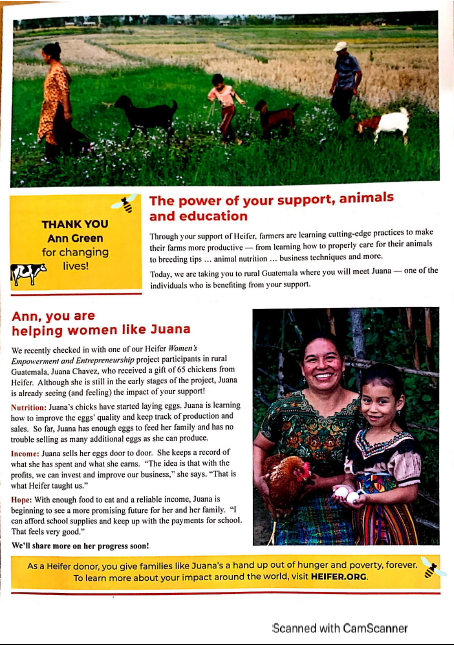
Photos can enhance your print communication by breaking up the narrative. You can also complement your written stories with photos. Here’s a great example from an update I recently received.

You’ll notice that it’s a short, but engaging update. There’s no need for long print pieces. If you’re worried about mailing costs, postcards and other short pieces with photos are the way to go. You could even do a Postcard Annual Report 

If you use social media, you need to communicate several times a week. As your donors scroll through an endless number of Facebook and Twitter posts, an engaging photo can stand out and get their attention.

Use photos everywhere – fundraising appeals, thank you letters/cards, newsletters, annual reports, updates, your website, and social media. Create a photo bank to help you with this.

It’s fine to use the same photos in different channels. It can help with your brand identity. Be sure to use high-quality pictures. Also, make sure your photos match your messages. If you’re writing a fundraising appeal about children who aren’t getting enough to eat each day, don’t use a picture of happy kids.

Work with your program staff to get photos and videos (more on videos below). Confidentiality issues may come up and you’ll need to get permission to use pictures of kids.

10 Ways Nonprofits Can Leverage Visual Storytelling

6 Ways to Tell Your Nonprofit Story With Images

6 Steps to Establishing a Photo Policy that Boosts Giving & Shows Respect

Highlight your work with a video

Videos are becoming a more popular way to connect. They can be used to show your programs in action, share an interview, give a behind-the-scenes look at your organization, or my favorite – thanking your donors. 

You can share videos that are relevant to our current situations. If you’re a museum that’s re-opened, you can show people how they can visit it safely. You could give a virtual tour of some of your collections for people who aren’t comfortable visiting. You could also talk about how the pandemic or systemic racism has impacted the people/community you work with. 

I would definitely recommend creating a personalized thank you video. If that’s not possible, you can make a general one.

How to (Easily) Thank Donors with Video

Make your videos short and high quality. Short is key. People are still spending a lot more time online. If your video is more than a couple of minutes, they may not bother to watch it.

You can use videos on your website, in an email message, on social media, and at an event (virtual or in person, when it’s safe).

6 Ways to Fundraise With Video

5 Examples of Nonprofit Storytelling that Compel People to Give

5 Inspirational Nonprofit Impact Story Videos

Spruce up your statistics by using infographics

A typical annual report is loaded with statistics. You want to share these, along with your accomplishments, but you don’t want to overwhelm your donors with a lot of text.

Why not use an infographic instead of the usual laundry list of statistics and accomplishments? Here are some examples. 

A Great Nonprofit Annual Report in a Fabulous Infographic

Infographics are also great in other types of communication such as newsletters and updates.

6 Types of Nonprofit Infographics to Boost Your Campaigns

3 Infographic Tips for Nonprofits

10 Tools for Creating Nonprofit Infographics

Good visuals will enhance both your print and electronic communication. Keep your donors engaged with all types of stories.

A Beginner’s Guide to Visual Storytelling in Your Nonprofit Communications