You’re Lucky To Have Your Donors

422810636_b02ba5dfed_m

Do your donors know how lucky you feel to have them support your organization? Take time this month to let them know that and keep letting them know that throughout the year. St. Patrick’s Day is coming up so you could use that as a theme.

Luck isn’t everything

Luck isn’t everything, though. You have to work at it. Donors don’t magically keep donating to your organization. In fact, if you ignore them or communicate poorly, they’re unlikely to donate again.

It takes more than leprechauns granting wishes. You need good donor relations. Donor relations should be easier than raising money, and it can be fun, too. But not only do you have to work at it, you need to make it a priority!

New beginnings

If you don’t want to use St.Patrick’s Day as a theme, spring is just around the corner. Spring is a time for new beginnings. Maybe you can share a new initiative that you were able to launch with your donors’ help.

Speaking of new beginnings, think about sending something special to your first-time donors. Let them know how much you appreciate this new relationship. If you don’t, it’s likely to be a short-term relationship.

Also, I bet you can freshen up some of your stale old thank you messages.

Keep donors front and center

You can also send an update emphasizing how your donors are helping you make a difference.

Heifer International does a great job of communicating with their donors. I just received a couple of updates – one by mail, the other by email. They’re filled with donor-centered language such as:

See the progress you made possible!

Ann, An update on Your Gift to Heifer!

You are very much a part of this enterprise.

Read more inside about how your gift promotes strong bodies and minds through nutrition.

THANK YOU!

Many organizations seem to forget about the donor when they communicate. Make your messages stand out with donor-centered language

Keep building relationships

It’s always a good time to build relationships. It’s easy to get complacent right now, especially if you’re between fundraising campaigns or events. Don’t do that. Let your donors know how lucky you are to have them and keep doing that again and again.

Here are a few other themes you can use in March via The Nonprofit Marketing Guide.


Is Your Newsletter Boring?

7949872568_ba8f714d82_m

There’s a good chance the answer to this question is yes. Many nonprofit organizations use a newsletter as a way to engage their donors, but the opposite is happening. That’s because most donor newsletters can be used as a cure for insomnia. They’re too long and filled with articles that brag about how wonderful the organization is.

Don’t worry. You can create an engaging newsletter your donors will want to read. Here’s how.

Think about what your donors want

You may opt not to do a print newsletter because it’s expensive and takes too much time, but you’re making a mistake if many of your donors prefer print.

I think you’ll have more success if you can do both print and electronic newsletters. I recommend a short e-newsletter once or twice a month and one to four print newsletters a year. But ask your donors what they like, and listen to what they say. If a majority of them prefer one over the other, then doing both may not make sense.

You also want to include content that will interest your donors. Do you think they would rather read an article about your CEO receiving an award or one about Jacob acing his math test after his weekly tutoring sessions? The answer should be obvious.

Your donors want to hear how they’re helping you make a difference.

Share stories

Each newsletter needs to begin with a compelling story. Client stories are best, but you could also do profiles of volunteers, board members, and donors. Focus on what drew them to your mission.

Create a story bank that includes at least three client success stories to use every year.

Write to your donors

Write your newsletter in the second person, emphasizing you much more than we. Be personal and conversational. Say – You helped Jacob improve his math skills or Because of donors like you, X number of students are now reading at their grade level or above.

Ditch the jargon and other language your donors won’t understand. Write as if you’re having a conversation with a friend.

I’m not a fan of the letter from the CEO because those tend to be organization-centered instead of donor-centered.  

Say thank you

Never miss an opportunity to thank your donors. Every one of your newsletters needs to show gratitude and emphasize how much you appreciate your donors.

Make it easy to read (and scan)

Most of your donors aren’t going to read your newsletter word for word, especially your e-newsletter. Include enticing headlines and email subject lines, at least a 12-point font, and lots of white space so your donors can easily scan your newsletter.

Stick to black type on a white background as much as possible. Colors are pretty, but not if it’s hindering your donor’s ability to read your newsletter. Photos can be a great way to add color, as well as tell a story in an instant.

Use the inverted pyramid and put the most important story first, keeping in mind your donors may not get to all the articles.

Very important –  make sure your donors can read your e-newsletter on a mobile device.

Short and sweet

Your print newsletter should be no more than four pages. Limit your monthly e-newsletter to four articles. Some organizations send an e-newsletter twice a month. Those should be even shorter – two or three articles.

You may find you have more success with shorter, more frequent email updates.

Send it to the right audience

Fundraising guru Tom Ahern recommends sending your print newsletter only to donors. This can help you keep it donor-centered, as well as cut down on mailing costs.

Send e-newsletters only to people who have signed up for it. They may or may not be donors, but an e-newsletter can also be a good cultivation tool.

Let’s put an end to boring newsletters. Create one your donors will want to read.

Read on for more information about donor newsletters.

Shhh! Secret Formula for Donor Newsletters That Delight

3 Pitfalls of Nonprofit Newsletters and How to Avoid Them

HOW TO CREATE A BETTER NON-PROFIT NEWSLETTER

How to Format Your Nonprofit Newsletter

Photo by Dwight Sipler


Can Your Organization Pass the Donor-Centered Test?

3636017744_11ca3c37f5_m

I recently received a newsletter from an organization that focused mainly on themselves, then their clients, and then barely mentioned their donors. There’s no question this organization does good work, but their newsletter failed the donor-centered test. Unfortunately, they’re not the only guilty culprits.

The term donor-centered is pretty self-explanatory. It means focusing on your donors’ needs and interests, acknowledging them in your letters and other communication, and taking into account that not all donors are the same.

Can your organization pass the donor-centered test? Take a few minutes to find out.

Fundraising Appeals

  • Are your fundraising appeals focused too much on your organization – rambling on about how great you are?  Your organization may be great, but let your donors figure that out. Your donors are the ones who are great, and they want to hear how they can help you make a difference for the people/community you serve.
  • Are your appeals segmented to the appropriate audience? Thank past donors or reference your relationship to a potential donor. Maybe they’re event attendees, volunteers, or friends of board members.
  • Are your appeals addressed to a person and not Dear Friend?
  • Are your appeals vague, impersonal, and filled with jargon your donors won’t understand?  Don’t say we’re helping underserved members of the community. A donor-centered appeal would say something like – With your support, we can help low-income families find affordable housing.
  • Do your appeals make people feel good about donating to your organization?

Thank you letters

  • Do your thank you letters come across as transactional and resemble a receipt? Yes, you need to acknowledge the donation is tax deductible, etc, but most donors are more concerned about how their gift made a difference.
  • Do your thank you letters (or better yet, a handwritten note) shower your donors with love?  Start your letter with You’re amazing or Thanks to You!, and not On behalf of X organization.
  • Are you telling your donors the impact of their gift?  For example – Thanks to your generous donation of $50, a local family can get a box of groceries at the Southside Community Food Bank.
  • Do you recognize each donor?  Is this the first time someone has donated?  If someone donated before, did she increase her gift?  Acknowledge this in your letter/note.

Newsletters

  • Do your newsletters sound self-promotional and focus on all the wonderful things your organization is doing instead of showing your donors how they’re helping you make a difference?
  • Is your newsletter written in the second person?  Write to the donor and use the word you more often than we. How to Perform the “You” Test for Donor-Centered Communications – Do You Pass?  BTW, all your donor communication should be written in the second person. It’s much more personal.
  • Does your newsletter include success stories, engaging photos, and other content your donors want you to share?
  • Are you using the right channels?  Perhaps you only send an e-newsletter, but some of your donors prefer print.
  • Are you showing gratitude to your donors in your newsletter?

Always think of your donors first

Use these test questions on other donor communication such as annual reports (these are rarely donor-centered), your website, and social media posts.

How did you do?

Be sure the messages you send to your donors focuses on them and makes them feel special. Staying donor-centered can help you build relationships and keep your retention rate from plummeting.

Read on for more information on how to be donor-centered.

A donor-centered organization, your donors, & relationship building

How to Create a Donor-Centered Fundraising Letter


Where Did All Our Donors Go?

2200500024_e93db99b61_m-1

The ACLU saw a record number of donations come in right after the Trump administration enacted its travel ban. This spawned a discussion on the Nonprofit Happy Hour Facebook page in which someone wondered if these would be one-time donations. That’s a good question since donor retention rates are declining again. New Study Shows Donor Retention Rates Are In Decline

Yikes! This should not be happening. I hope your organization isn’t hemorrhaging donors. If you’re not sure, then you need to figure out your retention rate to see how you’re doing. A Guide to Donor Retention

Donors stop giving to organizations for a variety of reasons. Some you can’t control, such as their financial situation, but many you can, such as how you communicate with them.

If you’re wondering where did all our donors go, here are some ways to get them back or prevent them from leaving in the first place.

Reach out to your lapsed donors

Did you have a number of donors who gave in the past, but didn’t this year?  Reach out to people who haven’t donated in the last two years by phone or personalized letter.  Let them know how much you appreciate their support, that you miss them, and you want them back. Some people may have been busy in December and didn’t have time to respond to your appeals.

Personalization is the key. Don’t send some generic appeal. That’s why I recommend mail or phone, although you could follow up by email.  

Reaching out to lapsed donors could be a good way to make up for lost revenue, Disappointing year-end campaign results? Here’s how to recover.

Show your donors how you’re making a difference

As a new monthly donor to the ACLU, my response to their court petitions was, my money is going to good use. This is what you want to show your donors. The ACLU was lucky that they were able to show results on such a grand scale, but that doesn’t mean you can’t show your donors how you’re making a difference, too. A recent newsletter from a local organization whose mission is to end homelessness shows how they’re helping people “find their road home.”

Welcome new donors and keep showing the love

According to the latest Fundraising Effectiveness Project results, new donor retention is an abysmal 23%. We spend so much time trying to get people to donate and then think our work is done, when in fact in has only just begun. Your Appeal is Just The Beginning

If you haven’t already done this, send your new donors a welcome package by mail or email. But keep showing the love to all your donors

You want as many donors as possible to give again, preferably at a higher level. This won’t happen if you don’t stay in touch throughout the year.

Break through the noise.

There’s a lot going on right now. We all get so many email messages and social media posts it’s enough to make you want to turn off your computer or put your phone away.

Don’t be part of the noise. When you communicate with your donors, make it good. It’s not enough just to send a donor newsletter or post a social media update. Show gratitude and share engaging updates.

To get noticed, aim for shorter more frequent content. Send email once a week and social media posts a few times a day. Don’t forget to reach out by mail, too. But most important, share stories and updates your donors will want to read.

Shifting priorities

Social justice organizations are seeing a huge increase in donations right now. I donated to many more nonprofits at the end of the year, but still supported the ones I had in past years. Some people might not be able to do that.

Your organization may be seeing a decline in donations because of this. That means you need to work harder to keep your donors. If you follow the advice above, you’ll have a better chance of keeping your donors for a long time.

Read on for more on declining retention rates. What are the Obstacles to Improving Donor-Retention Rates?

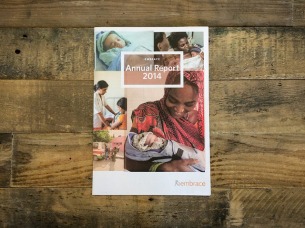
How to Create a Better Annual Report

19523182406_27b919a580_zIt’s annual report season, for better or for worse. Often it’s for worse since many of them are long, boring booklets that put your donors to sleep.

You don’t have to do an annual report, but you do need to share accomplishments with your donors. You may opt to nix the annual report and send short progress reports a couple of times a year or monthly e-updates instead.

If you decide to do an annual report, I encourage you to move away from the traditional multi-page one. These take a lot of time to produce and there’s no guarantee your donors will read it. Aim for something no longer than four pages.

Here are a few things to keep in mind to help you create a better annual report.

Your annual report is for your donors

It’s not for your board and you don’t have to do it the same way you’ve always done it – no more massive, boring booklets.

You may want to consider different types of annual reports for different donor groups. You could send an oversized postcard with photos and infographics or a two-page report to most of your donors. Your grant and corporate funders might want more detail, but not 20 pages. See if you can dazzle them with no more than four pages.

One way to shorten your annual report is to not include a donor list. The Annual Report Donor List is a Stupid Waste of Time If you feel you must have one, put it in on your website.

Show your donors how much you appreciate them

Donors want to feel good about giving to your nonprofit. Think of this as a gratitude report.

Focus on thanking your donors for their role in helping you make a difference. Get inspired by some of these examples from Agents of Good. Annual/Gratitude Reports 

How are you making a difference?

The theme of many annual reports is look how great we are. Are You Bragging Too Much?

They also include a bunch of boring lists, such as number of clients served, You need to share specific accomplishments that show how you are making a difference.

Focus on the why and not the what. Something like this – Thanks to you, 85% of the students in our tutoring program are reading at or above their grade level and now have a better chance of graduating from high school on time.

Tell a story

Donors love to hear about the people they’re helping. You can tell a story with words, a photo, or a video. Share a success story. For example – Jeremy, a fourth grader at Clark Elementary School, used to get a pit in his stomach if he had to read aloud in class. He struggled with the words and hoped no one would laugh at him. Now after weekly tutoring sessions with Kevin, one of our volunteer tutors, his reading is much better and he doesn’t dread reading time.

Make it visual

Your donors are busy and don’t have a lot of time to read your report. Engage them with some great photos, which can tell a story in an instant. Choose photos of people participating in an activity, such as Kevin helping Jeremy with his reading.

Use colorful charts or infographics to highlight your financials. This is a great way to keep it simple and easy to understand. Sprinkle in quotes and short testimonials to help break up any text.

Be sure your report is easy to read. Use at least a 12-point font and black type on a white background. A colored background may be pretty, but it makes it hard to read.

Write as if you’re having conversation with friend

Go jargon-free. Most of your donors don’t use words like underserved or at-risk, and neither should you. Use everyday language such as – With your help, we found affordable housing for over 100 homeless families. Now they no longer have to live in a shelter, a motel, or their cars and have a place to call home.

Write in the second person and use a warm, friendly tone. Of course, use you much more than we.

For more information on creating a better annual report, I encourage you to take time to watch Kivi Leroux Miller’s great webinar Go Short with Your Annual Report


The Good, the Bad, and the Ugly in Year-End Fundraising – Part Two

In my last post, The Good, the Bad, and the Ugly in Year-End Fundraising – Part One, I gave examples of how organizations thanked me, welcomed me as a new donor, and recognized my monthly gifts after I gave my year-end donations. In many cases, I didn’t receive anything except a boring, email thank you acknowledgment. With a little extra effort, you can do better than that.

In this post, I’ll give you the good, the bad, and the ugly of how organizations are staying in touch since I made my donations at the end of November. I know it’s only been about six weeks, but organizations should reach out at least once or twice a month in ways in which they are not asking for money. Here’s some of what I’ve received so far.

Holiday greetings

One organization sent an email holiday greeting with pictures of cute kids, a link to a great video, and no donation request. I’ve included the link to their video because I think it does a nice job of capturing what the organization does in two minutes. You could do something like that, too.

Three other organizations sent email holiday greetings. Another was combined with an ask. A couple of organizations sent holiday cards with donation envelopes. This is a huge pet peeve of mine. Sending holiday greetings is a great way to reach out. Don’t ruin the moment with a donation request.

A couple of organizations wished me a Happy New Year and sent a New Year’s update. Some sent New Year’s and year-end thank yous. One large organization sent an email handwritten thank you note.
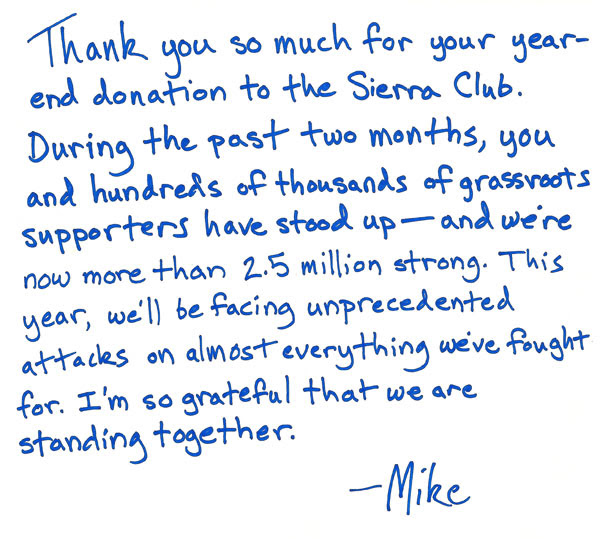
Thank you so much for your year-end donation to the Sierra Club. During the past two months, you and hundreds of thousands of grassroots supporters have stood up -- and we're now more than 2.5 million strong. This year, we'll be facing unprecedented attac

Yes, it’s somewhat impersonal, but it would have been impossible to send actual handwritten notes to 2.5 million supporters.

Holidays and different times of the year are a great way to connect. Find creative ways to say thank you and update your donors on Valentine’s Day, St.Patrick’s Day, the first day of spring, Mother’s Day, Father’s Day, etc.

Getting donors involved

I donated to several social justice organizations. Some are keeping in touch with regular updates and advocacy alerts. Encouraging people to contact their legislators about important issues is another great way to engage without asking for donations.

Two organizations just sent short, five-question surveys by email. One asked what issues are most important to me and the other was a combination of questions about issues and gathering some personal information. This is yet another great way to connect, and you could also ask questions about communication preferences –  Do your donors prefer print, email, social media, or a combination of those?

The key is to keep your surveys short. Those five questions took no time to complete.

All or nothing

Speaking of print communication, I do think organizations should communicate by mail a few times a year. Some smaller organizations don’t use direct mail because they think it’s too expensive. This is a mistake. Your donors are more likely to see a print piece than an email or social media message.

Larger organizations don’t have a problem with print communication; the problem lies in what they’re sending. It’s unlikely I’m going to read your wordy 10-page newsletter, so you might want to bump that down to four pages or make it very visual with photos and infographics. One of the new organizations I donated to sends a bi-monthly magazine, which I just skimmed through.

Remember, your donors are busy, and less is more. Handwritten notes, postcards, and two to four-page newsletters and annual reports are great. Anything longer than that may go directly in the recycling bin. 

Also, give some thought to the content. Include donor-centered updates filled with gratitude. And, make sure it’s easy to read. That teal background may be pretty, but it makes it hard to read. So do does your small font.

Another donation so soon

By far the most communication I’ve received in the last six weeks were additional donation requests with no indication that I had donated recently. I know the end of December is the busiest time of the year for fundraising and sending multiple fundraising requests to people who haven’t given yet is necessary. But what about the people who have already given their year-end gift?

Try to personalize these requests. Either don’t send one to people who have already given or include a thank you to those people. A couple of more palatable ways organizations asked for an additional donation this year was to request one on behalf of someone as a holiday gift or to give a specific need. For example, one organization cited a recent fire that left 32 families homeless.

Otherwise, it looks like you’re treating your donors as if they’re money machines when you send a continuous stream of impersonal donation requests. The Worst End-of-Year Email of 2016  Give some thought to your year-end requests and intersperse them with holiday greetings, thank you messages, and engaging updates.

While I’ve seen examples of good, bad, and ugly communication, I should add another category – nonexistent. Some organizations aren’t communicating at all, and if that continues you’re not making a good impression.

I’ll write another post in a couple of months to see how these organizations continue to communicate with me.


The Good, the Bad, and the Ugly in Year-End Fundraising – Part One

At the end of November, I made year-end donations to 25 organizations. Because I was worried about people who would be left behind in the new administration, 11 of these were new donations.

I wish I could tell you that all these organizations sent glowing thank you letters and have been following up with engaging updates and minimal additional requests for donations, but, alas, that is not the case.

Some organizations are doing a better job of communicating than others. Here is the good, the bad, and the ugly of what I experienced after I made my year-end donations.

Saying thank you

I made all my donations online, but only four organizations sent me thank you letters, and one sent a handwritten postcard. I’m a big believer in sending a thank you by mail or making a phone call even if someone donates online.

Two of the letters started with the dreaded “On behalf of.“ If you’re sending something on your letterhead, I already know it’s coming from your organization. The first words in your letter should be Thank you or something like You’re incredible.

One of the letters included a pre-printed Thank You! in big, bold, blue scripted letters at the top. Another opened with Welcome, and thanks so much … since I’m a new donor. These are simple things you can do to make your letters stand out.

All of the organizations sent email thank you messages. Some were generic receipts. Others opened with a story and an engaging photo.

Automatic emails won’t be personalized, which is why you should also thank by mail or phone. You can, however, still write a warm, heartfelt thank you message.

Another way to stand out is with a good email subject line. You have to include a subject line, so give some thought to it. Many of the organizations said thank you in the subject line.  One acknowledged it was a monthly gift.

A couple of good examples are Thank you, Ann and Thank you for your generosity. Some not so good examples are Donation received, Thank you.Your gift has been received (they get additional demerits for using the passive voice), and X organization Gift Acknowledgement

If you use a lame subject line, it’s less likely someone will even open your thank you email. Once they do, inspire them with opening lines such as You did something incredible, You are taking a stand for justice or You did something important.

Welcoming new donors

I made a number of first-time donations, but I’m not feeling a whole lot of new donor love. As mentioned above, I did get welcomed as a new donor and the thank you letter included links of ways to get involved.

One organization offered me a t-shirt, which I declined.  A thank you letter included contact information and a link to tell the organization why I supported them. Another invited me to take a tour of the organization, which is a great way to connect.

Otherwise, it was business as usual. Don’t fall into that trap. You need to go the extra mile to welcome new donors. With first-time donor retention rates at about 30%, you can’t afford to be complacent.

Monthly giving

This is the first time I’ve done monthly giving – approximately half of my gifts were monthly ones. I actually got more response to being a monthly donor than being a new one.

One organization gave me the name of a contact person if I needed to change anything. Another specifically sent me a story letting me know how my monthly donation is helping them make a difference.

Here’s a good example of a way to communicate your thanks to your monthly donors  –  I really can’t emphasize enough how much we appreciate our monthly donors. Your consistent support is the backbone of our program.  Another organization refers to their monthly donors as Friends for All Seasons.

A different organization sent me an email thank you acknowledgment for the second installment of my monthly gift. I assume this will be a regular occurrence, which is a great idea. You want to encourage monthly donations and ensure your donors will keep supporting you this way. Setting up an engaging thank you email to go out each month is a great start.

Stayed tuned for Part Two where I share the good, the bad, and the ugly of how these organizations are staying in touch, or not.

Start the New Year on the Right Track

32038668575_5ae959edde_m

Happy New Year! I hope you had a good holiday. I just returned from my family’s annual trip to Florida. It’s quite a contrast from dreary Boston, but at least there’s no snow (yet).

I also hope 2016 was a good year for your organization, and 2017 will be successful, too. You can help ensure that by starting the New Year on the right track. Here’s how.

Evaluate and plan

Take a look back at 2016 to see what worked and what didn’t in your fundraising and communications. Incorporate what you’ve learned into your 2017 plans.

If you haven’t made fundraising and communications plans yet, do that now! Don’t go too far into the New Year without plans in place. Also, make sure you evaluate your progress at least once a quarter.

Nonprofit Fundraising Plan: 6 Must-Do Steps For Success

COMMUNICATION PLAN TEMPLATE

Rev Up Your Data with Dashboards

Figure out your retention rate

As you’re doing your year-end evaluation, figure out your donor retention rate. A Guide to Donor Retention

If it’s low, it’s something you can fix, usually with better communication. Most of the reasons your donors leave are your own fault

Get in touch with your lapsed donors

Get in touch with donors who have given in the last two years, but not this year. Call them or send a personalized note. Let them know you miss them and want them back.

They may not have given to your year-end campaign for a variety of reasons including being too busy or not wanting to spend too much in December. The New Year could be a perfect time to reach out.

Thank your donors

I hope you thanked your donors after your year-end appeal and I hope you didn’t send one of those lame, generic letters. If you never sent a thank you, do that now!

Either way, the New Year is a great time to thank your donors. You want to show gratitude at least once a month. Wish your donors a Happy New Year, thank them again, and share a success story. You can do this by email or social media.

And, make a resolution to do a better job of thanking your donors this year. Say Thank You Like You Mean It

Don’t brag so much

Your donors wouldn’t have given to your organization if they didn’t think highly of you. You may be planning to create an annual report and continue to share accomplishments in your newsletter and other updates. When you do this, remember to focus on how your donors are helping you make a difference for the people/community you serve.

I just received a year-end update from an organization that included some extreme bragging. Only at the very end did they thank their donors. They should have done that in the first sentence.  

Give specific examples of how you are helping people, and dial back on the bragging. Are You Bragging Too Much?

More stories – less jargon

On the other hand, I received a short report from a different organization which opened with a compelling story about a man named Michael who is worried about where he and his young son, Eli, will find their next meal.

Okay, they did throw in the dreaded words food insecurity, but that jargon is countered with real stories about real people.

Spend time this year collecting stories and use language your donors will understand. Write as if you’re having a conversation with a friend. Don’t get bogged down with a lot of explanation.

Be sure to tell visual stories, too. You can capture your donors’ attention in an instant with an engaging photo or short video.

3 AMAZING EXAMPLES OF NON-PROFIT STORYTELLING

Stay in touch throughout the year

Your donors want to hear how they’re helping you make a difference. Don’t let them down.

It will be a whole lot easier to stay in touch with your donors if you use a communications (aka editorial) calendar.  Why You Need a Communications Calendar

Here’s wishing you a successful 2017!

10 Ways To Engage Donors And Boost Donations This Holiday Season


2086084757_0dec5905e6_mGuest Post by Jeremy Silverstein

Fundraising for your nonprofit organization occurs year-round as you build relationships with donors, host events, and ask for donations. However, research shows that almost one-third of yearly online giving occurs in December. Capitalize on generosity this holiday season as you engage donors and boost donations. Here are 10 ways you can do that.

Create a Seasonal Holiday Campaign

Deck the halls and give your seasonal donation campaign a holiday flare.

  • Post a picture of a rescue dog sporting a holiday wreath.
  • Bake cookies for families in need, and ask donors to sponsor a plate.
  • Feature a holiday tree on your thank you cards.

Consider hosting a holiday party, too, as you engage donors and incorporate seasonal elements into your fundraising campaign.

Share Your Goals

Tell donors why you’re raising money. Will it provide school supplies to 100 kids or send 10 developmentally delayed adults to job training? Your transparency builds trust in your cause.

Get Personal

Donors are human, and they want to know that their money makes a difference. Why should they give to your cause?

This year, consider asking organization beneficiaries to share their stories as you get personal.

  • Give donors a tour of the handicap van you purchased for client transportation.
  • Showcase photos of rescue dogs with their new families.
  • Ask a job-training recipient to record a video of his/her work day.

Re-Examine Your Donation Process

A cumbersome or time-consuming donation process turns away busy donors. Simplify the process with a few tips.

  • Update your website so it’s mobile-friendly.
  • Add a bright “donate here” button to every page.
  • Make the donation forms short and sweet.

Ask for Gifts in Kind

Cash donations are always appreciated, although not everyone can give a monetary donation. Another way people can help out is with tax-deductible in-kind gifts. Examples include:

  • New, unwanted electronics that you can sell online or use in your next auction fundraiser.
  • Gently used office supplies that keep your organization functioning properly.
  • Vehicles that are sold and turned into cash.
  • Annuities or life insurance policies that continue giving,

Help Donors Give Gifts

Help your donors cross everyone off their gift-giving list when you invite them to donate in someone else’s name. On your print and online donation forms, include a box where supporters can “give a donation as a gift.”

To increase participation, create an attractive gift package. It may include a thank you note, recognition certificate, or small branded gift. As an example, donors who give $100 to your animal rescue receive a stuffed dog in a branded coffee mug.

Participate in Giving Tuesday

Started in 2012, Giving Tuesday promotes charitable holiday giving. More than 700,000 people raised $116 million in 2015.

While Giving Tuesday has passed, be sure to thank donors who participated and encourage giving throughout the month. Prepare social media posts and mailings that give donors facts, photos, and testimonials detailing your organization’s impact in the community.

Be Grateful

Many people show generosity during the holidays. Join in and remind your donors that you’re grateful for them.

Send handwritten thank you notes to all your supporters, whether they give $10 or $1,000. Use social media, your website, and your newsletter, too, to highlight how donations make a difference for your cause. These stories and your gratitude ignite even more generosity.

Target Volunteers

Volunteers already give so much of their time to your cause, but think about asking them for financial gifts, too. Volunteers are twice as likely to give as non-donors partly because they already know and love your cause.

Think Ahead

Of course, you’re focusing on securing year-end donations. Think ahead to next year, too.

Remember that some of your donors may not be able to give during the holidays, but they will resume giving when the new year arrives. Reach out to these donors when you share your goals for your fundraising efforts, thank them for past support, and build bridges for the future.

The holiday season provides 10 excellent ways to engage donors and increase gifts. With these tips, you can increase donations for your cause. What other ideas work for you?

Author bio: Jeremy Silverstein is Vice President of Operations and Vehicle Dispatching at Goodwill Car Donations. During his five years with the organization, Silverstein has handled tens of thousands of donated vehicles and has become an expert in the field.

What You Can Learn from Your Donors

Image result for creative common images for smiley hearts

Do you know why your donors give to your organization? Most likely they feel a connection to your cause. Most of us are good people and we want to help others.

I’m very upset about the results of the recent U.S. presidential election, which prompted me to donate to organizations that will help people/communities who will be left behind in the next administration.

There’s no question that nonprofit organizations do good work, but as a donor, I feel that many aren’t good at communicating this or making a personal connection with me.  

You hear a lot about how important it is to be donor-centered, but organizations need to practice this. You need to think from your donors’ perspective. This is what’s important to us.

Why should I give to your organization?

Why is it important to give to your organization now?  It doesn’t matter to me that it’s your annual appeal, #GivingTuesday, or the end of your fiscal year. I want to hear how you’re helping people or the community.

I don’t want a bunch of boring statistics either. Tell me a story. Show me how I can help make a difference for someone or in the community.

I also don’t need to hear about how great your organization is. If I’m a current donor, I wouldn’t have supported you if I hadn’t thought highly of you.

Do you really know me?

I’m barraged with fundraising appeals, especially at the end of the year. Some of them are from organizations I support and others aren’t. There’s not much difference between them. Most are generic with no regard for who I am. I guess I expect that from organizations I don’t support.

But it bothers me when organizations I’ve supported for many years never acknowledge that. It’s not that hard to segment your letters or add a handwritten note.

I’m always thankful for the few organizations who take the time to be more personal.

Let me know that you appreciate my gift

The generic automatically generated thank you email doesn’t cut it. I need something better. Let me know how much you appreciate my gift.

If I’m a new donor, welcome me.  If I’ve given before, thank me for my continued support.  Surprise me with a phone call, handwritten note, or at the very least, a heartfelt letter. Say Thank You Like You Mean It

I made a number of first-time donations this year, many of them monthly gifts. I’m curious to see how many of these organizations welcome me and do anything special for monthly donors.

Use language I understand

I don’t use words like at-risk and underserved and neither should you. Your jargon is boring and makes me gloss over your letter. Instead of using the term food insecurity, tell me families have to choose between buying groceries or paying the heating bill. Use plain language to help me understand your messages.  10 plain English principles for writing better web content

This feels like a transaction

Many fundraising appeals focus more on the transaction than the relationship. Yes, you’re trying to raise money, but you should also try to build a relationship with me.

I make a majority of my donations on #GivingTuesday. I almost dread opening my email inbox because there’s a relentless stream of Donate Now messages.

As a donor, I like the idea of #GivingTuesday and I’m always happy if there’s an opportunity for a matching gift, but it’s very transactional, and that includes the thank you experience or lack there of.

Whether you participate in #GivingTuesday or not, please keep your relationship with me front and center.

Don’t ignore me

After I give a donation, I want you to stay in touch, and that doesn’t mean blasting me with appeals. Send me updates on how my gift is making a difference.

Very few organizations do that and do it well. I’m always grateful when I get an endearing update like the one in this post. Knock it Out of the Park

Remember, your donors give to your organization because they care about what you do. Show them that you care about them, as well.