Sharing Donor Stories on Your Nonprofit Website: 4 Tips

Donor stories and testimonials help show appreciation for supporters and encourage others to get involved. Use these tips to write better donor stories. 

By Anne Stefanyk 

Donors want to know that their contributions matter to your nonprofit. According to Double the Donation’s donor retention guide, not receiving a proper thank-you is one of the top reasons donors stop giving. One way to effectively thank supporters while encouraging others to get involved is to incorporate donor stories and testimonials into your website. 

Often, nonprofits share donor stories to promote participation in planned and legacy giving programs. However, you can incorporate donor stories on other fundraising pages too, like peer-to-peer fundraising information pages or your ways to support page. You can even create a dedicated donor stories page to highlight a variety of supporters.

With that being said, here are a few tips to create better online donor stories: 

  1. Include rich details
  2. Show impact
  3. Ensure stories are engaging
  4. Include a call to action

Throughout this post, we’ll highlight examples of effective donor stories from the best nonprofit websites, including some best practices used and ways to emulate each example in your content strategy.  

1. Include rich details

Your donor stories should paint a detailed picture of who donors are, how they became involved with your cause, and what motivates them to continue participating. Use the following strategies to infuse your donor stories with informative detail: 

  • Incorporate facts about your donors’ lives. Help website visitors understand your donors on a personal level by including information about their interests and backgrounds in addition to their giving motivations. For instance, you could mention their hobbies, job histories, or family information. This helps potential donors find more in common with your current supporters, generating a stronger sense of community. 
  • Make the stories relatable. Choose a wide array of diverse stories that resonate with different audience segments. For example, The Michael J. Fox Foundation website includes donor stories that cover all types of giving, including supporters who participated in peer-to-peer fundraising, donated through their estates, gave in tribute to their loved ones, and more. 
  • Use donor-focused language. Make sure the text on your donor stories page uses supporter-focused language. For example, the CARE donor stories page includes a “Supporters Like You” title to inspire a sense of belonging to a community. 

When you provide plenty of details and relatable information about your current donors, you’ll make it easier for prospects to envision themselves becoming part of your donor community. For example, if a wealthy prospect feels connected to a donor testimonial because of a shared interest in your volunteer program, they might feel inspired to leave your organization a bequest in their will. 

2. Show impact

Another common reason donors stop supporting nonprofits is because they didn’t receive any information about how their gift was used. Ensure your donor stories include information about the impact of your donors’ gifts to show supporters that your nonprofit uses donations effectively. 

The Santa Clara University “Why We Give”page offers a few helpful examples of ways to show impact. For example, a story about a recent grad details the positive impact of receiving an endowed scholarship. The story includes direct quotes from the grad about how the support allowed her to become the first member of her family to graduate from college. 

Showcase your donors’ impact on your website by including:

  • Direct quotes or audio clips from beneficiaries
  • Statistics, charts, graphs, or maps that demonstrate the extent of your donors’ impact
  • Before and after comparisons via images or videos that visually demonstrate the power of donations

Impact updates give current donors a greater sense of fulfillment from their involvement. Meanwhile, prospective supporters will be able to see how your organization has put past donations to good use, reassuring them that you’ll also make the most of their gift. 

3. Ensure stories are engaging

By making your donor stories interesting and fun to read, you’ll encourage more website visitors to engage with them. This can increase the chances that they’ll connect with your mission and be inspired to give. 

Write interactive and intriguing stories by taking these steps: 

  • Include multimedia elements. Photos, videos, audio clips, infographics, and other multimedia content help break up text blocks and add more visual intrigue to your donor stories. Check out the University of Georgia’s donor recognition stories for some examples. These gratitude stories feature photos, videos of donor interviews, information about donors’ impact, and more. 
  • Naturally incorporate stories throughout your web design. Your donor stories don’t have to be limited to a page of links to testimonials. You can incorporate shorter snippets or features on pages like your online donation page or ways to give page. For example, look at how the Girls Who Code Ways to Support page features a short donor story and image seamlessly incorporated into the page’s layout. 

An example of a donor story on the Girls Who Code website, with a short text description and image

  • Keep your stories fresh and up to date with a regular posting schedule. Maintaining content freshness shows potential supporters that your organization is successful at continually bringing new donors on board. Freshness is also one of many factors that can help your content rank higher on search engines. Create a schedule for your content team to follow that provides deadlines for writing new donor stories, gathering images and other visuals, publishing the stories, and promoting them on social media and other marketing channels. Assign clear task owners to each step of the process to promote accountability. 

Kanopi’s WordPress for Nonprofits guide recommends writing for the web as you develop your content to make your testimonials more readable and accessible to all. Avoid jargon, use simple language, and incorporate more “you” pronouns rather than “I or “our.” Keeping the focus on the reader helps promote donor-centricity, making supporters and constituents the heroes of your stories.  

4. Include a call to action

Your donor stories should end on an inspiring, uplifting note that encourages readers to take action immediately. 

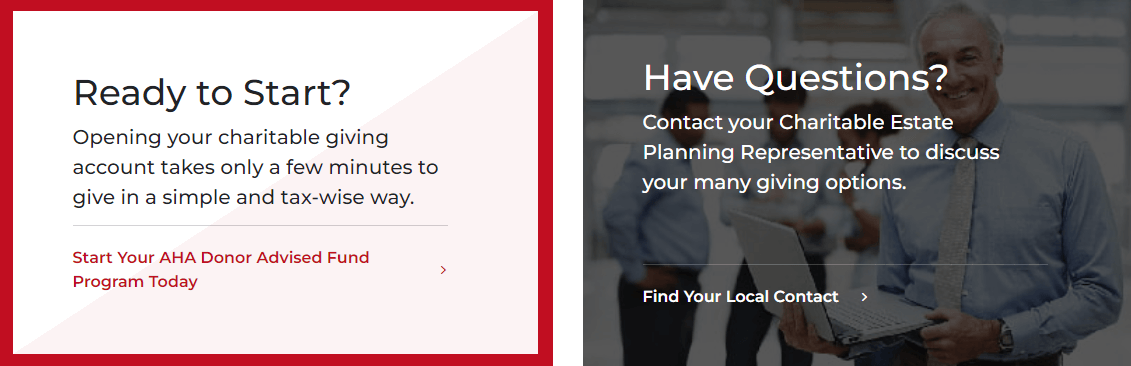
For example, the American Heart Association offers an effective example of useful calls to action (CTAs) for healthcare websites. Their donor stories end with CTAs that help visitors open a charitable giving account or reach out to a local representative with any questions. 

American Heart Association CTAs for opening a charitable giving account or contacting a representative

Welcome new donors with clear CTAs that allow website visitors to take the next step that aligns with their interests and needs. For example, your CTAs could say:

  • Support our scholarship fund today to help other students in need.
  • Leave a positive legacy with a planned gift.
  • Contact a local representative for more information about the impact of your gift.
  • Find the giving opportunity that works for you.

Your CTAs should be specific and welcoming, and they should lead to a user-friendly form or information page where supporters can take the next steps toward becoming donors or getting more involved in your cause. 


After optimizing your donor stories, promote them across multiple channels, including social media, email, and your printed newsletter. This will help reach a wider potential donor audience and ensure as many current donors as possible see your gratitude efforts. 

As Founder and CEO of Kanopi Studios, Anne Stefanyk helps create clarity around project needs, and turns client conversations into actionable outcomes. She enjoys helping clients identify their problems, and then empowering the Kanopi team to execute great solutions.

Anne is an advocate for open source and co-organizes the Bay Area Drupal Camp. When she’s not contributing to the community or running her thoughtful web agency, she enjoys yoga, meditation, treehouses, dharma, cycling, paddle boarding, kayaking, and hanging with her nephew.

How Your Nonprofit Can Ensure Success in 2024

Happy New Year! I hope you had a nice holiday. My vacation went by way too quickly.

I also hope 2023 was a successful year for your nonprofit organization. If it wasn’t, you can work to make 2024 a better year. As with personal New Year’s resolutions, you want your goals to be realistic and attainable. If you’re a small organization, you may not have much luck pulling off a huge gala.

Here are a few ways to help you ensure a more successful year.

Have a plan in place

You must have fundraising and communications/marketing plans. If you haven’t put together these plans yet, do that now! 

You know from past experience that you may need to make changes to your plans. In 2020, organizations that were able to make changes to a plan already in place were most successful.

Take a look back at 2023 to see what worked and what didn’t in your fundraising and communications/marketing. Incorporate what you’ve learned into your 2024 plans. 

Be sure your fundraising plan includes a diverse stream of revenue. Individual giving has proven to be successful. A lot of small donations can add up! Start or grow your monthly giving program (more on that below). Also, look into major and legacy giving. 

You can apply for grants and hold events, but those sometimes require more effort than it’s worth. Invest in strategies that make sense for your organization.

Revisit your fundraising and communications/marketing plans regularly and make changes as needed. Do this at least every two to three months.

Make sure that donor relations and donor retention are part of your fundraising plan. Those are key to your success.

Pay attention to your donor retention

Many donors have stepped up over the past few years to support nonprofit organizations. You don’t want to lose these valuable donors.

Donor retention should be a priority. You’ll have more success if you work to keep the donors you already have instead of focusing on getting new ones.

First, if you don’t already know it, figure out your retention rate. Do this after every fundraising campaign.

If it’s low, it’s something you can fix, usually with better communication. Donor retention is a huge problem for nonprofits. Your goal should be to have donors who support you for a long time.

It’s easier and less expensive to keep your current donors than to find new ones so once again, make donor retention a priority.

That said, you may have some new donors who saw a need and felt a connection to your cause. Don’t let these donors slip away either.

Go all in on monthly giving 

Speaking of retention, the retention rate for monthly donors is 90%. These donors are dedicated to your nonprofit. 

I’m a huge fan of monthly giving. It’s always made sense, but it’s been especially crucial over the last few years. Organizations that have monthly giving programs receive a steady stream of revenue throughout the year. Donors who opt for monthly giving find it’s easier on their finances. Even gifts of $5.00 or $10.00 a month can make a difference for your organization. Dedicated monthly donors have also stepped up and have given additional donations.

Work on starting or growing your monthly giving program so you can have a bunch of highly committed donors. A good way to start is to invite your current donors to become monthly donors.

Monthly donors are also potential major and legacy donors. Remember the importance of individual giving.

Do a better job of communicating with your donors 

There are many ways to do a better job of communicating with your donors. First, make this the year you say goodbye to boring, generic communication. Stop using jargon, such as at-risk and underserved. Tell more stories and go easy on the statistics. It makes a difference if you can put things in human terms, so you can do a better job of connecting with your donors.

Better communication also means more frequent communication. Donors want to  feel appreciated and know how they are helping you make a difference. Be sure to implement the ask, thank, report, repeat formula

You want to segment and personalize your communication, too. Address your donors by name (not Dear Friend) and recognize their past giving or if they’re a monthly donor.

Better, more frequent communication will help you raise more money. Having a communications calendar will help you with this. 

Work on building relationships

You may think the most important component of fundraising is raising money. While that’s important, so is building relationships with your donors. 

It’s hard to raise money year after year if you don’t build a good relationship with your donors. Every single interaction with your donors needs to focus on building relationships. That includes fundraising appeals. It’s possible to raise money and build relationships at the same time. 

Stop thinking of the donations you receive as a transaction and instead think of them as the start or continuation of a relationship. 

Good relationships with your donors will help you with retention.

Create an attitude of gratitude

A big part of building relationships is showing gratitude to your donors. Many nonprofits do a poor job of this. 

You need to start by sending a heartfelt thank you immediately after you receive a donation and then find ways to thank your donors throughout the year. Put together a thank you plan to help you with this.

Start the New Year off by making fundraising and communications/marketing plans, if you haven’t already done so. Prioritize donor retention, monthly giving, showing gratitude, and building relationships with your donors. This will help bring you more success in 2024.

Photo by Marco Verch

The Importance of Creating a Nonprofit Communications Calendar

I always like to emphasize the importance of keeping in touch with your donors throughout the year. I hope that’s a priority for you, too.

Your donors want to hear from you and don’t just want to be blasted with fundraising appeals. The good news is that better donor communication (thank yous and updates) can help you raise more money. This is especially important if you’re falling behind in your revenue goals. Remember the ask thank report formula.

Ideally, you should communicate with your donors at least once or twice a month throughout the year. I know that might sound impossible, but it will be a whole lot easier if you put together a communications calendar (also known as an editorial calendar).

I like the term communications calendar because it emphasizes the importance of communicating with your donors and other supporters all year round.

Some of you may already have a communications calendar, which is great. Now is a good time to update yours for 2024. For the rest of you, here are some suggestions to help you get started. Even though it will take a little time to put together, it will be worth it in the end because you’ll be able to do a better job of communicating with your donors.

This is not just a job for your marketing department. All departments need to work together. Figure out what information you need to share and when you need to share it. You want a consistent stream of information – not three email messages in one day and nothing for three weeks.

As you put together your communications calendar, think about how you will use different channels and which audience(s) should receive your messages. You may only send direct mail a few times a year (and I hope you do use direct mail), but send an e-newsletter once a month and communicate by social media several times a week. You’ll often use several different channels when you send a fundraising appeal or promote an event.

Start big by looking at the entire year and then break it down by months and weeks. You’ll keep adding to your communications calendar throughout the year.

Your communications calendar is a fluid document and these past few years are a good example of how our world is constantly changing. It’s important to keep things current.

Here are some categories you can use in your communications calendar. Some items will be time-sensitive and others won’t be.

Updates

Your donors want to hear how they’re helping you make a difference. Your print and e-newsletters should be included in your communications calendar. If you don’t do a newsletter, make a plan to share updates another way – maybe by postcard, email, and/or social media. Sometimes short updates are more effective.

Current events/News stories

At the beginning of 2020, most of us couldn’t predict the year we were about to have. There’s still so much going on, almost too much. Who knows what next year will bring.

Many donors will expect you to address current situations. Keep them apprised of how all this is affecting your clients/community. Sometimes staying silent isn’t the best option.

Legislation

Advocacy alerts are a wonderful way to engage with your supporters. Be on the lookout for any federal or state legislation that’s relevant to your organization. Encourage people to contact their legislators about an issue or a bill. Then report back to them with any updates and thank them for getting involved.

Time of year

Is there something going on during a particular month that’s pertinent to your organization? Perhaps it’s homelessness or mental health awareness month.

Thanksgiving, the holidays, and winter can be a difficult time for some people. How can you weave that into an engaging story to share with your supporters? This may be another hard winter for many people.

Keep in mind your organization’s anniversary doesn’t mean much to your donors unless you can tie that in with how they’re helping you make a difference. You could, however, reach out to your donors on the anniversary of their giving.

Fundraising and recruitment

Be sure to add your fundraising campaigns to your communications calendar. You’ll want to have a separate fundraising calendar, too. Of course, your campaigns are important, but you also want to show gratitude and send updates during this time without inundating your donors with too many messages. Planning ahead will help you strike this balance.

If your organization has specific times it needs to recruit volunteers, add that to your calendar, as well. 

Thank your donors

Make this a priority! Find different ways to let your donors know how much you appreciate them. You can combine a thank you with an update. Do this at least once a month. Create a separate set of thank yous for your monthly donors, too.

Events

Perhaps your organization holds events, either in-person, hybrid, or virtual. Besides your events, are there other events in your community that would be of interest to your supporters? If so, you could share that on social media.

Ongoing content

If you’re making a difference, you have stories to tell. Share a story at least once a month. Client stories (either in the first or third person) are best. Your stories need to be relevant to the ever-evolving current situations, so you may need to create some new ones.

You could also profile a board member, volunteer, donor, or staff member. Be sure to highlight what drew them to your organization.

Put together a story bank to help you with this.

Don’t stop communicating with your donors

As you hear about other relevant information, add it to your calendar, so you can stay connected with your donors/supporters throughout the year.

Here’s more information to help you create a communications/editorial calendar. A couple of these links also include templates.

Nonprofit Editorial Calendars

Get your nonprofit organized with an editorial calendar

How to create and use a nonprofit editorial calendar

3 Tips for Marketing Your Organization on a Limited Budget

Marketing your organization on a budget is easy when you know the right strategies and tools to use. Explore these top tips to step up your marketing strategy. 

By Melissa Mendez

Picture this: your organization is about to host another fundraising event. You’ve assembled a fundraising team, booked a venue, and put together the perfect program agenda. Once it comes time to get the word out about your event, you quickly realize you don’t have that much money left in your budget to create promotional materials and decide to deprioritize marketing. However, this results in low attendance numbers, causing you to miss the mark on your fundraising goal. 

If this sounds like a situation your organization has been in before, you need to update your approach to marketing. Even if you’re strapped for cash, there are a variety of ways to get the word out about your events, campaigns, and current initiatives without spending a single dollar! 

In this article, we’ll go over three money-saving tips that you can use to market your organization and get the support you need: 

  • Keep your website content fresh
  • Generate quality social media content
  • Create compelling email newsletters 

Whether you’re a dance studio hoping to promote your donation form for your year-end campaign or a nonprofit that wants to market its monthly giving program, the right marketing strategies and tools can help. Let’s dig into the essentials.

Keep your website content fresh

Your website is a rich information hub that acts as the focal point of your digital presence, but are you harnessing its full potential? By updating your website regularly and using it to spotlight your upcoming events, campaigns, projects, and more, you can successfully expand your reach and bring in new audiences for your organization. 

Leverage these cost-effective strategies to shape your website into a powerful marketing tool: 

  • Create event and campaign landing pages: Dedicated landing pages can help you dive deep into the details of your upcoming events and spotlight why it’s worth your audience’s time to register, donate, or take another relevant action. Cover all the logistical details, including the date and time of your event or campaign, its purpose, and how to get involved. Be sure to embed your registration or donation form directly into your landing page to help drive conversions and streamline your users’ actions. 
  • Share testimonials: Testimonials can provide great social proof that drives prospective audience members to support your organization. Create a testimonials page that features varied quotes from community members explaining why they support your organization or are eager to receive your services. For example, a dance studio might collect testimonials from students, parents, and alumni to show the value in signing up for classes. Similarly, nonprofits can feature testimonials from beneficiaries, explaining how your organization has made a difference in their lives. 
  • Generate blog content: Consistent blog content can keep community members tapped into your organization and eager to sign up for your upcoming events. Write content regularly, such as posting every other week to communicate important updates about your organization. To help offload the burden of creating content, you can also ask your beneficiaries, volunteers, donors, or loyal customers to create content reflecting on their experiences. 

As you refresh your website and create new content, make sure to widely promote these links to your audience. For example, if you recently created an event landing page to spotlight your upcoming peer-to-peer fundraising event, you could summarize the purpose of this event in your email newsletter and include a link to your landing page for people to learn more and register. 

Keep in mind that taking a multichannel approach, such as sharing links on social media or through QR codes in your direct mail, can help you direct multiple audiences to your website and keep your organization at top of mind. 

You might also leverage a dedicated communication app so you can more easily reach your target audience and ensure you have their support for your upcoming project. There are many cost-effective marketing platforms available that have built-in communication tools, so do your research to find the best solution for your organization. While investing in a marketing solution might seem like a big expense upfront, you’ll be able to derive a high ROI from it year over year, ensuring your organization can make back its investment and more. 

Generate quality social media content

With audiences spending more time on social media than ever before, regularly posting social media content is an easy money-saving strategy to ensure your content gets in front of your target audience. However, spamming content about your upcoming event or campaign can have the opposite effect, turning prospective audiences away from your organization and decreasing your engagement levels. 

Instead, construct a quality and intentional social media strategy that is tailored to your audience and supports your marketing goals. Use these tips to get started: 

  • Share a variety of visuals: Posting the same type of content over and over can quickly bore your audience. Generate a variety of visuals, such as photos from your latest event or infographics that highlight your organization’s impact, to grab your followers’ attention. You could also tap into the power of video, which can help you convey important information in an easily digestible format. Double the Donation’s guide to fundraising videos recommends keeping your video short and sweet and ending in a firm call to action so audiences know how to get involved. 
  • Use catchy hashtags to expand your reach: Hashtags can open up your community to new audiences and boost brand visibility. For example, if you’re a dance studio hosting a dance-a-thon, you might use the hashtag #DancingForACause or #DancingForDollars to create interest. You can also feature your dance studio name or city in your hashtag to draw local audiences to your event, such as #YourCityDanceAThon or #YourStudioNameDanceAThon. When participants post about your event, encourage them to pair it with your dedicated hashtag. 
  • Consider hosting social media contests: A social media contest is a great way to rally your whole community around your organization while growing your reach. You might ask supporters or customers to post videos about why they support your organization, and then award the audience member with the greatest number of likes or comments with a prize. Pair a hashtag with your contest and ask audiences to tag your account in their post so people in their personal networks can learn more about your organization. 

As you share content on social media, track metrics, like impressions and likes, to assess your performance. You may have to make adjustments to your content to better appeal to your audiences and drive greater engagement levels. 

Create compelling email newsletters

Your email newsletter is the perfect place to remind people of your upcoming activities and include links to your website and social media accounts. To strengthen your email newsletters and maximize their value, use these best practices: 

  • Include an eye-catching subject line: Your audience receives anywhere from tens to hundreds of emails a day. To stand out from the crowd you’ll need to create a brief, yet compelling subject line that piques your subscribers’ interests. For example, a subject line like “Don’t Miss Out On Our Annual Halloween Fundraiser!” or “Register Tonight for the Event Of the Season!” summarizes the central purpose of the newsletter while drawing the reader in so they feel motivated to open your email. 
  • Break up your content with visuals: Make your email newsletters even more engaging by adding a variety of visuals, like photos, videos, and graphics. Ensure these elements are reasonably sized to create a positive user experience and avoid using too many visuals so your audience isn’t overwhelmed. 
  • Use clear calls to action: Firm calls to action direct your audience to their next step so they can easily complete it. Create call-to-action buttons that stand out from the rest of your newsletter content and ensure they are hyperlinked to the relevant resource, like your donation page or event registration form. You’ll also want to use succinct, clear language that creates a sense of immediacy. For instance, a call to action like “Donate by midnight to get your gifts matched!” gets to the point quickly while using time-bound language to spur action. 

DanceStudio-Pro’s guide to dance studio marketing also recommends using email to show appreciation to your audience. Once your supporters complete a target action like donating or registering for an event, automate a thank-you email conveying your gratitude for their continued support. This practice will help you develop strong relationships with your audience that will benefit your organization for years. 

Wrapping Up

Marketing your organization doesn’t have to cost your team an arm and a leg when you have the right tools and strategies! Assess your existing toolkit and make adjustments to your marketing plan as needed to optimize your promotional strategies. Keep in mind that adding an all-in-one marketing platform to your tech stack can streamline your approach and help you save money in the long run. 

Melissa Mendez is the Operations Manager at Studio Pro, where she leads the Support, Customer Success, and Professional Services teams. Since 2019, Melissa has helped thousands of dance, cheer, gymnastics, and performing arts studio owners streamline enrollment, recital and showcase planning, ticketing, and accounting automation. She and her team deliver personalized onboarding, expert training, and ongoing support to make running a studio smoother and more sustainable.

A lifelong dancer who started at age three, Melissa built a successful mobile dance company that expanded to four locations across multiple states. Now based in San Antonio, Texas, she brings firsthand studio experience and operational expertise to every interaction—empowering studio owners to grow their businesses, strengthen their communities, and focus on what they love most: their students.

Welcome Your New Donors With Open Arms

Year-end fundraising is underway. I hope your campaign is going well so far. Perhaps you also participated in Giving Tuesday. The latter often brings in new donors and that’s never something you want to take for granted. 

These donors saw a need and found a connection to your cause. Or maybe they were drawn into whatever Giving Tuesday promotion you initiated, but I like to think they wanted to help you make a difference. 

Unfortunately, it’s unlikely these donors will stick with you. The retention rate for first-time donors is around 20%. We can and have to do better.

This is why it’s so important to get a second donation, also known as a golden donation. Once you get that golden donation, you’re more likely to have long-time donors who will stick with you. One way to ensure this is to make your new donors feel welcome.

Start with a special thank you

According to fundraising expert, Dr. Adrian Sargeant, “The thank you is the single most important piece of communication that your donors get. They have a higher recall of it than the appeal that generated the gift.”

Keep that in mind, especially for your new donors.

If someone donates online, it’s hard to tailor the thank you email specifically to new donors. But you can do that with a phone call, handwritten note, or thank you letter.

Try to call your new donors or send a handwritten note. This will make a great impression on them. Get together a group of board members, other volunteers, and staff to help you. If that’s not possible, create a thank you letter specifically for your new donors.

*Make sure these are actually new donors. A good CRM/database will help you avoid any missteps.*

Create a welcome plan

A week or two after the initial thank you, send a welcome package. You can do this by mail, email, or a combination of both. Try to send at least one welcome message by mail. Mail is always more personal and your donors will be more likely to see it.

Welcome your new donors. Thank them again and show them other ways they can connect with you. Invite them to subscribe to your newsletter, join you on social media, and volunteer.

Your welcome package should include a warm introductory message and a few facts about your organization, but don’t brag too much. Keep it donor-centered and be personable. You could also direct people to your website for more information about your organization.

Be careful about how much information you send. Donors want to feel welcome, not overwhelmed.

I don’t recommend sending unsolicited swag. Personally, I don’t like it, but some donors might. You could offer your new donors a gift and they can let you know if they want to receive it, but it’s not necessary. What donors really want from you is to know how they’re helping you make a difference.

Create a series of messages, also known as a drip campaign. Set a timeline. The first sequence of messages can be sent about once a week. After that, you should continue to communicate regularly (at least once a month) and follow the ask, thank, update formula. In a few months, you could invite your new donors to give monthly. Monthly donors are committed donors.

Welcome emails have high open rates. Impress your new donors right away, so they’ll be more likely to donate again.

Who are your new donors?

They could be event attendees, volunteers, or newsletter subscribers. If you know, refer to that in your thank you note, letter, or phone call. If not, send a short survey with your welcome package and ask, “How did you hear about us?” or “What drew you to our organization?” 

Another question to ask is whether your donors prefer print or electronic communication. Short surveys are also a good way to connect throughout the year. The more you know about your donors the easier it will be to communicate with them.

Make your current donors feel special, too

While I’ve been focusing on new donors in this post, retention rates for current donors aren’t anything to celebrate. The overall donor retention rate is around 45%, so we have some work to do.

Remember the golden donation, but don’t stop there. You want a third (would that be platinum?) and a fourth, etc. donation.  

If you’re not acknowledging a donor’s past support, you’re making a huge mistake. Imagine how you would feel if you gave to an organization for over five years and they never thank you for your long-time support.  

These valuable, long-time donors could leave at any time, so ignore them at your own peril. Make sure they also get a special thank you from you.

Keep it up throughout the year

It’s so important to communicate with your donors regularly. Plan on special mailings or emails specifically targeted to new donors. Remember to try to send something by mail if you can. 

Think of other ways to do something special for your new donors too, such as an open house or a tour of your facility, either in person or virtual.

Of course, don’t ignore your other donors. You could do something special when you get that all-important second gift. Keep reaching out – at least once or twice a month. 

Show appreciation and share updates. A huge factor in donor retention is a good donor relations plan that you’ll carry out regularly as long as your donors support you, which hopefully will be for many years.

Why You Need to Segment Your Donors

I’ve been emphasizing the importance of personalizing your communication lately. One way to do that is to segment your donors.

Your donors are not the same. Some donors have given for at least five years (these donors should get a lot of attention). Some are monthly donors. Yet, nonprofit organizations fail to recognize that and send everyone the same messages. 

I often receive generic, one-size-fits-all communication from organizations that don’t acknowledge I’m a longtime donor or recognize that I’m a monthly donor. How do you think that makes me feel?

Another benefit of segmenting your donors is it can help you raise more money. If you’ve been struggling to meet your revenue goals, that may be why.

Unfortunately, if you’re not segmenting your donors into different groups, you’re missing opportunities here –  both to connect with your donors and to raise additional revenue. 

Isn’t it time for you to start segmenting your donors? If you’re already segmenting your donors, kudos to you!

You may be worried about how much time this will take. Plus, you don’t think your current CRM/database can handle it and it will cost too much to get a better one. 

In reality, it may cost you more not to segment. A good CRM/database is worth the investment. Segmenting your donors will help you with retention, which costs less than trying to find new donors. 

Your appeals and thank you letters will stand out if you can personalize them and not send everyone the same generic letter. You don’t need to create a 100 different types of letters, though. Four or five should be sufficient. 

Here are a few different types of donor groups to help get you started. Remember, investing in a good CRM/database will help you with this.

Current single gift donors

An appeal letter to current single gift donors (Monthly donors get their own appeal. More on that below.) must acknowledge their past support. You can segment donors by gift amount and use this opportunity to ask for an upgrade. Many organizations don’t do this, but it’s a good way to increase your revenue.

Your donors will be more receptive to upgrading their gifts if you’ve been doing a good job of thanking them and staying in touch throughout the year.

If these donors give again, they should get a handwritten note, phone call, or letter letting them know how much you appreciate their continued support. If they’ve upgraded their gift, be sure to acknowledge that, too. 

Potential/new single gift donors

If you’re sending an appeal to someone who’s never donated to your nonprofit before, what is your connection to them? Are they volunteers, event attendees, or people on a list you purchased?

The more you can establish a connection, the better chance you have of getting a donation.

The retention rate for first-time donors is terrible. One of the reasons is poor communication. You can help boost your retention rate by making your new donors feel special.

New donors should get a handwritten note, phone call, or letter welcoming them as donors. Invite them to connect with you in other ways such as signing up for your newsletter, following you on social media, and volunteering.

Then a week or so later, send them a welcome package by mail or email. Personalization is essential for new donors.

One of the biggest hurdles nonprofits face is ensuring first-time donors give a second time. If they keep giving after that, they’re showing their commitment to your organization. That’s why the second gift is called a golden donation. Don’t blow it by ignoring this.

New monthly donors

Brand new donors who opt for monthly or other recurring donations get the same special thank you treatment mentioned above. Welcome them to your family of monthly donors. 

Current monthly donors

Your current monthly donors must get their own appeal that recognizes them as monthly donors. In this appeal, you can either ask them to upgrade their gift or give an additional gift. 

When your donors give an additional gift or upgrade their monthly gift, they, of course, get an amazing thank you.

Current donors who become monthly donors

Your current donors who decide to become monthly donors are also showing their commitment to you. They get a handwritten note, phone call, or letter thanking them for their continued support and for joining your family of monthly donors. From now on they should get specialized appeals and other communication targeted to monthly donors. 

Segment as much as you can

While I’ve suggested a few ways you can segment, there are many more options. You can segment by gift amount and number of years someone has been a donor. You can segment volunteers, event attendees, and non-donors. You can also use segmentation in other types of communication, such as creating a special newsletter for monthly donors (or at the very least including a cover letter for monthly donors with your newsletter) and sending handwritten notes to people on their donor anniversary.

Segmenting your donors makes a difference

We continue to face an uncertain economy. It’s possible some donors may cut back on their giving. Don’t let them choose between organizations that communicate throughout the year with engaging personalized appeals, thank yous, and updates or organizations that just send generic, one-size-fits-all communication. People always appreciate a personal connection.

Spending some extra time segmenting your donors and personalizing your communication will be worth it if you can raise additional revenue and boost your retention rate.

Lights, Camera, Action! 5 Tips to Engage Donors with Video

The right video has the power to spark an emotional connection between your nonprofit and its donors. Learn how to engage donors through video in this guide. 

By Doug Scott

Imagine a donor is searching online for charitable causes to support. With a desire to make a difference, they scroll through various nonprofit websites, reading about their missions and impact. Suddenly, something catches their eye. It’s a compelling and emotionally charged video showcasing your nonprofit’s work. Impressed by the video, they immediately sign up for your mailing list and follow you on social media.

Video has the unparalleled ability to grab people’s attention. By combining visuals, music, and storytelling techniques into one unique package, nonprofits can resonate with donors in a way that’s difficult to achieve through other mediums.

In this guide, we’ll explore five ways you can use video to engage, inspire, and leave a lasting impact on the hearts and minds of donors.

1. Film for each stage of the donor journey

The donor journey refers to the process by which individuals progress from being unaware of your nonprofit to becoming engaged and committed donors. When you know which stage of the donor journey an individual is at, you can more effectively appeal to their interests and solicit their support.

For each stage of the donor journey, you can create engaging videos:

  • Awareness stage: At this stage, donors are learning about your organization for the first time. Create compelling “Who We Are” videos that introduce them to your mission, values, and impact. 
  • Consideration stage: Here, donors are evaluating whether or not they have a connection to your cause. Produce educational videos that explain how your programs address specific issues and share success stories of those you’ve helped, emphasizing positive outcomes. 
  • Decision stage: As donors prepare to give, they need assurance that their support will make a real impact. Create testimonial videos featuring past donors that reinforce their decision to give. Have them share their experiences and the impact they have witnessed. 
  • Retention Stage: After donating, donors want to stay engaged and see the impact of their gift. Update them through video, demonstrating the progress you have made and thank donors for their contributions. Highlight upcoming projects and events to encourage ongoing involvement.

Track engagement at each of these stages to gain insight into the content that resonates with donors and adjust your communication strategies accordingly. 

2. Create a compelling story

Whether you’re creating content for donors in the awareness or retention stage, it’s important to use storytelling techniques to create an emotional connection with donors and transport them to the heart of your mission. To tell a compelling video story, follow these steps:

  1. Set the scene. Decide where your video will take place, whether that’s behind the scenes of your facility, through the communities you serve, or in front of a plain backdrop. 
  2. Showcase character development. Introduce relatable characters, such as beneficiaries, volunteers, staff members, or other donors. Share their personal challenges, aspirations, and journeys. Through their experiences, viewers can emotionally connect to the cause and the impact your organization makes.
  3. Highlight conflict and resolution. Present the challenge that your beneficiaries face. Then, showcase how your organization’s efforts and your donors’ support lead to resolution and positive change. 

Let’s explore how these elements can be translated into a campaign video. Opening with a close-up of volunteer Sarah’s passionate smile, the scene expands to show her engaging with beneficiaries at a community center. As Sarah narrates the food insecurity challenges faced by her community, she shares the transformative story of a young girl who receives free, nutritious meals due in part to the donations of generous viewers.

3. Keep it short and sweet. 

Attention spans are declining, so keep your videos short and sweet. According to Tectonic Video, the ideal length of a nonprofit video is around two to three minutes, meaning you have a small window of opportunity to grab people’s attention and get them invested in your cause. 

Write a script in advance to outline key points and ensure that the video stays focused. Make sure to read the script out loud and time it before filming to verify it’s the right length. Then, after filming, use editing tools to remove any redundant or repetitive information.

If you have more information to share, create a series of videos related to the same topic and stagger their release over a longer period of time. This will help you maintain a steady stream of engagement.

4. Include a call to action

Add a call to action to the final scene of your video to provide clear and immediate next steps for donors feeling inspired by the content. Encourage them to take specific actions, such as visiting your website to explore involvement opportunities, following you on social media for updates, or sharing the video to spread awareness. 

This can be accomplished through narration, on-screen text, and buttons. For instance, the narrator could say, “Join us in our mission to provide clean drinking water to communities in need.” Then, on-screen text could appear that says, “Visit our website to contribute to the construction and maintenance of water infrastructure,” pointing viewers to a large donation button. 

5. Share it widely 

Once you have created a compelling video, publish it on Vimeo or YouTube. Then, Double the Donation recommends sharing the content across several channels, which may include:

  • Direct mail: Include a QR code or a short URL in your direct mail materials that recipients can scan or type to access the video online. Use a compelling image from the video on the mailer to pique interest. 
  • Email: Embed the video directly in targeted email campaigns or your email newsletter for easy viewing. Craft a captivating subject line that hints at the video’s content. Then, use a short, attention-grabbing preview image that encourages recipients to click and watch. 
  • Social media: Customize the video for each platform’s specifications. For instance, videos must be vertical for Instagram Stories and square for Facebook. Write engaging captions that highlight the purpose of the video and use relevant hashtags to increase visibility. 
  • Website: Embed the video prominently on your website’s homepage and relevant landing pages, such as your donation page. For optimal performance, compress videos to reduce load time and use responsive video players that adapt to different screen sizes.

With multiple touchpoints, you can reach people on their preferred platforms and grab the attention of as many donors as possible. In turn, you’ll see higher engagement rates.


Now that you know how to engage donors with video, it’s time to create content! If you want to ensure the highest level of quality and engagement, partner with a nonprofit video production company. Their teams of experts will work alongside your nonprofit to get to know your mission, target audience, and goals, before translating these insights into a compelling video concept. Together, you can harness the power of video to leave a lasting impact on donors, one frame at a time.

Doug Scott is the Founder & CEO of Tectonic Video. He has more than 20 years of nonprofit communications experience as a filmmaker, communications director, chief marketing officer, and leader of two creative agencies for nonprofits. Doug is a global citizen having traveled to more than 50 countries. He earned his B.A. in Strategic Communications from DePaul University, and he’s a frequent guest lecturer at Stanford University on topics related to nonprofit storytelling and storytelling ethics.

The Many Forms of Nonprofit Stories

Stories come in many forms. You can tell a story with words, pictures, and videos. I prefer written stories, but others are drawn to videos. Some people might not have the time or energy to look at anything but a photo or infographic.

Your nonprofit organization needs to share stories using all these forms. Sharing stories will help you connect with your donors.

Donors want to hear your stories

I imagine you’re not using stories as much as you should. That’s a mistake because people respond better to stories than a bunch of facts and statistics. Stories bring the work you do to life by using everyday language to create a scene.

You may be reluctant to use stories because it’s more work for your organization, but that shouldn’t stop you. Make time to come up with some engaging stories.

Your stories need to be relevant

Update your stories at least once a year. They need to take the everchanging current situations into account. How are the economy, the aftereffects of the pandemic, discrimination, climate change, etc impacting your clients/community right now?

Create a culture of storytelling

If you create a storytelling culture in your organization, you can make storytelling the norm instead of the exception.

Work with your program staff to create stories that will help you connect with your donors. Everyone needs to understand how important this is. Share stories at staff meetings and/or set up regular meetings with program staff to gather stories. 

When you put together a story, ask.

  • Why is this important?
  • Who is affected?
  • Why would your donors be interested in this story?
  • Are you using clear, everyday language (no jargon) to make sure your donors understand your story?
  • How are your donors helping you make a difference or How can your donors help you make a difference?

Client or program recipient stories are best. Remember, donors want to hear how they’re helping you make a difference for your clients/community.

Another way to find stories is to put a Share Your Story page on your website. This could be a good way to get some current, relevant stories.

Your stories aren’t about your organization

Keep in mind that your stories aren’t about your organization. Your organization may have had to make a lot of changes over the last few years to do some of the work you do, but that’s not your story. Your story is why this is important for the people/community you work with. 

Maybe you had to change the way you run your food pantry, but what’s most important is that people in your community continue to have access to healthy food. 

Make your stories personal 

Tell a story of one (person or family). Use people’s names to make your stories more personal. I realize you might run into confidentiality issues, but you can change names to protect someone’s privacy. You could also do a composite story, but don’t make up anything.

Use different stories for different types of communication

Create a story bank to help you organize all your stories. You want to use stories as much as possible. Use them in your appeals, thank you letters, newsletters, updates, impact (annual) reports, website, blog, and other types of social media. 

While you can come up with some core stories, they’ll be slightly different depending on the type of communication. 

In a fundraising appeal (all appeals should start with a story), you want to highlight a problem or need. Let’s return to the food pantry example. Here you can tell a story about Melanie, a working single mother with three kids who’s having trouble feeding her family because of rising food costs and cuts in benefits. 

In your thank you letter, you can let your donor know that because of their generous gift, Melanie can get healthy food for her family at the Eastside Community Food Pantry.

Then in your newsletter, impact report, or update, you can tell a success story that because of your generous donors, Melanie doesn’t have to worry so much about how she’ll be able to feed her family.

Tell a story in an instant with an engaging photo

You’ve probably heard the phrase a picture is worth a 1000 words. Cliche, yes, but it’s true.

You can capture your donors’ attention in an instant with an engaging photo. That doesn’t mean one of your executive director receiving an award. Use photos of your programs in action or something else that’s engaging.

Print newsletters and impact reports tend to be dominated by long-winded text. Most of your donors won’t want to read the whole thing. But if you share some engaging photos, they can get a quick glance at the impact of their gift without having to plow through a bunch of tedious text.

Photos can enhance your print communication by breaking up the narrative. You can also complement your written stories with photos. If you’re worried about mailing costs, postcards and other short pieces with photos are the way to go. You could even do a Postcard Impact/Annual Report.

If you use social media, you need to communicate several times a week. As your donors scroll through an endless number of posts, an engaging photo can stand out and get their attention.

Use photos everywhere – fundraising appeals, thank you letters/cards, newsletters, impact reports, updates, your website, and social media. Create a photo bank to help you with this.

It’s fine to use the same photos in different channels. It can help with your brand identity. Be sure to use high-quality pictures. Also, make sure your photos match your messages. If you’re writing a fundraising appeal about children who aren’t getting enough to eat every day, don’t use a picture of happy kids.

Work with your program staff to get photos and videos (more on videos below). Confidentiality issues may come up and you’ll need to get permission to use pictures of kids.

Showcase your work with a video

Videos are becoming a more popular way to connect. They can be used to show your programs in action, share an interview, give a behind-the-scenes look at your organization, or my favorite – thanking your donors. 

I would definitely recommend creating a personalized thank you video. If that’s not possible, you can make a general one.

Make your videos short and high quality. Short is key. If your video is more than a couple of minutes, your donors may not bother to watch it. 

You can use videos on your website, in an email message, on social media, and at an event.

Spiff up your statistics by using infographics

A typical impact report is loaded with statistics. You want to share these, along with your accomplishments, but you don’t want to overwhelm your donors with a lot of text.

Why not use an infographic in your impact report instead of including the usual laundry list of statistics and accomplishments? 

Infographics are also great in other types of communication such as newsletters and updates. Good visuals will enhance both your print and electronic communication.

Connect with your donors and keep them engaged by using all types of stories.

What is a Call-to-Action? A Quick Guide for Nonprofits

A well-worded call-to-action (CTA) can encourage your nonprofit supporters to engage with your cause in a myriad of ways. Learn more about CTAs in this guide!

By Ira Horowitz

Your nonprofit exists because you’re seeking to enact positive change in your community, whether that means tutoring at-risk high school students, cleaning local beaches, or providing meals to unhoused people. 

However, you can’t do it alone—you need your supporters to help you make that positive change happen. This means you have to not only inspire your supporters by informing them about your cause and opportunities to get involved, but also explicitly ask them to take action. 

That’s where calls-to-action (CTAs) come in. By incorporating well-worded and carefully-designed CTAs into your marketing materials, you can encourage your supporters to take the necessary steps to put their passion for your cause into action, whether you want them to donate, volunteer, attend an event, or simply learn more about your organization. 

Let’s take a deep dive into the specifics of CTAs to help you get started! 

Calls-to-Action (CTAs): An Overview

A call-to-action (CTA) is a short statement or phrase that compels someone to take a specific action. Here are some examples of everyday situations in which we’re compelled to take action thanks to a CTA: 

  • In social media posts: “Follow us,” “Click the link in our bio,” “Comment below” 
  • In TV commercials: “Visit our store,” “See it in theaters this Friday,” “Talk to your doctor today about…” 
  • On mobile apps: “Download now,” “Try for free,” “Upgrade to premium” 
  • On billboards: “Call now for a free quote,” “Book your vacation now,” “Take the next exit to…” 
  • On websites: “Sign into your account,” “Find a store,” “Learn more about us” 
  • In emails: “Register for our upcoming event,” “Shop this exclusive sale,” “Learn more”  

Recognizing the everyday places where you’re called to action can help you determine how you can better leverage CTAs for your nonprofit. For example, as you get better at identifying CTAs, you might find you could do a better job of writing CTAs in your Google Ads copy, on your donation form, or in your spoken presentations

4 Forms CTAs Can Take Online

Depending on the medium they’re presented in, CTAs can take different forms. While you may include CTAs on physical marketing materials (such as posters or direct mailings) or tap into channels like TV or radio, your online assets (such as your website) will likely be where you focus on driving action and engagement among your community of supporters. 

Here are some of the most popular types of online CTAs to keep in mind: 

  • Buttons: A button CTA is a clickable button with CTA text on your website, such as “Donate now” or “Login to your account.” 
  • Text: Sometimes a CTA can easily be woven into website page copy, linking to a resource for taking action or simply inspiring action. Here’s an example: To learn more about our mission, visit our “About Us” page.” In this case, you could add a link to the words “visit our ‘About Us’ page.” 
  • Pop-up CTAs: Although website pop-ups are controversial, they can be effective when used sparingly. For example, you might use a pop-up on your website that has a CTA to encourage visitors who have been on the site for a certain amount of time to subscribe to your email newsletter. 
  • Image CTAs: Similar to button CTAs, image CTAs are images that have CTA text and a link to whatever action page you’re trying to get your website visitors to check out. 

It’s up to you to determine which type of CTA will work best in your online marketing materials. Start by deciding which action you want your supporters to take and how you want to communicate that action. 

For example, you might want to encourage website visitors to donate through your online donation page. To do so, you could include a button CTA on your website’s homepage that says “Give Now” and links to the donation page. On the donation page, you could feature an eye-catching image of your beneficiaries and a paragraph explaining why donations help make your work possible. Then, you could end the paragraph with one last inspiring call-to-action sentence that says, “Donate today to help us change more lives for the better.” 

While you don’t want to overwhelm your supporters with too many CTAs, having multiple touchpoints like this on the journey to a completed action can encourage potential supporters to follow through and make a move!

How to Create Effective CTAs

No matter the type of CTA you end up using, there are some universal best practices for making your CTAs as effective as possible: 

Use strategic wording.

Choose the words for your CTAs with care so you can catch your supporters’ attention. Start with an action verb like join, sign up, discover, explore, donate, give, register, or shop. You should also choose words that instill a sense of urgency in your audience such as now, today, limited time, or exclusive. 

Example: “Donate today to save more sea turtles” is a much more effective CTA than a generic “Donate.” 

Make it brief.

When creating a CTA, get to the point by using only a few words. This will help you clearly communicate what you need your supporters to do. Plus, keeping your CTAs short ensures that you leave no room for misunderstanding. 

Example: “Register today for our bikeathon on July 11” will likely encourage more event registrations than “We are hosting a bikeathon soon and hope to see you there as a participant or volunteer. Please visit our registration page to get started.”   

Make careful placement decisions.

Where you put your CTAs on your website matters. After all, you need to ensure that they stand out from your other content and resources so they’re easy to see and click on. 

Example: You decide to put your “Donate Now to End Cancer” button in your static menu at the top of your web pages instead of at the bottom so it’s always visible no matter where your visitors go on your website.  

Pay attention to the visual design.

According to Cornershop Creative, color and specific styling are essential to creating a great CTA. Your designs should be eye-catching and consistent with the branding and style of your website. 

Example: You create an image CTA to encourage more people to sign up to foster shelter animals. You use your organization’s brand colors—red, white, and purple—and include an image of a shelter animal that is currently part of your foster program. 

Test and optimize.

As you begin adding CTAs to your website and other marketing materials, it may be helpful to test out different versions. Try asking a small group of your team members to identify what wording, visual look, and placements they think will be most effective for encouraging people to act. You can formalize this process using A/B testing.

Additionally, on your website, pay attention to how well your CTAs help boost conversions on your most important action pages, like your donation page or event registration page. You can monitor conversions with Google Analytics and use the insights you gather to improve your CTAs.

3 Examples of Eye-Catching CTAs

Still need some inspiration for creating a great nonprofit CTA? Check out these three examples of CTAs your organization can emulate. 

1. American Cancer Society 

The CTAs on the American Cancer Society website are brief and clear, encouraging visitors to act quickly. 

The American Cancer Society homepage features a few CTAs without overwhelming its website visitors. Here are a couple of standout CTA moves that inspired us: 

  • The “Donate” button in the top right corner is bright red and features the image of a heart, which helps it stand out and emphasizes the difference a donation can make to those whose lives have been affected by cancer. 
  • The “Learn About Screening” CTA in the center of the screen is paired with an image of real people and language that encourages authenticity and getting a screening to stay healthy.

2. American Society for the Prevention of Cruelty to Animals

The CTAs on the ASPCA website have bright colors, emotionally-evocative images, and prominent placement to help encourage action. 

ASPCA does an excellent job of making its CTA buttons stand out with bright orange coloring and bold white text. The text and pictures that accompany the buttons on its rotating banner image also pull at your heartstrings and encourage you to give. 

In particular, the phrase “63¢ a Day Can Help Her Survive” not only implores website visitors to contribute a donation but also highlights how easy it is to make a difference to an animal in need. 

3. Save the Children 

The CTA on the Save the Children homepage is brief and encourages urgent action. 

The Save the Children website reserves the color red for its most important website elements—its logo and CTA buttons, helping them stand out against a white and gray background. Here are a few other reasons we love their CTAs: 

  • The phrase “For many kids living in poverty, summer isn’t fair” is effective in evoking emotion in website visitors.
  • This main button CTA is paired with an image of a child, emphasizing the human aspect of the organization’s mission.
  • Save the Children uses the word “now” to instill urgency in its website visitors, encouraging them to give right away.

CTAs are small additions that can make a big difference for your nonprofit. Use these examples and tips to start creating (or fine-tuning) your organization’s CTAs and pulling in more support for your mission. 

And, if you need the help of an expert, invest in a web design partner that can help you with everything from designing your website to crafting CTAs and beyond! 

With 15 years of experience, Ira Horowitz is an expert in nonprofit online communications and online fundraising. His work has resulted in increased funds and resounding supporter engagement for hundreds of organizations.

Ira oversees Cornershop Creative’s project management team and works with clients to provide them with the best possible final product. He also manages all of their strategic engagements and helps guide nonprofits to determine their long-term strategy goals for online communications.

Rise Above Mediocrity With the 5 C’s of Good Nonprofit Communication

Unfortunately, a lot of nonprofit communication is not that great. Something that can help is the 5 C’s. Keep these in mind when you’re writing a fundraising appeal, thank you letter, update, or any type of donor communication.  

Is it Clear?

What is your intention? What message are you sending to your donors? Are you asking for a donation, thanking them, or sharing an update? 

Whatever it is, make sure your message is clear. If you have a call to action, that needs to be clear, as well. You also want to stick to one call to action. Don’t distract your donors with too many choices. If you ask them to make a donation, volunteer, and contact their legislators in the same message, you run the risk of them not doing any of those.

You want your message to produce results. Plain and simple, your fundraising appeal should entice someone to donate. Your thank you letter should thank your donors (no bragging or explaining what your organization does) and make them feel good about donating.

Use language your donors will understand (no jargon). Keep out terms like food insecurity and underserved communities. Just because something is clear to you, doesn’t mean it will be clear to others. 

Is it Concise?

Can you say more with less? Eliminate any unnecessary adverbs, adjectives, and filler. Make your point right away. Concise writing doesn’t mean you need to be terse or all your print communication has to be one page. Sometimes it will need to be longer, but the same rules apply. 

Nonprofit organizations like to pack a lot of information into their monthly/quarterly newsletters and impact reports, but many donors won’t read something if it looks like it will be too long. 

Shorter, more frequent communication is better. This applies to the example I gave above about not putting more than one call to action in a message. You’ll have better results if you send separate messages for each call to action.

Also, most people skim, so use short paragraphs and lots of white space, especially for electronic communication.

Make all your words count.

Is it Conversational?

Write as if you’re having a conversation with a friend and be personable. Use the second person – where you refer to your donors as you and your organization as we. Remember to use you much more than we. 

Avoid using jargon, cliches, multi-syllable words, and the passive voice. Is that the way you talk to your friends? I hope not.

You may think you’re impressing your donors by using jargon and big words, but most likely you’re confusing them or even worse, alienating them. Connect with your donors by using language they’ll understand.

Is it Compelling?

Is whatever you’re writing going to capture someone’s attention right away and keep them interested? The average human attention span is eight seconds, so the odds are stacked against you. If you can’t stand out, your donors are going to move on to something else.

Start with a good opening sentence. Leading with a question is often good. Stories are also great. 

Put a human face on your stories and keep statistics to a minimum. Start a fundraising appeal with an engaging story that leads to a call to action.

Are you establishing a connection?

Donors are drawn to your organization because they feel a connection to your cause. You also need to establish a connection with them. You can start by segmenting your donors by different types, such as new donors, current donors, and monthly donors. 

Get to know your donors better and give them content you know they’ll be interested in. Hint – it’s not bragging about your organization. They want to know how they’re helping you make a difference for your clients/community. They also want to feel appreciated. Focus on building and sustaining relationships.

Rise above mediocrity and keep these 5 C’s in mind to help ensure good communication with your donors.