How to Personalize Communications With Nonprofit CRM Data

Personalization allows nonprofits to deepen donor relationships and boost retention. Learn how to personalize nonprofit communications using data from your CRM.

By Philip Schmitz

In an age where technology has tailored our online experiences based on our interests and behaviors, today’s donors expect personalized communications before engaging with an organization. 

However, nonprofits that want to build strong, lasting relationships with their donors often struggle to connect with individual donors. This is especially true when communicating on a massive scale without expending resources and stretching their teams thin.

Fortunately, the right data and technology can streamline (and enhance) communication for you. That’s where your constituent relationship management (CRM) system comes in! Along with standard demographic and contact information, a good nonprofit CRM will accurately capture behavioral and engagement information that can help tailor communications. 

Let’s review what your nonprofit needs to do to tap into the benefits this powerful tool can bring.

1. Understand What Your CRM Can Do

Understanding the functionality of your CRM will allow you to make the most use of it to properly collect and analyze data. Many nonprofit CRMs offer robust functionalities and tools built to help scale your donor outreach, but their value is lost if you don’t make the most of the platform.

According to CharityEngine’s roundup of top CRMs, the key features to look for in this software include:

  • Payment processing: A built-in payment processor ensures your nonprofit is equipped to accept payments when donors respond to your communications. 
  • Marketing automation: The right CRM can automatically segment donors and communicate with them through several channels, like email and direct mail. Since your CRM has a full view of each donor’s engagement history, it’s well-equipped to send out timely and relevant messages.
  • Major gift management: The best CRMs integrate with prospect research databases, helping your nonprofit identify and steward relationships with potential major donors. Effective donor cultivation strategies are rooted in a personal touch, and your CRM provides the data needed for that.
  • Online forms: Accessible (and eye-catching!) online forms make things easy for you and your supporters. Your CRM should be able to create and manage these forms for you.
  • Reporting and analytics: Out-of-the-box reports and dashboards provide a comprehensive view of donor behaviors and your nonprofit’s growth. When you can easily analyze this data, your communications will become more accurately targeted.

Evaluating a CRM solution is critical to finding the one that best fits your organization’s needs. Take advantage of resources such as demo calls to ask specific questions and see what the platform looks like in action. Blog articles, review platforms, and help communities are great ways to engage with current users of the platform, understand how they’re faring with the platform, and identify any issues you may need to be aware of before moving forward.

2. Segment Supporters for Smarter Messaging

Audience segmentation refers to the process of dividing a broader group into smaller, more defined groups based on shared behaviors and characteristics. Instead of sending the same message to all audiences, this process allows for more effective outreach by sending the right message to the right people at the right time. 

Your CRM tracks data that’s critical to grouping donors, such as:

  • Engagement: By tracking donors’ involvement and engagement with your organization, you can speak directly to their interests and motivations. For example, a volunteer may enjoy an impact report detailing the results of their hard work, while an auction attendee would enjoy receiving a recap of the event, including the amount it raised for your organization’s work. 
  • Giving frequency: Recurring donors are more likely to appreciate impact metrics and recognition for their continued gift, while one-time donors may be less engaged and could need more background information about your mission. For example, you might share your appreciation with a recurring donor for the total amount they’ve contributed over the years, while a reminder that your nonprofit still needs help would be more appropriate for someone who gave once a few months ago.
  • Lapsed donors: Disengaged donors will likely require messaging that conveys urgency, such as a reminder about your year-end campaign or a time-sensitive beneficiary need. When communicating with donors who have paused their gifts, be sure to use language that encourages them to reconnect with your organization. 

According to Getting Attention’s marketing statistics, segmenting digital campaigns produces up to 760% more revenue compared to non-segmented campaigns! If you’re not already segmenting your campaigns, it’s a step you should take immediately—and your CRM may even automate it.

3. Test and Optimize Your Messaging Strategy

With such large amounts of donor data, you may have conflicting ideas about how to approach messaging for certain segments. A/B testing is the process of comparing two versions of a strategy to determine which performs better and achieves a desired outcome, such as higher conversion rates or engagement.

When trying out different communication strategies with your donors, consider running an A/B test to see which resonates the most with them. Adopting a test-and-learn approach will help you find the most effective communication strategy and messaging. 

Your CRM can help you A/B test the following elements: 

  • Email subject line: Test subject lines with different tones and messages to see which resonates the most with users by measuring metrics such as open rates. You may find that emotionally compelling subject lines work better with some audiences, while subject lines that convey urgency perform better with other audiences. 
  • Call to action: Try different messages in your CTAs, such as action-oriented language, to encourage readers to follow through on the ask. Remember to tailor the opportunity to recipients’ interests. For example, a long-time donor looking for new ways to get involved may be interested in volunteer opportunities.
  • Send time and day: Test different times and dates of your email sends to observe the highest open and engagement rates. For example, donors of one age demographic may be more likely to read your emails in the morning, compared to another demographic that is more responsive in the afternoon. 

Be sure to take a step back and review past campaigns to determine which messages garnered the most attention from your donors. Based on this information, adjust your messaging according to what performs best and is most likely to appeal to your donors. 

4. Empower Your Team to Use Data Confidently

Every member of your team must be able to handle and interpret data effectively to receive the most value from your system. When decisions across all teams are backed by data and evidence, you’ll be confident that your nonprofit is represented well and consistently in all its communications. 

The process of ensuring your team can use data effectively is two-fold. First, you must ensure that the data in your CRM is accurate, as accurate data informs better decisions, engages more donors, and guarantees that nothing falls through the cracks. Also referred to as data hygiene, this process may involve removing outdated or duplicate records, appending missing data, and updating information to be more accurate.

Secondly, you must build internal data fluency within your team. This could include:

  • CRM walkthroughs: Host short, role-specific training of your CRM for members of your team, focusing on the functionality that is most important to their day-to-day tasks. For example, you may focus only on data analysis with one team while another team needs to be familiar with the platform’s event management capabilities.
  • Lunch & Learns: Consider hosting 15- to 30-minute sessions focused on specific topics, such as building donor reports and segmenting audiences. You can also open these opportunities to team members, encouraging them to take ownership of exploring the CRM’s capabilities and sharing best practices with their colleagues.
  • Internal glossary: Create an internal document that defines commonly used terms like average gift size and return on investment (ROI). Clearly map out how to find this information in your CRM, and outline troubleshooting steps to take if team members encounter any problems.

Technology is the key to successfully running a nonprofit, but its power is only fully utilized if people know how to use it. The power of a robust CRM can help even the smallest of teams achieve big results with the right tools and habits to run the most effective campaigns and achieve your mission.

Phil Schmitz is the founder and CEO of CharityEngine, a complete fundraising platform powering some of the nation’s largest nonprofits and associations. Phil has developed patent-pending anti-fraud tools and industry-leading recurring payment technology that allows nonprofits to retain more sustainer revenue than the industry average; clients have raised nearly $5 billion using these tools. Phil’s passion for leveraging technology to empower nonprofits is supported by more than 20 years of experience in building successful technology and e-commerce companies.

Why You Need to Start Planning Your Year-End Fundraising Campaign Now

Wow, it’s already August. And it won’t be too long until September rolls around. I know it’s hard to think about fall when it’s been sweltering for most of the summer. Even so, September will be here before you know it, and we’ll be seeing all things pumpkin spice.

If you’re doing a year-end fundraising campaign, you’ll want to start planning it now, hopefully in an air-conditioned space. You don’t want to wait too long, especially if you’re behind in your revenue goals.

I’ve put together a checklist to help you get started. You can also use this for fundraising campaigns at other times of the year.

How much money do you need to raise?

You may have already set a goal for your year-end campaign in your 2025 fundraising plan (at least I hope you did), and maybe that has changed. 

You must determine how much money you need to raise before you start your campaign and raising as much as we can is not a goal.

Do you have a campaign plan?

Put together a plan or brief for your campaign that includes a timeline, a task list that includes who will do what, and the different channels you’ll use. Make it as detailed as possible.

I strongly encourage you to mail an appeal letter. Direct mail appeals are more successful. You can also send an email appeal and follow up with email, as well. 

When do you want to launch your appeal? If you’ve experienced funding cuts and are behind in your fundraising goals, you might want to start your campaign earlier – maybe in October. Make sure your goal is to have the letters done at least a week before that, because things always take longer than you think they will. Work backwards to figure out how you can get to your proposed send date.

Keep in mind you’ll be competing with many other organizations that are doing appeals. Think about how you can make yours stand out.

Also, how are you mailing your appeal? Do you use a mail house or get staff and volunteers together to stuff envelopes? Either way, plan ahead, so you’re not scrambling at the last minute.

Do you have a good story and photo to share?

If you’ve been using the same boring, generic appeal letter template for the last few years, it’s time for a refresh. It’s a good idea to revise your templates at least once a year. Situations keep changing and usually not for the better, so you need to take that into account.

A good way to start is to create an engaging story for your appeal. What challenges are your clients/community facing? Many people are struggling right now. Focus on them, not your organization. Each year is different and this is why you need new stories.  

You’ll want some good photos for your letter and donation page, too. Quotes and testimonials from clients will also enhance your appeal.

How can your donors help you make a difference?

Your appeal letter should focus on a need and let your donors know how they can help you make a difference. You might want to start by creating an outline.

You may be seeing more people at your food pantry because of rising food costs and cuts in benefits. Maybe your clients are struggling to find affordable housing.

You can also highlight some of the accomplishments you’ve made recently and state what you would like to do in the coming year, although these are usually more appropriate for a newsletter or impact report. 

One way to frame it is to describe a situation such as this. You run a tutoring program in your community and work with students who are falling behind in school. You can describe how thanks to your generous donors, your one-to-one tutoring program has helped students get better grades and are now less likely to be held back a year. You want to keep that going and serve more students.

Remember to focus on your clients/community and don’t brag about your organization.

Are your mailing lists in good shape?

Make sure your mailing lists are up to date. Check for duplicate addresses and typos. Your donors don’t want to receive three letters at the same time or have their names misspelled. Take a little time to do some data hygiene. Give your email list some attention, too.

Also, now is a good time to segment your mailing lists – current donors, monthly donors, lapsed donors, event attendees, etc. This is so important. Your current donors are your best source of donations. You should have more success if you can personalize your appeal letters. Acknowledge if someone has donated in the past or is a monthly donor. Donors like it when you recognize them for who they are, so don’t send everyone the same appeal.

Do you have enough letterhead, envelopes, and stamps?

Don’t wait until September or October to check your supply of letterhead and envelopes. Make sure you have enough. 

Speaking of envelopes, something besides the standard white business envelope can improve your response rate. Think about using an oversized, colored, or embellished envelope. If that’s not possible, don’t use a window envelope because it resembles a bill. A general rule is that you don’t want any of your direct mail pieces to look like a bill or junk mail.

Even though many people donate online, you want to make it easy for donors who prefer to mail a check. Include a pledge envelope or a return envelope and a preprinted form with the donor’s contact information and the amount of their last gift.

Stamps are more personal, so you could find some nice ones to use. 

Is it easy to donate online?

Be sure your donation page is user-friendly and consistent with your other fundraising materials. Using a branded donation page and not a third-party site is best. Highlight your year-end appeal on your homepage and include a prominent Donate Now button.

One way to ensure a good experience is to have someone on your staff or, even better, someone outside of your organization make a donation on your website. If they want to run out of the room kicking and screaming, then you have some work to do.

Do you offer a monthly or recurring giving option?

I’m a huge fan of monthly giving. It’s a win-win for your organization. You can raise more money, boost your retention rate, receive a steady stream of revenue, and allow your donors to spread out their gifts.

If you don’t have a monthly giving program or have a small one, don’t wait any longer to start one or grow the one you have. Be sure to highlight it as a giving option.

Do you want to find a major funder who will give a matching gift?

Another good way to raise additional revenue is to find a major funder to match a portion or all of what you raise in your year-end appeal. If you want to go down this route, now would be a good time to reach out to these potential funders. 

How will you thank your donors?

Be sure to spend as much time on your thank you letter/note as you do on your appeal letter and write them at the same time. And if it’s been a while since you’ve freshened up your thank you templates, I think you know what you need to do. It’s so important to thank your donors and thank them well as soon as you receive their gifts, so have a thank you letter/note ready to go. Don’t treat thanking your donors as an afterthought.

Handwritten notes and phone calls are much better than a preprinted letter. Create or buy some thank you cards and start recruiting board members and volunteers to make thank you calls or write notes. 

You’ll want to put together a welcome plan for your new donors and that also needs to be ready to roll after the donations come in.

How will you keep up with your donor communication?

Even though you’ll be busy with your fundraising campaign, you want to ramp up your donor communication this fall. Keep engaging your donors and other supporters (who may become donors) by sharing updates and gratitude. Pour on the appreciation! 

Send at least one warm-up letter or email. I’m a big fan of postcards. You could create a thank you video or a video that gives a behind-the-scenes look at your organization. Maybe you could hold an open house or offer tours. Just don’t disappear until appeal time. 

Yes, we’re in a period of economic uncertainty. Some donors may not give as much or at all, but others will give more. They won’t give anything if you don’t ask.

There’s still plenty of time to go to the beach and get ice cream this summer, but right now find that air-conditioned space and start planning your year-end campaign.

Best of luck!

Photo by creditscoregeek.com/

How to Encourage Donations on Your Nonprofit’s Website

Your website can be a great marketing tool, but it can also help your nonprofit raise funds. Learn how to encourage donations on your nonprofit website. 

By Ira Horowitz

Your nonprofit’s website is more than just a hub for your online presence—it’s a versatile platform that can help you connect with supporters, amplify your mission, and make a lasting impact. 

However, one of its most important functions is as a tool for fundraising. If designed correctly, your website can be an unstoppable force in driving donations. When your website is optimized for online giving, it can make donating a seamless and rewarding experience for your supporters. This is essential because 63% of donors prefer to give online!

Below we will explore actionable tips and strategies to help you design or revamp your website to turn it into an effective fundraising powerhouse. Whether you’re looking to inspire first-time donors or make recurring donations easier, these insights will guide you toward creating a site that encourages generosity. 

1. Create prominent donation buttons. 

Donation buttons are a critical part of a well-designed nonprofit website. They act as clear calls to action, guiding visitors toward supporting your cause. A strategically placed, well-designed button can simplify the donation process, reduce hesitation, and increase conversion rates. The more prominent and appealing the button, the more likely visitors are to notice it and act.

How to Create Effective Donation Buttons 

  • Use contrasting colors. Choose colors that stand out from the rest of your website but still align with your branding. For instance, if your site has a neutral color palette, a bright green or orange button can grab attention. High-contrast buttons improve click-through rates because they are easier for users to spot.
  • Write clear and action-oriented text. Use direct language that tells users exactly what to do, such as “Donate Now,” “Support Our Mission,” or “Give Today.” Avoid vague terms like “Click Here.” Action-oriented text creates urgency and communicates purpose.
  • Place buttons with care. Place donation buttons in high-visibility areas, such as your website header, at the top of your homepage, and near impactful content like success stories or impact videos. Repeat them in the footer and on pages dedicated to your programs. Consistency ensures users can donate no matter where they are on your site.
  • Ensure all buttons work and lead to the correct place. Test each button regularly to confirm it works and links directly to your donation form. Broken or misdirected links can frustrate visitors and lead to lost donations. 

Regular website maintenance is crucial to ensuring all donation buttons are functional and optimized. Schedule time each month or quarter to conduct a review of your website and make necessary improvements. 

2. Simplify the donation process. 

A smooth, quick donation process can significantly increase conversion rates. When potential donors face a complicated or time-consuming form, they’re more likely to abandon the process. By reducing friction and making it as easy as possible for someone to give, you encourage more people to complete their donations.

How to Improve Your Online Donation Process 

  • Ensure your donation form is user-friendly. The design and functionality of your donation form are key. It should load quickly, be visually appealing, and work seamlessly across all types of devices. Intuitive forms with clear instructions create a positive user experience and encourage completion.
  • Only ask for necessary information. Keep the fields to a minimum. For instance, instead of requesting detailed personal information, stick to essentials like name, email, and payment details. The simpler the form, the quicker donors can complete it, reducing drop-offs.
  • Keep the form to one page. Avoid making users click through multiple steps to finish their donation. A single-page form keeps the process straightforward and ensures donors aren’t overwhelmed or confused by navigating between pages.
  • Test the form before pushing it live. Before launching your form, test it thoroughly to ensure it works flawlessly. Check for broken links, errors, and compatibility issues across different browsers and devices. Simulate user scenarios to confirm that the process is as smooth as possible.

3. Provide multiple donation options. 

Donors come from diverse financial backgrounds and have unique preferences when it comes to supporting causes. A one-size-fits-all approach can alienate potential donors who may need options tailored to their giving capacity and circumstances. By offering multiple ways to give, you make it easier for everyone to contribute, increasing donor satisfaction and your chances of securing ongoing support.

How to Offer Different Opportunities for Donors 

  • Provide suggested giving amounts. Include preset donation amounts, such as $25, $50, or $100, to guide donors and simplify decision-making. Highlight what each amount accomplishes (e.g., “$50 feeds a family for a week”) to create a tangible connection between their contribution and your impact.
  • Add the option to give a recurring gift. Allow donors to set up monthly, quarterly, or annual gifts. Recurring donations provide a stable income stream for your nonprofit while making it easier for donors to contribute smaller, manageable amounts over time.
  • Enable donors to give in honor or memory of someone. Offer an option for donors to dedicate their gift to a loved one. This personalization adds an emotional element to the donation and creates an opportunity for them to share their contribution with others, further expanding your reach.
  • Include multiple payment options. Make it easy for donors to pay by offering a variety of methods, such as debit and credit cards, PayPal, Venmo, Apple Pay, and other digital wallets. The more flexible your payment options, the fewer barriers donors face when contributing.

4. Be transparent about how donations will be used. 

Transparency is key to building and maintaining trust with donors. When people understand exactly how their contributions are used, they feel more confident about giving and are more likely to continue supporting your organization over the long term. 

Tips for Donation Transparency 

  • List current needs or priorities on your donation page. Clearly outline your immediate funding priorities, such as specific programs, campaigns, or goals. For example, detail how a $50 donation supports educational programming or how $100 provides meals for families. This specificity shows donors how their contributions directly address your mission.
  • Share financial information on your website. Include access to annual reports, IRS Form 990 filings, or detailed financial summaries. Offering insight into how funds are allocated demonstrates accountability and reassures donors that their money is being used effectively.
  • Include elements of social proof. Add donor testimonials, photos, or videos showing how previous contributions have been used. Quotes from past donors about their positive experiences or stories from beneficiaries create a compelling narrative about your impact. This social proof can influence potential donors to trust and contribute.
  • Publish an annual impact report. An annual impact report is a powerful tool for showcasing your achievements and financial transparency. Highlight metrics, success stories, and detailed breakdowns of how donations were used to further your mission. Make this report visually engaging and easy to find on your website.

Transparency is essential to growing trust amongst your audience. It can be enhanced by sharing impactful donor stories and expressing gratitude

5. Leverage matching gifts. 

Matching gift programs allow your organization to capitalize on donors’ generosity without requiring them to give more out of pocket. These programs, offered by many employers, will match an employee’s charitable contributions, effectively doubling (or even tripling) the impact of each gift. 

Steps to Securing a Matching Gift 

  1. Educate donors about matching gifts. Make donors aware that many employers offer matching gift programs. Include information about these programs on your website, in email campaigns, and during donation drives. Use phrases like, “Your donation could go twice as far!” to spark interest and encourage participation.
  1. Embed a matching gift database on your website. Simplify the process by integrating a matching gift database directly into your website. These tools allow donors to quickly check if their employer offers a matching gift program and learn the steps to apply. Many databases also include details on company policies, eligibility requirements, and submission deadlines. 

Creating a nonprofit website that drives donations effectively is not just about design—it’s about understanding donor behavior and meeting their needs with intentional features. From compelling calls-to-action and simplified donation processes to flexible giving options and transparent communication, every element plays a role in fostering trust and inspiring generosity. Additionally, leveraging tools like matching gift programs can further amplify the impact of individual contributions.

Not only will you enhance the donor experience, but you’ll also cultivate long-term supporters who feel connected to your mission and confident in your stewardship of their contributions.

With 15 years of experience, Ira Horowitz is an expert in nonprofit online communications and online fundraising. His work has resulted in increased funds and resounding supporter engagement for hundreds of organizations.

Ira oversees Cornershop Creative’s project management team and works with clients to provide them with the best possible final product. He also manages all of their strategic engagements and helps guide nonprofits to determine their long-term strategy goals for online communications.

The Time to Start Planning Your Year-End Fundraising Campaign is Now

Can you believe it’s August already? Time flies and soon it will be September. I know It’s hard to think about fall when it’s been sweltering in many parts of the world, including places where it’s usually not that hot. Even so, September will be here before you know it. I’m already starting to see ads for back-to-school sales….

If you’re doing a year-end fundraising campaign, the time to start planning it is now, hopefully in an air-conditioned space. You don’t want to wait too long, especially if you’re behind in your revenue goals.

I’ve put together a checklist to help you get started. You can also use this for fundraising campaigns at other times of the year.

How much money do you need to raise?

You may have already set a goal for your year-end campaign in your 2024 fundraising plan (at least I hope you did) and maybe that has changed. 

You must determine how much money you need to raise before you start your campaign and raising as much as we can is not a goal.

Do you have a campaign plan?

Put together a plan for your campaign that includes a timeline, task list, and the different channels you’ll use. Make it as detailed as possible.

I strongly encourage you to mail an appeal letter. Direct mail appeals are more successful. You can also send an email appeal and follow up with email, as well. 

When do you want to launch your appeal? If you’re in the United States, it’s best to wait until after the November 5th election, and you know why. For those of you outside the US, you can start earlier. Whenever it is, make your goal to have the letters done at least a week before that, because things always take longer than you think they will. Work backwards to figure out how you can get to your proposed send date.

Keep in mind you’ll be competing with many other organizations who are doing appeals. Think about how you can make yours stand out.

Also, how are you mailing your appeal? Do you use a mail house or get staff and volunteers together to stuff envelopes? Either way, plan ahead, so you’re not scrambling at the last minute.

Do you have a good story and photo to share?

If you’ve been using the same boring, generic appeal letter template for the last few years, it’s time for a refresh. It’s a good idea to revise your templates at least once a year. Our world has changed a lot in the last few years and you need to take that into account.

A good way to start is to create an engaging story for your appeal. What challenges are your clients/community facing right now? Many people are struggling to make ends meet. Focus on them, not your organization. Each year is different and this is why you need new stories.  

You’ll want some good photos for your letter and donation page, too. Quotes and testimonials from clients will also enhance your appeal.

How can your donors help you make a difference?

Your appeal letter should focus on a need and let your donors know how they can help you make a difference. You might want to start by creating a brief and an outline.

You may be seeing more people at your food pantry because of rising food costs and cuts in benefits. Maybe your clients are struggling to find affordable housing.

You can also highlight some of the accomplishments you’ve made recently and state what you would like to do in the coming year, although these are usually more appropriate for a newsletter or impact report. 

One way to frame this is to describe a situation such as this. You run a tutoring program in your community and work with students who are falling behind in school. You can describe how thanks to your generous donors, your one-to-one tutoring program has helped students get better grades and are now less likely to be held back a year. You want to keep that going and serve more students.

Remember to focus on your clients/community and don’t brag about your organization.

Are your mailing lists in good shape?

Make sure your mailing lists are up-to-date. Check for duplicate addresses and typos. Your donors don’t want to receive three letters at the same time or have their names misspelled. Take a little time to do some data hygiene. Give your email list some attention, too.

Also, now is a good time to segment your mailing lists – current donors, monthly donors, lapsed donors, event attendees, etc. This is so important. Your current donors are your best source of donations. You should have more success if you can personalize your appeal letters. Acknowledge if someone has donated in the past or is a monthly donor. Donors like it when you recognize them for who they are, so don’t send everyone the same appeal.

Do you have enough letterhead, envelopes, and stamps?

Don’t wait until September or October to check your supply of letterhead and envelopes. Make sure you have enough. 

Speaking of envelopes, something besides the standard white business envelope can improve your response rate. Think about using an oversized, colored, or embellished envelope. If that’s not possible, don’t use a window envelope because it resembles a bill. A general rule is you don’t want any of your direct mail pieces to look like a bill or junk mail.

Even though many people donate online, you want to make it easy for donors who prefer to mail a check. Include a pledge envelope or a return envelope and a preprinted form with the donor’s contact information and the amount of their last gift.

Stamps are more personal, so you might want to find some nice ones to use. 

Is it easy to donate online?

Be sure your donation page is user-friendly and consistent with your other fundraising materials. Using a branded donation page and not a third-party site is best. Highlight your year-end appeal on your homepage and include a prominent Donate Now button.

One way to ensure a good experience is to have someone on your staff or, even better, someone outside of your organization make a donation on your website. If they want to run out of the room kicking and screaming, then you have some work to do.

Do you offer a monthly or recurring giving option?

I’m a huge fan of monthly giving. It’s a win-win for your organization. You can raise more money, boost your retention rate, receive a steady stream of revenue, and allow your donors to spread out their gifts.

If you don’t have a monthly giving program or have a small one, don’t wait any longer to start one or grow the one you have. Be sure to highlight it as a giving option.

Do you want to find a major funder who will give a matching gift?

Another good way to raise additional revenue is to find a major funder to match a portion or all of what you raise in your year-end appeal. If you want to go down this route, now would be a good time to reach out to these potential funders. 

How will you thank your donors?

Be sure to spend as much time on your thank you letter/note as you do on your appeal letter and write them at the same time. And if it’s been a while since you’ve freshened up your thank you templates, you know what you need to do. It’s so important to thank your donors and thank them well as soon as you receive their gifts, so have a thank you letter/note ready to go. Don’t treat thanking your donors as an afterthought.

Handwritten notes and phone calls are much better than a preprinted letter. Create or buy some thank you cards and start recruiting board members and volunteers to make thank you calls or write notes. 

You’ll want to put together a welcome plan for your new donors and that also needs to be ready to roll after the donations come in.

How will you keep up with your donor communication?

Even though you’ll be busy with your appeal, you want to ramp up your donor communication this fall. Keep engaging your donors and other supporters (who may become donors) by sharing updates and gratitude. Pour on the appreciation! 

Send at least one warm-up letter or email. How about a postcard? You could create a thank you video or a video that gives a behind-the-scenes look at your organization. Maybe you could hold an open house or offer tours. Just don’t disappear until appeal time. 

Yes, we’re still in a period of economic uncertainty. Some donors may not give as much or at all, but others will give more. They won’t give anything if you don’t ask.

There’s still plenty of time to go to the beach and get ice cream this summer, but right now find that air-conditioned space and start planning your year-end campaign.

Best of luck!

Photo by CreditScoreGeek.com

What Kind of Experience Are You Giving Your Donors?

What kind of experience are you giving your donors when they interact with your organization? Is it good, bad, or somewhere in between? It’s important for you to look at things from their perspective, not yours. Let’s examine some of the different aspects of fundraising and donor communication to see what kind of experience you’re giving your donors.

The Fundraising Appeal Experience

Your donor receives an appeal from you. At least one appeal per campaign should come by mail because your donor will be more likely to see it and take action. It’s also a more personal way to connect. Donors can get a lot of fundraising appeals from many different organizations, especially on GivingTuesday and at year-end. What are you doing to make yours stand out?

Does your appeal address your donor by name and take into account any past giving? Is it easy to read (and scan) and include a story and a clear, prominent ask that lets the donor know how she can help make a difference for your clients/community?

Or is it a generic, long-winded mess in a tiny font? Are you using jargon and other language your donor won’t understand? Are you focusing too much on your organization so your donor feels like an afterthought?  

You only have a few seconds to capture your donor’s attention and get her to make a donation. If this is not a good experience for her, then I think you know what will or won’t happen.

The Giving Experience

Congratulations, someone has decided to donate to your nonprofit. Since most people give online, I’ll focus on that first.

They’re on your website ready to give. How’s that going to go? Does your Donate Now button stand out? Do you have a branded donation page (worth the investment) that’s easy to use and navigate? That means keeping it simple without too many fields to fill out and not making people set up an account. Be sure it’s focused on making a donation. You can include information about volunteering and other ways to get involved elsewhere, such as a thank you landing page. You don’t want to distract people from giving. It also needs to be accessible on a mobile device. If your donation page is a pain to deal with, you run the risk of someone giving up and not donating. 

Speaking of websites, your entire site needs to provide a good experience for your donors, as well.

While many donors give online now, some people are not comfortable doing that. Be sure your direct mail appeal includes a reply envelope/card so someone can send you a check. You can help your donors by filling out their name, address, and past giving amounts on the reply form. Depending on your CRM/database, you may be able to customize gift amount strings. Your mailing address should be included in your email appeal and on your website. 

Other donors may want to call you with a credit card number. Is it easy to reach you by phone? Several years ago I was working with an organization that was holding an event. Someone wanted to register by phone and the staff person tried to get her to register on their website. Hello, she wouldn’t have called you if she wanted to do that.

Every donor is different. Some donors are comfortable using their cell phones to make a donation and others aren’t. Many donors might see your letter and then go on their computer to give. Offer different options so you can meet your donors where they are to give them the best giving experience. 

The Thank You Experience

Okay, now your donor has made a gift (yea!), but her journey isn’t over. In fact, it’s just beginning.

If someone donates online, what happens next? Is she directed to a thank you landing page that showers her with appreciation or does it look like a transactional receipt? It’s not that hard to make an engaging landing page, maybe one that says Thank you, Diane! and includes a thank you photo or video and other ways to get involved.

The same goes for the automatically generated thank you email. Make sure your donor experiences some gratitude here. There’s no reason why you can’t craft an engaging thank you message. You could go one step further and have Development staff send an additional personal thank you email message to donors. Also, make sure the subject line says something like Thank you, Diane! or You did something great today! and not Donation Received. 

All donors whether they give online or by other means get a thank you by mail or phone. Donors may miss your email, but something by mail or phone will stand out. If you can send a handwritten thank you card or make a thank you call, you’re doing more than most organizations.  

At the very least, send a thank you letter, maybe with a short personal handwritten note. The recommendation is to get thank you letters out within 48 hours. If that’s going to result in a mediocre letter (which many of them are), then it’s okay to take a week to produce an amazing letter. An amazing letter is one that’s personal and takes into account whether a donor has given before. It’s also all about thanking the donor – not bragging, explaining what your organization does, and asking for another gift.

Don’t wait too long, though. What are telling your donors if it takes you months to send a thank you letter? They deserve a better experience.

To give your donors the best thank you experience, make a plan to show gratitude once a month. Use this opportunity to send a handwritten note. It’s always a welcome surprise if you do.

The Donor Engagement Experience

Showing gratitude is just one way to engage with your donors. They also want to hear how their gift is making a difference.

You may send newsletters, impact reports, and other updates, but what kind of experience are you providing? Are you sharing stories and other content you know your donors will be interested in? Or is your newsletter or impact report just one big, boring bragfest? Even if you’re sharing stories, are you making them engaging

Are you getting to know your donors? You could send them a short survey and ask what drew them to your organization. Do you send welcome packages to new donors? Do you do something special for long-term donors? Do you invite donors to engage with you in other ways, such as volunteering?

Keep in touch with your donors at least once a month. A communications calendar will help you with this. Remember the ask, thank, report, repeat formula. If all you do is send generic appeals, you’re not giving your donors a good experience.

Think of your donors at every level of their journey to give them the best experience possible.

What is a Call-to-Action? A Quick Guide for Nonprofits

A well-worded call-to-action (CTA) can encourage your nonprofit supporters to engage with your cause in a myriad of ways. Learn more about CTAs in this guide!

By Ira Horowitz

Your nonprofit exists because you’re seeking to enact positive change in your community, whether that means tutoring at-risk high school students, cleaning local beaches, or providing meals to unhoused people. 

However, you can’t do it alone—you need your supporters to help you make that positive change happen. This means you have to not only inspire your supporters by informing them about your cause and opportunities to get involved, but also explicitly ask them to take action. 

That’s where calls-to-action (CTAs) come in. By incorporating well-worded and carefully-designed CTAs into your marketing materials, you can encourage your supporters to take the necessary steps to put their passion for your cause into action, whether you want them to donate, volunteer, attend an event, or simply learn more about your organization. 

Let’s take a deep dive into the specifics of CTAs to help you get started! 

Calls-to-Action (CTAs): An Overview

A call-to-action (CTA) is a short statement or phrase that compels someone to take a specific action. Here are some examples of everyday situations in which we’re compelled to take action thanks to a CTA: 

  • In social media posts: “Follow us,” “Click the link in our bio,” “Comment below” 
  • In TV commercials: “Visit our store,” “See it in theaters this Friday,” “Talk to your doctor today about…” 
  • On mobile apps: “Download now,” “Try for free,” “Upgrade to premium” 
  • On billboards: “Call now for a free quote,” “Book your vacation now,” “Take the next exit to…” 
  • On websites: “Sign into your account,” “Find a store,” “Learn more about us” 
  • In emails: “Register for our upcoming event,” “Shop this exclusive sale,” “Learn more”  

Recognizing the everyday places where you’re called to action can help you determine how you can better leverage CTAs for your nonprofit. For example, as you get better at identifying CTAs, you might find you could do a better job of writing CTAs in your Google Ads copy, on your donation form, or in your spoken presentations

4 Forms CTAs Can Take Online

Depending on the medium they’re presented in, CTAs can take different forms. While you may include CTAs on physical marketing materials (such as posters or direct mailings) or tap into channels like TV or radio, your online assets (such as your website) will likely be where you focus on driving action and engagement among your community of supporters. 

Here are some of the most popular types of online CTAs to keep in mind: 

  • Buttons: A button CTA is a clickable button with CTA text on your website, such as “Donate now” or “Login to your account.” 
  • Text: Sometimes a CTA can easily be woven into website page copy, linking to a resource for taking action or simply inspiring action. Here’s an example: To learn more about our mission, visit our “About Us” page.” In this case, you could add a link to the words “visit our ‘About Us’ page.” 
  • Pop-up CTAs: Although website pop-ups are controversial, they can be effective when used sparingly. For example, you might use a pop-up on your website that has a CTA to encourage visitors who have been on the site for a certain amount of time to subscribe to your email newsletter. 
  • Image CTAs: Similar to button CTAs, image CTAs are images that have CTA text and a link to whatever action page you’re trying to get your website visitors to check out. 

It’s up to you to determine which type of CTA will work best in your online marketing materials. Start by deciding which action you want your supporters to take and how you want to communicate that action. 

For example, you might want to encourage website visitors to donate through your online donation page. To do so, you could include a button CTA on your website’s homepage that says “Give Now” and links to the donation page. On the donation page, you could feature an eye-catching image of your beneficiaries and a paragraph explaining why donations help make your work possible. Then, you could end the paragraph with one last inspiring call-to-action sentence that says, “Donate today to help us change more lives for the better.” 

While you don’t want to overwhelm your supporters with too many CTAs, having multiple touchpoints like this on the journey to a completed action can encourage potential supporters to follow through and make a move!

How to Create Effective CTAs

No matter the type of CTA you end up using, there are some universal best practices for making your CTAs as effective as possible: 

Use strategic wording.

Choose the words for your CTAs with care so you can catch your supporters’ attention. Start with an action verb like join, sign up, discover, explore, donate, give, register, or shop. You should also choose words that instill a sense of urgency in your audience such as now, today, limited time, or exclusive. 

Example: “Donate today to save more sea turtles” is a much more effective CTA than a generic “Donate.” 

Make it brief.

When creating a CTA, get to the point by using only a few words. This will help you clearly communicate what you need your supporters to do. Plus, keeping your CTAs short ensures that you leave no room for misunderstanding. 

Example: “Register today for our bikeathon on July 11” will likely encourage more event registrations than “We are hosting a bikeathon soon and hope to see you there as a participant or volunteer. Please visit our registration page to get started.”   

Make careful placement decisions.

Where you put your CTAs on your website matters. After all, you need to ensure that they stand out from your other content and resources so they’re easy to see and click on. 

Example: You decide to put your “Donate Now to End Cancer” button in your static menu at the top of your web pages instead of at the bottom so it’s always visible no matter where your visitors go on your website.  

Pay attention to the visual design.

According to Cornershop Creative, color and specific styling are essential to creating a great CTA. Your designs should be eye-catching and consistent with the branding and style of your website. 

Example: You create an image CTA to encourage more people to sign up to foster shelter animals. You use your organization’s brand colors—red, white, and purple—and include an image of a shelter animal that is currently part of your foster program. 

Test and optimize.

As you begin adding CTAs to your website and other marketing materials, it may be helpful to test out different versions. Try asking a small group of your team members to identify what wording, visual look, and placements they think will be most effective for encouraging people to act. You can formalize this process using A/B testing.

Additionally, on your website, pay attention to how well your CTAs help boost conversions on your most important action pages, like your donation page or event registration page. You can monitor conversions with Google Analytics and use the insights you gather to improve your CTAs.

3 Examples of Eye-Catching CTAs

Still need some inspiration for creating a great nonprofit CTA? Check out these three examples of CTAs your organization can emulate. 

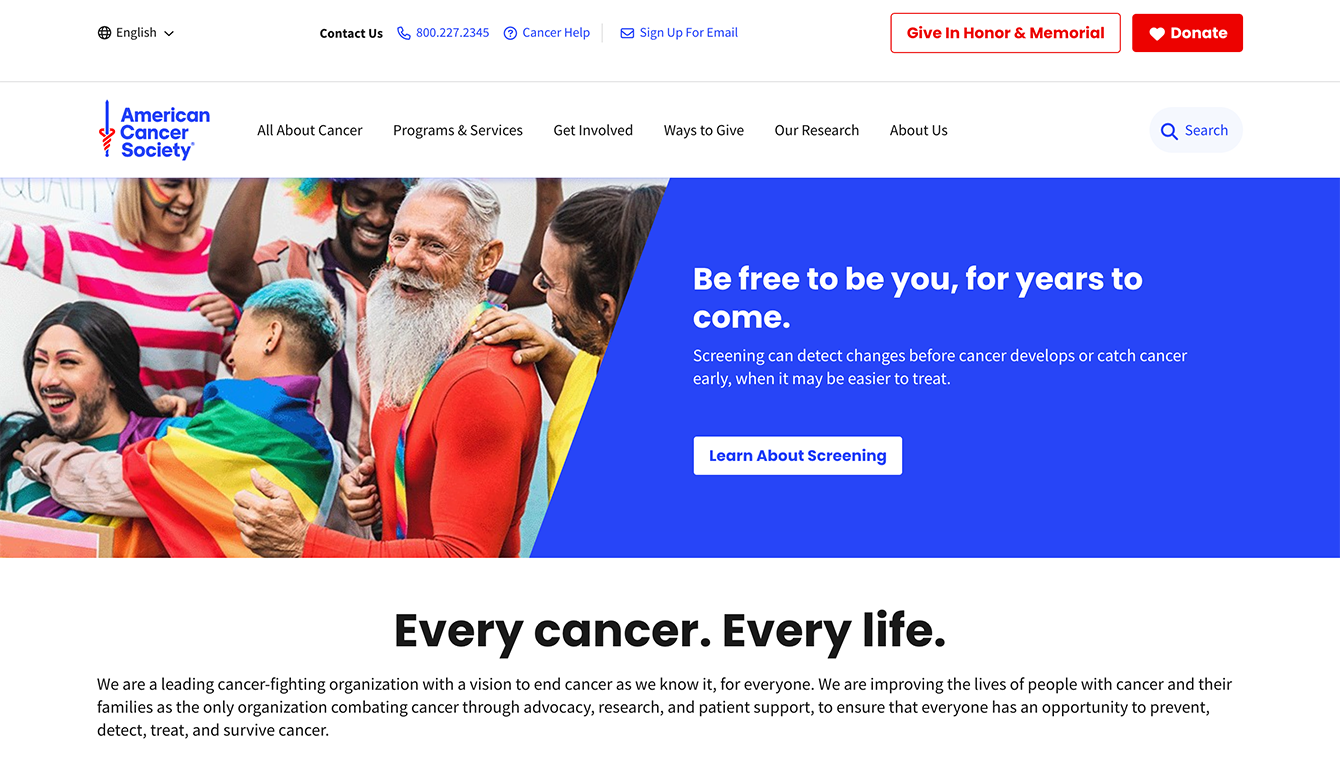
1. American Cancer Society 

The CTAs on the American Cancer Society website are brief and clear, encouraging visitors to act quickly. 

The American Cancer Society homepage features a few CTAs without overwhelming its website visitors. Here are a couple of standout CTA moves that inspired us: 

  • The “Donate” button in the top right corner is bright red and features the image of a heart, which helps it stand out and emphasizes the difference a donation can make to those whose lives have been affected by cancer. 
  • The “Learn About Screening” CTA in the center of the screen is paired with an image of real people and language that encourages authenticity and getting a screening to stay healthy.

2. American Society for the Prevention of Cruelty to Animals

The CTAs on the ASPCA website have bright colors, emotionally-evocative images, and prominent placement to help encourage action. 

ASPCA does an excellent job of making its CTA buttons stand out with bright orange coloring and bold white text. The text and pictures that accompany the buttons on its rotating banner image also pull at your heartstrings and encourage you to give. 

In particular, the phrase “63¢ a Day Can Help Her Survive” not only implores website visitors to contribute a donation but also highlights how easy it is to make a difference to an animal in need. 

3. Save the Children 

The CTA on the Save the Children homepage is brief and encourages urgent action. 

The Save the Children website reserves the color red for its most important website elements—its logo and CTA buttons, helping them stand out against a white and gray background. Here are a few other reasons we love their CTAs: 

  • The phrase “For many kids living in poverty, summer isn’t fair” is effective in evoking emotion in website visitors.
  • This main button CTA is paired with an image of a child, emphasizing the human aspect of the organization’s mission.
  • Save the Children uses the word “now” to instill urgency in its website visitors, encouraging them to give right away.

CTAs are small additions that can make a big difference for your nonprofit. Use these examples and tips to start creating (or fine-tuning) your organization’s CTAs and pulling in more support for your mission. 

And, if you need the help of an expert, invest in a web design partner that can help you with everything from designing your website to crafting CTAs and beyond! 

With 15 years of experience, Ira Horowitz is an expert in nonprofit online communications and online fundraising. His work has resulted in increased funds and resounding supporter engagement for hundreds of organizations.

Ira oversees Cornershop Creative’s project management team and works with clients to provide them with the best possible final product. He also manages all of their strategic engagements and helps guide nonprofits to determine their long-term strategy goals for online communications.

How to Build Your Recurring Giving Program: 4 Tips

Recurring donors can provide valuable sustainable revenue for your nonprofit. Tap into the vast potential of a recurring giving program with these four tips.

I’m a big fan of recurring giving. It’s a great way to both boost revenue and your retention rate. In this guest post, Philip Schmitz of CharityEngine lets you know how you can build your recurring giving program.

By Philip Schmitz 

Acquiring recurring donors for your nonprofit can revolutionize your fundraising progress, helping you efficiently and effectively achieve your goals. You’ll need to invest time and resources to attract new support for your mission, but chances are you already have untapped potential in your existing connections.

To help you secure a reliable source of funding with recurring gifts, we’ll walk through these four essential tips:

  1. Add a recurring giving option to your donation page.
  2. Market your recurring gifts program.
  3. Leverage your CRM to boost recurring giving.
  4. Report the impact of recurring donations.

From regular volunteers to small-level repeat donors, your organization already has people dedicated to driving your nonprofit’s impact. Give them the opportunity to invest in your cause for the long run by establishing a recurring giving program.

1. Add a recurring giving option to your donation page.

Your nonprofit’s donation page is the primary location for prospective donors to give in support of your mission. Therefore, it’s essential to design your online giving page with everything that supporters may need to maximize their contributions.

As you optimize your donation page for recurring gifts, consider the donor experience. Make it easy and convenient for them to participate. Your donation form should have a checkbox option that allows donors to turn their donations into monthly gifts. Additional ways to further optimize your donation page include:

  • Specifying the impact of each recurring gift amount. Inspire your supporters to take action by giving examples of how each recurring giving amount will contribute to your organization’s on-the-ground impact. This allows them to see how they can make a tangible difference in your cause. For example, an animal welfare nonprofit could write that $20 will provide a shelter dog’s meals for one month, while $50 will cover its medical treatments.
  • Allowing donors to manage their accounts. Offer your donors the flexibility to change their account profiles, recurring gift amounts, payment methods, and any other relevant information online. Your supporters will feel much more comfortable getting involved in your recurring giving program if they have the freedom to adjust their enrollment whenever they’d like.
  • Accepting multiple secure payment options. Facilitate recurring payments by having multiple payment options featured clearly on your nonprofit’s donation page. Donors should be able to pay for recurring gifts with their debit or credit cards, by direct deposit, or using mobile payment services like PayPal.
  • Ensuring your giving page is mobile-friendly. These days, much of the world’s online interactions occur on mobile devices. Whether they’re on the go or relaxing at home, make sure your potential donors can access a high-quality version of your donation page on their tablets or smartphones as well.

According to 360MatchPro’s fundraising statistics, recurring donors contribute 42% more per year than one-time donors. Make the most of this valuable opportunity by setting up your online giving page to promote recurring giving.

2. Market your recurring giving program.

The success of your nonprofit’s recurring giving program depends on how well you spread the word. It’s crucial to not only make your supporters aware of this option, but also motivate them to become recurring donors. Send email updates to your existing donors with information on how to enroll in recurring giving, along with how these gifts will benefit your nonprofit.

To notify as many potential donors as possible, disperse your communications across multiple channels. Appeal to younger donors by creating memorable and engaging social media posts that promote your program. And, as you approach the end of the year, CharityEngine’s year-end giving guide recommends checking back in with your recurring donors and encouraging new enrollment during this popular giving time.

Go further with your marketing by creating a page on your website specifically for your recurring giving program. This will ensure that your supporters have a single, authoritative resource on all there is to know about the program, including the steps for opting in and who to contact with any additional questions.

Tie together all of your web pages and communications with consistent branding and visuals such as your organization’s colors, logo, and photos related to your mission. This way, prospective donors can feel confident that enrolling in the program will directly benefit your nonprofit.

3. Leverage your CRM to boost recurring giving.

Aside from having a CRM with billing software to automatically process recurring donations, use its capabilities for data-driven outreach. The more you understand your supporters, the better you can appeal to them to participate in your recurring giving program.

Segment your donors based on the information in their profiles and tailor your communications to those who may be most interested in becoming recurring donors. Look for repeat donors who tend to give relatively small amounts. They’d likely be receptive to automated monthly payments to support your cause. Some common ways to segment your donors include:

  • Giving history
  • Relevant interests
  • Past involvement with your nonprofit
  • Communication preferences

With these donor segments, you’ll be able to boost the effectiveness of your communications by sending messages that are more relevant to your individual supporters. They’ll feel more valued if you acknowledge their preferences and interests when reaching out about your recurring giving program. 

Furthermore, you can use the recurring gift data you collect in your organization’s CRM to personalize messages to your existing recurring donors as well. For instance, if they tend to give $15 a month, your next email to them could suggest that they increase their monthly gift to $20 a month to power your upcoming initiatives.

4. Report the impact of recurring donations.

The key to maintaining long-lasting support for your nonprofit is regularly updating and thanking your supporters. Even though their gifts are automated, your recurring donors still need to be recognized for their contributions each time they give. 

Be sure to have automatic follow-up emails in place to confirm and express gratitude for every recurring donation you receive. Remember to personalize each message with the donor’s name to show them that your organization values them as an individual. For additional ways to appreciate your recurring donors, consider the following ideas:

  • Mail handwritten thank-you cards at least once a year.
  • Host exclusive monthly donor appreciation events.
  • Spotlight longtime recurring donors as part of your nonprofit social media strategy.
  • Send small gifts of branded merchandise.

By communicating the impact of their contributions and the goals you’ve been able to achieve with their help, you’ll ensure that supporters stay enthusiastic about supporting your mission. Incorporate key data points into a powerful impact story to help them emotionally connect with the positive change they’re contributing toward.


Take advantage of your CRM’s capabilities to guide your communications about recurring giving and more. Your current donor profiles are incredibly useful for identifying ways to encourage further engagement from your supporters. Prioritize your donors’ interests to maximize your fundraising results. With a data-driven approach, you’ll be able to build an optimized recurring giving program that opens up a source of sustainable revenue for your nonprofit.

Philip Schmitz is the CEO and founder of cloud-services leader BIS Global, creators of the CharityEngine fundraising & communications technology platform. Founded in 1999, Phil has managed the vision and strategy for BIS’s suite of integrated business applications & hosting tools used by more than 400 businesses & non-profits.