Monthly Giving Mistakes

16185149128_a4db78e711_m

Monthly giving is a great way to raise additional revenue and boost your retention rate. If you don’t have a monthly giving program, start one now. How to Create a Monthly Giving Program for Your Nonprofit

Many organizations do have a monthly or recurring giving option, which is great. What’s not great are some of the mistakes I see nonprofits making with their monthly giving.

Here are few of those monthly giving mistakes and how you can avoid them.

Sending generic appeals to monthly donors

I’m a firm believer that once someone becomes a monthly donor, they get their own appeal. You should be segmenting your appeals anyway (by current donors, potential donors, etc) and that rarely happens.

Recognizing that you know your donors can help you raise more money. Some organizations have special names for their monthly donors. All donors are special, but monthly donors are extra special because they made a commitment to support you long-term.

Therefore, you’re not showing the love when they get a one-size-fits-all appeal that doesn’t recognize they’re monthly donors.

I mentioned before that monthly giving allows you to raise extra money. Another way to raise additional revenue is to ask for a larger gift. Most organizations don’t do this and that’s one of the perils of generic appeals.

Here’s a way to craft an appeal to ask monthly donors to upgrade their gifts.

Thank you so much for your donation of $5.00 a month. We really appreciate your support. You can help us out even more by increasing your gift to $7.00 or even $10.00 a month.

Be reasonable. One organization did ask me to increase from $5.00 to $7.00 a month. Another asked me to become a Sustainer at $25.00 a month, which is a bit of a jump.

Not paying attention and letting monthly gifts expire

A little over a year ago, I started making monthly donations. Some organizations let you choose how many months you want to donate, although most don’t have that option. When given an option to choose, I picked 12 months. I didn’t keep track of which organizations had “expiration dates.” Neither did these organizations.

It wasn’t until I went through my credit card statements at the beginning of January, that I discovered three of my monthly donations had stopped charging. I did renew these donations and now I’m keeping track of which donations will expire in a year.

But how much of this is my responsibility? Donors are busy, especially at the end of the year. Help them out a little. These organizations missed two months of donations because they weren’t paying attention. I wonder how many other monthly donations they missed as well.

You can avoid this by keeping track of when monthly donations are set to expire. A month ahead of time, send donors a friendly reminder letting them know it’s time to renew their monthly donation. You can use the example above to thank donors and ask for an upgrade as well.

Monthly donors are not the same as single gift donors. I did receive generic appeals from some of these organizations but ignored them because I figured my monthly gift would continue.

Your thank you acknowledgments are boring  

Given that some organizations don’t bother to thank their donors at all, I should be happy that I get thank you acknowledgments each month for my monthly gifts. But many of these organizations send exactly the same thank you letter (most by email, a few by mail) every time. Sometimes it’s sporadic – thank yous one month, nothing another.

Here’s the text of one thank you I get every month.

Thank you very much for your ongoing support and your sustainer donation of $5.00 to X

Your next donation is scheduled for 1/31/18.

If you need to change your credit card or billing information, please visit the Gift Service Center or contact our Member Services team at …….

Your ongoing commitment will make a real difference, and we are deeply grateful for your support. It’s good to know you’re with us.

At the bottom, there’s a Donation Transaction Summary. Oh, that dreaded word transaction.

Kind of boring, isn’t it? Monthly giving expert, Erica Waasdorp recommends sending one thank you letter for the tax year and not sending monthly thank you letters. Is Your Monthly Donor Tax-Letter Ready? This way you can send one super-fabulous thank you letter instead of 12 boring ones.

However, it is possible to create 12 interesting updates. If you want to send a thank you each month, then give a specific example of how a donor’s gift is helping you make a difference. Or take Erica’s advice and nix the monthly thank you. Instead you could create a newsletter or send updates specifically for monthly donors.

Either way, be sure to stay in touch with your monthly donors at least once a month. They’ve made a commitment to support you once a month. You can do the same for them by pouring on the gratitude and showing these donors how they’re helping you make a difference.

A monthly/recurring giving program can be a great opportunity for your organization. Don’t blow it by making these mistakes.

I Expected More

9436653177_fd00cc9d2c_m

I didn’t feel a lot of donor love after I made my year-end gifts at the end of November. I thought maybe it’s coming later. Okay, now it’s later – the middle of January. Let’s see how things are going.

How long do I have to wait for a thank you letter?

The Whiny Donor (@thewhinydonor) always shares spot on fundraising tweets, and one of her best is “Seriously. How long are you going to make me wait for that thank you letter?” I’ve been thinking the same thing over the last several weeks.

It’s recommended that organizations thank their donors within 48 hours. I made all my donations online, so technically most of these organizations did that, even though their automatically generated thank you emails weren’t laced with donor love. This is an easy fix. There’s no reason why you can’t create a warm and personal thank you email.

But you’re not off the hook. Even if someone donates online, she should get a thank you by mail or phone.

Only three organizations sent me thank you letters, and two of them came in mid-January. One was from a new organization, that due to recent events, I felt compelled to give to last year. I had been disappointed that the only thing I received from them were PayPal receipts for my monthly donation. Therefore, I was quite pleased that they welcomed me as a monthly donor and let me know that “none of our work would be possible without caring donors like you.”

The phrase better late than never applies here, but don’t wait too long. If you haven’t sent a thank you by mail do that now!  And in the future, be ready to send thank you letters/handwritten notes or make phone calls right after you receive a donation.

Naughty and nice

Thank you letters are just the beginning. You need to stay in touch throughout the year. Some organizations sent me holiday and New Year’s greetings by email. One of the holiday emails included the subject line “Celebrating Ann this season.” Several included year-end updates, one with the subject line“Here’s how we put your gift to work.” These organizations are on the nice list.

I also received a couple of holiday cards in the mail. Unfortunately, these organizations are going straight to the naughty list since they included donation envelopes with their cards. A couple of holiday emails included a donate button at the bottom of the message, but that wasn’t as obvious.

I get that you’re trying to raise money, but there are times when you should just show gratitude. Also, I had recently donated to one of the organizations that sent me a “thask”

But I just donated

Speaking of raising money, most of the communication I received from nonprofits in December were fundraising requests. I was barraged with generic fundraising appeals, even though I already gave in November or give a recurring monthly donation.

Sometimes it seems these organizations don’t know me as a donor. Do you expect me to give another gift in December even though I just gave a month earlier? If so, acknowledge my previous donation and let me know why I should give again. If I give monthly, why am I getting a request for a one-time gift? If there’s a specific need, let me know.

Again, I get that you’re trying to capitalize on year-end giving. But try not to send appeals to people who have just donated. If you can’t do that, then include a thanks to people who’ve already donated. One organization ended their appeal with “P.S. — If you’ve already made your gift, THANK YOU. We’ve had an outpouring of support and are busy processing donations.”

Monthly donors should get separate appeals recognizing that they’re monthly donors. Only a couple of organizations acknowledged me as a monthly donor.

Fundraising is more than just raising money. It’s also about building relationships. This means framing your appeal to sound less like you’re begging for money and more like you recognize your donors for who they are.

Focus on what’s important to your donors

I mentioned before the importance of staying in touch with your donors throughout the year. I do hear from some organizations through their newsletters, updates, and advocacy alerts. All the organizations I support should be staying in touch and that’s not happening. I tend to hear from the same handful of organizations.

Just sending a newsletter or an update is not enough. You need to focus on how your donors are helping you make a difference and not on your organization. I like PetPartners and what they do, and they generally create a good newsletter. But in a recent e-newsletter, they fell into the look at how great we are trap by including this organization-centered subject line – “Pet Partners Chosen As 2017 Best Animal Therapy Nonprofit!”

Looking at other articles in the newsletter, I would have used “Meet Swoosh, a cancer therapy dog” as the email subject line to help draw me in. To their credit, three out of the four articles were about therapy dogs. I’m much more interested in hearing stories about how therapy animals are helping people. That’s what drew me to the organization in the first place.

When choosing articles for your newsletter or sharing an update, think about why someone donates to your organization. It’s usually because they care about your cause and not because you’re number one in something.

Don’t leave your donors with the feeling they should be expecting more. Let your donors know how much you appreciate them and share information that shows them how they’re helping you make a difference.


Increasing Donations: The Essential Ingredients of Effective Nonprofit Web Design

2474481532_2493a0b1c3_m

By Dishan Jay

Good web design is a bit like clean air. You never really think of it, until the garbage truck passes you by and you realize how indispensable it is. It’s often dismissed until lack of it becomes a hazard. The same thing happens with nonprofits and design. It gets overlooked, downright ignored in favor of something basic just to “get things out there,” because often“there simply isn’t a budget for fancy stuff.”

But that’s the biggest – and to be fair – the easiest mistake to make, thinking that an effective design is also fancy. Good design has a purpose without it being obvious. Great design drives people’s attention to the right details, steers the visitor’s eyes to the donate button, or gives the visitor a subconscious impulse help out.

The truth is, as human beings, we want to identify with something, or we want to be distracted by the things we access online, and if that doesn’t happen within the first few seconds, we’re going to go somewhere else to get that.

And we do. Social media, AI, augmented reality, and virtual reality are all becoming parts of a larger new design trend with some more common, yet very effective and useful concepts and design patterns, a few of which you could call proven recipes for success in getting more user engagement and thus more donations.

There are a number of straight-forward concepts you can use on your nonprofit’s site, so you’ll increase donation chances every time a website visitor lands on it.

Tell your story right from the start: on your Homepage

While there are other nonprofits with a similar mission as yours, your story can differentiate you from the crowd. You are the only one who can share your story, so why not draw web visitors’ attention to the “story” part of your website?

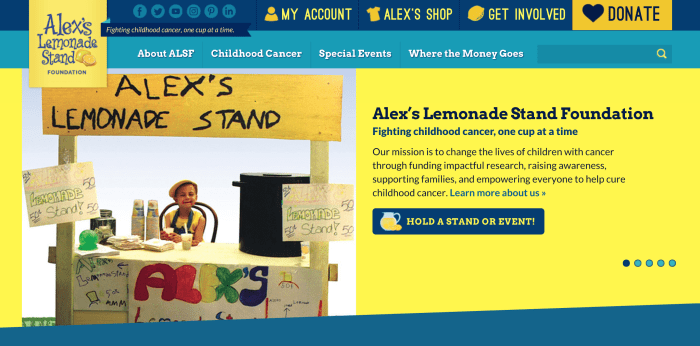
Alex’s Lemonade Stand’s homepage does not go unnoticed. They convey the right message while using lively colors to grab a visitor’s attention.

They also support their story with images and testimonials, which demonstrate their hard work, so that visitors won’t feel they are being taught about how great their cause is. After all, stories appeal much more to the emotional side of human nature.

Alex's Lemonade Stand

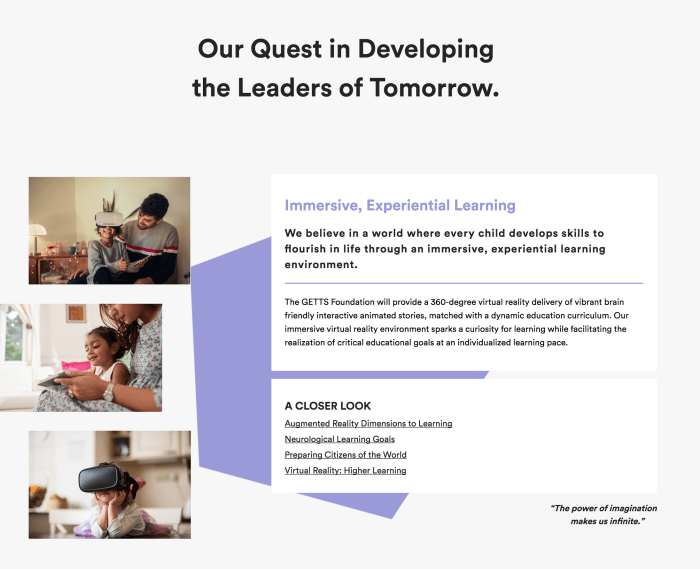
Additionally, a nonprofit might feature bright colors to grab a visitor’s attention, just like The GETTS Foundation does, portraying their story in an easy to follow way.

Getts Foundation


Takeaways: Choose beautiful color palettes that grab attention and convey your story using facts combined with an emotional connection.

Your donation form – keep it simple

Due to their hidden donation forms, usually tucked under menus or other pages, many nonprofits reduce the number of donations they could receive, making it a difficult and time-consuming activity for users who are generally on the hunt for specific information.

Furthermore, they complicate their donation forms by adding too many fields, and donors really hate completing long forms.

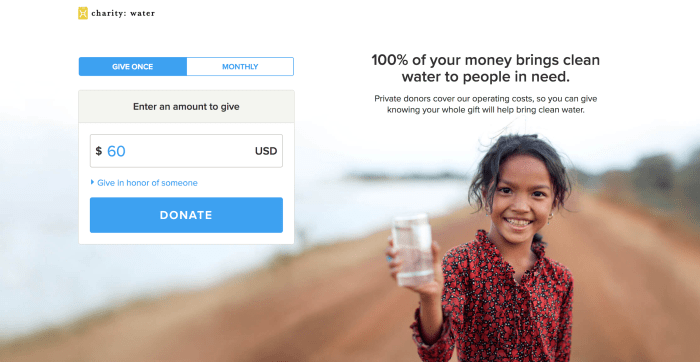
So, grab their attention right from the start and make sure to limit your donation form to only a few important fields. Charity water’s donation form is a perfect “How to”example.

With a minimalist design, its strong imagery and message supports their reason for giving.


Charity Water

Furthermore, it is limited to a small number of fields, which appeals to donors who want to donate right away rather than being forced to complete multiple required fields, which would only increase the chances of someone abandoning the process and never end up donating.

So, don’t distract donors by overfilling your form with useless information and keep both your donation form and page simple and straightforward.

Also, don’t forget to make it even simpler for mobile devices. Reduce the donor’s need to zoom by optimizing it with easy-to-click buttons and a vertical layout.

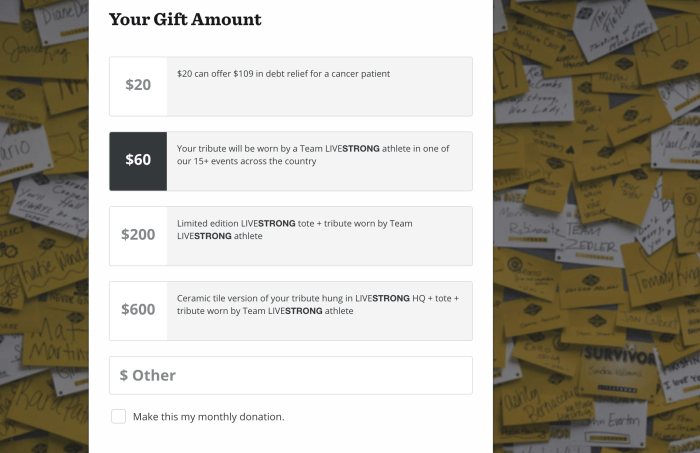
Another great way to improve your donation form is to use giving levels. Take Livestrong’s donation form for example. Your goal is to get people to give larger amounts of money than they’d donate if they wouldn’t receive suggested giving amounts.

If you start your giving levels from $20, $30 and so forth, the donor might round up and give $20 instead of $15. You can also include a box for “other” if people decide to donate a different amount.

Livestrong

Takeaways: Simplify. Make the action of donating easy: for the best user experience possible, stick to one image situated at the top of the form or in the background, add a few sentences of reasons to donate, and keep your donation form concise.

Add social proof and gain more donors

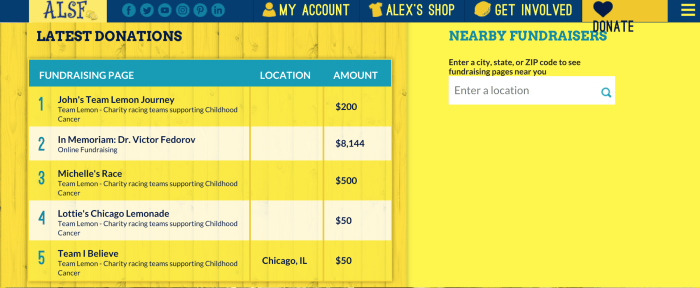
By placing a social proof, you can persuade a prospective donor to join others who have already supported your cause. Alex’s Lemonade Stand is definitely attracting new donors with this tactic. It’s simple, people care about what others recommend.

ALSF

Takeaways: You can increase the visibility of your nonprofit and its credibility by tapping into social proof to also gain new donors.

Stop neglecting your website’s footer   

Your ultimate goal is not only to gain trust, but also continuing support from your visitors, so you have to pay attention to your website’s footer as well.

The footer is your last opportunity to get users to where you need them to go, while also giving them important information. The Case Foundation connects with their visitors by letting them receive ongoing information on several topics if they subscribe.

Case Foundation

Takeaways: Stick to relatively minimal information in your footer to convert into subscriptions.

What actions would you like your visitors to take? Be it donating, signing up for your newsletter, or Social Media appreciations, your nonprofit website should be designed around these specific actions. So, be sure you make those “calls to action” obvious. Also, don’t forget to tell your story simply and clearly. Hopefully, these tips will help you maximize the value you can get from each person who visits your website.

Dishan Jay is the founder of DG Studio, a Los Angeles based digital agency that develops websites and apps, and executes marketing strategies plus storytelling and design techniques around them. Dishan Jay

How to Do Better in 2018

27638260149_81bb7264b4_m

Happy New Year! I hope you had a good holiday. I just returned from my family’s annual trip to Florida. It’s quite a contrast from the frigid, wintery weather we’re having in Boston.

I also hope 2017 was a good year for your organization, and 2018 will be even better. If things didn’t go so well last year, here are a few ways to help you do better.

Evaluate and plan

Take a look back at 2017 to see what worked and what didn’t in your fundraising and communications. Incorporate what you’ve learned into your 2018 plans.

If you haven’t made fundraising and communications plans yet, do that now! Don’t go too far into the New Year without plans in place. Be sure to include donor engagement and donor retention in your fundraising plan (see the first link below for more information). Also, make sure you evaluate your progress at least once a quarter.

Nonprofit Fundraising Plan: 6 Must-Do Steps For Success

COMMUNICATION PLAN TEMPLATE

How to Integrate Your Nonprofit Fundraising Plan With Your Marketing Plan

5 FUNDRAISING SUCCESS METRICS TO START TRACKING

Figure out your retention rate

As you’re doing your year-end evaluation, figure out your donor retention rate.

A Guide to Donor Retention

If it’s low, it’s something you can fix, usually with better communication. It’s easier and less expensive to keep your current donors than to find new ones, so make retention a priority.

Why you should care about donor retention

One Thing Most Nonprofits Stink at (Donor Retention) and How You Can Change It

Get in touch with your lapsed donors

If you fell short of your year-end fundraising goal, one way to raise extra revenue is to get in touch with donors who have given in the last two years, but not this past year. Call them or send a personalized note. Let them know you miss them and want them back.

They may not have given to your year-end campaign for a variety of reasons including being too busy or not wanting to spend too much in December. The New Year could be the perfect time to reach out.

We Want You Back! A Simple Strategy for Reactivating Lapsed Donors

Start or enhance your monthly giving program

Monthly or recurring giving is also an excellent way to raise more money and boost your retention rate as well. If you don’t have a monthly giving program, start one this year. If you have one, but people aren’t taking advantage of it, work on promoting it more. Invite current donors to become monthly donors and make it a prominent option on your donation page and pledge form.

Making the Most of Monthly Giving

Do a better job of thanking your donors

I hope you thanked your donors after your year-end appeal and I hope you didn’t send one of those boring, generic letters. If you never sent a thank you letter, do that now!

Either way, the New Year is a great time to thank your donors. You want to show gratitude at least once a month. Wish your donors a Happy New Year, thank them again, and share a success story. You can do this by email or social media.

I haven’t been impressed with the thank yous I received after I made my year-end donations. You can stand out if you make a resolution to do a better job of thanking your donors this year.

Thank You 101

Stay in touch throughout the year

Your donors want to hear how they’re helping you make a difference. Don’t let them down.

It will be a whole lot easier to stay in touch with your donors if you use a communications (aka editorial) calendar. When you do communicate, remember to be donor-centered and focus on building relationships.

Stay in Touch Throughout the Year by Using a Communications Calendar

Here’s wishing you a successful 2018!

Stay in Touch Throughout the Year by Using a Communications Calendar

37251899914_2155c24033_mDonor retention continues to be a problem and one of the reasons is poor communication. Nonprofits don’t communicate with their donors enough. Sometimes the only time we hear from organizations is when they’re asking for donations.

You must communicate with your donors at least once or twice a month throughout the year. If you’re getting stressed out wondering how you’re going to pull this off, then you need a communications calendar (also known as an editorial calendar).

I like the term communications calendar because it emphasizes the importance of communicating with your donors and other supporters all-year-round.

This is not just a job for your marketing department. All departments need to work together. Figure out what information you need to share and when to share it. You want a consistent stream of information – not three emails in one day and nothing for three weeks.

As you put together your communications calendar, think about how you will use different channels and which audience(s) should receive your messages. You may only send direct mail a few times a year, but send an e-newsletter once a month and communicate by social media several times a week. You’ll often use a number of different channels when you send a fundraising appeal or promote an event.

Start big by looking at the entire year and then break it down by months and weeks. You’ll keep adding to your communications calendar throughout the year.

While this post is primarily about setting up a communications calendar, you also have to share content your donors will be interested in. I’ll write more about that in future posts.

Here are some categories you can use in your communications calendar. Some items will be time sensitive and others won’t be.

Events

Does your organization hold any events? Besides your events, are there other events in your community that would be of interest to your supporters? This is a great thing to share on social media.

Legislation

Advocacy alerts are a wonderful way to engage with your supporters. Be on the lookout for any federal or state legislation that’s relevant to your organization. Encourage people to contact their legislators about an issue or a bill. Then report back to them with any updates, and thank them for getting involved.

Time of year

Is there something going on during a particular month that’s pertinent to your organization? Perhaps it’s homelessness or mental health awareness month.

Thanksgiving, the holidays, and winter can be a difficult time for some people. How can you weave that into a good story to share with your supporters?  In addition, think of creative ways to connect at other times of the year such as Valentine’s Day, spring, and back-to-school time.

News stories

There’s a lot going on in the news these days. You won’t be able to predict news stories in advance. However, if there’s a hot item in the news that’s relevant to the work you do, that could be something to share or use as an example of how you’re helping to make a difference for the people/community you serve.

Fundraising and recruitment

Be sure to add your fundraising appeals to your communications calendar. You want to highlight these and not inundate your donors with a lot of other information at that time.

If your organization has specific times it needs to recruit volunteers, add that to your calendar, as well.

Thank your donors

This is crucial! Find different ways to let your donors know how much you appreciate them. Do this at least once a month.

Ongoing content

If you’re making a difference, you have stories to tell. Share a story at least once a month. Client success stories (either in the first or third person) are best. You could also profile a board member, volunteer, donor, or staff member. Be sure to highlight what drew them to your organization.

Create a story bank to help you with this.

Keep it up

As you hear about other relevant information, add it to your calendar so you can stay connected with your donors/supporters throughout the year.

Here is more information to help you create a communications/editorial calendar, along with a couple of templates.

How to Create a Nonprofit Editorial Calendar

The Power of a Donor Communications Calendar

Evergreen Editorial Calendar

Editorial Calendars – Resources for You


Donating Online Shouldn’t Feel Like a Transaction

26750421559_86e5c241ee_m

Last week I both purchased some holiday gifts and made a bunch of donations online and there wasn’t much difference in the process.The key word here is process because both felt like a transaction. My inbox was filled with pleas – last chance to get a Cyber Monday deal or make a donation on #GivingTuesday.

Many fundraising appeals focus more on the transaction than the relationship. I’m trying to help kids receive presents on Christmas morning or help low-income families stay safe and warm this winter. I’m not buying sweaters.

Yes, you’re trying to raise money, but you should also try to build a relationship with me.

I did see a few heartfelt requests for donations on #GivingTuesday, but most were focused on the imperative need to donate today because it’s #GivingTuesday. Your donors get to decide when they want to donate and not everyone is on the #GivingTuesday bandwagon. Thank God It’s Wednesday

I may rethink about making my donations on #GivingTuesday. I’m glad if there’s an opportunity for a matching gift, but it’s so transactional and that includes the thank you experience or lack there of. 

We can do better. After #GivingTuesday or anytime you receive a donation, focus on the relationship and not the transaction.

Make a good impression with your thank you landing page

Most of the landing pages of the organizations I donated to said Thank You. Some included a donation receipt, which is fine because donors often want one. But they could have included a short description of how my gift is helping them make a difference, along with an engaging photo or video. Most of the landing pages were not that different from the ones I received from online retailers.

Your subject line matters, too

Make your thank you email stand out with an engaging subject line.

The best one I received was – Thank you. We appreciate your generosity. That’s fine but not outstanding.

Others included a simple Thank you for donating X organization, Thank you for becoming a (name of monthly giving program), or just Thank You.

One for an organization where I just started making monthly donations said Sustaining Initial Thank You I trust there will be more thank yous to come.

Others had the less than inspiring Donation Receipt, Your Recurring Donation Receipt, and Electronic Receipt for your gift to X organization.

Overall, I was not impressed. A better subject line would be something like You just did something incredible! or You’re Amazing!

A receipt is not a thank you

I like to use PayPal for online donations and purchases when I can. As great as PayPal is, it doesn’t provide a warm and fuzzy experience. PayPal will send you it’s own receipts. Most organizations sent their own automatically generated thank yous and one sent a personalized email.

I made a first-time donation to one organization and all I received were PayPal receipts – nothing from the organization. So, I’m curious to see what comes next, if anything.

If your organization uses PayPal, make sure your donors receive a stellar thank you email from you.

Speaking of which, let’s look at some of the thank you emails I received.

I just became a monthly donor for one organization. They welcomed me to their monthly donor club and gave me the name of a contact person if I had questions or wanted to arrange a tour (always a great way to connect).

One of the good ones opened with Through your support – which we’re grateful for each and every day – we’re able to: Then they listed some accomplishments and included a short thank you video, which showed how my gift is making a difference.

Another good one included Thank you for standing with those from across the country in supporting common sense solutions to gun violence. We can’t achieve real change without your support. This organization also sent a second thank you email two days later!

Here are a couple that are okay, but would have been better if they gave specific examples of how their donors are helping them make a difference.

We are deeply grateful for your generosity and support of our efforts. Your gift makes a difference — it enables us to provide vital services to the community we serve. We count on you and people like you to ensure that we can continue providing these services.

Your gift on Nov 28, 2017, will help X organization provide needed services to over 100,000 people each year through its neighborhood network.

Others didn’t even bother to tell me the impact of my gift. I checked my spam filter to see if any thank yous crept in there, but alas that was not the case. Maybe I’ll hear from some of these organizations or maybe not.

Again, I was not impressed. Most of these organizations could use some Thank You 101

Is there more to come?

A week after giving, I’ve received no type of thank you in the mail or a thank you phone call. I’ll write again in the New Year to let you know what type of #DonorLove I receive, if any.

And, I’m not the only one who thought donating on #GivingTuesday felt like a transaction. 2017  #GivingTuesday Secret Shopper Review

Photo by Mike Lawrence –  CreditDebitPro.com


Don’t Brag So Much

113532111_8479d80294_m

I’m sure you’ve been to a party and ended up stuck in a conversation with someone who talks too much about himself or brags about all the wonderful things she’s done. It’s exasperating and you can’t get away fast enough.

Imagine your donors having the same reaction when all your communications sound like one big bragfest that have nothing to do with them. Then imagine all your hard work going to waste when your boring appeal or newsletter goes straight to the recycle bin.

Yes, you want to share your accomplishments, but you don’t don’t want to sound like that annoying person at the party. It’s possible to do this without bragging. Here’s how.

Be donor-centered

You don’t need to tell your donors your organization is great. They wouldn’t have given you money if they didn’t think highly of you.

Let your donors know they’re great because they helped you make a difference for the people or community you serve. Give specific examples. Because of donors like you, the Smith family doesn’t have to choose between buying groceries and paying the heating bill.

All your communications should be donor or audience-centered. One way to ensure this is to use the word you more than we or us. Can Your Organization Pass the Donor-Centered Test?

Tell a story

Telling a story is a great way to share accomplishments. Whether it’s in the first or third person, you can give a personal account of how you’re making a difference. Remember to focus on the people you serve and keep your organization in the background. Connect With Your Donors by Telling Stories

Photos and videos featuring the people you serve is another good way to share accomplishments.

Why is what you do important

Instead of the usual laundry list you see in annual reports, such as we served over X number of students in our tutoring program, focus on why that’s important, too. Students in our tutoring program are now reading at their grade level and have a better chance of graduating from high school on time.

Instead of focusing on what you do, let your donors know why it’s important.

Show don’t tell

Too many newsletters and annual reports ramble on about how an organization is number one in such and such, or there was a crisis and Y organization came in to solve it.

Go back to stories and examples. You can’t ignore your organization altogether, but instead of saying we were the first organization to come in and help the hurricane victims or we’re the number one hospital in the community, say Thanks to you, the hurricane victims now have access to clean drinking water and can start rebuilding their homes or Thanks to you, Westside residents have a new outpatient clinic within walking distance of their homes, so they have easy access to all their health care providers.

How you made a difference is more important than being first or best.

Current donors want to see the results of their gift. Potential donors may be more interested in your reputation, but they also want to see how their donation will make a difference.

Your anti-bragging checklist

Before you share accomplishments in an appeal letter, thank you letter, newsletter article, social media update, annual report, etc, ask yourself these questions:

  • Is this donor/audience-centered?
  • Are we focusing on the people/community we serve?
  • Are we showing results?
  • Are we saying why this is important?
  • Are we bragging too much about ourselves?

Read on for more about the perils of bragging.

Bragging is not fundraising

Bragging Versus Mission

Your Appeal is the First Step

6920161535_21c3af8287_m

I imagine many of you are beyond busy working on your year-end appeal, but if you think you can take a deep breath and relax once the letters have gone out, you can’t. Your appeal is only the first step.

In fact, what comes next is even more important, especially if you want to to keep your donors for a long time.

Do a good job of thanking your donors

In my last post, I asked Are You Thankful for Your Donors?  Take a few minutes to think about this, because most of the thank you letters I see don’t reflect that.

Make your donors feel good about their donations. A handwritten note or phone call is better than a letter, but if you only have the the means to do a letter, make it sparkle. Don’t send the same old boring, generic thank you letter. Take time to write something awesome.

Create a welcome plan for your new donors

Did you know over 75% of first-time donors don’t make a second gift (according to the Fundraising Effectiveness Report)? This is horrible and we must do a better job of keeping our donors.

One way to help ensure people will give again is to create a welcome plan, which will provide you with ways to let your new donors know how much you appreciate them.

Make your current donors feel special, too

You may think your most valuable donors are the ones who give the most money, but what about the people who have supported your organization for three, five, or even ten years? These are your valuable donors.

If you’re not acknowledging a donor’s past support, you’re making a huge mistake. Imagine how you would feel if you gave to an organization for over five years and they never thank you for your long-time support.

This is why segmenting your donors and personalizing their correspondence is crucial, so is a good database to help you with this. 11 Ways To Segment Your Donors To Improve Your Fundraising

Repeat donor retention rates are 60%, which is better, but still not great. The highest retention rate comes from monthly donors, which is an impressive 90%.

I highly recommend inviting your current donors to become monthly donors, especially the ones who’ve supported you for at least two years. Making the Most of Monthly Giving

Don’t skimp on your donor communication

I know you’re swamped with your year-end appeal right now, but this is not the time to scale back on your donor communication. Continue to send your newsletter and other updates. Keep them donor-centered.

Send your donors Thanksgiving and holiday greetings, either by mail or email. Intersperse your fundraising appeals with messages in which you’re not asking for donations.

Keep it up

Your first New Year’s resolution should be to communicate with your donors more. Keep reaching out to them – at least once or twice a month. Show appreciation and update them on how they’re helping you make a difference.

Think of other ways to do something special for your donors, such as offering tours of your facility or holding an open house.

You want to keep your donors for a long time and making them feel good about supporting your organization will help with this.


Are You Thankful for Your Donors?

Thanksgiving is coming up and it’s a time of year in the U.S. when we show gratitude to the special people in our lives. Do you extend this same gratitude to your donors? Sometimes it doesn’t seem that way.

Nonprofit organizations tend to treat thanking their donors as an afterthought.But you need to spend just as much time thanking your donors as you do on fundraising.

Here are some ways you can show that you are thankful for your donors.

Wish your donors a Happy Thanksgiving

Send your donors a special Thanksgiving message. If you can send a card or postcard, that’s great, but an email message is also fine.

Let your donors know how grateful you are to have them as part of your family. Share a success story and photo or video. Your donors will appreciate a heartfelt message, especially when they’re being deluged with year-end appeals.

Of course, you can also send cards or email messages during the holidays, Valentine’s Day, or any time of the year. DO NOT include a donation envelope or any other type of ask with your thank you message. This will deflate your donor’s good feelings in an instant.

Be ready to thank your donors right away

If you’re doing a year-end appeal (or any other fundraising campaign), you need to thank your donors right away, within 48 hours if you can.

Every single donor, no matter how much they’ve given or whether they donated online, gets a thank you card/letter mailed to them or receives a phone call.

Make this a priority. You need to start planning how you will thank your donors at the same time you plan your fundraising appeal. Don’t do this alone. Get your board, other staff, and volunteers together to make phone calls, write thank you notes, or include a handwritten note on a thank you letter.

Give your donors an unforgettable thank you experience

When was the last time you received a thank you letter that knocked your socks off? Maybe a couple of times. Maybe never.

Nonprofits often relegate thanking donors to a last-minute process. If you donate online, you get taken to a boring, generic thank you landing page and receive an equally boring thank you email. If you’re lucky, you’ll get a letter, but it’s usually impersonal and filled with mind-numbing jargon that doesn’t make you feel good about your donation.

Start off by sounding like a human and not a robot. Don’t open with On behalf of X organization we thank you for your donation of…. Open with You’re amazing! or Thanks to you, David won’t go to bed hungry tonight.

The second example above gets to the heart of a good thank you.Your donors need to feel valued and know how they’re helping you make difference. This isn’t the time to explain what your organization does or brag about how great you are. The donor is the one who’s great.

Make your thank yous personal. Write as if you’re having a conversation with a friend and leave out any jargon or other information your donors won’t understand.

Create an experience for your donors –  an experience that will last as long as your donors support your organization.

5 Thank You Letters Donors Will Love Gratitude and Results Keep Donors Coming Back

How to Craft a Killer Thank You Letter

Don’t make this one and done

The thank you letter you send after your appeal is just the beginning. You must thank your donors all year round. You can make this easier by creating a thank you plan, which you can incorporate into your communications calendar.

Find ways to say thank you at least once a month. Here are some ideas.

  • Create a thank you video and share it on your website, by email, and on social media.
  • Send welcome packets to new donors.
  • Invite your donors to connect with you via email and social media. Keep them updated with accomplishments and success stories. Making all your communications donor-centered will help convey an attitude of gratitude.
  • Always thank your donors in your newsletter and social media updates. Emphasize that you wouldn’t be able to do the work you do without their support.
  • Hold an open house at your organization or offer tours so your donors can see your nonprofit up close and personal.
  • Thank your donors just because they’re great.
  • Keep thinking of other ways to thank your donors.

This Thanksgiving and throughout the year, be thankful for your donors. Treat them well so you can ensure a long-term relationship.


5 Fatal Donor Communication Mistakes Nonprofits Should Avoid

Donor communication can be the key to growing your nonprofit’s community and reaching your fundraising goals. Be wary of these 5 fatal communication mistakes!

By Steve Page

16185149128_a4db78e711_m

When your nonprofit’s fundraising efforts are in full swing, it can be easy to get caught up in a numbers game of trying to reach your fundraising benchmarks.

However, if your team wants to raise as much money as possible for your cause, there’s one area of your fundraising strategy that you shouldn’t disregard: your donor communications.

Having an air-tight donor communication strategy in place is one of the fundamentals of perfecting your fundraising strategy. Without optimizing how your organization connects with donors, your nonprofit could be missing out on some of your most important supporters.

Not sure if your nonprofit is making the most of how you communicate with donors? Look out for these five fatal donor communication mistakes that could derail your fundraising efforts:

  1. You don’t have a donor communication strategy in place
  2. You’re failing to communicate through diverse channels
  3. You’re discounting traditional donor communication channels
  4. You’re not thinking through your social media strategy
  5. You’re not making the most out of your email communications

Ready to learn how to overcome these common donor communication missteps? Let’s dive right in!

Bonus! Is your nonprofit looking to strengthen all areas of your fundraising strategy? Check out MobileCause’s fundraising software buyer’s guide to learn about how investing in the right online tools can help your team fundraise better, as well as improve your donor communications.

MobileCause_Ann Green Nonprofit_5 Fatal Donor Communication Mistakes to Avoid_Header1

1. You don’t have a communication strategy in place

One of the biggest mistakes nonprofit organizations make is failing to identify where and how they want to see their communication strategy grow like they would for their fundraising strategy as a whole.

It’s important that your team takes the time to develop an overarching communication strategy to shape each individual strategy from its foundation. As your team makes changes to improve the way you connect with donors, consider some of the following tactics.

Identify your communications goals.

While the ultimate goal of your communication strategy should be to increase donations and achieve the goals of your fundraising strategy, you also need to identify tangible benchmarks to meet that are specific to donor communications, such as adding new supporters to your email list or increasing profile views on your social media pages.

Create a communications calendar.

When your team plans out a fundraising campaign, you likely create a fundraising calendar to structure how the campaign plays out. Similarly, your team should create a communications calendar that accounts for each channel of your communications with donors. This way, you can easily keep track of what each channel is responsible for and when you will communicate.

Keep your plan flexible and responsive.

Now that you’ve developed actionable goals for your overall communication strategy, periodically follow up on them throughout your fundraising calendar and see what’s working. If you’re not progressing as planned, make the necessary changes across all arms of your communication with donors.

Bonus! Thinking through your nonprofit’s communication strategy should be one of the central parts of developing your fundraising plan. Check out Aly Sterling Philanthropy’s guide to crafting your nonprofit’s fundraising plan for more tips to get ahead!

MobileCause_Ann Green Nonprofit_5 Fatal Donor Communication Mistakes to Avoid_Header2 (1)

2. You’re failing to communicate through diverse channels

When it comes to your nonprofit’s community of supporters, your team should know better than anyone that they have donors from many different walks of life.

To paint them with the same brush would be shortsighted, and your fundraising strategy likely already accounts for differences in giving capacity, age, gender, region, and more.

That being said, with supporters coming in all shapes and sizes, it’s doubly important that your donor communication strategy takes account of these differences by thoughtfully implementing multiple channels of donor communication.

Put simply, your team needs to have a targeted multichannel donor communication strategy in place if you want to effectively communicate with your supporters.

Don’t put all your eggs in one basket! Develop specific communication strategies for:

  • Social media
  • Email
  • Phone
  • Direct mail

Many of your donors will respond better to certain communication channels over others. Some may not even use a particular channel of communication and will be completely blind to any calls to action, invitations to upcoming fundraising events, or other information that might be primarily shared on that channel.

To avoid missing out on members of your donor community, you can assess the reach of campaigns on different communication channels by using A/B testing as a means of comparison.

Additionally, by carefully segmenting your lists of supporters, you can more accurately identify the demographics of your donors and volunteers. With this knowledge, you’ll have a better idea of which communication channels to prioritize and how to better approach communicating across all channels.

The next sections will show you how to communicate more effectively on specific channels.

MobileCause_Ann Green Nonprofit_5 Fatal Donor Communication Mistakes to Avoid_Header3 (1)

3. You’re discounting traditional donor communication channels

These days, when nonprofits talk about donor communication the conversation usually circles back to one thing: social media. Having an effective social media communication strategy certainly is important and your team should take the time to hone how you communicate with donors within that important medium.

However, although donors are increasingly turning to digital means of accessing and engaging with nonprofits online, that doesn’t mean your organization should completely discount more traditional communication channels.

In particular, communicating with donors via the phone and through direct mail can both be useful ways to build relationships with supporters who might not respond well to email communication or who don’t spend much time on social media.

Even better? Just because these methods have been around for a long time, that doesn’t mean they can’t be brought into the 21st century! You can easily integrate online fundraising tools and tactics into your phone and direct mail donor communication strategies.

For example, your team could set up a phonathon run by staff or volunteers. They can call potential supporters and process their donations using your online donation forms in a matter of minutes. With this method, you can access potential donors who may need assistance in completing their online donation or those who simply need an extra reminder to give.

When it comes to direct mail, you could include a QR code or the URL of your online donation form in any mail communication you have with donors. Because this communication is on paper, these supporters can keep the letter up on their fridge or desk if they’re not immediately able to donate, which serves as a more permanent reminder of your ongoing campaign.

MobileCause_Ann Green Nonprofit_5 Fatal Donor Communication Mistakes to Avoid_Header4 (1)

4. You’re not thinking through your social media strategy

In much the same way that a nonprofit might lean too heavily on social media communications to connect with donors and end up neglecting more traditional communication methods, it’s just as easy for your team to fail to think through your social media strategy entirely.

Many nonprofits seem to see social media communication as a new frontier for connecting with donors. Because of this, some organizations think that any form of social media communication will be effective and that just having an active Twitter, Facebook, or Instagram page will help boost their fundraising efforts.

Unfortunately, it’s not as simple as it appears! Effectively using social media to engage with donors should take time, research, and a strategic approach.

Your team can start this process by asking yourselves the following questions.

What are we posting about?

Your nonprofit’s social media profiles should be sharing a variety of relevant information with supporters, but not overwhelming them with a lot of white noise. Aim to consistently post 3-5 times each day, and vary the types of posts you share. You should share upcoming events, call supporters to action with donation requests, post impact videos, and even interact with supporters’ own posts.

Are we steering supporters toward donation tools?

Some of your supporters will only encounter your organization on social media and never venture onto your nonprofit’s main website. Because of this, it’s important to get your online donation form in front of these visitors while they’re on your social media pages. By sharing links to your forms or even embedding these forms in your Facebook page, these supporters are more likely to give.

How can we learn more about our community through social media?

What’s great about social media communication with donors is that it can tell you a lot about who you’re interacting with, their habits, and the types of engagement strategies that work with them. Track metrics such as post views, click through rates, and more by analyzing how your supporters respond to your social media strategy. Armed with this knowledge, you can tailor your approach to better serve your social media audience in the future.

MobileCause_Ann Green Nonprofit_5 Fatal Donor Communication Mistakes to Avoid_Header5 (1)

5. You’re not making the most out of your email communications

In much the same way that your team should take a dynamic approach to communicating with donors via social media, the same can apply to how your nonprofit uses email to connect with donors.

Right now, your organization may simply be using email to remind supporters about upcoming donation deadlines or the next big fundraising event. However, your email communication strategy can do so much more!

Consider some of the following ways your team can maximize email communications with your donors:

  • Enable giving through email. Just as you should enable giving through your social media pages, your team can make giving easier for supporters by directing them to your online donation form right from your email messages.
  • Pair email campaigns with text-to-donate messages. Strengthen your email campaigns with text-to-donate reminders. When you pair email calls to action with a text reminder to give, you can increase your nonprofit’s email open rate from an average of 14% to 90%!
  • Track campaigns with shortlinks and keywords. Be sure to create unique keywords and short links for each of your fundraising campaign’s donation pages. This way, by including these in your email communication with donors, you can track engagement.
  • Use email to thank your donors and send updates. Your donors need to feel appreciated and receive regular updates from you. Email is a great way to stay in touch.

Just like with social media communication, it’s important to not relegate your email strategy to simply performing one task. Make the most of your email communications by using them to both steer supporters toward donating and to learn more about your community.

Keeping in touch with donors can be daunting! Now that your nonprofit knows what missteps to look out for, it’s time to start perfecting the way you connect with your supporters.

Steve Page is a blogger, marketer, and webmaster for MobileCause, the world’s leading mobile and online fundraising platform. MobileCause helps organizations reach their goals with a full suite of mobile-friendly solutions that allow donors to connect and give to your cause from any device. When he’s not working at MobileCause, Steve can usually be found helping organizations with their websites, learning the latest marketing trends, or working on his golf game.